Business.com aims to help business owners make informed decisions to support and grow their companies. We research and recommend products and services suitable for various business types, investing thousands of hours each year in this process.
As a business, we need to generate revenue to sustain our content. We have financial relationships with some companies we cover, earning commissions when readers purchase from our partners or share information about their needs. These relationships do not dictate our advice and recommendations. Our editorial team independently evaluates and recommends products and services based on their research and expertise. Learn more about our process and partners here.
Here’s how businesses can help employees build stronger critical-thinking skills.


Critical thinking is one of the most valuable soft skills employees can develop. It combines experience, observation and analytical thinking to help people evaluate information, solve problems and make thoughtful decisions. In the workplace, strong critical-thinking skills can help employees look at situations from multiple perspectives instead of reacting too quickly or relying on assumptions.
The U.S. Department of Labor has identified critical thinking as an important workplace skill that supports problem-solving and decision-making. Here’s how businesses can help employees strengthen and apply critical-thinking skills at work.
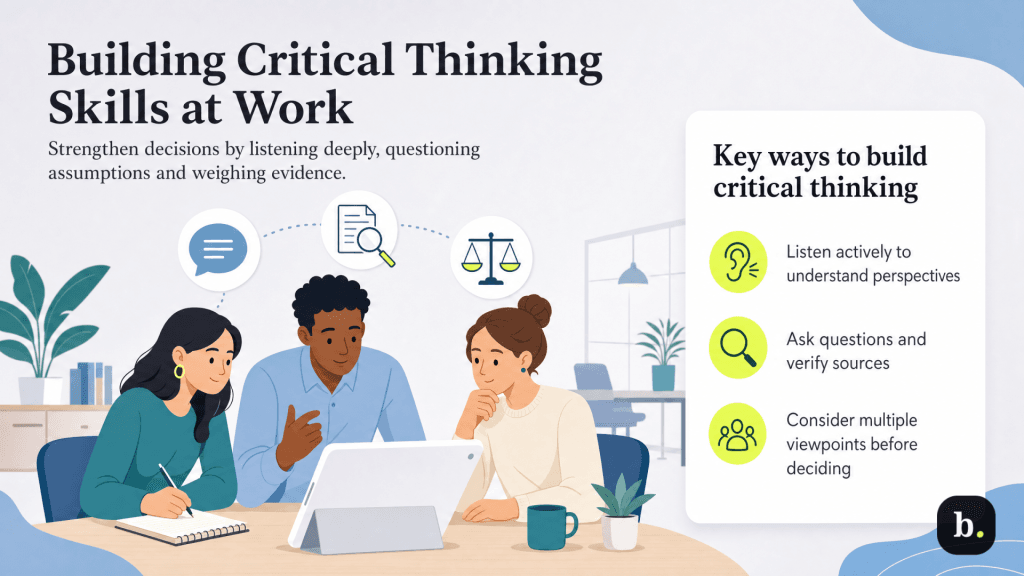
Here are a few ways you can polish your critical thinking skills.
Practice active listening by keeping an open mind and paying close attention to the people around you, from co-workers to C-suite executives. Listening carefully can help you better understand other people’s perspectives, expectations and concerns while also building empathy and stronger working relationships.
“One of the biggest challenges we have is that we listen to respond instead of listen to understand,” said Michael Lopez, a career coach and leadership expert at Michael Lopez Consulting.
That difference can have a major impact on workplace communication and business decision-making. “Particularly in conflicts, we quite often will be formulating a response, or set of responses, based on the arguments of the other person,” Lopez explained. “When we listen with the goal of understanding, we are far more empathetic. This allows us to connect with the experience of the other person.”
Instead of accepting information at face value, stay curious and ask questions to make sure you fully understand the situation before making a decision. Asking thoughtful questions can help uncover missing details, challenge assumptions and open the door to deeper discussion.
“When we listen to understand, we also ask better questions,” Lopez said. “Among the most important questions to ask is, ‘Do I have that right?’ That is a question that we ask after we repeat back to the person what we heard and ensure that we understand their experience.”
Open-ended questions are especially helpful because they get people talking beyond a quick yes-or-no answer. That’s usually where the more useful details come out — the concerns, context or ideas that may not have surfaced otherwise — and those conversations often lead to better decisions in the long run.
Don’t assume every new piece of information you hear at work is accurate, complete or current. Before acting on it, take time to check where it came from, whether the source is credible and how it fits with the evidence you already have.
It’s also important to think about what may be missing from the conversation. Ask yourself whose perspective hasn’t been considered yet, what assumptions people may be making and whether the conclusion still makes sense when you look at the situation from a different angle.
According to Marie Joachim, an assistant professor of strategic management and entrepreneurship at the Essca School of Management, critical thinking is especially important in uncertain environments because it helps employees verify information before using it to make decisions.
Even when you feel confident in your own viewpoint, it’s important to consider how other people may see the situation differently. Looking at multiple perspectives can help you better understand your co-workers’ reasoning, communication styles and priorities instead of jumping to conclusions too quickly.
This approach can also make team collaboration smoother. When people take the time to understand where their co-workers are coming from, conversations are usually more productive and less emotionally charged — especially during disagreements or stressful situations.
Everyone brings personal experiences, assumptions and biases into workplace decisions, even when we try to stay objective. “Our brain is constantly making guesses about what will happen next,” Lopez said. “What are these predictions based on? Our own experience. And this is inherently the challenge we have when it comes to new ideas, new information and, in extreme cases, information that directly conflicts with and/or disproves what we already know.”
Strong critical thinkers recognize that their first reaction isn’t always the most accurate one. Taking a step back to question your assumptions, reconsider automatic responses and stay open to new information can help you make more balanced decisions.
“When we challenge our natural reactions — or more foundationally, our core beliefs — we trigger a neurochemical cascade that allows us to learn,” Lopez said.
When important questions remain unanswered, take time to research the issue before making a decision. Strong critical thinking often depends on gathering additional context instead of reacting too quickly or relying on incomplete information.
As you research, pay attention to where the information is coming from and whether the source appears credible and well-supported. Try to rely on reputable publications, peer-reviewed research, official data and sources that clearly explain where their information originated. It’s also smart to be cautious of information that seems heavily agenda-driven, overly promotional or designed mainly to persuade rather than inform.
Social media can be helpful for spotting industry trends or gauging people’s reactions and sentiment, but it’s usually not the best place to verify crucial information or base workplace decisions on.
Strong critical thinkers don’t simply accept the loudest opinion in the room or automatically follow group consensus. Instead, they listen to different viewpoints, evaluate the available evidence and use their own reasoning to reach conclusions.
That doesn’t mean you should ignore other people’s ideas or assume your first instinct is always right. Some of the best workplace decisions come from hearing different viewpoints, talking through disagreements and being willing to rethink your position when new information comes up.
Joachim advises professionals — especially managers — to remember Margaret Mead’s quote: “Children must be taught how to think, not what to think.” In the workplace, that means creating an environment where employees are encouraged to think through problems on their own instead of simply being told what conclusions to reach.
“Leaders that are able to not only encourage their teams to challenge their individual beliefs but that are also able to harness the power of diverse thought, get better outcomes,” Lopez said. “But teams and individuals must be taught how to do this. When we do this, we don’t just get more ideas; we get better decisions that have been pressure-tested with provocative thinking.”
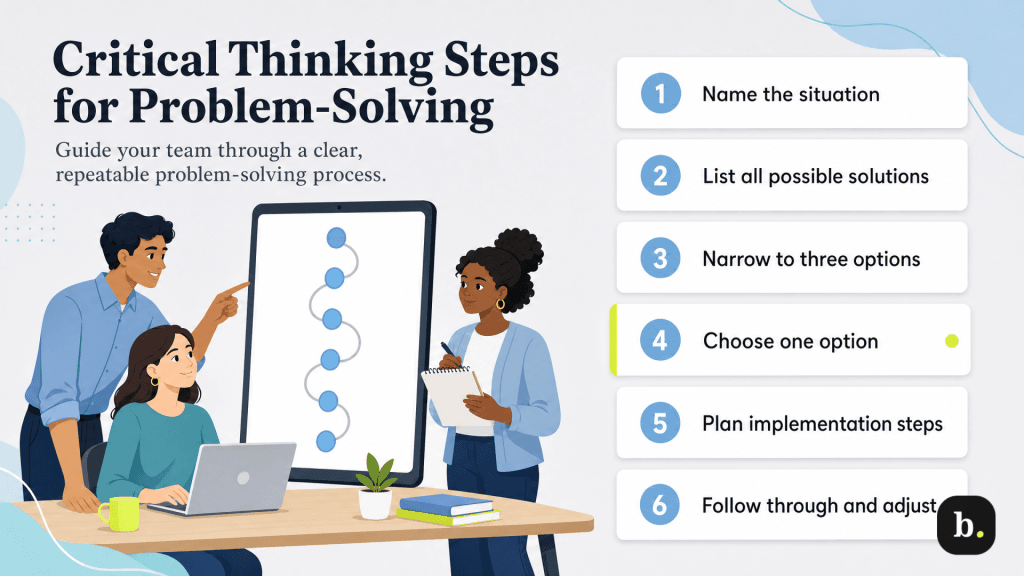
Here’s a six-step problem-solving process to try with your team.
Start by clearly identifying the problem or situation the team is trying to solve. Defining the issue upfront gives everyone a shared point of focus and helps prevent discussions from drifting into unrelated topics or assumptions.
It helps to keep the problem written down somewhere everyone can see it — on a whiteboard, shared doc or even a sticky note during the meeting. Otherwise, conversations have a way of wandering, and suddenly the team is debating three different problems instead of the one they originally set out to solve.
This step also encourages employees to slow down and look at the situation objectively instead of reacting emotionally or jumping to conclusions too quickly.
This is the brainstorming stage of the process, so the goal is to encourage ideas without shutting them down too quickly. Opening the discussion to multiple possibilities can help teams think beyond their usual assumptions and uncover solutions that may not have surfaced otherwise.
At this point, don’t get too hung up on whether every idea is immediately realistic. Some of the best solutions start as rough or half-formed suggestions that get refined as other people add context, push back or build on them.
Still, try to keep things a bit structured. If the team stops focusing on the original problem, the discussion can wander pretty quickly. Suddenly people are debating side frustrations, old decisions or completely different issues instead of figuring out what to actually do next.
Once the team has explored a range of ideas, begin narrowing the discussion to the strongest potential solutions. Ideally, everyone involved should feel comfortable supporting at least one of the remaining options, even if it isn’t their personal first choice.
This part of the process usually comes down to compromise. People may disagree on the best path forward, but teams tend to make better decisions when they’re willing to hear each other out and work toward a solution everyone can realistically get behind.
Many teams find it helpful to write the top options on a whiteboard or shared document and list the advantages and disadvantages of each one underneath. Looking at the pros and cons side by side can help employees evaluate ideas more rationally instead of making decisions based only on assumptions, emotions or personal preferences.
Once the team has narrowed the options down, it’s time to make a decision and move forward with it. The goal here usually isn’t to find a flawless solution (most workplace problems don’t have one) but to choose the option that makes the most sense based on the information the team has at the time.
Before moving on, make sure the solution actually addresses the original problem. Teams sometimes spend so much time debating different ideas that they slowly drift into solving a completely different issue than the one they started with.
Once the team chooses a solution, the next step is turning it into a realistic action plan. Establish clear timelines, define priorities and identify who is responsible for each part of the implementation process so everyone understands their role moving forward.
This stage is crucial because many workplace ideas sound great in meetings but never really go anywhere afterward. The good news is that people are usually more motivated to help a plan succeed when they’ve been part of the discussion and can see how their role fits into the bigger picture.
This stage is where many otherwise strong ideas start to fall apart. A solution may sound great during meetings, but without accountability, timelines and regular follow-up, it can quickly lose momentum.
Make sure everyone understands what they’re responsible for and where they fit into the plan. It also helps to play to people’s strengths when assigning tasks instead of treating every role the same. As the project moves forward, regular check-ins can help catch delays, confusion or new problems early before the whole plan starts drifting off course.
Critical thinking doesn’t stop once a decision is made. Teams still need to evaluate what’s working, identify potential problems early and make thoughtful adjustments along the way. When employees are included throughout the process, they’re also more likely to feel invested in the outcome and committed to making the plan succeed.
Using a process like this regularly can help critical thinking become part of how teams solve everyday problems instead of something people only focus on during major decisions or workplace conflicts. Some employees may also benefit from additional training, coaching or team exercises that help them get more comfortable with collaboration, problem-solving and analytical thinking.
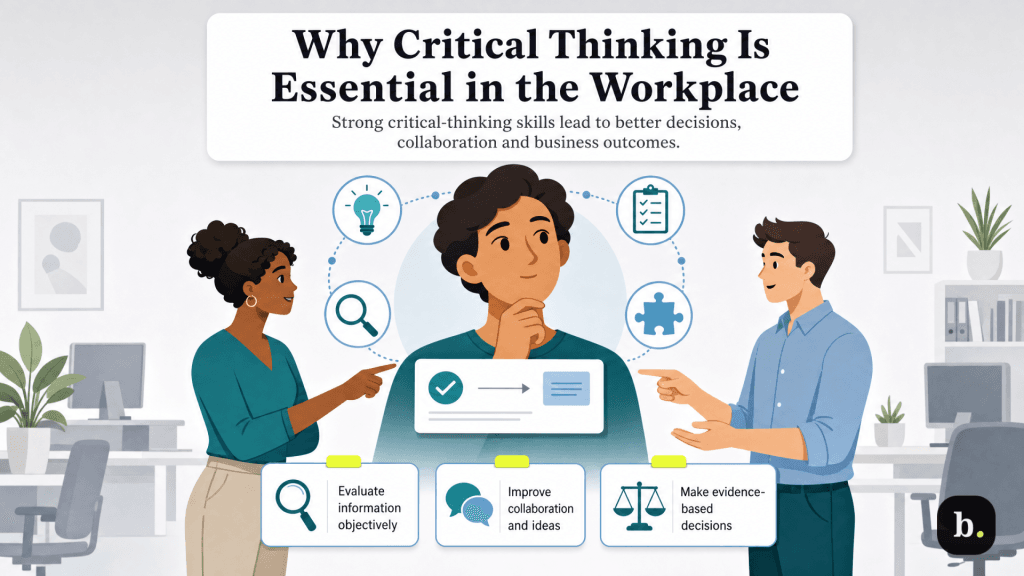
Critical thinking can strengthen nearly every part of a business, from daily problem-solving to long-term strategic planning. Employees who think critically are often better equipped to evaluate information objectively, collaborate well and make decisions based on evidence instead of assumptions or emotions.
“Enhancing managers’ critical thinking skills can lead the way to strategic success by enabling them to acknowledge the impact of emotions, biases, assumptions as well as the nature of information, on a business decision,” Joachim said. “It is particularly relevant to manage the relationship with stakeholders or develop a new offering, making sure that the decisions are in line with what actors need and not based on a flawed analysis.”
Here are some additional benefits of critical thinking in the workplace.
Critical-thinking skills are especially valuable in roles that involve research, analysis, strategy or high-stakes decision-making. Employees in fields like finance, law, healthcare, education and management often need to evaluate incomplete information, weigh competing priorities and make decisions without clear-cut answers.
In jobs like these, critical thinking helps employees slow down, look at the facts carefully and consider different viewpoints before jumping to conclusions. That usually leads to better problem-solving, clearer communication and smarter business decisions overall.
Employees with strong critical-thinking skills tend to approach decisions more carefully and objectively. Instead of reacting impulsively, they take time to research the situation, ask questions, evaluate available information and weigh potential risks and rewards before moving forward.
“Critical thinking skills are essential for managers to [make] good business decisions,” Joachim said. “Poor decision-making often stems from flawed reasoning, emotional bias or incomplete understanding.”
This kind of thoughtful analysis can help businesses make more informed choices, reduce costly mistakes and better evaluate the potential impact of important decisions before taking action.
Critical thinking can help create a happier and more productive work culture by giving employees the confidence to make informed decisions, solve problems independently and contribute meaningful ideas. Employees who feel empowered to think through challenges on their own are often more engaged in their work and more invested in team success.
These skills can also make day-to-day collaboration easier. Teams that are comfortable having thoughtful discussions, hearing different opinions and giving constructive feedback are usually better at working through disagreements, adjusting when priorities shift and solving problems together without unnecessary friction.
Employees who regularly reflect on their own decision-making and challenge assumptions may also be better positioned for long-term professional growth and employee development.
Critical thinking is one of the most valuable business skills employees can bring to the workplace because it helps people make better decisions, solve problems more effectively and work through challenges as a team. Employees who slow down, ask questions and look at situations from multiple angles are often better prepared to handle complicated workplace issues without jumping to conclusions too quickly.
By encouraging critical thinking across teams, businesses can also create a more thoughtful, adaptable and productive work environment. Employees who feel comfortable questioning assumptions, sharing ideas and participating in problem-solving discussions are often more engaged in their work and better prepared to handle change and uncertainty.
Amanda Clark and Lynette Reed contributed to this article. Source interviews were conducted for a previous version of this article.