Business.com aims to help business owners make informed decisions to support and grow their companies. We research and recommend products and services suitable for various business types, investing thousands of hours each year in this process.
As a business, we need to generate revenue to sustain our content. We have financial relationships with some companies we cover, earning commissions when readers purchase from our partners or share information about their needs. These relationships do not dictate our advice and recommendations. Our editorial team independently evaluates and recommends products and services based on their research and expertise. Learn more about our process and partners here.
Learn what companies are doing to improve diversity and inclusion in the workplace.

Although some major corporations have recently scaled back the diversity, equity and inclusion (DEI) initiatives they once prioritized — DEI remains an important business component for many small and midsize businesses (SMBs) and their employees. According to the LinkedIn Global Talent Trends report, 80 percent of job seekers want to work for a company that values DEI initiatives. Not only that, but today’s workforce and consumers expect businesses to implement policies that create lasting change. DEI efforts now emphasize accountability, equity in hiring and promotions, and fostering an inclusive culture where employees feel valued and heard.
For small businesses, the retreat from DEI creates an opportunity: organizations that stay committed to building inclusive workplaces can differentiate themselves in the talent market and build stronger, more innovative teams. To understand how small businesses are embracing this shift, we spoke with business leaders about the meaningful changes they’ve made to build more inclusive and diverse workplaces.
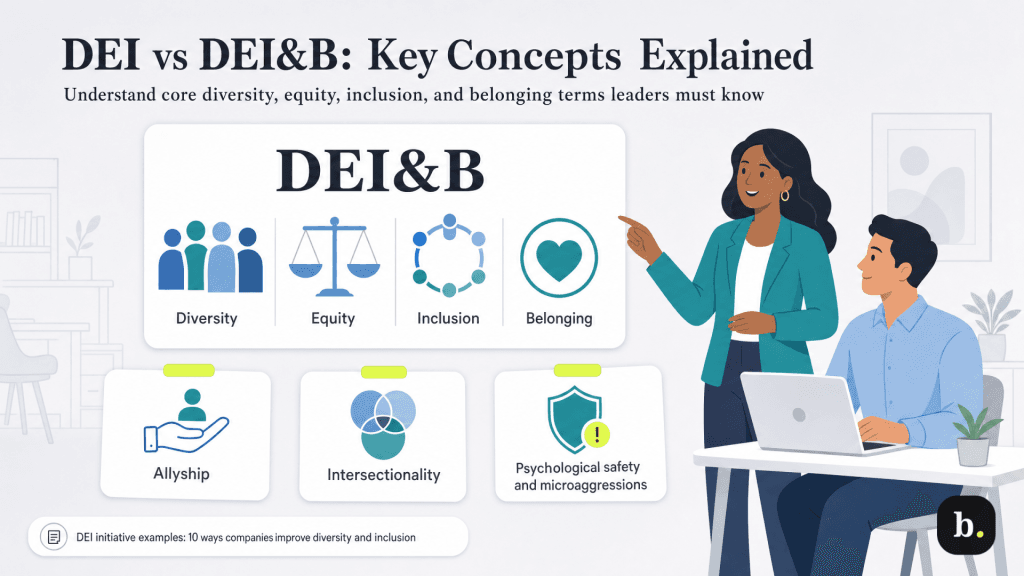
While Diversity, Equity and Inclusion (DEI) remains the standard acronym, many forward-thinking organizations have evolved to DEI&B, adding “Belonging” to the list. A diverse and inclusive workplace represents a variety of workers from different backgrounds and provides the support they need to help them perform their best. Understanding the nuances is vital:
Business owners focused on DEI&B must also be familiar with these key concepts:
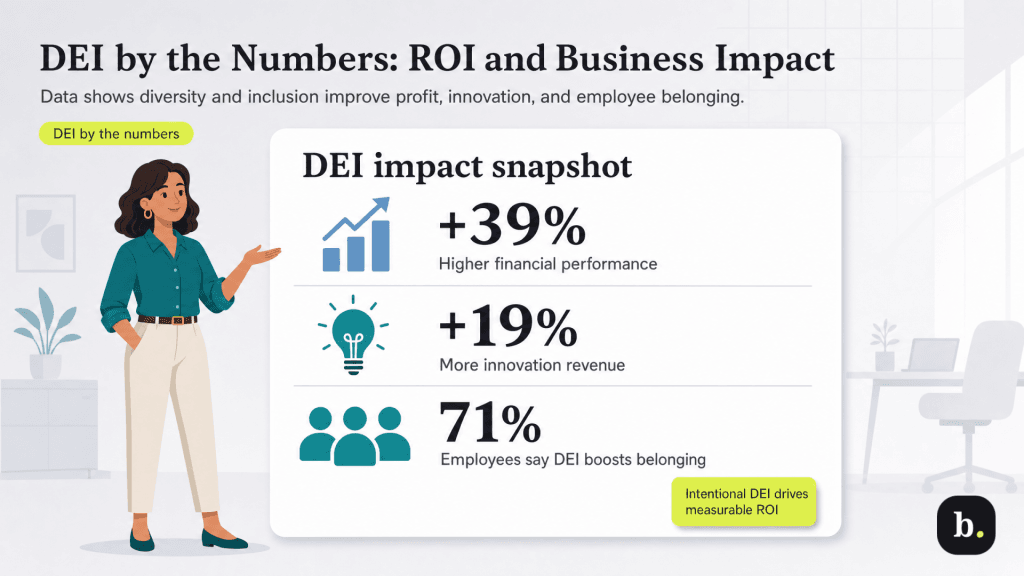
The business case for diversity is supported by recent data:
“With my experience in leadership development and DEI strategy, I’ve seen firsthand how intentional, measurable initiatives drive lasting change in Fortune 500 companies and other professional organizations,” Tamanna Ramesh, founder of Spark Careers, said in an interview with Business.com. “Small businesses have a unique opportunity to embed DEI into their DNA early on, creating workplaces where diversity thrives and innovation flourishes.”
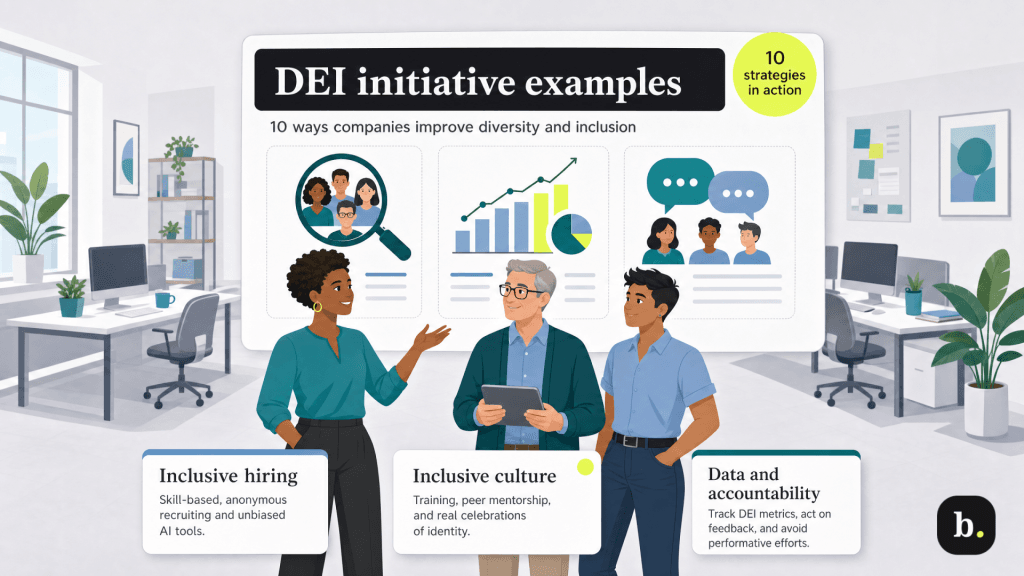
It’s all too easy to hitch on to the diversity bandwagon with a generic corporate statement, but that is not enough. Some organizations are making real changes to improve DEI in the workplace — even as others pull back. Below are 10 actionable strategies, paired with company spotlights and expert insights, so you can see exactly what effective DEI looks like in practice.
Having a diverse and inclusive workplace starts with the hiring process. One effective way to do this is through a detailed diversified recruitment strategy. This can include reaching out to a broader range of candidates, as well as using various evaluation methods.
For example, if a person can perform well in a job without a degree, consider removing the degree from the list of job requirements. Instead, you can rely on experience and skills testing. “One impactful strategy is ‘equitable hiring through diversified recruitment,’ including outreach to a wider range of colleges and HBCUs,” Ramesh said. “Implementing skill-based hiring over credential-based hiring helps reduce bias and opens opportunities to a broader talent pool.”
IBM has been a pioneer in “New Collar” jobs, removing bachelor’s degree requirements for many of its U.S. job postings. By focusing on skills over credentials, they emphasize capabilities learned through coding camps, community colleges and modern apprenticeships.
Your team may have internal biases that they are unaware of. You can work to remove these unconscious biases from your hiring process by facilitating anonymous recruiting. Software platforms can redact identifying information (e.g., photos, names, colleges) so you compare applicants purely on experience. This will help you choose the best candidate while teaching you about your own unconscious biases.
“Removing identifiable details such as names and photos from applications means that hiring decisions are made purely on skills, experience, and potential,” said Kirill Bigai, co-founder of Preply. “This helps attract diverse talent and equal the playing field for candidates from underrepresented backgrounds.”
To combat bias, major organizations like the BBC have utilized blind recruitment for years. In pilot programs, removing names from CVs resulted in a higher proportion of candidates from diverse backgrounds making it to the interview stage, validating that anonymization levels the playing field.
Humans are not the only ones with bias; sometimes technology is biased too. As more businesses use AI for resume screening in 2026, auditing these tools is critical. Reassess the programming to ensure it removes all bias to help make your organization diverse and inclusive.
“We trained our artificial intelligence algorithms without the ‘personal information’ section,” said Rolf Bax, CMO at Career.io. “Our HR representatives noticed that selection algorithms sometimes shortlist the CVs of candidates based on personal data. For example, if some department is female-dominant, it will prefer the CVs of female candidates. So, we have finished this portion from the algorithm’s training.”
Consumer goods giant Unilever uses AI-driven assessments to evaluate candidates on cognitive and emotional traits rather than resumes. The company works with third-party auditors to test its algorithms for adverse impact across race, gender and socioeconomic background. This ongoing review process has helped Unilever broaden the diversity of its candidate pools while maintaining the efficiency that AI hiring tools provide.
Training should not be a “one-and-done” event. Train your team on cultural sensitivity and inclusion so they understand how to respect and support each other’s differences. Implicit bias training, cultural competence workshops and workshops on measuring microaggressions are all examples.
It is also important for workers to be trained and developed professionally. Talk to each employee to map out their career path, and provide the adequate training, development programs and support they need to reach their goals.
“We invest in diversity strategies like talent development, [employee] learning, performance management, and strategies to retain the top talent,” said Nicholas Holmes, founder of The Product Reviewer. “We give them training from time to time to better implement cultural sensitivity that is important for both employers and the employees.”
Following incidents of racial bias in retail, Sephora launched diversity training programs. What sets them apart is their mandatory training series for all employees that covers unconscious bias and cultural competency, tied to performance metrics.
One way to show your employees that you care about their cultural events, holidays and movements is to celebrate as a team. Whether this means giving your employees the day off or celebrating in the office, it is essential to acknowledge and respect the traditions of employees from various backgrounds. Consider implementing “floating holidays” so employees can take time off for the days most meaningful to them — a low-cost, high-impact benefit that shows respect for individual backgrounds.
“We always celebrate, as much as we can, different holidays that show that we support gender equality, like Gay Rights Parade or Women’s Day, and we also celebrate Martin Luther King Jr. Day to show that we respect different races, especially African Americans,” said John Howard, founder and CEO of Coupon Lawn. “We come together as a team and celebrate these special occasions to show that we support our employees.”
Salesforce is renowned for its “Ohana” culture, which includes multiple employee resource groups (ERGs) such as BOLDforce (Black employees) and Outforce (LGBTQ+). These groups lead company-wide celebrations for heritage months, ensuring the programming is authentic and employee-led.
Another great way to facilitate an inclusive environment is to use a buddy system. Pair up employees from different backgrounds to foster closer connections and a better understanding of other cultures. This is often called “cross-cultural mentorship.” A team that understands each other builds the foundation for a positive company culture.
“Our DEI team meets monthly, introducing various inclusive initiatives; the latest being ‘Reverse Mentoring’ — pairing senior leaders with junior employees from diverse backgrounds, challenging traditional hierarchies and sharing experiences and perspectives,” said Nicki Thornley, HR Director at Space & Time. “Senior leaders gain cultural insights and bridge generational gaps, whilst the junior employees gain leadership skills, confidence and empowerment.”
Social media company Buffer runs a “Culture Buddy” system for onboarding. New hires are paired with veterans to navigate the unique company culture. This helps remote, diverse teams connect on a personal level faster, reducing isolation.
If you can find a way to incorporate your employees’ unique backgrounds and experiences to enhance your product, your business will be better for it. Diverse perspectives are essential for innovation and creativity. When your team reflects your customer base, you avoid product blunders and discover new markets.
On the enterprise side, Google’s “Real Tone” technology for Pixel cameras was developed by listening to employees and experts of color who helped the company accurately capture darker skin tones in photography.
On the startup side, Hummii, a chickpea-based ice cream brand, uses its team’s cultural diversity to inspire unique flavor profiles that resonate with a broader customer base. “One initiative we plan to roll out as we grow is to have each team member share and create their own flavor and workout that represents their background,” said Tyler Phillips, founder of Hummii Snacks. “We then will all share in completing that workout and follow it up with a taste testing of that flavor.”
You can’t manage what you don’t measure. The only way to truly understand the current state of your organization — and whether your DEI initiatives are actually working — is to track their effects over time. Move beyond “vanity metrics” (like raw hiring numbers) to “process metrics” that reveal systemic patterns, such as promotion rates, pay equity, retention by demographic group and representation at the leadership level.
“The advancements in data analysis and AI technology have changed the game for measuring what previously seemed unmeasurable,” said Dr. Serena Huang, F100 AI advisor and author of “The Inclusion Equation.” “The AI revolution … has opened up new possibilities for measuring inclusion. By analyzing large amounts of text data from employee surveys, Slack conversations and other sources, organizations can now gain a deeper understanding of their inclusion dynamics.”
Intel has long been recognized for its commitment to DEI transparency. The company publishes detailed annual diversity reports that go well beyond demographics — tracking measurable progress against specific goals for women and underrepresented minorities in senior leadership roles.
A seemingly simple but highly effective method is to listen to your diverse employees to see what changes (both big and small) they think need to be made. Conduct “stay interviews” to understand why diverse talent chooses to remain at your company. Set up one-on-one time between employees and upper management to elicit constructive feedback.
“We’ve made diversity and inclusion one of our primary company objectives,” said Brian Lim, CEO of The Emazing Group. “We are setting time aside so that members of leadership are able to meet with our diverse team members one-on-one in order to listen to how they feel and get feedback on how we can make improvements to our company culture.”
Dell Technologies uses its Employee Resource Groups (ERGs) as structured feedback channels. Senior leaders meet regularly with ERG leads to understand employee sentiment, discover concerns and identify opportunities to strengthen company culture. This direct line of communication has helped Dell earn consistent recognition as a top employer for diversity.
To create an inclusive and equitable environment, seek out “yes, and … “ solutions rather than “either/or.” This applies to making decisions and solving problems. Avoid zero-sum thinking where one group’s gain is perceived as another’s loss.
“Our primary strategy is to embrace nonbinary thinking in problem-solving and decision-making,” said Amanda “Mandy” Ralston, founder and CEO of NonBinary Solutions. “For example, instead of framing decisions as trade-offs, like choosing between equity and efficiency, we ask how both can coexist and strengthen one another. This mindset helps us create systems that work for everyone, not just those who fit neatly into predefined categories.”
Pixar fosters a “Plussing” culture (similar to “Yes, and…”). During creative reviews, feedback cannot just be critical; it must add a constructive suggestion. This inclusive communication style invites diverse viewpoints without shutting down ideas, fostering psychological safety.
DEI is not one-size-fits-all. A 10-person startup cannot run the same programs as a global conglomerate. Use this breakdown to find the right scale for your business.
Company Size | Effective Initiatives | Budget Considerations |
|---|---|---|
Micro (1–50 Employees) |
| Low Cost: Focus on policy changes and culture rather than expensive software. |
Small/Mid (50–200 Employees) |
| Moderate Cost: Budget for one or two HR software tools and an annual training consultant. |
Mid/Large (200–500 Employees) |
| Moderate-High Cost: Budget for ERG stipends, an HR analytics platform and a part-time DEI coordinator or consultant. |
Enterprise (500+ Employees) |
| High Investment: Dedicated salaries, software suites and external audit budgets. |
You cannot improve what you do not count. While quotas are often legally risky and inadvisable, setting goals is essential. Here are the key metrics to track:
Even well-intentioned leaders can stumble. Avoid these common pitfalls:
Ready to start? Use this checklist to get moving.
Month 1: Listen and audit
Month 2: Plan and train
Month 3: Act and institutionalize
The best way to promote diversity and inclusion at work is through a multifaceted process. In addition to the strategies listed above, here are a few other steps you can take to work toward a more diverse and inclusive workforce.
Building your DEI knowledge base doesn’t always require a big budget. Here are credible, free or low-cost resources to help:
Start with data: understand your current workforce composition and employee experience. Then set specific, measurable goals. Prioritize two to three high-impact initiatives — typically inclusive hiring, manager training and transparent reporting — before expanding. Use the 90-day implementation plan above as a starting framework.
A diverse workforce that embraces and encourages each other’s differences puts your business in the best position for long-term success. Don’t think of this as an obstacle to overcome. Think of workplace diversity and inclusion as a way to enhance your business, gain a competitive advantage, and grow an organization that is respected internally and externally.
Some source interviews were conducted for a previous version of this article.