While our personal and professional lives may overlap, most of us still try to keep them separate. However, what you do in your free time can influence how you perform at work, including your productivity. Habits like eating well, exercising and getting enough sleep are obvious examples. But your sex life can play a role, too.
Research suggests that sexual activity can affect workplace productivity by improving mood, reducing stress and supporting overall well-being. Those benefits don’t stop at home; they can carry into your workday, shaping how you focus, collaborate and perform. Here’s a closer look at how intimate relationships may influence productivity on the job.
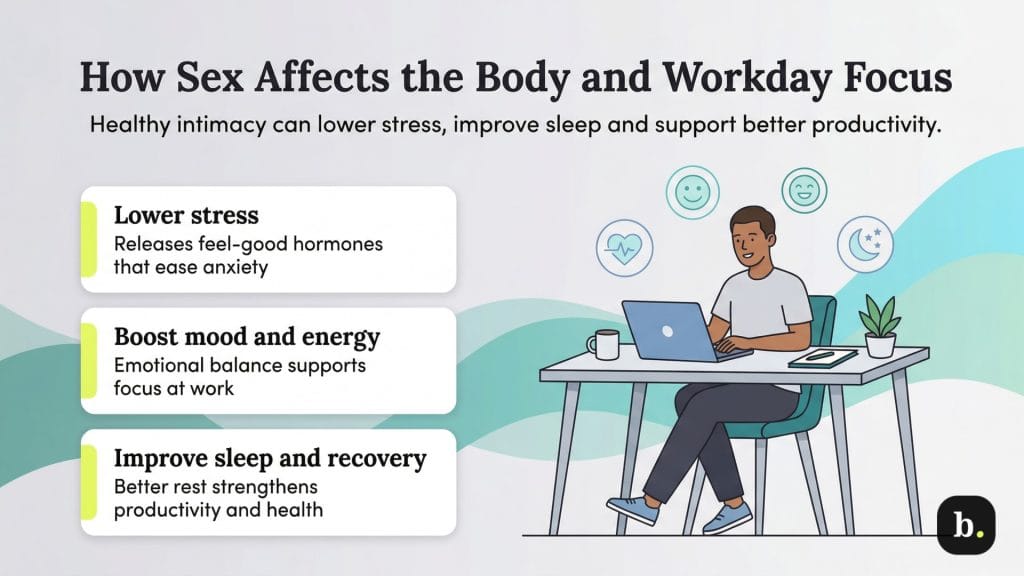
How sex affects the body
The connection between sexual activity and productivity isn’t complicated — it comes down to how it affects your focus and mood. And those effects don’t stay at home; they show up in how you work.
Sex releases hormones that reduce stress and support emotional balance. According to Lynn Brown Rosenberg, author of My Sexual Awakening at 70, “If you’ve had great sex the night before, the next day you’re going to feel more powerful, energized, balanced and wanted in a deeply personal way. Engaging in sexual intimacy can make us feel right with the world. We are less stressed and more able to be productive.”
Sex can also help lower stress-related blood pressure in two ways:
- It increases heart rate, improving cardiovascular efficiency over time.
- It releases “feel-good” chemicals, such as endorphins and oxytocin, that help reduce anxiety and stress.
Endorphins boost mood and reduce pain perception, while oxytocin — often called the “bonding hormone” — can promote relaxation and better sleep. And better sleep doesn’t just improve productivity; it also supports immune health and overall well-being.
Sexual activity can support your physical, mental and emotional health while helping to reduce
productivity-killing stress, all of which can carry over into your performance at work.
How biology and social expectations influence productivity
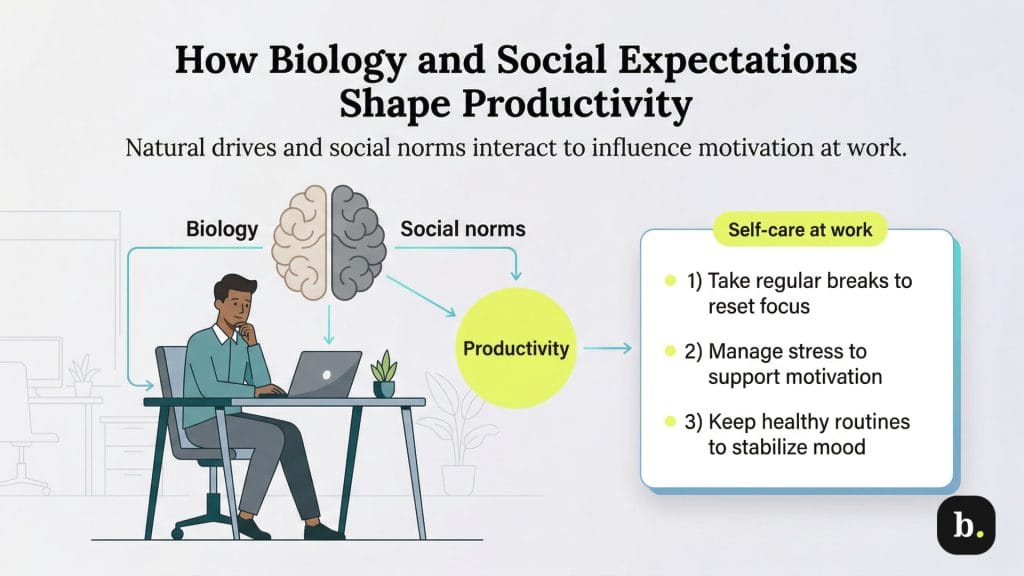
The Asian Efficiency Sex and Motivation Chart, shown above, highlights how both biology and social expectations play a role in how sex affects productivity.
Biological forces drive us to survive and reproduce, creating what’s known as “pursuit motivation” — the behaviors we use to achieve those goals. After sexual activity, we experience “post-sex benefits,” which include both biological and social effects, regardless of whether reproduction occurs.
At the same time, these natural drives don’t always align with social expectations. That tension can shape how we think about productivity, motivation and behavior at work. In other words, the way sex influences productivity isn’t just biological; it’s also shaped by how we interpret and respond to those signals.
Prioritizing
self-care in the workplace, whether that's taking breaks when needed, managing stress or keeping healthy routines, can have a direct impact on your focus, mood and productivity.
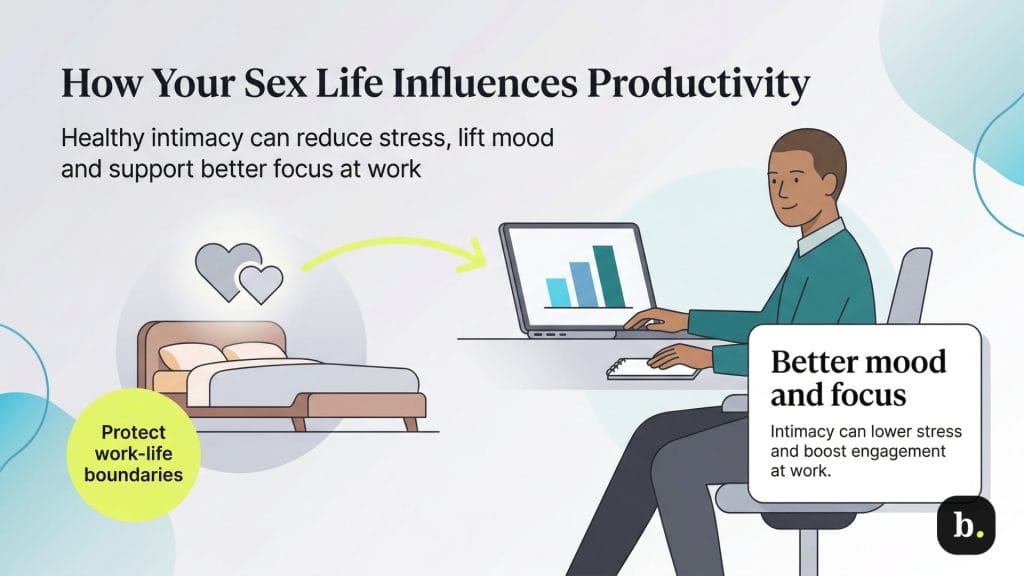
How your sex life influences productivity
A study published in the Journal of Management offers some of the clearest evidence of a connection between sex and productivity. Led by Keith Leavitt of Oregon State University, the research tracked 159 married, full-time employees over two weeks, asking them to complete short surveys throughout each day. Key findings included:
- When employees had sex at home, they tended to show up at work in a better mood the next day.
- That boost wasn’t tied to how satisfied they were in their relationship overall.
- It also carried over into higher job satisfaction and stronger engagement.
As Leavitt noted in an Oregon State University interview, “We make jokes about people having a ‘spring in their step,’ but it turns out this is actually a real thing and we should pay attention to it.”
One reason for this link is stress. Sexual activity can help reduce stress levels, which in turn supports focus and business decision-making. According to the U.S. Surgeon General’s Framework for Workplace Mental Health & Well-Being, chronic stress can disrupt sleep, increase muscle tension and interfere with overall physical functioning. Activities that help regulate stress, including intimacy, can help reset those responses and make it easier to approach work with clarity and emotional control.
However, the relationship goes both ways. The same study found that bringing work-related stress home can negatively affect personal relationships:
- When work interferes with personal relationships, workplace engagement declines.
- Employees who consistently let work spill into their personal lives may see their performance suffer over time.
Taken together, these findings suggest that maintaining healthy relationships, along with managing workplace stress and maintaining a healthy work-life balance, can help protect against employee burnout and support more consistent performance.
More business benefits of sex
Higher productivity isn’t the only benefit of a healthy sex life. Other factors, like improved mental health, better sleep and fewer sick days, can also influence how employees show up and perform at work.
Improved mental health
Sexual activity can support mental health in part through the release of hormones and neurotransmitters linked to mood regulation. Research published in the Journal of Affective Disorders in 2025 found that people who engage in sexual activity at least once per week have lower odds of depression, with one to two times per week associated with the strongest effects.
Regular sexual activity also helps people build psychological resilience by maintaining steady hormone levels and may improve their ability to adapt better after stressful events. This creates a foundation for long-term mental wellness beyond just immediate mood improvements.
Increased sleep quality and energy levels
Sleep plays a bigger role in workplace performance than most people realize, and sex may be one way to support it. The hormonal shifts after sex, including prolactin and oxytocin, can help you unwind and fall asleep more easily.
When you’re well-rested, you’re better equipped to handle daily work demands, from staying focused to managing stress. In fact, sleep is so closely tied to productivity that some employers have even experimented with letting employees nap on the job.
Fewer sick days
People who are more sexually active may get sick less often. Physical intimacy has been linked to a range of positive health outcomes, including lower blood pressure and reduced levels of chronic pain. Some research also suggests a connection between regular sexual activity and heart health.
Better overall health can translate to fewer sick days and less disruption from workplace absenteeism, both of which support more consistent productivity at work.
How sex can hurt productivity
While sex can have a positive impact on productivity, it can also become a distraction if it starts to take priority over other responsibilities. Here are a few potential downsides to keep in mind:
Compulsive sexual behavior
There’s no single “normal” level of sex drive or frequency; it varies from person to person and relationship to relationship. However, it can become a problem if it begins to interfere with your work or other areas of your life.
In some cases, sexual behavior can become compulsive, turning into a primary focus at the expense of mental health, job performance, relationships and finances.
Health risks and safety concerns
While sex is often linked to positive health outcomes, it can also carry risks if you’re not careful. Infections or illness may lead to time away from work, and sexually transmitted infections (STIs) can range from mild or asymptomatic to more serious conditions that require ongoing care.
Practicing safe sex and taking steps to reduce risk can help protect both your health and your ability to stay consistent at work.
According to the
World Health Organization, anxiety and depression cost the global economy $1 trillion each year, largely due to reduced productivity.
Impaired decision-making
Persistent sexual arousal can also interfere with decision-making, a phenomenon sometimes referred to as “sex brain.” From a physiological standpoint, sexual arousal is linked to the brain’s limbic system, which can override the higher-level thinking needed to make careful, rational decisions.
According to the American Psychological Association’s 2025 Work in America survey, an overwhelming majority of workers say it’s important to work for an organization that supports their emotional and psychological well-being.
While employers may not directly address sexual wellness, the broader principle still applies. Supporting employee well-being helps create an environment where people are better able to regulate emotions, stay focused and make sound decisions, both in and out of the workplace.
Skye Schooley and Lucinda Watrous contributed to this article.