Business.com aims to help business owners make informed decisions to support and grow their companies. We research and recommend products and services suitable for various business types, investing thousands of hours each year in this process.
As a business, we need to generate revenue to sustain our content. We have financial relationships with some companies we cover, earning commissions when readers purchase from our partners or share information about their needs. These relationships do not dictate our advice and recommendations. Our editorial team independently evaluates and recommends products and services based on their research and expertise. Learn more about our process and partners here.
Advertisers must adapt to new technology or be ignored online.

Technology has fundamentally reshaped the advertising industry, and the pace of change shows no signs of slowing down. New platforms, AI-driven tools and evolving consumer behaviors continue to raise the bar for what effective internet advertising looks like. Advanced digital media advertising technologies help cut through the noise, allowing your company to reach potential customers more effectively than ever before. Read on to learn about the technologies changing how companies of all sizes attract and capture new customers with internet advertising.
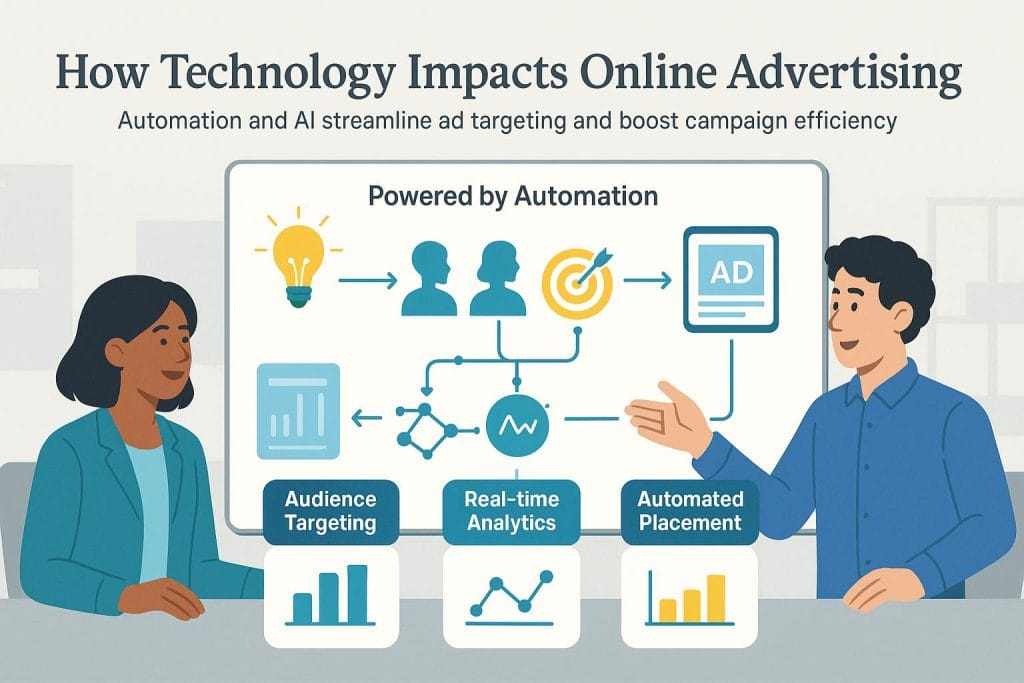
New technology is impacting internet advertising with each passing year. Here are the advancements changing digital media advertising and how you can capitalize on them.
Workflow automation has proven to be a game-changer in nearly every facet of internet technology, and advertising is no exception. The internet facilitates the collection of extensive consumer data, and there’s no way advertisers can manually browse through all that information to build customer personas.
Automated advertising platforms are essential for analyzing this data and putting it to use. They save time and money by freeing up advertising departments tasked with building and managing ongoing ad campaigns. You may see this approach referred to as “programmatic advertising,” which is the practice of delivering ads based on targeted audiences rather than distributing them in a broad and aimless manner.
Automated platforms can do the following:
Automated ad platforms can be set to run until they reach your desired digital marketing ROI. (You can set a cap on how much the platform spends on ad space.) For example, Google AdSense automatically places relevant ads on publisher websites and shares revenue based on clicks or impressions. It’s a widely used way for businesses to monetize digital content while benefiting from Google’s automated ad matching.
Josiah Roche, fractional CMO at JRR Marketing, cited Google’s Performance Max — an AI-powered, fully automated Google Ads platform — as one of the biggest shifts in digital advertising today.
“It blends inventory from across Search, YouTube, Display and more into a single campaign powered by machine learning,” Roche explained. “So instead of targeting placements or keywords, advertisers now feed signals like first-party data, audience lists and high-intent creative. Then Google decides where and how to serve the ads.”
When set up correctly, Performance Max can help drive conversions and often outperforms traditional search campaigns. However, Roche cautioned, it needs scale. “So running small, segmented campaigns with limited signals tends to underperform,” Roche noted. “The better approach is to consolidate campaigns, provide strong conversion data, and let the system optimize.”
Email is already a powerful and effective digital marketing tool, and it’s made even more impactful with sophisticated targeting. The best email marketing platforms have introduced advanced tools that support the hyper-specific pinpointing of customer segments who are more likely to buy certain products over others.
Here are some examples of these innovations:
According to Statista, as of early 2025, roughly 5.24 billion people — about 64 percent of the world’s population — are active social media users. This makes focusing on social media marketing and advertising non-negotiable for brands that want to reach their audiences.
Fortunately, major social media platforms, including Facebook, Instagram, TikTok and X, make it easy to advertise and can accommodate a wide range of preferences and budgets.
Here are a few tips for planning social media advertising campaigns:
Remember old television shows that proudly announced their sponsors? They’d say, “This program has been brought to you by…,” letting viewers know which brand made the entertainment possible.
This practice now has a modern twist with digital in-content ads, also known as sponsored content or native advertising, on popular content sites. For example, you’ve likely seen product reviews labeled as “sponsored” on online news platforms or how-to articles featuring a company’s tools in an online publication. It’s a creative way for advertisers to get their messages across to users.
Many ad networks now offer packages that include sponsored articles designed to match the look and feel of a site’s regular content. Some companies, like ADYOULIKE, even help brands create ads that blend right in with the platform’s layout and style.
“Everything on the internet is branded, whether consumers realize it or not,” noted Halli Rainer, digital experience & CRO manager at Medterra. “It has been proven to be more effective than other forms [of advertising] on the internet. Advertisers are expected to provide content that is engaging and either entertaining or insightful.”
These ads must be unobtrusive and not impact the user’s experience. Josh Markham, Chief Product Officer of Mula, stressed that advertisers must understand their audience to run successful in-content ad campaigns.
“Best practices include designing creative [ads] that feel native, optimizing for sound-off playback, and aligning content contextually with the page it runs on,” Markham advised. “The mistake is treating this like any other ad unit.”
Markham added that vertical video requires a distinct creative approach, along with unique attention metrics and pacing logic. “It is not a banner, and it is not a pre-roll; it is its own category. For marketers willing to adapt, the upside is enormous, with more meaningful engagement, more time spent with the brand, and entirely new canvases for storytelling,” Markham added.
Progressive Web Apps (PWAs) deliver the capabilities of an app within a web browser. Not only does this cement mobile’s place as the most popular way to access the web, but it also ensures a smooth customer experience, regardless of how your customers choose to access your products and services.
PWAs are gaining more traction because they prioritize the user experience, which can be compromised by even a single second of lag. Prioritizing speed, ease of use and usability is much easier with PWAs — and supports better ad performance and higher conversion rates.
Augmented reality (AR) blends digital content with the physical world, allowing users to interact with virtual elements in real-life settings. A familiar example is the mobile game Pokémon GO, where characters appear in the player’s environment when viewed through the device’s camera.
“The big boom of augmented reality is happening, as phone manufacturers are already developing AR-capable devices, and that creates a large window of untapped potential for advertisers,” Rainer noted.
Snapchat’s augmented reality filters are another form of AR advertising, and they continue to grow more sophisticated. Brands increasingly create custom AR experiences on the platform — from virtual try-ons to interactive product demos — giving users a hands-on way to engage with products before purchasing.
Artificial intelligence, especially generative AI, is making waves worldwide in all aspects of business, including advertising. Specifically, AI systems help marketers test campaigns for effectiveness before they have to dig into their advertising budgets.
Examples of AI-powered marketing platforms that use predictive analysis for pay-per-click (PPC) campaigns include tools like Albert AI and Basis Technologies (formerly Centro), both of which automate campaign optimization and audience targeting across multiple channels.
Nick Trenkler, CMO of Bagoodex AI, emphasized that AI and machine learning are now embedded in nearly every major ad platform.
“From predictive audience modeling to generative creatives, AI allows us to move from static segmentation to real-time personalization at scale,” Trenkler explained. “The most effective brands are using AI not just to optimize campaigns but to co-create content — automatically generating variations of copy, visuals and even videos tailored to micro-segments.”
Trenkler noted that the shift to AI in advertising means teams are often managing algorithms. “But it’s crucial to maintain human oversight,” Trenkler cautioned. “Just because AI can generate 100 ad variations doesn’t mean they all align with your brand voice or strategy. Creative direction and ethical boundaries still need to be set by humans.”
>> Learn More: How AI can turbocharge your small business marketing
Rob Gundermann, owner of Premier Marketing Group, believes voice represents a significant shift in the digital advertising arena. “Voice search optimization is another game-changer that’s reshaping digital advertising fundamentals,” Gundermann said.
As more consumers use voice assistants like Alexa, Siri and Google Assistant to search online, businesses should start optimizing their content and ad campaigns accordingly. Voice queries tend to be longer and sound more like natural conversation, so it’s smart to build out keywords and phrases that reflect how people actually speak.
Gundermann shared a real-world success story: “My landscaping clients have seen tremendous growth by restructuring their content around natural language patterns rather than traditional keyword phrases,” Gundermann explained. “One client saw a 63 percent increase in qualified leads after we optimized for conversational search queries.”
Chatbots have gained popularity with customer service providers, but they can also be powerful tools for marketers. A chatbot automatically engages users in real-time conversations, with replies based on the audience’s responses. For example, businesses can use chatbots to help website visitors navigate products based on their preferences — whether it’s recommending makeup shades, suggesting movies or narrowing down service options.
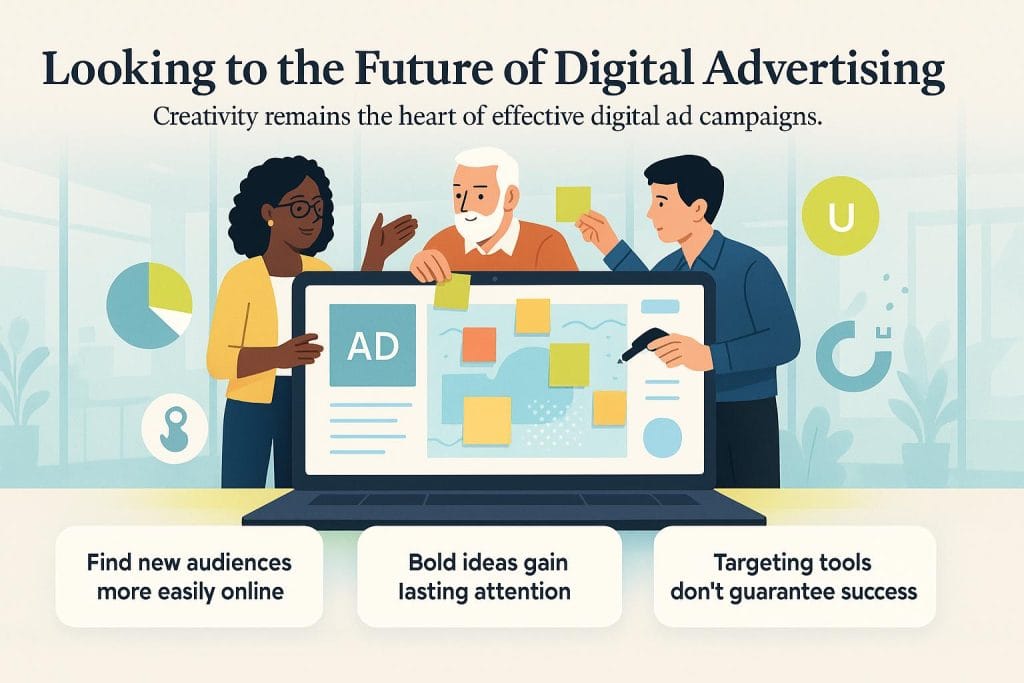
According to Rainer, advertising on the internet has become a double-edged sword.
“There are more platforms and places to advertise than ever before, but at the same time, consumers are being shown so much advertising throughout the day that it takes something special to grab their attention,” Rainer explained.
Advertisers need to continually look ahead as the internet evolves and new technologies emerge. That means staying current with shifts in AI, data privacy regulations and platform algorithms — all of which shape how internet advertising performs. But no matter how sophisticated the tools become, creativity must remain at the heart of every campaign. Even the most advanced technology can’t save an ad that fails to resonate with its audience.
“The internet has allowed good, creative advertising to be more effective, because it’s easier than ever to find and track the target audience for optimal effectiveness,” Rainer said. “However, if the advertising is bad, it won’t matter how well the audience has been targeted.”
Jennifer Dublino contributed to the reporting and writing in this article. Source interviews were conducted for a previous version of this article.