The term “insight selling” is probably familiar to most sales professionals, but many would likely struggle to explain exactly how it works. This sales approach eschews more traditional persuasion tactics in favor of guiding customers through the buying process with information, strategies and context that actually matter to them.
At its core, insight selling uses data, market research and real-world context to help buyers make more informed purchasing decisions, ultimately helping organizations increase sales. If you’re new to insight selling, this guide is a great place to start.
What is insight selling?
Insight selling is a sales approach that focuses on helping customers understand their challenges and make better decisions using data, research and relevant insights, rather than relying on traditional persuasion tactics.
In practice, that means using industry trends, experience and market research to guide buyers through the information that matters most. Instead of simply pitching a product, you’re helping customers diagnose problems, clarify their needs and decide what will actually work for them.
The RAIN Group’s Mike Schultz and John Doerr have written extensively on the topic, including the book Insight Selling: Surprising Research on What Sales Winners Do Differently. They define insight selling as “the process of creating and winning sales opportunities, and driving change with ideas that matter.” In other words, the salesperson (especially in business-to-business, or B2B, environments) acts more like a strategic consultant or business coach, helping customers navigate complex decisions at different stages of the sales funnel.
“Most buyers are looking for ways to address the problem behind the problem,” said Eric Quanstrom, VP of GTM Engineering at B2B sales intelligence and engagement platform Apollo.io. “They tend to favor sellers who can teach them useful things about their own business.”
Buying decisions are more complex today, with more people involved and more information to consider. Insight selling helps bring clarity to the
sales process by keeping everyone focused on what actually matters.
What is the history of insight selling?
To understand insight selling, it helps to look at how selling has changed over time.
- Product-focused selling: Not long ago, selling was more straightforward. Sellers focused on explaining product features and benefits and how their offerings stood out from the competition. Buyers didn’t always have the tools or information to compare options on their own.
- Consultative selling: In the 1980s, that started to shift. B2B sellers began asking more open-ended questions — like “What are your quarterly goals?” or “What keeps you up at night?” — and using those answers to shape potential solutions. This approach was more personalized, but it didn’t stay effective for long.
- Today’s information overload: As the internet took off, buyers gained access to far more information than before. Instead of relying on salespeople, they could research products, compare options and form their own opinions. The problem? There was suddenly too much information, and not all of it was useful.
“Increased access to information has made traditional solution sales a thing of the past,” said Steve Wunker, managing director of New Markets Advisors and co-author (with Jennifer Luo Law) of the book Costovation: Innovation That Gives Your Customers Exactly What They Want — and Nothing More. “Buyers no longer need to listen to any type of sales presentation to understand your product; they simply browse online.”
Why insight selling matters now
Buyers still want guidance, just not in the same way. They’re looking for someone who can help them make sense of what they’re seeing, learn from similar situations and feel more confident in their decisions.
And that need has only grown. Research from Gartner shows that B2B buying groups often include five to 11 stakeholders across different functions, making business decision-making much harder. Many buyers also say the amount of change in their organization feels overwhelming, which makes it even harder to evaluate options and take the next steps.
This is where insight selling comes in. Instead of leading with a pitch, sellers help buyers sort through the information, focus on what matters and move forward with confidence.
Many business buyers now expect salespeople to act as trusted advisors. “With insight selling, you come to the table bubbling with new ideas, perspectives and, potentially, data points,” Wunker said. “Insight selling is about becoming a true partner to your customer, not just a salesperson. You need to offer value beyond the research that buyers can conduct on their own.”
Traditional sales often focuses on solution selling, where
sales teams diagnose the problem and recommend an answer. Insight selling shifts that dynamic by helping customers think through the problem and arrive at the best solution themselves.
What are the categories of insight selling?
Insight selling generally falls into two categories: opportunity insight and interaction insight. Together, they shape how sellers uncover problems and guide buyers toward the right solution.
Opportunity insight
Opportunity insight is about spotting problems before the customer fully recognizes them. Instead of waiting for a prospect to ask for help, the salesperson brings forward a new idea or perspective that highlights a gap or opportunity.
In practice, that might mean identifying an inefficiency, surfacing a missed opportunity or reframing a challenge the customer hasn’t clearly defined yet. The goal is to help the buyer see why something needs to change and why it matters now.
Interaction insight
If opportunity insight introduces the idea, interaction insight helps the customer work through it. This approach focuses on how sellers engage with buyers, asking thoughtful questions, challenging assumptions and encouraging deeper thinking.
Sellers don’t just hand over the answer. They guide customers to their own conclusions, and that’s usually when things start to click. The buyer connects the dots and feels more confident about what to do next.
Insight selling is especially effective when
selling intangible goods and services, where value isn't always obvious upfront. Helping buyers understand what's at stake and why it matters can make the difference between hesitation and a confident decision.
What are the components of insight selling?
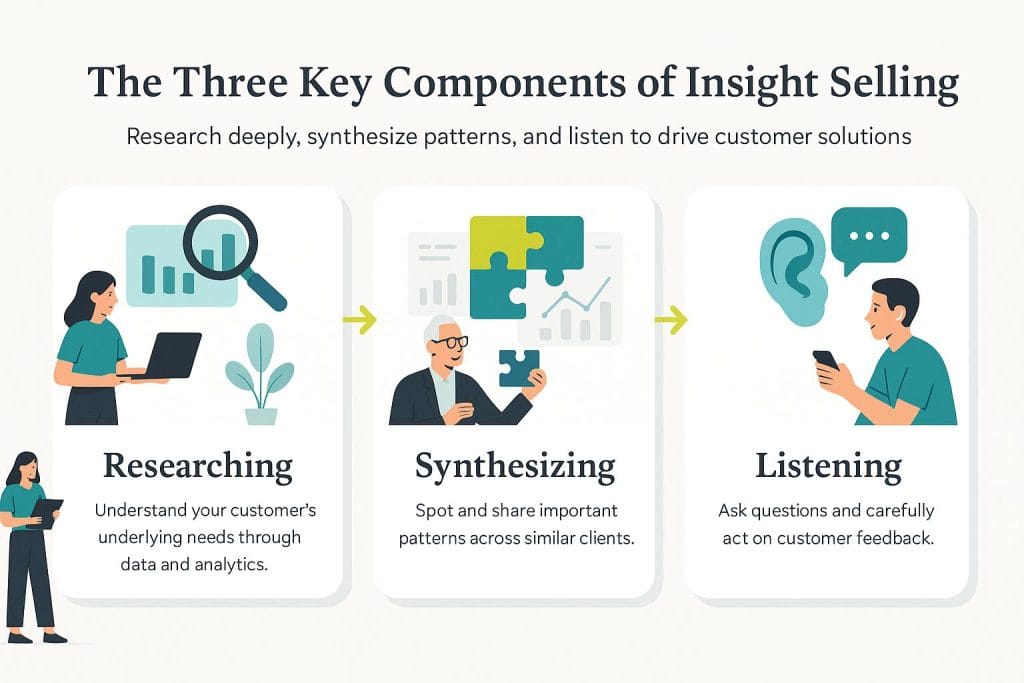
Insight selling typically comes down to three core components: researching, synthesizing and listening. Together, these steps help sellers understand what buyers need and guide them toward the right solution.
Researching
At the core of insight selling is a deeper level of research. Beyond surface-level details, it’s crucial to understand what your customer is actually trying to accomplish.
“Don’t just learn the basic metrics about your customers — instead, push to develop a deep and holistic understanding of the jobs your buyer is trying to get done,” Wunker explained. “Some jobs might be functional, like building a business case for a new venture. Other jobs might be more emotional, like being the hero to a tough, unsolved problem.”
In practice, that means going beyond basic data points. Sellers need to dig into the challenges their customers are facing and look for patterns in how they’re trying to solve them. Data analytics tools can help surface trends, uncover buying patterns and highlight gaps that aren’t obvious at first glance.
“Once you understand what your buyer is trying to do, you can pinpoint obstacles that are getting in the way of that, and you can help them overcome those pain points,” Wunker said.
Synthesizing
Salespeople who focus on a specific industry are in a unique position to see overarching patterns that their customers often can’t. Over time, they hear the same challenges come up across different companies, sometimes before those issues are even fully recognized by the buyer.
“Sellers have a useful seat at the table in that they typically sell to a similar cohort and can listen, synthesize information and see patterns across businesses dealing with the same problems,” Quanstrom noted.
The real value comes from connecting those dots. Instead of treating each interaction in isolation, sellers can draw on what they’ve seen elsewhere to offer perspective, highlight emerging trends and help customers think differently about where they are in the sales pipeline.
That approach is far more useful than relying on traditional sales tactics alone. When sellers bring in what they’re seeing across the market, it helps customers get a clearer sense of what’s coming and what to do next.
Listening
Listening is where insight selling really comes together. It starts with asking thoughtful questions, but more importantly, paying attention to what the buyer is actually saying.
Instead of jumping straight into a sales pitch, strong sellers take the time to understand how the customer sees the problem, including the customer emotions that shape their decisions. From there, they can use what they’ve learned to help shape the conversation and guide the next steps.
Although listening sounds straightforward, it’s not always easy in practice, especially for salespeople who are used to having the next pitch ready. “The risks are that this is hugely demanding of salespeople,” said Quanstrom. “They cannot be transactional, tone-deaf [or] shallow in their approach.”
When it’s done well, the difference is clear. “Your customer will relish feeling heard,” Wunker said.
Sammi Caramela and Kimberlee Leonard contributed to this article. Source interviews were conducted for a previous version of this article.