Business.com aims to help business owners make informed decisions to support and grow their companies. We research and recommend products and services suitable for various business types, investing thousands of hours each year in this process.
As a business, we need to generate revenue to sustain our content. We have financial relationships with some companies we cover, earning commissions when readers purchase from our partners or share information about their needs. These relationships do not dictate our advice and recommendations. Our editorial team independently evaluates and recommends products and services based on their research and expertise. Learn more about our process and partners here.
See a breakdown of international calling costs and learn how you can reduce them.

When your business starts working with clients, suppliers or partners overseas, international calls quickly become part of everyday communication. The challenge is that rates vary widely depending on where you’re calling, what tools you’re using and whether you’re dialing a mobile or landline number. Understanding how international calling costs work — and the strategies that can help you control them — makes it much easier to stay connected without overspending.
Here’s what to know about call rates, international numbers and the most affordable ways to reach contacts abroad.
International calling costs are simply the per-minute rates you’re charged when placing a call to another country. These rates vary widely depending on your carrier, whether you’re calling a mobile or landline number, and whether you have an international calling plan.
Without a plan, basic pay-per-minute rates add up quickly. Many major carriers publish their nondiscounted international rates, and the differences can be dramatic. For example:
These steep rates explain why most businesses use international calling plans or VoIP services, which typically offer deeply discounted international rates or unlimited calling to specific countries. For companies that call overseas frequently, those savings add up quickly.
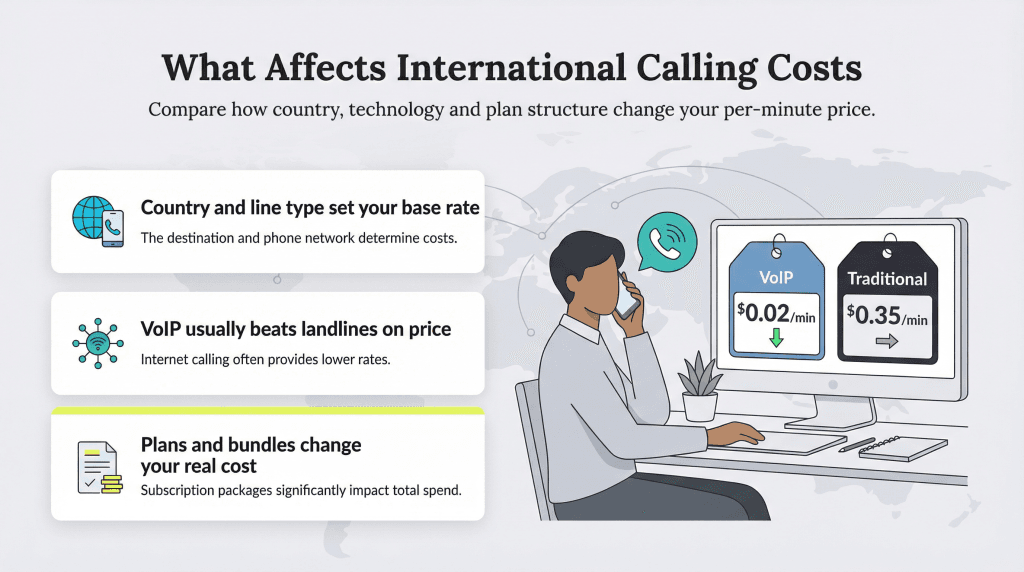
International calling rates can vary a lot, and the price you pay per minute depends on several factors — including your phone provider, the type of plan you have, whether you’re using VoIP technology or a traditional landline, and the specific countries (and sometimes even cities) involved. Below, we break down the biggest factors that influence what you’ll actually pay.
International calling rates differ for each country and can vary dramatically based on your provider and technology. If you’re using VoIP, your costs may also change depending on which city within a country you call and whether you’re reaching a landline or mobile phone.
For example, current Xfinity international voice rates show how prices vary across popular destinations:
Country | Rate per minute |
|---|---|
Brazil | 14 cents to 25 cents |
China | 15 cents |
Japan | 9 cents to 23 cents |
U.K. | 8 cents to 30 cents |
Your international rate also depends on the type of phone system you’re using — in other words, whether you’re calling over a VoIP phone system or a traditional landline. Generally, VoIP setups come with lower hardware and service costs than legacy hardwired systems, which is important to keep in mind when you compare international calling rates.
VoIP providers also tend to offer more competitive per-minute pricing. Many publish separate rates for landline and mobile calls and offer discounted pricing for high-volume destinations. For example:
Your total international cost will also depend on the type of calling plan your company chooses. Many VoIP providers sell low-cost add-on plans — usually an extra five to 10 dollars per user each month — that include a block of international minutes or unlimited calling to select countries. These plans can be a smart way to control spending, but it’s still important to read the fine print. Some bundles only apply to specific countries or number types, so if you’re not careful, you could end up paying higher per-minute rates than you expected.
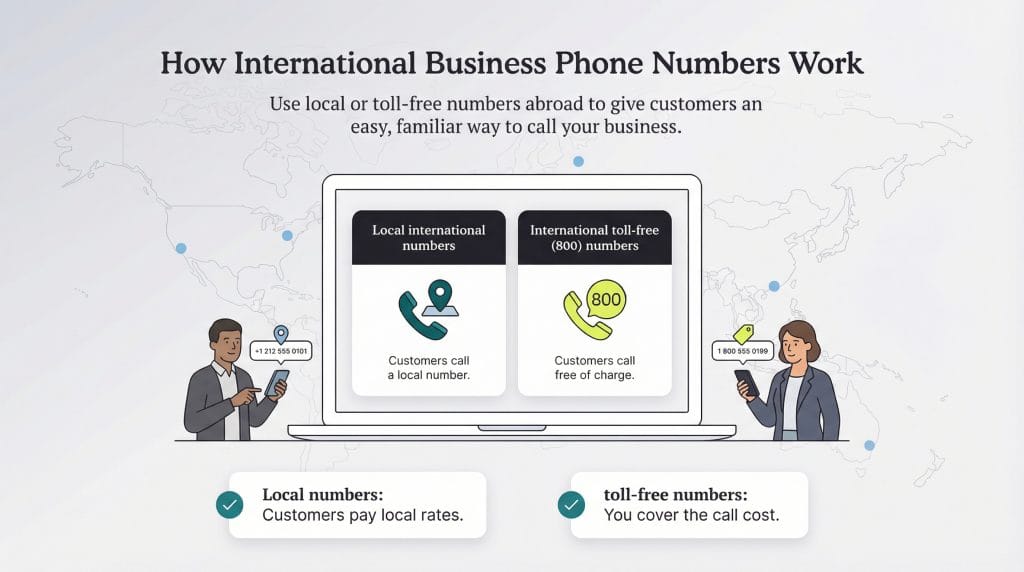
An international number is a phone number that lets your company receive calls from customers in multiple countries through one consistent, centralized line, even when each country has different dialing rules.
When setting up an international number, you can choose either a virtual phone number or a Universal International Freephone Number (UIFN).
There are two main kinds of international numbers: local and toll-free.
Local international numbers
Local international numbers are the most common option for businesses expanding globally. Each provider handles them a little differently, but the concept is the same: You rent a local number in another country so customers there can call you as if you were in the same city. For example, if you obtain a local number in Mexico City through a VoIP provider like RingEx or 8×8, your number will carry the same area code as local businesses. Some providers don’t charge extra for incoming calls, though you’ll still pay standard international rates for outbound calls.
Many major VoIP platforms let you purchase local international numbers as an add-on. For instance:
With any of these options, the number is local to the country, but international calling rates usually still apply to incoming and outgoing calls based on your provider’s policies. The advantage is that customers calling from their area pay only local rates — not international — making this a popular choice for companies looking to establish a local presence abroad.
International 800 numbers
International 800 numbers are less common, and not all providers support them. They’re also more expensive than local international numbers because they function like in-country toll-free lines: Callers pay nothing, and you pay the full cost of the call. For example:
These numbers operate much like a U.S. toll-free line but work inside the destination country. Anyone calling your international 800 number from within that country pays nothing, while your business covers both the inbound toll-free charges and any international outbound minutes. Companies that want to appear established, trustworthy and easy to reach, especially in customer-service-heavy industries, often choose this option despite the higher monthly costs.
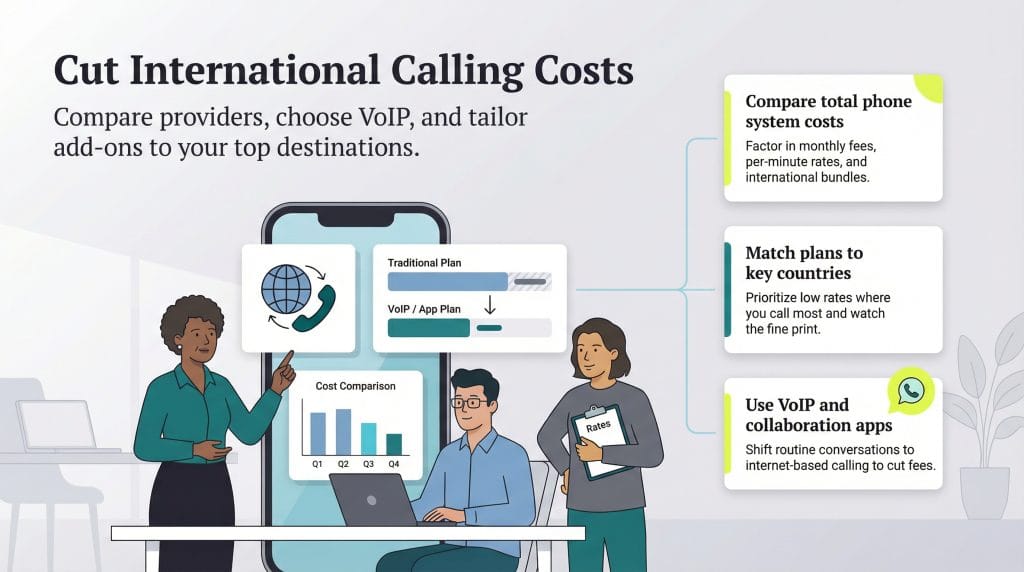
Once you understand the costs behind international calls and international numbers, the next question is obvious: How do you keep those expenses down? Here are a few smart ways to lower your bill:
International calling rates can vary widely depending on the provider, the country you’re calling, your plan type and, in some cases, even the specific city.
A practical example helps show these differences. Suppose you’re calling a supplier in Mexico. To illustrate how pricing varies, we compared a VoIP provider (Zoom Phone) with a traditional landline carrier (Xfinity). Note that your total cost also depends on whether you’re calling a landline or a mobile number.
To keep the comparison consistent, the chart below uses each provider’s standard pay-as-you-go rates rather than monthly commit plans or unlimited international calling packages, which can lower or even eliminate per-minute charges for certain countries.
Provider type | Provider | Landline rate | Mobile rate | Source |
|---|---|---|---|---|
VoIP | Zoom Phone | 5 cents/min | 17.1 cents/min | |
Traditional landline | Xfinity | 9 cents/min | 27 cents/min |
All rates shown are standard pay-as-you-go charges for outbound calls from the U.S.
As this example shows, the cost difference between providers can add up quickly, especially when calling mobile numbers. A 30-minute call to a Mexican landline costs about $1.50 with Zoom Phone and $2.70 with Xfinity, while a 30-minute mobile call shows a larger gap — roughly $5.10 with Zoom versus $8.10 with Xfinity.
Rates can vary just as much in other countries. For example, Zoom Phone charges about 6 cents per minute to landlines in Japan and about 14 cents to mobile numbers, while Xfinity charges 9 cents and 23 cents, respectively.
For companies that make frequent international calls, even small per-minute differences add up quickly. A business that logs 10 hours of international calls in a month could save more than 30 dollars simply by choosing a provider with lower rates. Those savings can add up significantly over the course of a year.