Business.com aims to help business owners make informed decisions to support and grow their companies. We research and recommend products and services suitable for various business types, investing thousands of hours each year in this process.
As a business, we need to generate revenue to sustain our content. We have financial relationships with some companies we cover, earning commissions when readers purchase from our partners or share information about their needs. These relationships do not dictate our advice and recommendations. Our editorial team independently evaluates and recommends products and services based on their research and expertise. Learn more about our process and partners here.

As your business expands locally and globally, it’s essential to have a phone system that can scale with you.
8×8 is built for companies that need to establish a virtual or local presence outside the U.S., thanks to its budget-friendly mix-and-match plans and unmetered international calling. This comprehensive 8×8 review will help you learn more about 8×8’s features, costs and other key information to aid your purchase decision.
Not every Voice over Internet Protocol (VoIP) phone system offers international numbers or supports non-U.S.-based workers, which is prohibitive for companies growing their business. However, this is where 8×8 shines. Its global footprint includes local interconnects and full public switched telephone network (PSTN) replacement service in more than 55 countries, plus inbound direct inward dial (DID) and toll-free virtual phone numbers in more than 100 countries.
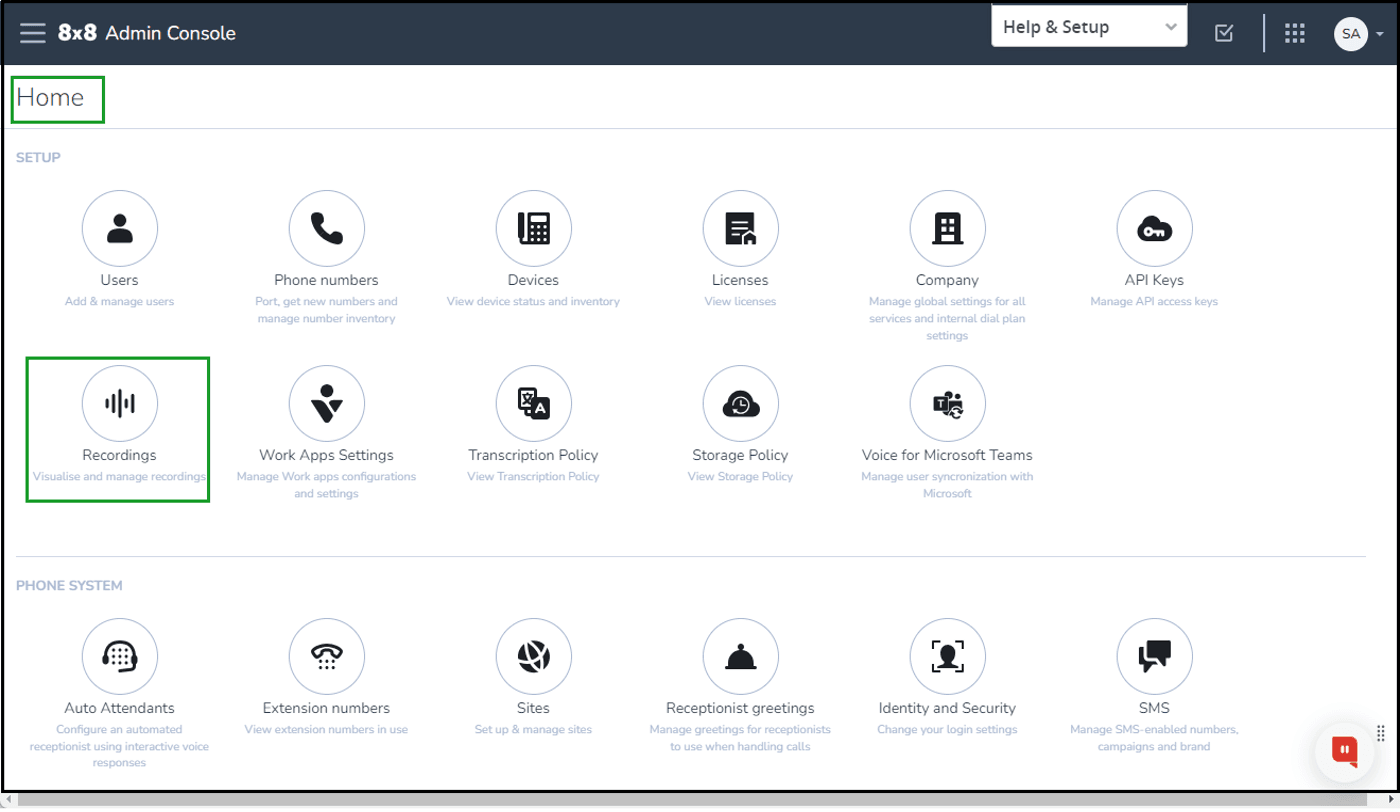
8×8 goes the extra mile by offering international deployment and multilingual customer service teams, with 10 multilingual support teams working across 11 technical support centers on a follow-the-sun schedule. This global support is invaluable for companies looking to establish an offshore call center or handle 24-hour customer service calls. We also appreciate the convenience of the mobile and desktop administrative controls. From a single administrative interface, you can quickly serve users, configure the system and manage sites no matter where your team is located.
Cost is always a concern when opening another business location. That’s why we appreciate 8×8’s flexible and affordable packages. Its mix-and-match plans cater to various roles, including receptionists and omnichannel customer service agents. Depending on your subscription, you can reduce international calling costs by taking advantage of unmetered calling to 14, 32 or 48 countries.
It’s not only about cost savings — 8×8 delivers value for growing businesses. All voice plans come with advanced call management, video conferencing and messaging tools. The service integrates with customer relationship management (CRM) platforms, and there’s also a no-license Microsoft Teams option. We also love that the 8×8 Platform for CX — which unites the vendor’s contact center, unified communications and communications API products under one roof — is designed to keep your workforce connected as your company expands. Its reliability, scalability and feature-rich services make it worth weighing against our picks for the best business phone systems.
For context, Market.us research shows that 67 percent of enterprises now use VoIP systems for their communication needs, with 93 percent of businesses that switched to VoIP platforms reporting increased productivity. That means that while your company is dealing with the busyness of expansion, it can gain efficiency as it uses 8×8.
According to Coherent Market Insights, the global VoIP services market is expected to reach $472.21 billion by 2033, with rapid growth driven by the increasing popularity of cloud-based technologies across industries. Cloud PBX (public branch exchange) systems like 8×8 let employees interact with co-workers and customers using any internet-connected device. We found 8×8’s desktop client user-friendly and comparable to RingEX or Vonage. Its light and dark themes, special action icons and sound library let you customize your experience to suit your needs.
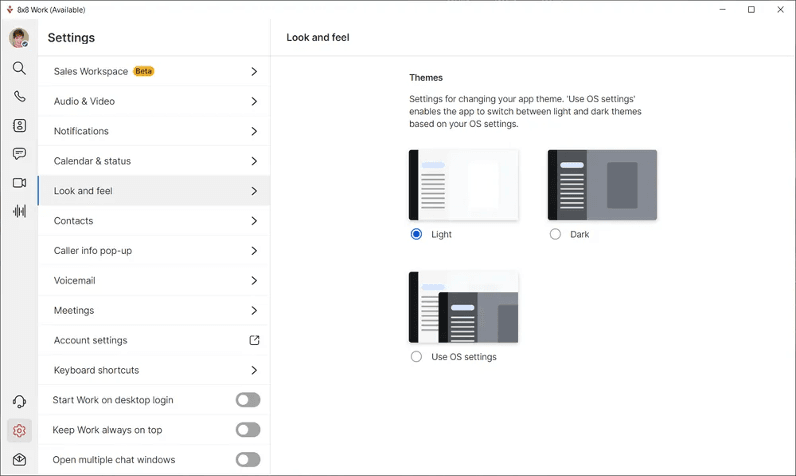
We like that 8×8 allows you to add a custom status message in addition to standard presence data. It syncs to your calendar, and you can select which message to display when you have an event. However, the iOS and Android apps could be more intuitive. Some business users mentioned having problems transferring and parking calls. We found that Nextiva and Ooma have more straightforward and usable mobile apps.
8×8 integrates with some of the best CRM software platforms, as noted above. We found it easy to activate these apps from the 8×8 settings integration panel. In contrast, some competitors, like Nextiva, require a third-party integrator tool to connect the phone system to a help desk or CRM software. Notably, 8×8 has more limitations when it comes to on-site integrations. We prefer Ooma for seamless connection to analog paging systems and fax machines. Learn more in our Ooma Office review.
8×8’s flexibility and advanced capabilities make it ideal for growing businesses. As your company expands, you can enable optional functions for users or departments or enforce them company-wide. Below, we identify the 8×8 X Series features that can support your organization’s growth and development.
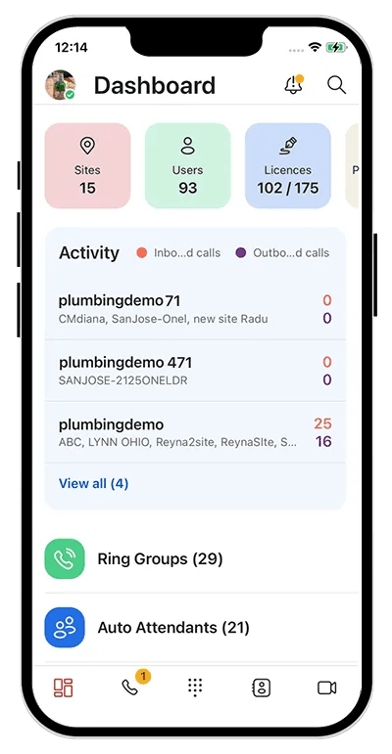
All VoIP phone systems have online admin portals, but not all providers or plans are multisite or globally compatible. We were thrilled that 8×8’s mobile administrative tools fully sync to the main 8×8 Admin Console, displaying time-critical alerts and a performance analytics dashboard. This lets companies manage several locations from a single admin platform on desktop or mobile devices. More recent additions include cross-PBX analytics, device status monitoring, support for multiple single sign-on configurations and admin console audit logs.
When testing the 8×8 platform, we liked the time-saving features, like standardized rules and auto-site generation. Establishing a new site’s phone system was quicker than with some competitors’ software that required us to start from scratch. We could also update all office lines simultaneously instead of applying changes manually.
8×8 meets industry security standards, including HIPAA compliance, when properly configured with encryption and secure data handling protocols. For healthcare organizations, this ensures patient communications remain protected according to federal regulations. The platform also supports PCI DSS compliance for businesses handling payment information.
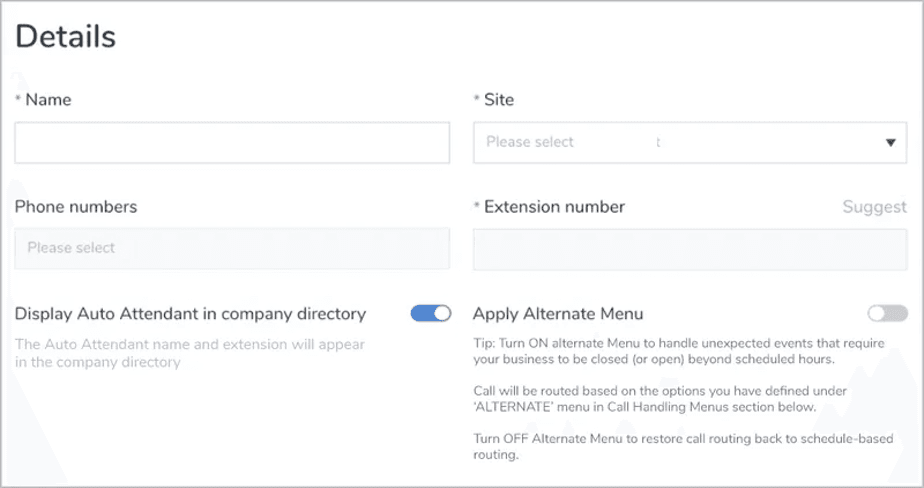
8×8’s multilevel automated receptionist supports the complex call flows that are standard with larger organizations. Rival Nextiva provides only a basic virtual receptionist (simple IVR) on its base plan, whereas 8×8, RingEX and Dialpad include full multilevel auto-attendants with all their subscriptions. With 8×8, you can configure the auto-attendant’s submenus and create multisite ring groups.
We also appreciate 8×8’s built-in configurations for alternate menus. These allow administrators to immediately switch to a substitute auto-attendant during an unplanned event that affects phone service. You can designate alternate menu greetings and call-forwarding rules to ensure business continuity, even if one or more of your locations cannot accept calls.
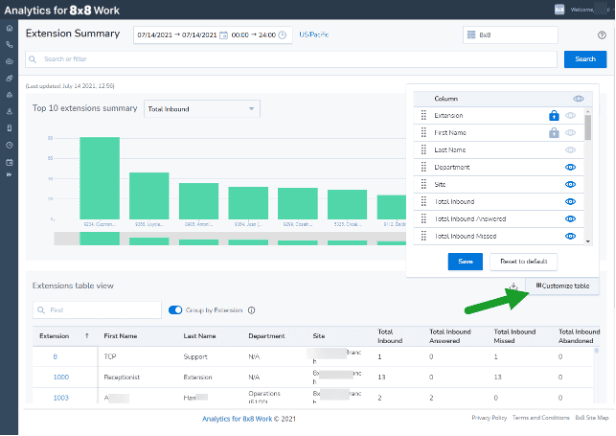
Data analytics, like 8×8’s unreturned calls or quality trends reports, are invaluable to growing businesses. Analytics data for 8×8 Work provides historical and real-time information for hardware and extensions across your organization. We liked the customization and filtering options. The platform displays granular details from any device in a table or graph.
8×8 call activity comes with the X2 unified communications plan and higher, and supervisor analytics start on the X4 tiers and higher. In comparison, in our RingEX review, we noted that this vendor includes essential business analytics on its midtier subscription while offering analytics for IT administrators on the base package.
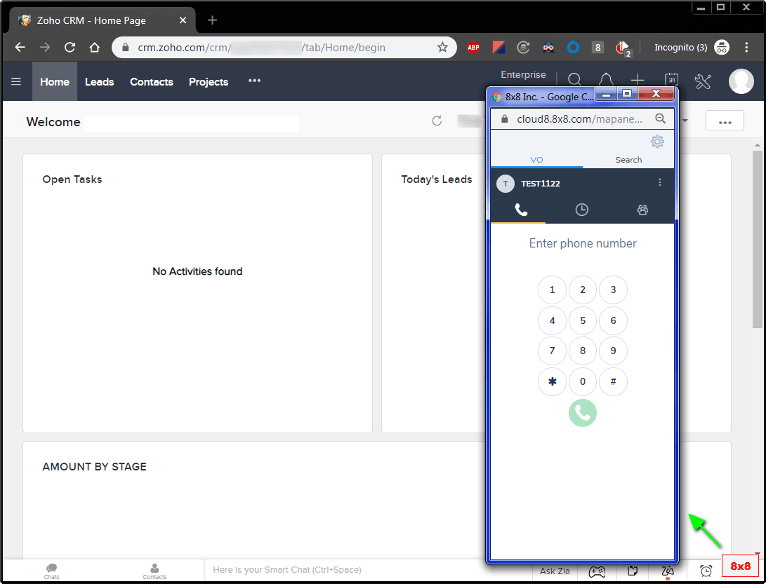
Because 8×8 offers both phone and call center features on one platform, we love that it also supports integrations at the base and contact center levels. It syncs with core CRM, service, productivity and support applications. For instance, 8×8 can store contact call data in HubSpot and Zoho CRM while providing call controls. 8×8 has also expanded native SMS and WhatsApp handling inside Salesforce, HubSpot, Zendesk, NetSuite, Zoho and Microsoft Dynamics, with screen pop, interaction logging and automated record creation included.
Although 8×8 integrates with fewer applications than RingEX and Zoom, we were impressed that all X Series licenses include multiple Microsoft Teams integration options. 8×8 offers both a Phone App for Teams that requires no Teams Phone license and a Voice for Teams solution that does require Microsoft licensing. We appreciate that 8×8, along with peers RingEX, Dialpad and Vonage, all provide license-free Teams integration options that don’t require expensive Teams Phone licenses. RingEX offers this through its embedded app approach, Dialpad provides License Free Routing (LFR), and Vonage offers both VBC for Teams and VBC Voice for Teams integration packages. Learn more about the latter in our Vonage review.
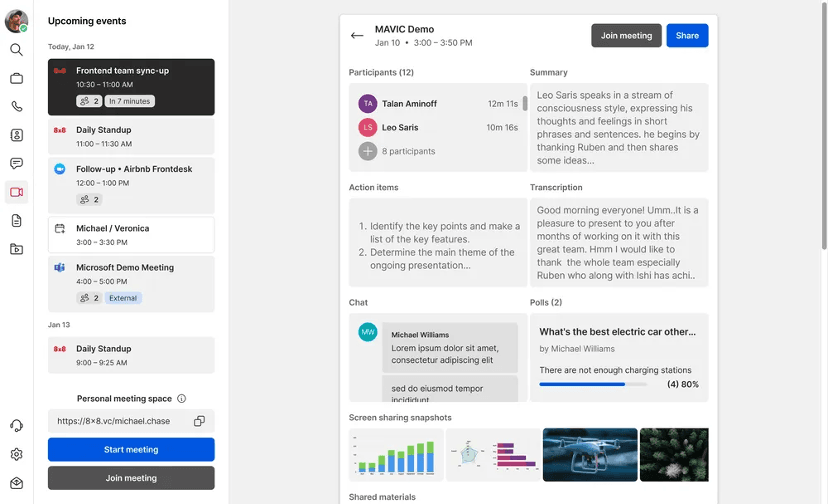
8×8’s VoIP solution has a 500-person audio and video conferencing limit — higher than most competitors, including Dialpad and Nextiva. Still, RingEX supports 1,000 audio meeting attendees. Like Dialpad and RingEX, 8×8’s platform now boasts AI-generated meeting summaries, action items and highlights for video conferences. This feature saves businesses time and increases productivity, which is critical as your workforce expands.
We like that 8×8 allows livestreaming to YouTube. The meeting application has advanced moderation controls and encourages engagement through instant polls, emoji reactions and hand raising. You can share videos in meetings and chat with participants.
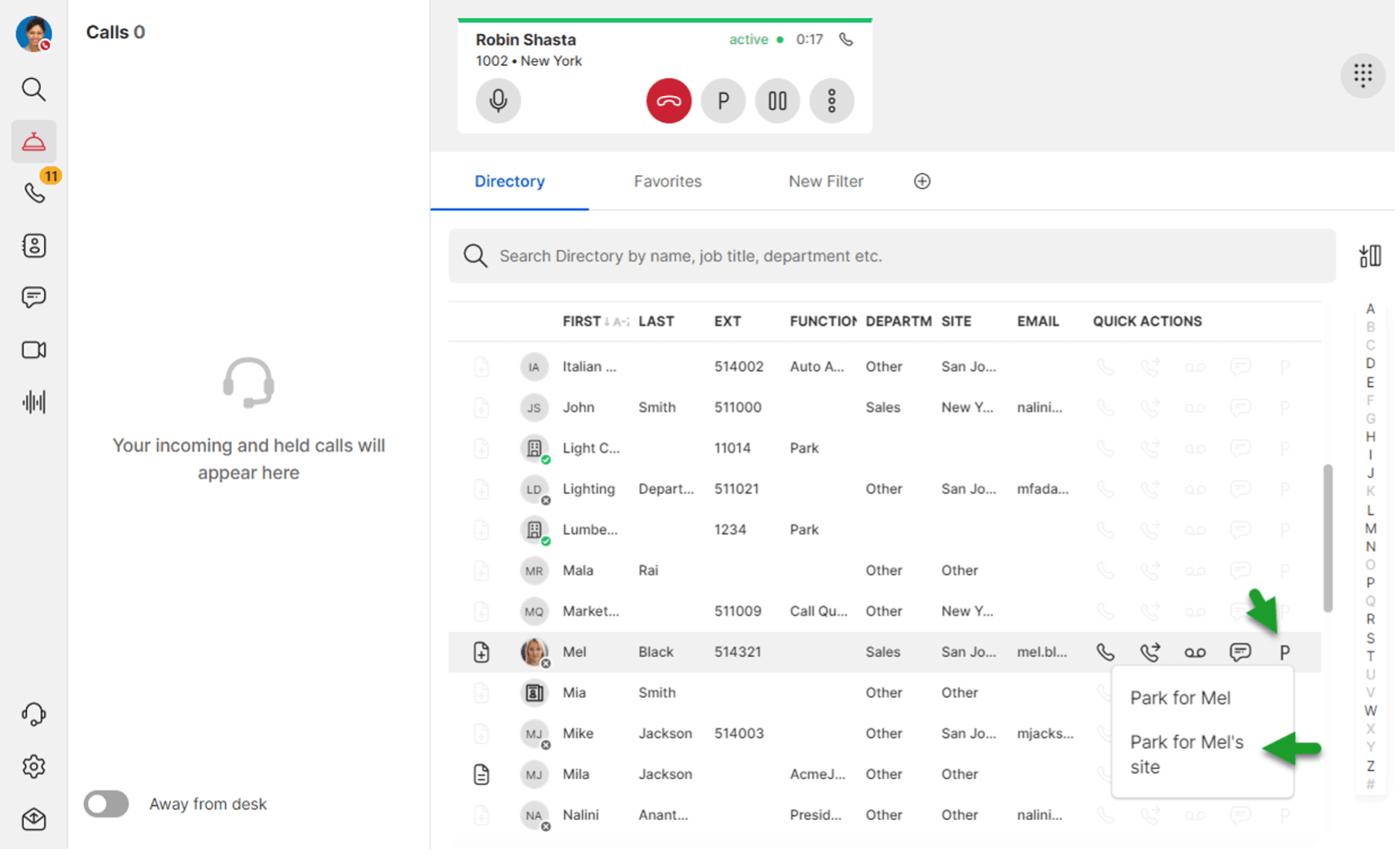
8×8’s softphone apps help employees deliver exceptional caller experiences with tools such as call transfer, forwarding and parking. Admins can distribute calls for more efficient customer service by leveraging ring groups and call queues. We also like that 8×8 offers Frontdesk app functionality for receptionists and operators. Notably, RingEX’s receptionist console is available on its base plan, whereas 8×8 requires you to sign up for the X4 plan to get this capability.
8×8 does not publish per-user pricing. Instead, its pricing page organizes the portfolio into five offerings you can mix and match: Unified Communications (8×8 Work), Contact Center, CX Beyond the Contact Center (8×8 Engage), Communications APIs and 8×8 for Microsoft Teams. Every one of them routes to a sales conversation or a quote request rather than a checkout page. The vendor provides custom quotes and discounts for annual prepayment, extended contracts and high-volume license purchases.
We were disappointed that 8×8 no longer lists specific pricing on its website, requiring businesses to contact the company’s sales team for detailed quotes. Still, based on our recent research and industry comparisons, 8×8’s unified communications plans remain competitively positioned within the RingEX and Nextiva price range. However, Dialpad has a cheaper option with annual billing, and Zoom Phone’s metered subscription costs less.
Underneath that packaging, 8×8 still sells the X Series license tiers, and they are what a quote will itemize. A domestic-only X1 license covers basic users who never dial internationally; the higher tiers are the ones most growing businesses will compare. Note that the unmetered calling zones exclude premium-rate and special-service numbers, and that mobile calling is metered in certain X2 destinations but unmetered from X3 up.
We appreciate that 8×8 includes these VoIP and contact center features regardless of the package you choose:
Beyond those standard components, here’s a breakdown of what you get in each plan:
8×8 X Series Plans | Key Features |
|---|---|
X2 |
|
X3 | Everything in 8×8 X2, plus:
|
X4 | Everything in 8×8 X3, plus:
|
X6 | Everything in 8×8 X4, plus:
|
X7 | Everything in 8×8 X6, plus:
|
X8 | Everything in 8×8 X7, plus:
|
Businesses can add several features to boost their phone system’s functionality. For example, unified communications users can choose media cold storage for long-term archival purposes, and quality management and speech analytics can be added for non-X8 users. We especially like 8×8 Secure Pay, a payment processing tool that lets your customers add their payment information through a secure interface.
As with other cloud-based phone systems, 8×8 doesn’t require the special wiring and hardware necessary for traditional landline solutions. Once the software is configured, employees can access team messaging and calling tools using a desktop client, browser or mobile app. When we set up our system, we liked the option to clone employee or administrator roles and bulk-upload new users.
Otto, 8×8’s AI-powered assistant, helps with training and onboarding. It works in the 8×8 admin portal, knowledge base and 8×8 support portal (My 8×8). 8×8 also provides free online training and paid courses through 8×8 University, similar to what RingEX offers. However, we preferred Vonage’s free live training sessions and found Nextiva’s support center easier to navigate.
That said, we found 8×8’s free tutorial pages helpful. These materials include guides, short videos and interactive demos. The complimentary self-paced learning modules help new users get up to speed without disrupting workplaces.
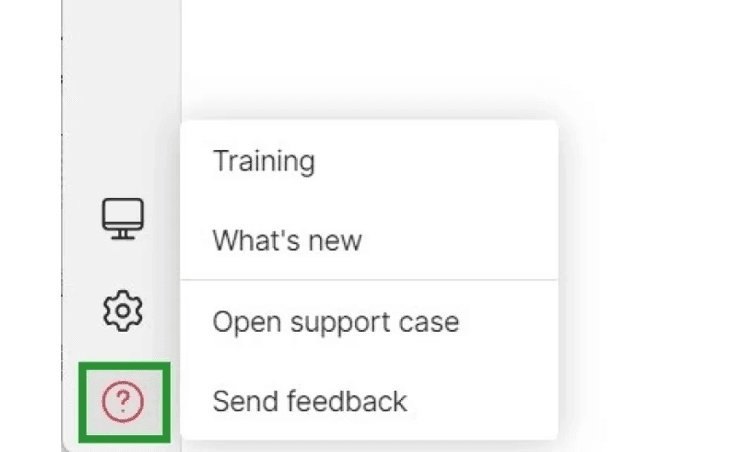
Although the 8×8 X Series comes with 24/7 customer support for all accounts, customer reviews and our experiences suggest it’s difficult to reach and understand some agents. Technical support runs around the clock by phone, chat and the 8×8 Support Portal, but email isn’t a supported channel, and help with billing and number porting is available only on weekdays. General customer service by phone is Monday through Saturday, 6 a.m. to 6 p.m. PT. The availability and knowledge levels of the vendor’s customer service representatives vary. For example, you’ll have to jump through a few hoops (roughly seven to eight mouse clicks) to reach a human via the live chat tool.
We found 8×8 often routes callers to the virtual chatbot during peak hours. Indeed, when comparing Nextiva to 8×8, we felt Nextiva’s agents were more responsive and better equipped to answer our questions. However, we love the recent updates to 8×8’s knowledge base. The addition of screenshots helped us navigate system configuration and basic troubleshooting without having to contact the support center.
The platform averages 99.9999 percent core call flow processing uptime and backs its service with a 99.999 percent uptime service level agreement, according to 8×8. This level of uptime is crucial for growing businesses that depend on consistent communications infrastructure.
Some 8×8 features — like auto-dialer functionality — are found only in the platform’s pricier plans, which may make this solution less financially feasible for budget-conscious businesses. We also felt 8×8’s base phone plans lag competitors on built-in AI. The AI video meeting tools are a nice touch, but the vendor’s deepest conversation intelligence lives in 8×8 Pulse, which is sold separately, whereas RingEX includes its AI assistant for voice and video on every plan and Zoom Phone bundles AI summaries for audio calls into its cheapest metered subscription.
8×8’s support is also concerning for businesses without a robust IT and administrative team, although the company isn’t alone in this problem; we encountered it several times when researching and testing VoIP services. However, our review of Nextiva highlights that our support experiences were noticeably better with this vendor than with many rivals.
Prospective users should also be aware that 8×8’s mobile apps can be buggy, especially after software updates, which affects user experience for remote and hybrid teams. Some users report call quality issues when using Wi-Fi connections, though the system typically defaults to carrier data for stability.
For this 8×8 review, we tested the 8×8 Work application and administrative console and evaluated the platform’s features, pricing structure and user experience. Our process involved:
To find the best business phone system for growing companies specifically, we also focused on scalability, international calling options and costs, integration possibilities and communication tools for distributed workforces.
We recommend 8×8 for …
We don’t recommend 8×8 for …

