Business.com aims to help business owners make informed decisions to support and grow their companies. We research and recommend products and services suitable for various business types, investing thousands of hours each year in this process.
As a business, we need to generate revenue to sustain our content. We have financial relationships with some companies we cover, earning commissions when readers purchase from our partners or share information about their needs. These relationships do not dictate our advice and recommendations. Our editorial team independently evaluates and recommends products and services based on their research and expertise. Learn more about our process and partners here.
Organized, consistent financial records help you substantiate your business’s performance when you seek financing, bring in an investor or prepare to sell.


This article is sponsored by Intuit
A lender asks for your latest financial statements. An investor wants to understand your margins. A potential buyer requests records supporting your asking price. If answering means sorting through months of transactions and searching for missing invoices, the opportunity comes with a bookkeeping scramble.
Preparing your books ahead of time gives you a clearer financial story and the documents to back it up. Accounting software such as QuickBooks Online can help you maintain those records throughout the year. The goal is to explain how the business earns money, where its cash goes and which obligations a lender, investor or buyer needs to understand.
Everyone reviewing your finances needs credible numbers, but they approach those numbers with different questions. A lender evaluates repayment capacity. An investor considers the return opportunity. A buyer examines the earnings and obligations that come with acquiring the business.
Reviewer | Central question | Financial evidence to prepare |
|---|---|---|
Lender | Can the business repay the loan? | Historical results, cash flow, existing debt and projections including new loan payments |
Investor | Does the business offer a credible return? | Revenue trends, margins, cash needs and support for growth assumptions |
Buyer | What earnings and obligations would I acquire? | Sustainable earnings, working capital, liabilities and documented adjustments |
For lenders, cash timing matters alongside profitability. We recommend demonstrating current and forecasted cash inflows and outflows, including how proposed loan payments fit. Our guide to business loan applications covers the broader preparation process.
Investors may ask how additional capital would change the business’s performance and how long that capital would last. The U.S. Small Business Administration notes that investor due diligence also considers management, the market, products and corporate governance documents. Your books support the financial part of that evaluation.
Buyers often look beyond reported profit to understand ongoing earnings and cash requirements. Quality of earnings, working capital and debt analysis are key financial due diligence areas. These analyses examine whether earnings are sustainable, which short-term resources and obligations support operations and what debt exists. Preparing for those questions is part of selling your business, even if a sale is still some distance away.
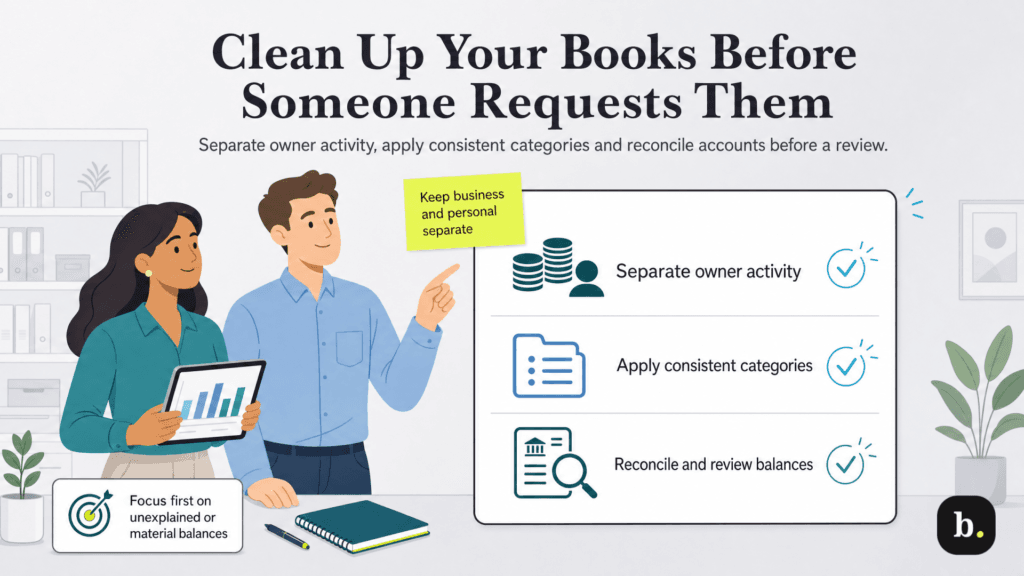
Keep business and personal transactions separate, and identify owner contributions, distributions and loans correctly. Money an owner transfers into the business isn’t sales revenue. A personal purchase paid from the business account shouldn’t automatically become an operating expense.
Review mixed-use purchases with your accountant rather than guessing. Correct treatment depends on the transaction and business structure. Clear records help a reviewer distinguish the company’s operating results from the owner’s financing and personal activity.
Use a manageable chart of accounts, the categories organizing your transactions. Record comparable expenses consistently so someone can compare periods without wondering whether a change reflects business performance or a bookkeeping decision.
Resolve uncategorized transactions and investigate large balances in miscellaneous accounts. If subcontractor costs appeared under direct costs last year and operating expenses this year, gross margin comparisons may be misleading. Work with your accountant to correct errors and document legitimate changes.
Reconcile your bank accounts and credit cards regularly, comparing the books with statements and explaining differences. Investigate missing payments, duplicates and unreconciled items. Matching a bank feed transaction to an entry helps prevent duplication, but it doesn’t replace the full reconciliation.
Review accounts receivable and unpaid supplier bills as well. Confirm whether customer balances are collectible, whether bills are complete and whether recorded debt matches lender statements. For inventory businesses, investigate obsolete stock and discrepancies between records and physical counts.
Keep supporting invoices, receipts, contracts and loan agreements organized alongside these reviews. A statement total is easier to substantiate when you can locate the records behind it.
Maintain a complete list of financial statements, including your monthly profit and loss statements, balance sheets and cash flow statements. Monthly history helps reveal seasonality, collection delays and changes in margins that annual totals can conceal. Save finalized reports with clear dates, and identify revisions so different versions don’t circulate without explanation.
Use a consistent accounting basis when comparing periods. Cash and accrual accounting recognize activity at different times. Changing methods can shift reported results even when the underlying business hasn’t changed. Ask your accountant whether the intended transaction requires a different presentation and how to make comparisons meaningful.
Document unusual events while they’re fresh. A major customer loss, a seasonal inventory purchase or a substantial repair. Brief explanations tied to supporting records make it easier to answer questions later.
Financial statements and tax returns may legitimately differ because of accounting methods or tax treatment. Have your accountant explain and reconcile significant differences rather than changing numbers simply to make the documents match.
Keep forecasts separate from historical results. Document assumptions about sales, hiring, expenses and collection timing, and explain how those assumptions relate to actual performance. If growth requires additional staff or inventory, include the resulting cash needs in the forecast.
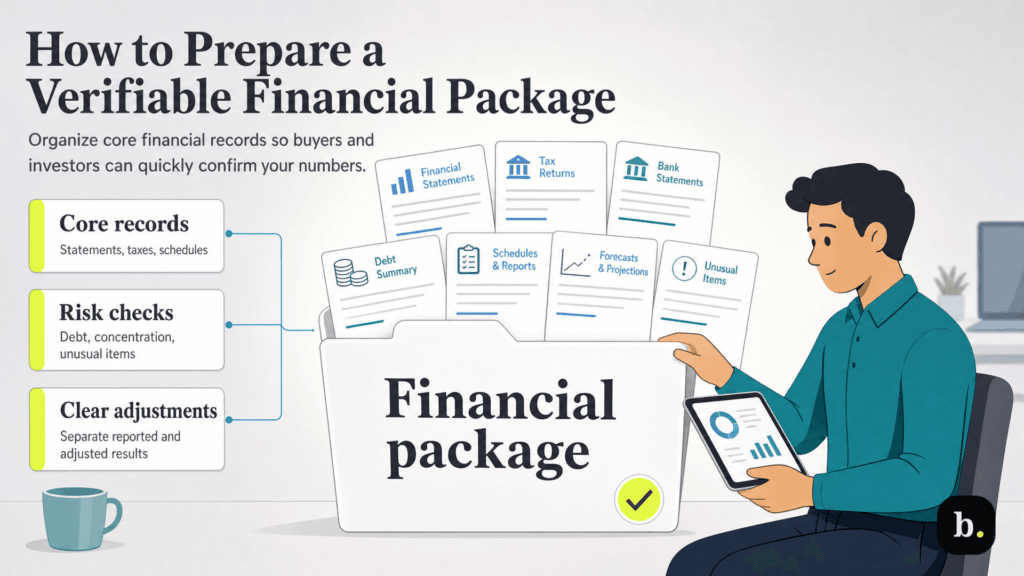
Assemble a core set of records before you’re under pressure, then tailor it to the request. A useful starting checklist includes:
Investors and buyers may also request revenue by customer, product or service. Identify customer concentration and distinguish recurring revenue from one-time projects. Strong totals can obscure dependence on one customer or a contract nearing expiration.
For a sale, an owner may propose “add-backs,” adjustments intended to show earnings without certain expenses. Document the amount, reason and supporting evidence for each proposed adjustment. A buyer may challenge whether an expense is truly nonrecurring or would continue under new ownership. Owner compensation also needs context if a replacement manager would require a salary.
Keep reported results and proposed adjustments separate. A clear schedule lets the reviewer evaluate your reasoning without losing sight of the original books.
Consider a hypothetical business, which we’ll call Harbor Services. Its owner wants an equipment loan. The latest profit and loss statement looks promising, but subcontractor expenses were categorized differently across periods, some customer invoices are overdue and owner transfers were mistakenly recorded as sales.
The owner and accountant first correct the transfers and expense classifications, then regenerate the affected reports. They review overdue invoices using an aging report and update collection expectations. Finally, they reconcile cash and debt balances and prepare a forecast incorporating the proposed loan payments.
The revised package may show lower revenue than the original reports. It also gives the lender a more accurate basis for assessing repayment capacity and gives the owner a better basis for deciding how much to borrow. The example illustrates preparation, rather than predicting an approval outcome.
Apply the same scrutiny before an investment or sale. Can you explain a sudden margin improvement? Are past-due taxes recorded? Does an equipment balance include assets no longer in use? Are payments to related businesses supported by agreements?
Some issues require operational changes. Consistently slow collections may call for different payment terms that shorten your collection cycle. Dependence on one customer may require a plan to diversify revenue. Documenting a cash shortfall makes it visible; addressing it requires a business decision.
Set a monthly close routine with clear responsibility for transaction review, reconciliations, supporting documents and financial statements. Choose a realistic deadline after the month-end, and track unresolved items until they’re addressed. Have your accountant review unusual balances and adjustments before a major transaction.
QuickBooks Online can support that routine through financial reporting and reconciliation tools. Intuit’s reconciliation guidance explains how to compare recorded transactions with bank and credit card statements. The software helps organize the work, while your review establishes whether the records are complete and correctly classified.
Its audit log adds traceability. According to Intuit, the log records changes and the users responsible, with events available for two years. That can help you investigate why a transaction or balance changed. Retain supporting documents and finalized reports separately according to your recordkeeping needs.
“Audit-ready” should mean organized records that support examination. It doesn’t mean your statements have been independently audited. If a reviewer requires audited financial statements, confirm that requirement early with your certified public accountant (CPA); exporting reports from accounting software doesn’t provide that assurance.
Before approaching a lender, investor or buyer, ask someone familiar with the business’s finances to walk through the package with you. You should be able to explain the major trends and trace important balances to supporting records. Maintaining that discipline throughout the year puts you in a better position to respond when an opportunity arrives.
