Business.com aims to help business owners make informed decisions to support and grow their companies. We research and recommend products and services suitable for various business types, investing thousands of hours each year in this process.
As a business, we need to generate revenue to sustain our content. We have financial relationships with some companies we cover, earning commissions when readers purchase from our partners or share information about their needs. These relationships do not dictate our advice and recommendations. Our editorial team independently evaluates and recommends products and services based on their research and expertise. Learn more about our process and partners here.
Creating a sales process helps you convert leads into customers and earn consistent sales in your business. Learn more about how to build a sales process.


Every business goes through a similar series of steps to make a sale. Understanding how the sales process works helps you maintain a consistent approach to generating sales leads and turning them into customers.
Documenting your approach and creating a structured sales process makes it easier for your sales team to know where to focus their energy. It also makes it easier to track your results and identify what’s working and what isn’t. This guide explains how the different stages of the sales cycle work and how to build a sales process for your business.
A sales process — also known as a sales cycle — is the method your company follows to sell your product or service to customers. It involves a series of steps, from initial contact with a lead to the final sale.
The sales process is similar to developing a relationship with someone new. When you first meet, you get to know each other, learn what they like and determine their goals. Along the way, you decide whether you can work together and if you’re a good match. If so, the relationship can proceed and grow.
A well-defined sales process is one of the most reliable ways to turn sporadic wins into consistent revenue. While many sales processes share similar stages, the specifics of each step should reflect your unique product, target audience and team structure.
Here’s how to build a sales process that works for your organization:
Begin by identifying the characteristics of your ICP. Consider factors such as industry, company size, budget and specific challenges you face. Creating detailed buyer and customer personas will help your sales team understand and empathize with potential clients, allowing for more personalized and effective outreach.
“The most important part of building a sales process is understanding your customer and identifying bottlenecks fast,” said Mari Milenkovic, founder and CEO of With Mari and co-founder of Her Brand & Co.
Start by understanding how your ideal customer makes a purchase decision, from awareness to evaluation to commitment. This is your chance to uncover common questions, hesitations and behaviors at each stage of the buying journey. Use the BANT (budget, authority, need and timeline) framework to see if your products align with a buyer’s budget and decision-making power.
“When I work with female founders, we ground the sales process in the context of the marketing funnel, which I break down into five key stages: Awareness, Lead Generation, Nurture, Sales and Retention,” Milenkovic said. “We start by mapping the customer journey … Each stage of the funnel may contain two to four touchpoints.”
Milenkovic shared examples of possible touchpoints at each stage:
This method helps you align your sales stages with your buyer’s real-world journey, ensuring your process supports them every step of the way.
Using the buyer’s journey as your foundation, outline the key stages of your sales process. “Once the customer journey is outlined, we assess what strategies to use at each stage,” Milenkovic said. “This is unique to each founder depending on their business model, resource availability and customer behavior.”
These typically include:
However, don’t just follow a template — make sure each stage reflects the actual steps your team needs to guide buyers forward. Each stage you develop should have a clear objective, entry/exit criteria and measurable actions that show progress. This way, you can tailor presentations and analysis to each prospect.
“The goal is to guide the customer in a way that makes sense for them,” Milenkovic said. “There’s no one-size-fits-all formula. Clarity comes from knowing your customer.”
For every stage you define, list the specific actions your sales reps should take. These could include sending a discovery email, conducting a demo or submitting a proposal. Alongside these actions, map out the tools or content reps should use, such as CRM templates, case studies or pricing calculators. The goal is to make it easy for reps to know what to do, when to do it and how to do it effectively.
Before finalizing your sales process, validate it with your sales team and customer-facing colleagues. Are the stages practical? Are the actions realistic? Do they reflect how your buyers want to engage? Make adjustments based on internal and external feedback to ensure the process is practical, buyer-centric and adaptable.
Once your process is built, document it in a clear, shareable format, preferably in your CRM or sales enablement platform. Include stage definitions, activity checklists, qualifying questions and examples. Garrett Ball, owner of 65Medicare.org, emphasized the importance of documenting a structured sales process. “This allows you to pass on your process as the team grows and changes, while also giving you a well-defined language to use with your business,” Ball explained.
Train your sales team on the new process and make sure they understand not just what the process is, but why it exists and how it benefits them. This is where you analyze your results to reinforce what’s working and improve where necessary.
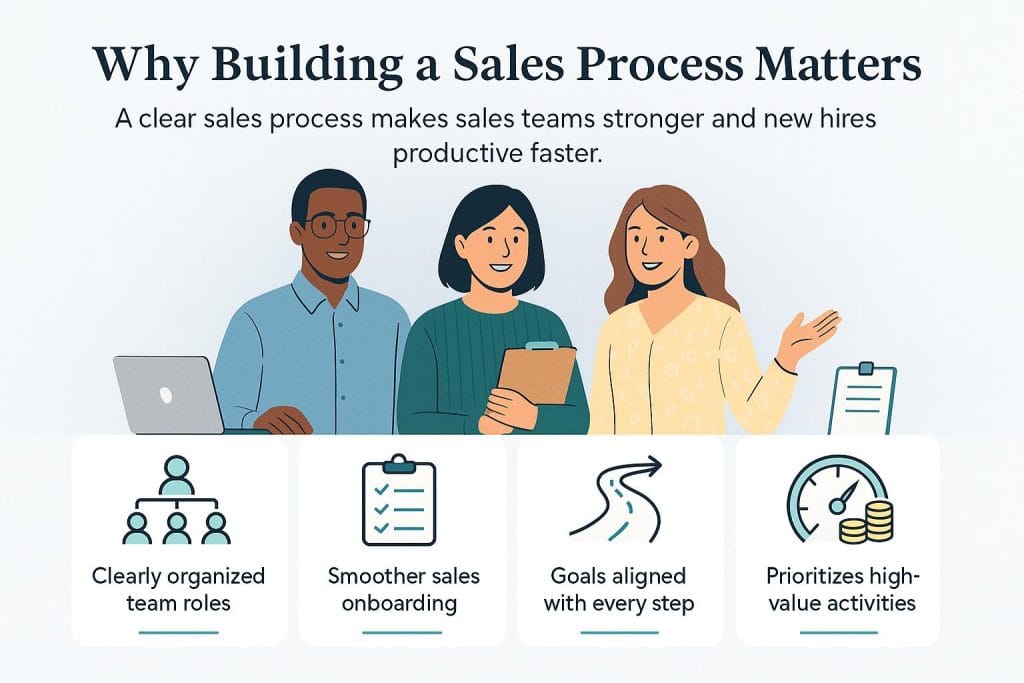
Here are some benefits of building a sales process for your business:
Once your sales framework is in place, the sales process itself typically unfolds in a series of stages that guide prospects from initial contact to a final purchase decision. Here’s how they work:
Once your sales process is defined, the first stage is prospecting — identifying potential customers who match your ideal client profile. This step requires some research and typically includes three components.
Milenkovic recommends using technology to streamline this process. “Use tools like audience personas, referral networks and outreach channels to build a list of qualified leads,” Milenkovic said. “I also recommend founders use the Value Proposition Canvas from Strategyzer to better understand their customer’s pains, gains and jobs to be done. This makes prospecting more precise and effective.”
After identifying the ideal prospect, reach out to contact them. “Contacting prospects is the first step toward fitting the product with the prospect,” Ball said. “Sales reps should meet the prospect on their terms and listen more than they speak.”
This step has two parts:
Although you’ve already done research to qualify the prospect before making contact, you still need to determine if they’d make an ideal customer. This can only happen in a direct conversation with the prospect (either over the phone or in person).
To qualify the prospect, learn more about them. Ask about their goals, budget, challenges and other issues that will help inform your decision. Make sure the person you’re speaking with has the authority to decide whether to do business with you. During the conversation, identify opportunities to provide value.
Qualifying the prospect involves confirming whether they meet the criteria of a good customer. If they’re not a good fit, tell the prospect why. If they’re still interested, determine why.
After qualifying a prospect, the next step is showing how your solution fits their needs. This typically involves answering questions about your offer, the benefits you provide and the problems you solve.
When answering the prospect’s questions and learning about their needs, you continue nurturing them through the decision-making process.
Ball explained that the nurturing stage can look different depending on the industry. “The one thing that all industries have in common is that prospects are on their own timetables frequently,” Ball explained. “Nurturing prospects just means that we recognize their timetables but also want to keep the process moving forward toward the sale.”
Nurturing prospects involves:
Some prospects may be both interested in your offering and qualified but not ready to become a customer yet. To nurture this type of prospect, stay in touch and continue demonstrating how you can help. This keeps your business top of mind when they’re ready to buy.
Use the information you’ve collected to present the prospect with your best possible offer. Make the offer personalized, targeted and relevant to your prospect’s needs. Craft the offer to address their challenges, budget and goals.
“Share your services or product in a way that solves a real problem,” Milenkovic advised. “Everyone is trying to solve a problem and show up as the hero; this is your opportunity to be the solution they’ve been looking for. Be clear about outcomes, pricing and how it works.”
While the content of your offer is very important, how you present it can be the difference between success and failure. Consider your audience and the situation when deciding how to present your offer. Creativity can be very effective, but you should also focus on what works best for you, given your team’s experience with previous presentations.
You’ve made the best possible offer — now it’s up to the prospect to make the next move. The most common response is typically some type of objection to your offer, like those listed below:
Ideally, you addressed the common objections during the nurturing phase or when creating the offer. However, you won’t always be able to address every objection before the prospect makes it. When objections arise, Milenkovic says it’s important to address them head-on. “Understand their concerns; most often these come down to time or money,” Milenkovic explained. “Acknowledge those realities and help them feel confident in moving forward by showing how your solution saves time, reduces opportunity cost or simplifies their workload.”
Consider these best practices to overcome or address objections:
Once you’ve overcome all objections, it’s time to close the deal. But first, you need the prospect to officially say yes. You need confirmation before you can move on to the next steps.
The key is to make it easy for the prospect to say yes. Remind them how your product or service will help them achieve a specific goal. To close the deal, you might:
“Make it easy to say yes,” Milenkovic said. “Send a proposal, walk them through next steps and provide clear guidance on onboarding or purchase. And don’t forget the follow-up — your urgency to close the deal isn’t always their priority. People get busy. Kind nudges are often welcome and appreciated.”
Once the prospect commits to the purchase, answer any remaining questions and walk them through the next steps. Provide a written agreement and a summary of the conversation so their supervisor or other stakeholders can review it.
If the prospect still responds with “not yet” or “not now” for reasons beyond your control (or theirs), return them to the nurturing stage. Stay in touch and follow up with prospects who aren’t ready to purchase yet.
After you’ve created a sales process, the next step is putting it into practice. Implementation is about making sure your team follows the process consistently and has the tools and guidance to move prospects through each stage. Here’s what to do:
Amanda Hoffman and Jamie Johnson contributed to this article. Source interviews were conducted for a previous version of this article.