Business.com aims to help business owners make informed decisions to support and grow their companies. We research and recommend products and services suitable for various business types, investing thousands of hours each year in this process.
As a business, we need to generate revenue to sustain our content. We have financial relationships with some companies we cover, earning commissions when readers purchase from our partners or share information about their needs. These relationships do not dictate our advice and recommendations. Our editorial team independently evaluates and recommends products and services based on their research and expertise. Learn more about our process and partners here.
Learn how to take advantage of the emerging do-it-for-me (DIFM) movement.


Although the do-it-yourself (DIY) trend had its time to shine, it’s now losing steam. In its place, the do-it-for-me (DIFM) movement is reshaping how customers interact with businesses and how companies respond to demand. If you want to take advantage of this growing opportunity, here’s a closer look at how DIFM works and how your business can benefit from the shift.
The do-it-for-me (DIFM) movement is a growing shift toward consumers paying businesses to handle tasks for them instead of doing the work themselves. It caters to people who don’t have the time, resources or desire to take on certain responsibilities. With DIY, you’re teaching a customer how to do the work. With DIFM, a business steps in and does the job for them.
DIFM also shows up in the business-to-business world, where companies outsource business processes, tasks and responsibilities to an outside firm or professional, often a managed service provider, to handle tasks they don’t have the time, staff or expertise to manage in-house.
“Attention spans are fleeting, and everyone seems to be juggling multiple roles. People are craving simplicity and efficiency,” said Alyssa Moorhead, a lead generation and sales expert who offers “done-for-you” sales services through her agency, Nerve Client Studio. “Imagine being able to focus solely on your core strengths instead of wearing all the hats — this is exactly what done-for-you services offer.”
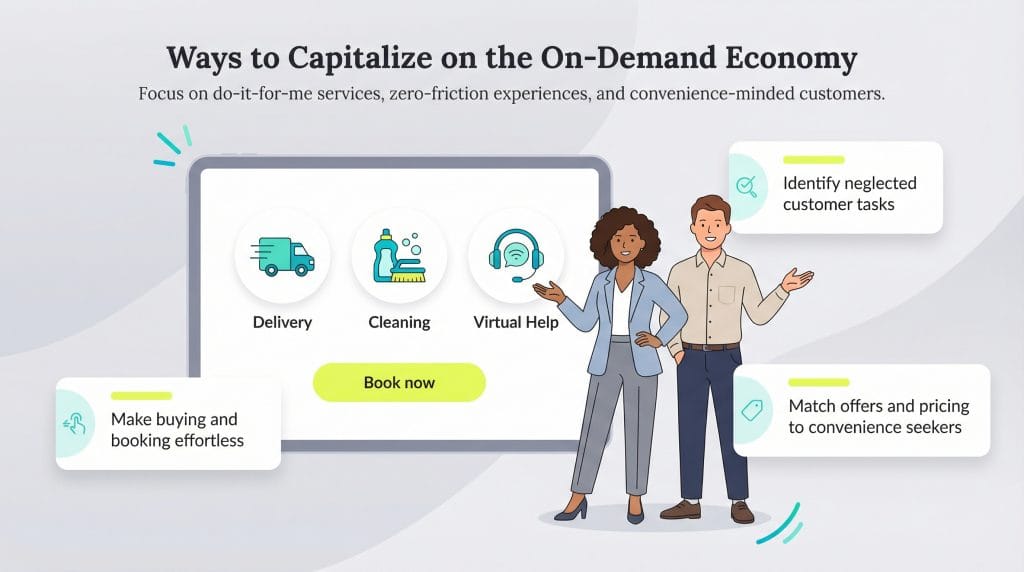
Entrepreneurs in almost every sector can tap into the DIFM trend. According to Business Research Insights, the global on-demand services market is projected to reach $320 billion by 2033 (up from about $210 billion in 2025), driven by growth in areas like trucking and delivery, food delivery, vacation rentals, beauty services, housekeeping and healthcare services.
As consumers look for faster, easier ways to get things done, businesses that offer “done-for-you” solutions have an opportunity to stand out and capture new demand.
“The most valuable innovations for business leaders and operators take big chunks of messy, complicated work off their plates, giving them leverage to focus on the highest impact work,” said Aaron Goldsmid, Head of Product at Deel.
With customer expectations rising and more industries shifting toward outsourced, on-demand services, here are some strategic ways to capitalize on this growing market.
When you’re starting a DIFM-focused business, your first step is to identify an underserved need. What’s a task people don’t want to handle themselves and would gladly pay someone else to do?
Once you have a few ideas, talk directly to the customers you hope to serve. What job are they trying to get off their plate? Why don’t they want to do it themselves? And most importantly, how much would they be willing to spend to have someone else handle it?
From there, study the companies already offering similar services. What do they do well? Where do they fall short? Understanding your rivals will help you pinpoint how your business can stand out from the competition. A clear point of differentiation gives you a stronger entry into the market and helps ensure your idea has room to grow.
Eliminating customer friction should be a high priority for any company, especially if your entire value proposition revolves around making life easier for your customers. The harder it is for someone to buy from you, the more likely they are to abandon the process altogether.
Friction can show up anywhere. Maybe a customer has to contact your business multiple times just to book an appointment, or your checkout process takes too long (80 percent of customers won’t wait any longer than 15 minutes), or your site is difficult to navigate on a phone. These small hurdles add up, and customers will quickly move on to competitors who offer a smoother experience.
Here are a couple of examples of reducing friction:
When customers encounter fewer barriers, they’re more likely to complete a purchase, return in the future and recommend your business to others, all of which drive growth in a DIFM-focused market.
In general, there are two types of customers: value-oriented and convenience-oriented. Value-oriented customers are willing to spend time to save money, while convenience-oriented customers are willing to spend money to save time.
Convenience-oriented customers are far more likely to hire a housekeeper, pay for lawn care or outsource other household or business tasks — all classic examples of do-it-for-me services. Research from Harvard Business School has also found that people who “buy back” their time report higher life-satisfaction scores than those who spend the same amount on material goods. This is a helpful reminder that convenience-oriented customers aren’t just paying for a service; they’re paying for more time and less stress.
Knowing which type of customer you’re working with helps you tailor your messaging and highlight the benefits convenience-oriented buyers care about most.
It’s easy to assume that convenience-oriented customers all have high disposable incomes, but that isn’t necessarily the case. According to the 2025 PYMNTS Paycheck-to-Paycheck report, “The Price of Time,” 67 percent of consumers across all income levels say they pay for services that save them time, such as grocery or restaurant delivery. That number climbs above 75 percent for households earning over $100,000. It’s clear that the appetite for convenience stretches across income brackets.
This has two implications. First, be thoughtful about how you price your services. Convenience buyers aren’t a single demographic, so offering only premium pricing may shut out a large segment of interested customers.
Second, create service options that fit different needs and budgets. Using the housekeeping example, a cleaning business might design packages for elderly homeowners, new homebuyers or families renting out their spaces. All of these customers want help with the same task, but the level of service and what they’re willing to pay can vary widely.
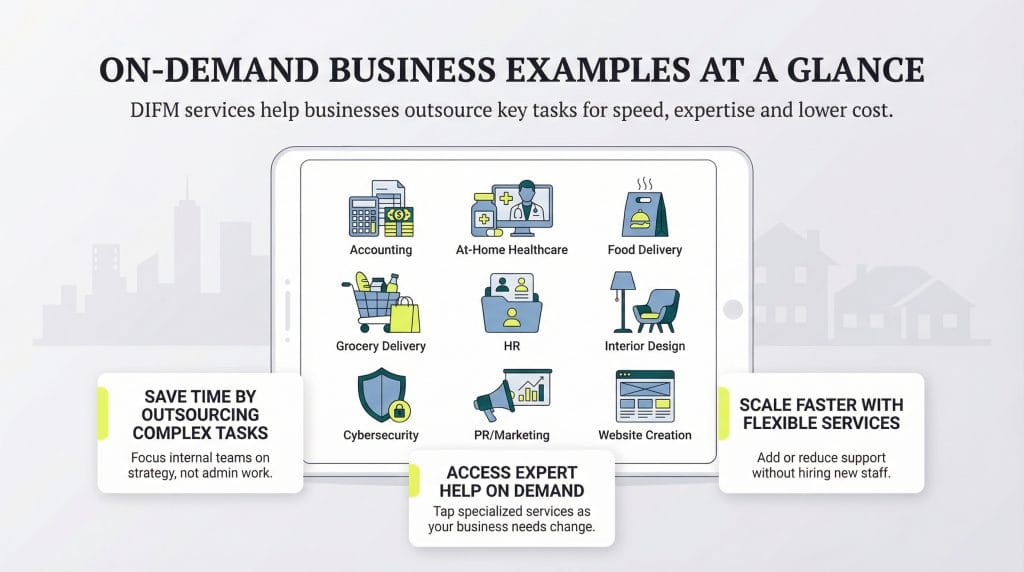
In case you’re looking for some inspiration, here are popular do-it-for-me services that have taken off in recent years:
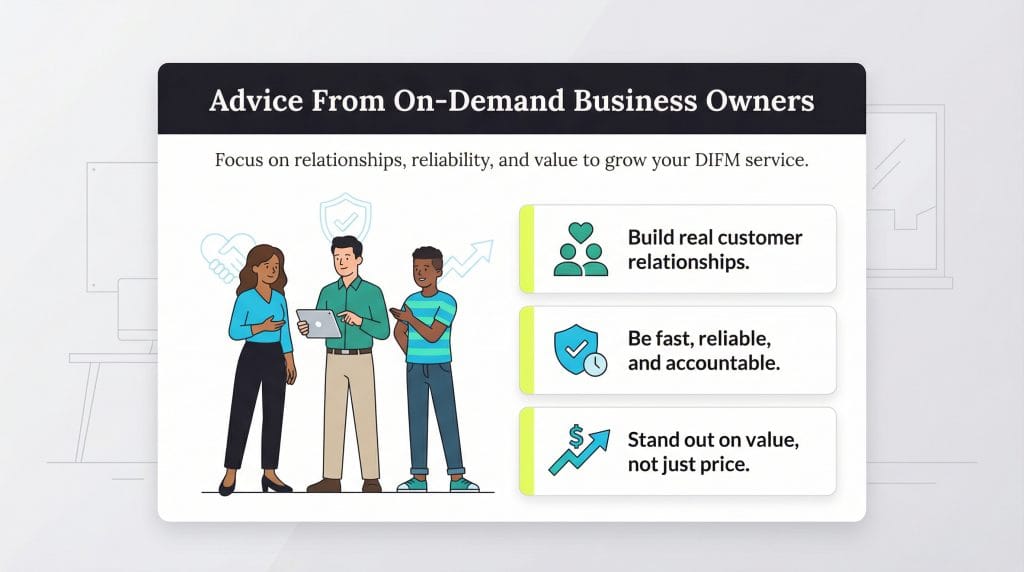
As the on-demand market continues to grow, here are a few expert suggestions to help you find success with your DIFM venture.
Loyal customers grow from strong relationships. Goldsmid said Deel has built true partnerships by listening closely and responding to customer problems as if they were its own.
“We’ve learned that the best [done-for-you] solutions are fast, highly accountable and versatile,” Goldsmid said, “[and] that an exceptional service requires doing the hard things first.”
According to Goldsmid, the most important aspect of building a done-for-you service is making sure customers can count on you to be the expert and solve problems quickly.
“At Deel, we respond to that need by building solutions on our own tech infrastructure (as opposed to wrapping our UX [user experience] around another vendor’s tech),” Goldsmid said. “Because we own the tech and compliance expertise in-house, we can identify and address sensitive problems quickly, answer urgent questions in hours instead of days or weeks and build new solutions faster than anyone else.”
Every business has competition, but standing out in a crowded on-demand market starts with knowing what makes your business different. Moorhead recommends bringing that uniqueness into your offers, your messaging and every interaction you have with potential clients.
“This distinctiveness helps attract the clients who are looking for exactly what you provide,” Moorhead said.
There will always be customers who are willing to pay more for high-quality, hassle-free services, especially in the DIFM space, where convenience and expertise carry real value. If your work consistently delivers strong results, you don’t have to compete on price alone.
When demand for your services grows, you consistently book out, or your offerings begin solving bigger or more complex problems, that’s often a sign that your rates may no longer reflect the value you provide.
“Build strong relationships, demonstrate your value and don’t be afraid to set higher rates,” Moorhead explained. “If you engage in meaningful conversations with potential clients and showcase your unique value, you’ll find that many are ready and willing to invest in what you offer.”
Scot Wingo contributed to this article. Source interviews were conducted for a previous version of this article.