Business.com aims to help business owners make informed decisions to support and grow their companies. We research and recommend products and services suitable for various business types, investing thousands of hours each year in this process.
As a business, we need to generate revenue to sustain our content. We have financial relationships with some companies we cover, earning commissions when readers purchase from our partners or share information about their needs. These relationships do not dictate our advice and recommendations. Our editorial team independently evaluates and recommends products and services based on their research and expertise. Learn more about our process and partners here.
Money-back guarantees come with pros and cons, so it's important to evaluate both sides before implementing such a policy.


While businesses are always on the lookout for ways to increase lead conversions and drive sales, there’s one strategy many companies are afraid to try: a money-back guarantee.
It may sound risky and complex, yet numerous businesses successfully implement money-back guarantees with measurable benefits. These policies can create value for both customers and companies when executed thoughtfully. By understanding how a money-back guarantee works, along with the pros and cons, you can determine if your business will benefit from implementing this policy as well.
There’s no simple answer here. A money-back guarantee can be a useful tool for some businesses and a poor fit for others. The right approach depends on your margins, your customers and how confident you are in what you’re offering.
The money-back guarantee isn’t a new or progressive idea. Josiah Wedgwood, an 18th-century entrepreneur, is credited with developing the strategy, but he certainly wasn’t the last to use it. Companies across all industries continue to leverage these policies, from startups to Fortune 500 corporations.
The decision to offer a money-back guarantee requires careful analysis of your business model, customer base and financial capacity. Does the risk of giving customers the option to walk away from a purchase outweigh the marketing benefits, or is it the other way around?
Plenty of companies have made this strategy work, but it isn’t something to implement lightly. Take time to consider both the benefits and the challenges so you can decide whether it’s the right fit for your business.
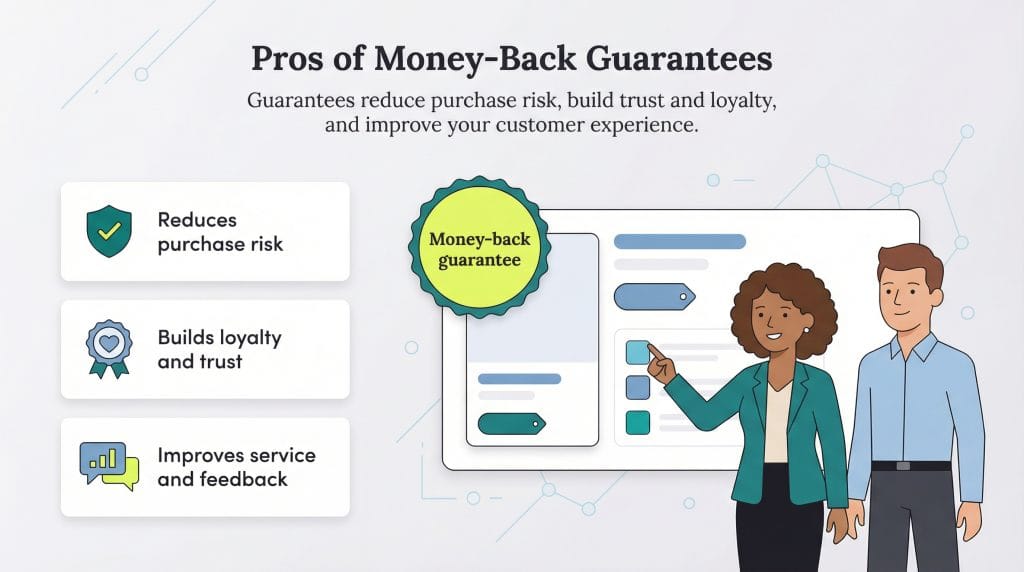
A money-back guarantee often shows customers that a business stands behind its quality and is serious about earning their trust and loyalty.
Brandon Frazier, CEO of Mobile Clear Shield, takes the strategy a step further and offers a lifetime guarantee on his business’s vehicle paint protection films. “It sets us apart from our competitors and helps us build a strong, loyal customer base,” Frazier explained.
Here are some of the top advantages of offering a money-back guarantee.
Perhaps the biggest advantage of offering a money-back guarantee is that it reduces perceived risk and makes it easier for customers to move forward with a purchase. Recent research shows just how much consumers value assurance: In the National Retail Federation’s 2025 Retail Returns Landscape report, 82 percent of shoppers said free or easy returns are a major factor in their buying decisions, and 76 percent prefer return options that provide an instant refund or exchange. While these findings refer to return policies broadly, they highlight a clear trend: Customers are more willing to buy when they know they won’t be stuck with a product that doesn’t work out.
A guarantee “instills confidence in our customers that we stand behind the quality and durability of our product,” said Frazier. “It shows that we are committed to providing a high-quality product that will last for a lifetime.”
With that trust established, customers become loyal to your brand and are more likely to choose your product over others, knowing you offer that level of assurance, according to Frazier. Costco, for example, is one company that has a transparent and successful money-back guarantee policy. The business promises a full refund on its products if customers are not satisfied. Despite this generous policy, Costco maintains industry-leading membership renewal rates of approximately 90 percent globally — demonstrating how guarantees can build customer loyalty rather than encourage abuse.
A money-back guarantee can also help your business stand out. Frazier noted that offering a guarantee “shows that we are confident in the longevity and performance of our product compared to others on the market,” which sends a strong signal to customers evaluating similar options.
Guarantees can be especially powerful in competitive categories. For example, imagine comparing two software platforms:
Even when the products are similar, the added reassurance can make the higher-priced option feel like the safer choice. Landmark research on money-back guarantees found that these policies reduce perceived risk and increase purchase intention by creating a more positive emotional response to the brand.
Money-back guarantees can also strengthen customer service and elevate your brand reputation. They create an environment where everyone on your team must stay focused on delivering consistent quality. That level of accountability contributes to a culture of excellence, which benefits customers at every touchpoint.
A guarantee “enhances our brand reputation and credibility,” Frazier said. “It shows that we are a reputable company that values customer satisfaction and is willing to go above and beyond to ensure their happiness.”
Southwest Airlines exemplifies this mindset with its flexible cancellation policy, which allows customers to cancel flights up to 10 minutes before departure and, for many fare types, receive a full refund or travel credit. This customer-friendly approach is reflected in Southwest’s strong performance in J.D. Power’s economy-class customer satisfaction studies.
Money-back guarantees can also be a valuable source of customer feedback. When customers return a product or express dissatisfaction with a service, it gives your business an opportunity to understand what went wrong and make meaningful improvements.
Modern tools make this even easier. Many companies use automated feedback prompts during the refund process to gather insights about product quality, pricing concerns or service gaps that might otherwise go unnoticed. Over time, this data can help refine your offerings and strengthen your customer experience.
“Your guarantee and/or refund policy [should] … support customer satisfaction and provide lessons learned to improve retention,” advised Teri Williams, president and chief operating officer of OneUnited Bank.
If money-back guarantees worked perfectly for every situation, every business would offer one. But like any strategy, they come with drawbacks. “Money-back guarantees can provide customers with a feeling of safety to try your products and services but are very difficult to execute,” Williams explained.
Here are a few potential challenges to keep in mind.
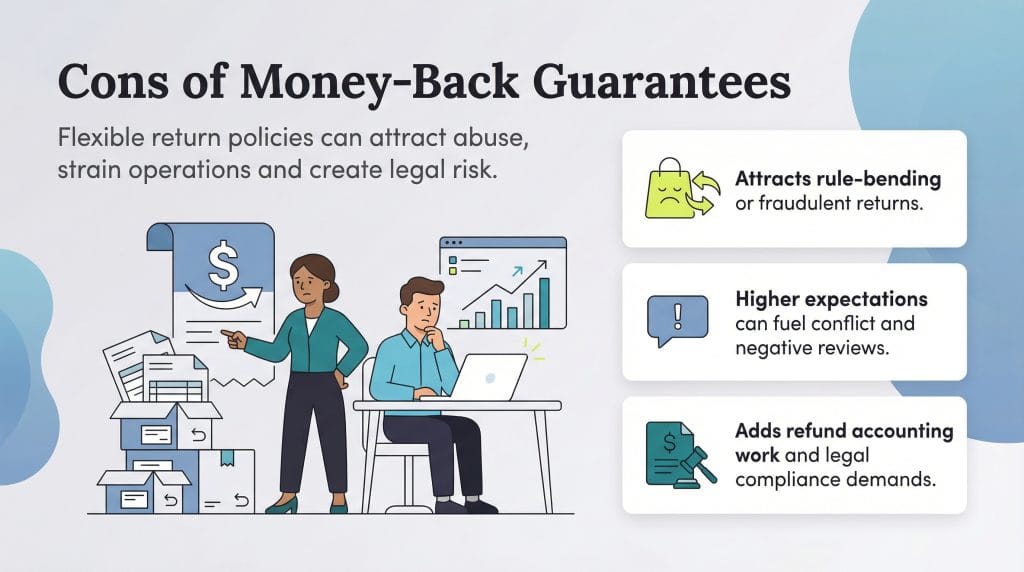
One concern among business owners is that money-back guarantees can attract the wrong type of customer — people who take advantage of flexible policies or request refunds for reasons unrelated to product quality. “Using a guarantee to attract new customers who are ultimately not happy and require a refund is not [always] a good formula,” Williams cautioned.
The broader retail landscape reflects this risk. According to the National Retail Federation’s 2025 Retail Returns Landscape report, 9 percent of all returns are fraudulent, and almost two-thirds of shoppers (62 percent) admit to engaging in at least one behavior that is costly to retailers, such as wardrobing, bracketing or overstating return quantities. Nearly half of consumers (45 percent) even say it’s acceptable to “bend the rules” when making a return — a mindset that can create challenges for businesses offering generous guarantees.
While these numbers reflect retail returns more broadly rather than money-back guarantees specifically, they illustrate a real risk: A small but meaningful percentage of customers may misuse flexible policies. Businesses should weigh that possibility when deciding how broad or generous their own guarantee should be.
Even the most reliable product can’t meet every customer’s expectations. Sometimes people misinterpret the results, expect outcomes a product isn’t designed to deliver or simply don’t feel they received the value they hoped for. According to Williams, a money-back guarantee can unintentionally heighten those expectations and lead to more negative reviews when customers don’t get the results they imagined. That dissatisfaction can create friction between your business and your customers and, over time, damage your brand.
A better long-term approach is to respond to all customer reviews — positive or negative — and use the feedback to improve your products and services. Consistent engagement shows customers you’re listening and helps resolve issues before they grow. And when customers are genuinely happy, word-of-mouth referrals from friends and family often carry far more weight than any guarantee you can offer.
A money-back guarantee can also add complexity to your finances and accounting processes. If customers take advantage of the offer, your team must be prepared to handle refunds properly, especially when it comes to revenue recognition. Under current GAAP standards, businesses are required to estimate expected returns and account for them at the point of sale, which can add another layer of work for small teams or growing companies.
In the United States, there’s no federal requirement for businesses to offer a money-back guarantee, but the Federal Trade Commission (FTC) does enforce strict rules for any guarantee that’s advertised. Under the Mail, Internet, or Telephone Order Merchandise Rule, companies must honor their guarantees exactly as promised and make all terms, conditions and limitations clear to consumers before purchase. Failing to do so can lead to enforcement actions and significant legal exposure.
Other regions have more defined consumer protections. In the United Kingdom, the Consumer Rights Act 2015 gives customers a 30-day right to reject faulty goods for a full refund. For online purchases, the Consumer Contracts Regulations allow buyers 14 days to cancel and return items for any reason, followed by another 14-day window for the seller to issue the refund. The European Union’s Consumer Rights Directive provides similar protections, with specific exemptions for personalized items, perishables and digital goods once they’ve been downloaded or accessed.
“Businesses need to ensure that the terms and conditions of the lifetime guarantee comply with consumer protection laws and regulations,” said Frazier. “They need to clearly outline the coverage, limitations and exclusions of the guarantee to avoid any legal issues or liabilities.”
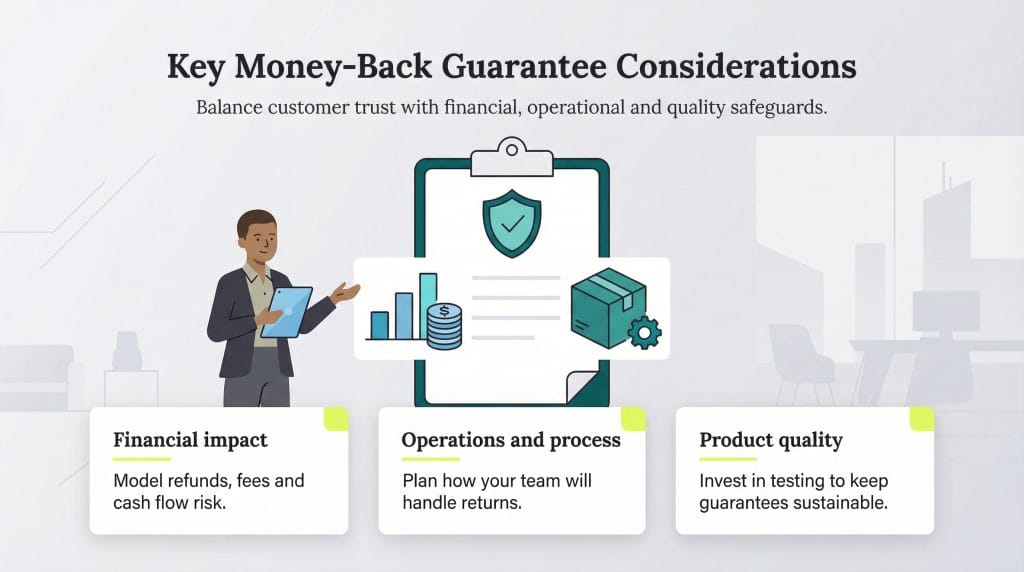
Before offering a money-back guarantee, businesses must evaluate the financial, operational and legal implications of the policy. Frazier emphasized that understanding these factors upfront can help prevent unexpected challenges later.
Consider how each of the following areas may affect your business before finalizing a guarantee.
A money-back guarantee can help build trust, but it may also strain your finances if many customers request refunds. Frazier advised considering the full cost of honoring the guarantee, including replacements, repairs, shipping and refunds.
Financial modeling should also account for indirect costs, such as processing fees, restocking expenses and potential impacts on cash flow, especially for businesses with seasonal demand or limited working capital.
A guarantee requires confidence in what you sell. If your product or service isn’t consistently reliable, the cost of honoring refunds can escalate quickly.
“Businesses need to invest in product testing and quality control measures to ensure that the product will last,” Frazier explained. “If the product is prone to defects or malfunctions, honoring the guarantee could become costly and unsustainable.”
Refunds are a helpful option because not every customer will be satisfied with the products or services you provide. Williams noted that refund requests should be treated as opportunities to understand what didn’t meet expectations, or, in some cases, signs that the sale may not have been the right fit in the first place.
“The goal of business should not just be to sell,” Williams said, “but to build and retain customers over time.”
Successful guarantee programs depend on clear communication, streamlined processes and a willingness to make ongoing improvements based on customer feedback. When implemented strategically, money-back guarantees can strengthen trust, differentiate your brand and ultimately support sustainable and profitable business growth.