Business.com aims to help business owners make informed decisions to support and grow their companies. We research and recommend products and services suitable for various business types, investing thousands of hours each year in this process.
As a business, we need to generate revenue to sustain our content. We have financial relationships with some companies we cover, earning commissions when readers purchase from our partners or share information about their needs. These relationships do not dictate our advice and recommendations. Our editorial team independently evaluates and recommends products and services based on their research and expertise. Learn more about our process and partners here.
This four-step environmental scan can help CEOs gain a competitive edge and stay proactive about the future of their business.
Spotting the next big opportunity — or catching an industry trend before competitors do — can make or break a CEO’s legacy. The real regret? Missing that clear signal to make a change in the company just when the business needs to pivot. Smart leaders use “environmental scanning” to scan the horizon for competitor moves, customer shifts and game-changing innovations. The CEO who’s ready for tomorrow is the one preparing today.
Environmental scanning is the process by which business leaders monitor both internal and external environments to identify opportunities, threats and emerging trends. This involves observing competitors, customers, industry shifts and broader macroeconomic factors.
“It means looking at what’s happening in the world around you, like changes in the economy, what customers are interested in, or what competitors are doing,” said Ryan Perry, franchise broker and founder of Franchising Path. “This gives you a bigger picture of which … opportunities are growing, which ones might be risky and which ones actually match what you’re looking for.”
Effective environmental scanning lets CEOs step out of day-to-day operations to take a macro view, helping leaders anticipate change, identify risks and inform strategic planning. By regularly scanning their environments, executives and managers can spot early signs of shifts in customer behavior, advances in technology or external disruptions that may impact operations.
“The power of environmental scanning lies in how well you synthesize and act,” said Rita Thomas, founder and CEO of 110 North The Creative Agency. “A strong sense of brand identity gives you clarity in the noise and confidence to ignore what’s not a fit.”
Leaders who ignore environmental scanning risk missing opportunities for innovation. These missed opportunities and indecision can result in lower productivity, weaker outcomes or loss of market share. Over time, companies that fail to evolve with the market risk being outpaced and, ultimately, failing.
“The brands that stay relevant and grow over time are the ones that actively track shifts in culture, technology, economy and customer behavior, not reactively, but intentionally,” Thomas said.
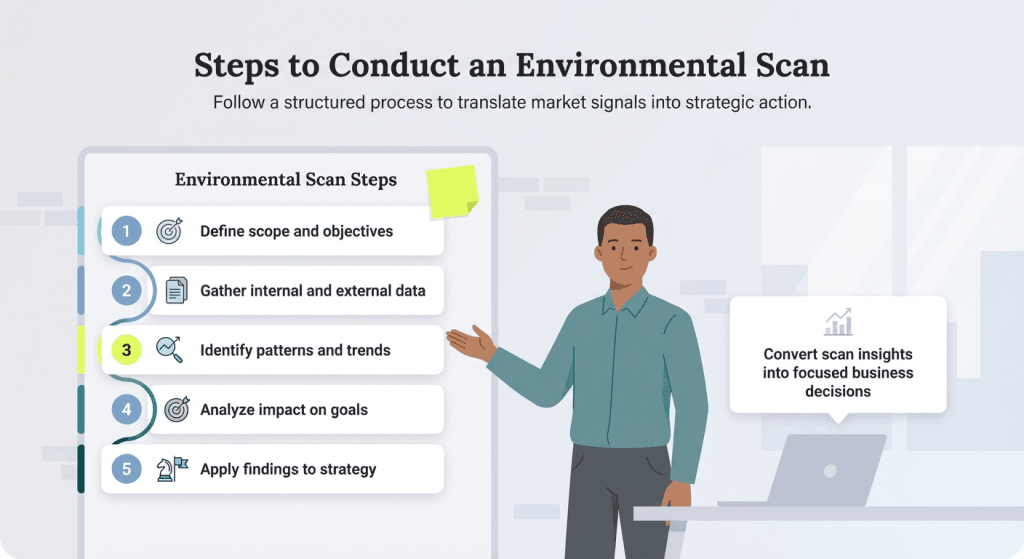
Leaders can perform a structured environmental scan by following these steps:
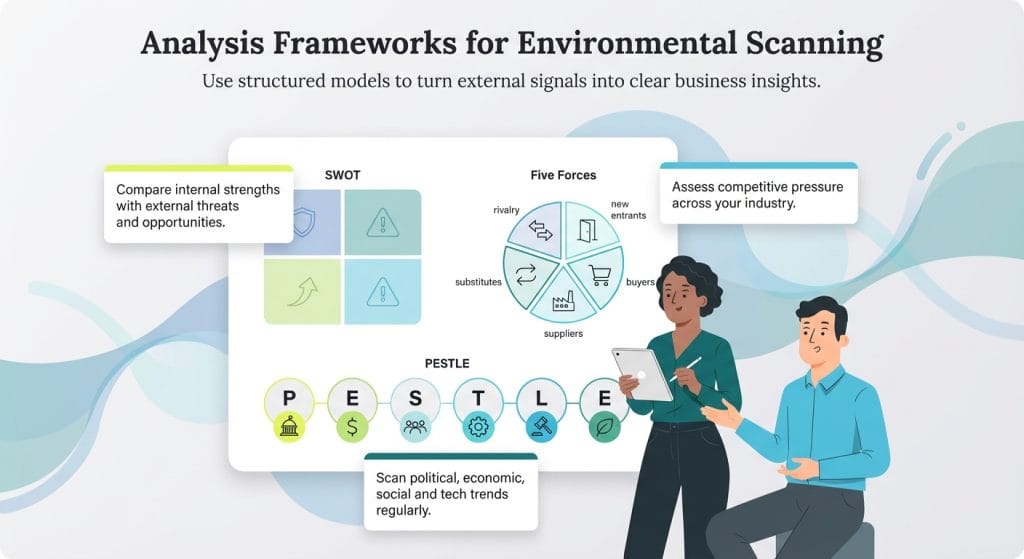
Analysis frameworks give structure to your environmental scan and help ensure nothing important gets overlooked. Once you’ve gathered your data, plugging it into one or more of these models can reveal how different forces interact and what they mean for your business.
Popular models include:
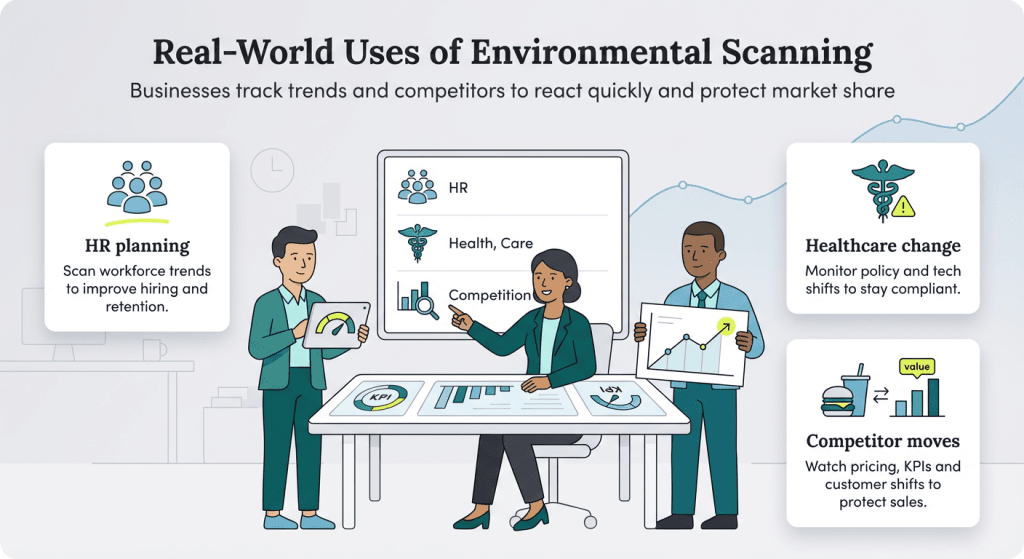
In human resource planning, organizations analyze workforce trends and generational expectations to shape effective recruitment and retention strategies. Healthcare organizations conduct scanning to prepare for shifts in government policy or emerging medical technologies. Competitive intelligence teams continuously monitor the landscape for product substitutes, new market entrants and evolving customer attitudes.
A real-world example: When fast-food chains began competing on value — from McDonald’s value meal promotions to Wendy’s discounted breakfast deals — competitors across the industry responded with their own limited-time offers and tiered pricing strategies. This illustrates the power of monitoring competitor moves and adapting quickly before customers defect.
While environmental scanning is powerful, leaders face several challenges:
Best practices include collecting both qualitative and quantitative insights, involving the whole team, building cultural intelligence and networking with industry experts through events, peer groups or advisory relationships.
“Some of the best trendspotting comes from unexpected places: a customer service call, a TikTok comment, a sales team anecdote,” Thomas said. “Encourage every corner of your team to bring cultural signals to the table. It creates a more agile and well-informed organization.”
Sammi Caramela and Jennifer Dublino contributed to the reporting and writing in this article. Source interviews were conducted for a previous version of this article.