Business.com aims to help business owners make informed decisions to support and grow their companies. We research and recommend products and services suitable for various business types, investing thousands of hours each year in this process.
As a business, we need to generate revenue to sustain our content. We have financial relationships with some companies we cover, earning commissions when readers purchase from our partners or share information about their needs. These relationships do not dictate our advice and recommendations. Our editorial team independently evaluates and recommends products and services based on their research and expertise. Learn more about our process and partners here.
Here’s why so many startups are heading to Texas.

They say everything is bigger in Texas. Well, the number of small businesses in the state is no exception. The question is: Why is the Lone Star State such a hotbed for small businesses? High-quality talent, financial benefits and tax breaks all factor in.
Here’s a closer look at the reasons entrepreneurs are heading to Texas to launch their small businesses.
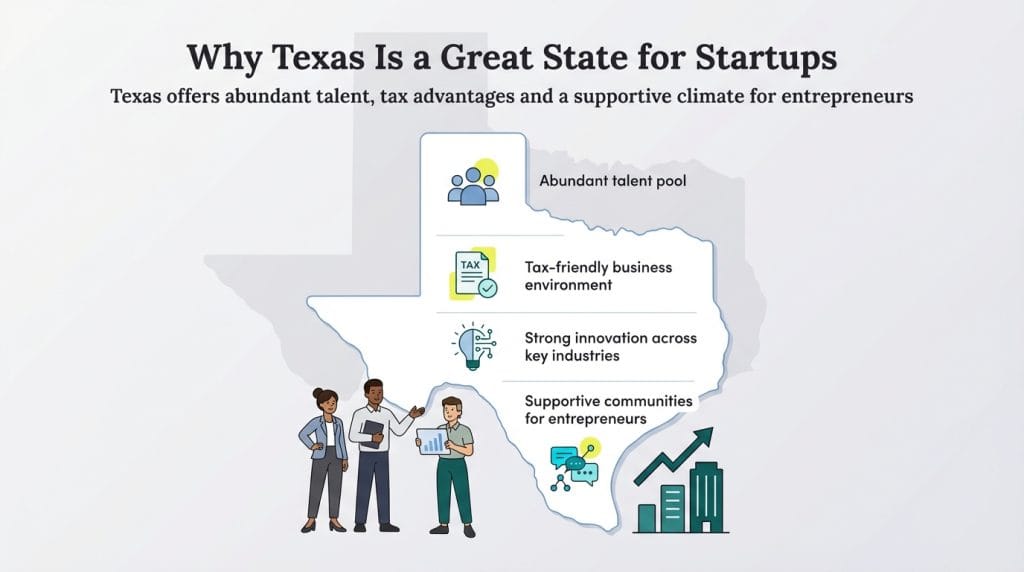
Texas is home to 3.2 million small businesses, making up over 99 percent of all businesses statewide, according to the U.S. Small Business Administration. Here are four reasons why the Lone Star State is so popular for new businesses.
One of the keys to a successful startup is the company’s team. It takes a village of talented individuals to overcome the challenges of starting a business, including HR, engineers and more.
However, some startups make the mistake of hiring too quickly. Maybe the candidate isn’t exactly the right fit or lacks key skills necessary for the role. An emerging small business may decide to hire and onboard them anyway. After all, filling the position is a priority — and the business might have struggled to find interested, available candidates.
Texas consistently attracts a robust workforce due to its strong economy and population growth. According to U.S. Census Bureau data, Texas residents increased 1.2 percent in 2025, bringing the state population to 31.7 million. The state also boasts a civilian labor force exceeding 15.9 million people, reported the Texas Workforce Commission, providing a massive recruitment pool for business owners.
Not too long ago, there was a time when many entrepreneurs flocked primarily to Delaware and Nevada to do business. Delaware has a reputation for being the incorporation capital of the world because of its business-friendly corporate tax laws. These laws have allowed the state to become the legal home to more than one million business entities. Nevada also has a reputation as a tax haven, since the state does not collect corporate or personal income tax.
But beyond Delaware and Nevada, more states have passed tax laws that benefit small businesses — including Texas. A lack of income tax, along with a thriving economy, continues to make Texas an attractive location for a startup.
Alysha Light, founder of Flight PR, experienced this benefit firsthand when she moved from California to Texas in 2017. “This is a huge financial benefit that is likely one of the primary draws for many companies,” said Light. “As a small business owner, Texas’ tax-friendly environment helps businesses reinvest more of their profits into growth and development.”
When many people think of innovation hotbeds, they might think of the East and West Coasts — specifically Silicon Valley in California and Manhattan (or Brooklyn) in New York.
But consider events like South by Southwest (SXSW), held in Austin every year, that celebrate the changing landscape of tech and media.
Texas features a robust transportation infrastructure, including more than 380 airports, which facilitates commerce and tourism. You might be surprised at some of the industries thriving in Texas:
Innovation is taking place throughout Texas right now. Thanks to a large population — and one that works hard to serve minority entrepreneurs — Texas is able to put itself on the map with its diversified economy. Texas now leads the nation in job creation as the Office of the Texas Governor pointed out; it plans to continue the trend throughout the next decade and beyond.
In addition to having overall business-friendly policies, the Lone Star State has a reputation for welcoming and supporting small business owners. Texas has plenty of communities and resources for current and aspiring entrepreneurs, including Capital Factory in Austin.
“As the ‘center of gravity’ for startups in the area, Capital Factory offers invaluable networking opportunities, resources and support,” Light told business.com. “I’ve found it an excellent platform for collaboration and innovation, and it’s been instrumental in connecting me with potential clients.”
There isn’t a guarantee of success for anyone who starts a business — in Texas or elsewhere. The best way to succeed is to plan and prepare; that’s true for any business that wishes to get off the ground. [Read more about starting a business from home.]
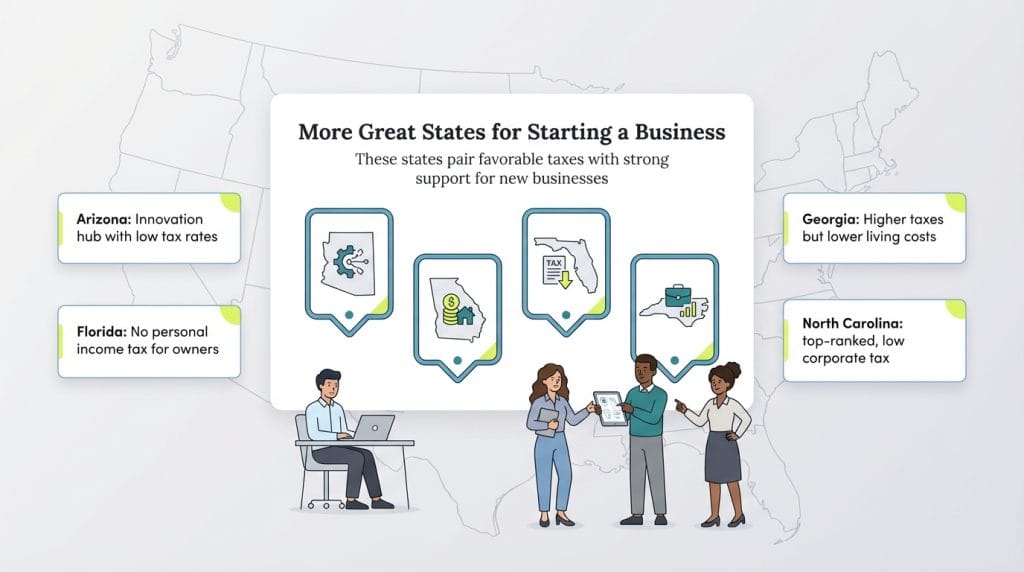
Here are a few competitive states that mirror Texas’s way of encouraging the survival of small businesses.
Arizona landed at No. 4 on WalletHub’s Best & Worst States to Start a Business study. The Grand Canyon State is known for its strong infrastructure, low tax rates and business-friendly policies.
It’s also gained a reputation as an innovation hub, per the Arizona Commerce Authority, with industry giants like Amazon, IBM and Zillow operating in-state.
Florida is a leading state when it comes to individual income tax, with no personal income tax assessed and a corporate tax no higher than about 5.5 percent. Keep in mind that natural disasters, specifically hurricanes, are one of the biggest downsides of companies moving to Florida.
The Peach State ranked fifth in WalletHub’s study. Although it has a high tax rate, the state makes up for it with a low cost of living — making Georgia one of the top affordable states with helpful startup incentives.
According to the Georgia Department of Economic Development, expansion and new businesses in Georgia accounted for more than $26.3 billion in investments. In addition, they created nearly 23,200 private sector jobs in the last fiscal year.
North Carolina ranked number one in CNBC’s America’s Top States for Business. It boasts impressively low corporate and individual tax rates, topping at 2.25 percent and 4.25 percent, respectively, along with business-friendly laws and regulations. The state also features a skilled and diverse workforce, top research universities and an impressive infrastructure.
Danielle Fallon-O’Leary and Deborah Sweeney contributed to the reporting and writing in this article. Source interviews were conducted for a previous version of this article.