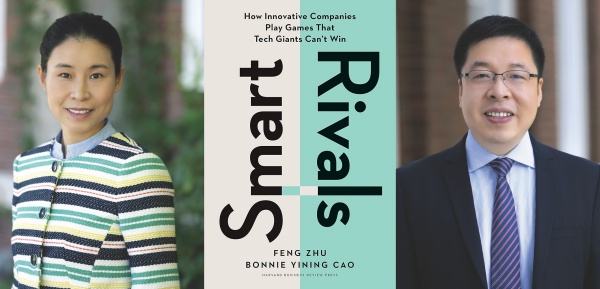
It may feel like the digital age has already been won, but small-business Davids can still triumph over Silicon Valley’s Goliaths, according to Harvard Business School’s Feng Zhu and Bonnie Cao. In their new book, Smart Rivals: How Innovative Companies Play Games That Tech Giants Can’t Win, Zhu and Cao detail how startups can work harder and smarter to stand out.
The duo spoke with b. about what it takes to surge forward by tapping into your distinctive strengths.
b.: Why, according to your research, is emulating big tech companies usually ineffective?
Cao: Many companies are attracted to the remarkable success and market dominance of big tech companies. They want … recipes or formulas to copy and apply in their own businesses, hoping for similar returns.
Zhu: Traditional businesses often lack the capabilities, such as advanced technical expertise and infrastructure, that tech giants have developed over many years. Attempting to develop such capabilities to the same level as tech giants is unrealistic for most traditional businesses.
[They] may fall into the trap of just copying the strategies of tech giants. This approach often leads traditional businesses into head-on battles with tech giants that are hard to win. Smart rivals need to continually challenge their conventional thinking, pushing themselves to become innovative leaders instead of merely following in the footsteps of tech giants.
b.: What advantages do traditional companies have?
Zhu: For instance, Domino’s has developed superior capabilities in pizza order fulfillment, and Sephora is well known for its personalization. As we detail in the book, both companies have leveraged technologies to amplify their strengths to a level that tech giants find difficult to match.
Cao: Becoming a smart rival requires … insights not readily available from data analytics or by observing tech giants.
b.: You highlight several companies that are standing out and outsmarting the tech giants. Each example is unique, but what are some common strategies?
Zhu: They have all created their own path to success instead of playing the catch-up game with tech giants. … Take Powell’s Books, a bookstore founded in 1971 in Portland. In response to the rise of Amazon, Powell’s focused on connecting readers and building a community. They host over 500 author events each year, bringing readers together to meet and learn from their favorite authors in person, allowing them to connect over shared interests in the author or genre and allowing Powell’s to survive and thrive.
b.: Is there any merit to trying to emulate some of the strategies tech companies use?
Zhu: Digital transformation is crucial for every business today. Learning from the success of tech giants can be incredibly valuable for business leaders, helping them recognize the power of digital technologies and understand how to become more customer-centric while building platforms and ecosystems. … However, it’s essential for business leaders to view digital transformation as a toolkit, not the ultimate goal.
Smart Rivals is now available.
This interview has been edited for length. Read our full Q&A at business.com.