
Business.com aims to help business owners make informed decisions to support and grow their companies. We research and recommend products and services suitable for various business types, investing thousands of hours each year in this process.
As a business, we need to generate revenue to sustain our content. We have financial relationships with some companies we cover, earning commissions when readers purchase from our partners or share information about their needs. These relationships do not dictate our advice and recommendations. Our editorial team independently evaluates and recommends products and services based on their research and expertise. Learn more about our process and partners here.


Teramind is the best employee monitoring software for security threat protection because of its ever-expanding roster of tools for proactively preventing data loss. You can also use this cloud-based or on-premises employee monitoring software to track employee behavior.
Teramind is a comprehensive employee monitoring platform that helps businesses keep tabs on employee activity, productivity and potential security risks. Along with traditional monitoring tools like screen recording and keystroke logging, the software offers advanced features for detecting suspicious behavior and protecting sensitive company data. Teramind is pricier than many competing solutions, but its extensive capabilities and flexible deployment options make it worth considering for businesses with more complex monitoring needs.
Teramind stands out from other employee monitoring solutions for its extensive security capabilities. Along with standard features like website and application monitoring, website blocking and user activity tracking, it can monitor printing, clipboard activity, social media, instant messages and online meetings. We especially like its advanced data loss prevention (DLP) tools, available on higher-tier plans, which can help businesses protect sensitive information and intellectual property. For example, you can set rules to detect suspicious file activity, block unauthorized data transfers and identify documents containing confidential information. Teramind also supports document tagging and fingerprinting to help businesses protect sensitive data.
Another strength is Teramind’s ability to identify potential insider threats through behavior analytics, anomaly detection and dynamic risk scoring. Instead of relying solely on screenshots, administrators can review video recordings of employee activity and use keystroke logging to investigate suspicious behavior. The company has also introduced a conversational AI copilot, rather improbably named Timmy, that answers questions about DLP and insider risks directly in Slack. This gives users a way to get quick, conversational insights without digging through static reports.
For all these reasons and more, Teramind is our pick for the best employee monitoring software for businesses that need help spotting security threats, investigating suspicious activity and preventing costly data breaches.
An employee monitoring system may alarm your staff, especially when it tracks things like keystrokes and screen activity. It’s a good idea to tell employees exactly what’s being monitored and what you’re doing with that information.
Teramind has an extensive feature set, but we found the software surprisingly easy to navigate. We liked the free online demo, which includes a guided tour that lets you explore the platform and see how its features work. Many of Teramind’s tools are customizable, so you can tailor the software to your company’s monitoring needs. You’ll need to spend some time getting everything set up, especially if you have complex security requirements, but the customization options are easy to work with. We also appreciated that Teramind offers installation assistance with its on-premises plans. Installing the monitoring agents on individual computers was straightforward during our testing, and the documentation was clear.
The dashboard has a clean layout, with a sidebar that makes it easy to move between employee monitoring, risk assessment, productivity tracking and other functions. We had little trouble finding what we needed. We particularly liked the visual rule editor, which lets you create policies without knowing how to code. There are also ready-made rule templates to help you get started. These touches make Teramind’s more advanced capabilities less intimidating, even if you’re new to employee monitoring software.
Teramind has all the features we look for in employee monitoring software, along with some impressive security tools. You can monitor employee activity in real time and review recorded data whenever you need it. We like that activity records are dated and timestamped, and you can search or filter them by employee or alert type. Teramind also regularly adds new features, including tools for monitoring AI use and detecting potential security risks.
Here’s a closer look at what Teramind can do.
Teramind offers an impressive selection of security tools, even with its entry-level plan. All plans include insider threat detection, malicious behavior detection and video recordings of employee activity. With the user activity monitoring (UAM) plan and above, you also get anomaly detection, dynamic risk scoring and the option to record employee activity only when a rule is violated. We like that you can create rules to flag suspicious behavior and take action when employees violate company policies. These tools can also help businesses meet security requirements under regulations such as the General Data Protection Regulation (GDPR) and the Payment Card Industry Data Security Standard (PCI DSS).
Businesses that handle particularly sensitive information should take a close look at Teramind’s DLP plan. It includes tools to identify confidential data, track how employees handle it and block unauthorized transfers. For example, you can create rules to prevent employees from sharing files containing customer information or copying sensitive documents to unauthorized locations. The DLP plan also includes predefined data classifications, document fingerprinting and tagging, and content-based rules. Teramind supports security information and event management (SIEM) integrations (on the UAM plan and above), allowing businesses to incorporate employee activity alerts into their existing security systems.
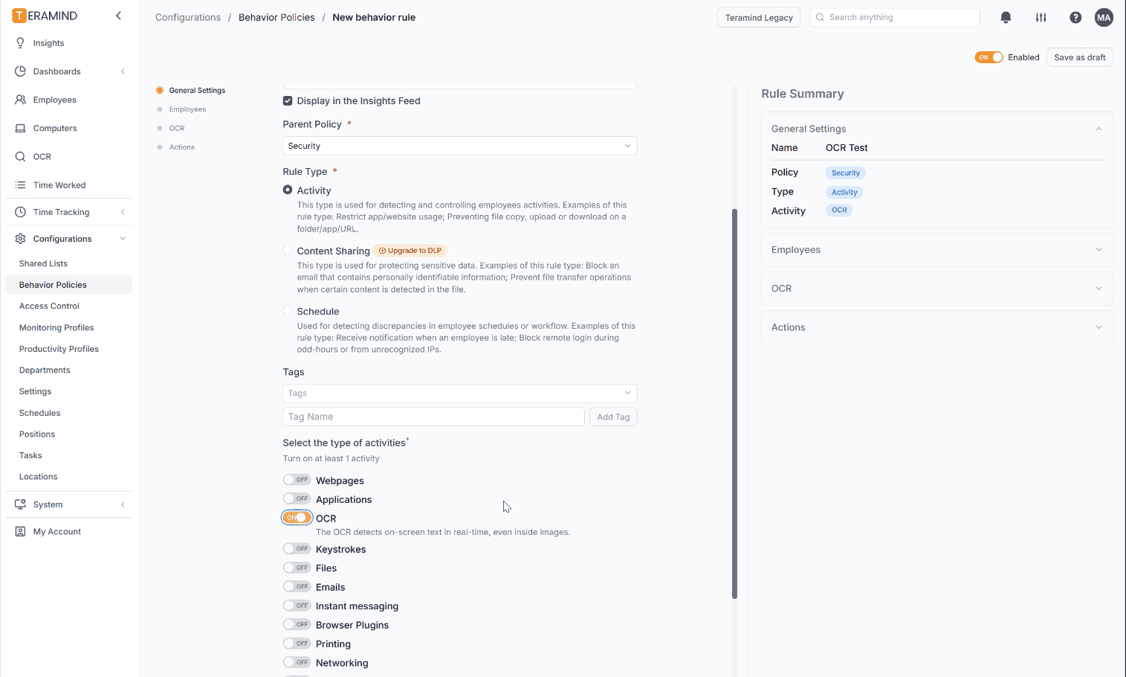
Looking for something specific in hours of employee screen recordings could be painfully slow. Teramind’s Enterprise plan includes optical character recognition (OCR), so you can search for words or phrases that appeared on an employee’s screen instead of going through the recordings yourself.
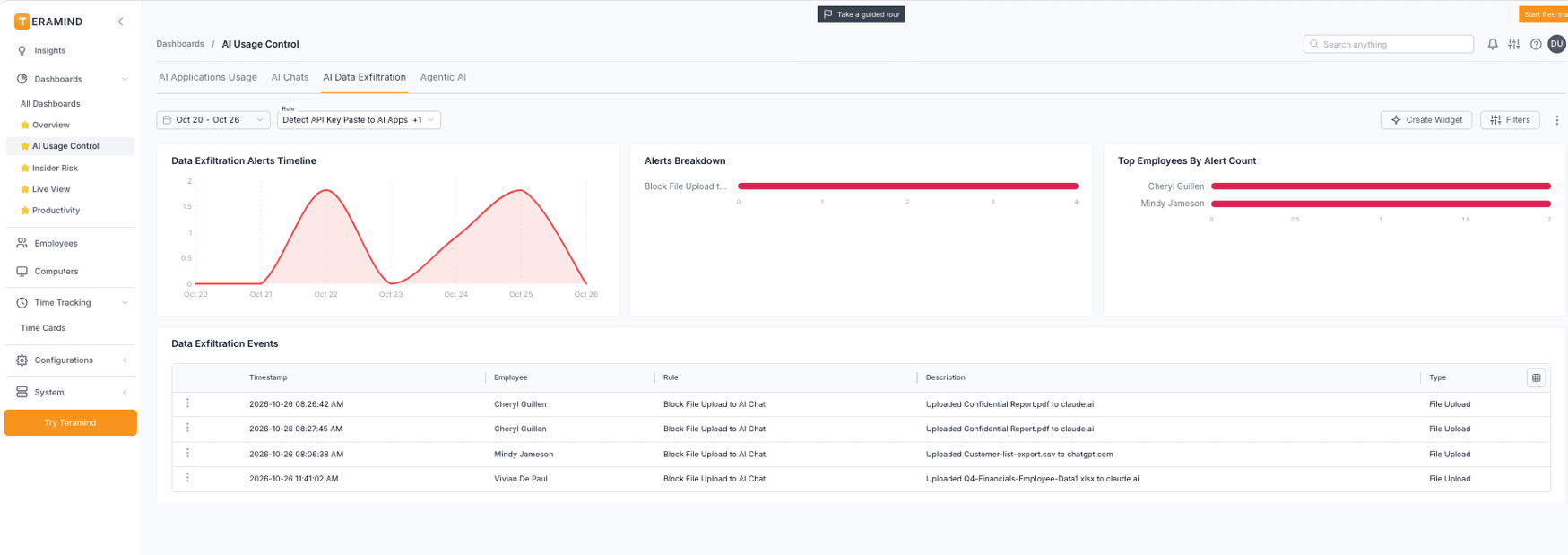
With more employees using AI tools at work, businesses have another potential source of data leaks to worry about. Starting with the UAM plan, Teramind’s AI Usage Control dashboard lets you see who’s using tools like ChatGPT, Claude and Gemini, including AI applications employees may be using without company approval. You can review supported AI conversations, see what files employees share and look for activity that could put sensitive information at risk.
We also like the AI Data Exfiltration dashboard, which shows when employees may be putting company information at risk. For example, you can see if someone uploads a confidential report to ChatGPT or Claude. Teramind lets you set rules to flag or block certain activities, and the DLP plan adds content-based rules to help catch sensitive information being shared. You can even monitor some autonomous AI agents, including the commands they run and the files they access or change.
Teramind also has an AI copilot named Timmy that works through Slack. Administrators can ask questions about employee activity, insider threats and data loss risks in plain English. We like the idea of getting answers to specific security questions without having to dig through multiple dashboards.

Teramind lets you watch employees’ computer screens in real time or review recordings of their activity later. You can move back and forth through an employee’s activity timeline to see what happened and when. This can be particularly helpful when you’re investigating suspicious behavior and need to see exactly what someone was doing on their computer.
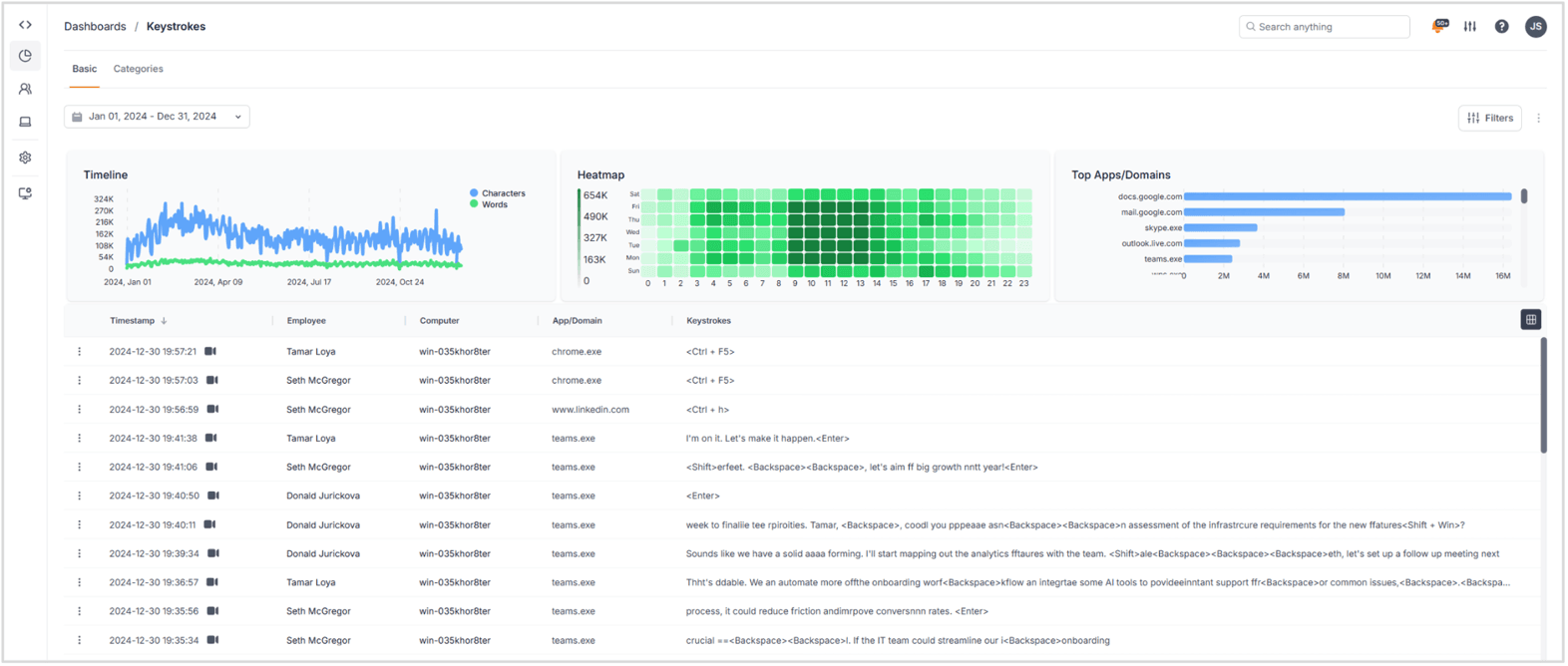
Starting with the UAM plan, Teramind can also capture what employees type, along with the application or website where they typed it. The software can record regular text and even hidden or invisible characters. You can also set rules to flag certain keystrokes, such as someone entering sensitive customer information on an unauthorized website. Although some employees may find keystroke logging invasive, it can be useful for businesses concerned about insider threats and data security. Not all the providers we researched offer this feature, which gives Teramind another advantage.
When testing Teramind, we noticed that you can set up behavioral rules to automatically flag or block prohibited websites, social media platforms and applications. You can also create rules to flag employees who log in outside their normal working hours. Depending on the rule, Teramind can warn employees, notify administrators or block the activity.
The higher-tier plans offer more ways to control how employees handle company information. The UAM plan adds file transfer monitoring, while the DLP plan lets you create rules based on file operations and content. For example, you could block an employee from transferring a document containing sensitive customer information to an unauthorized location.
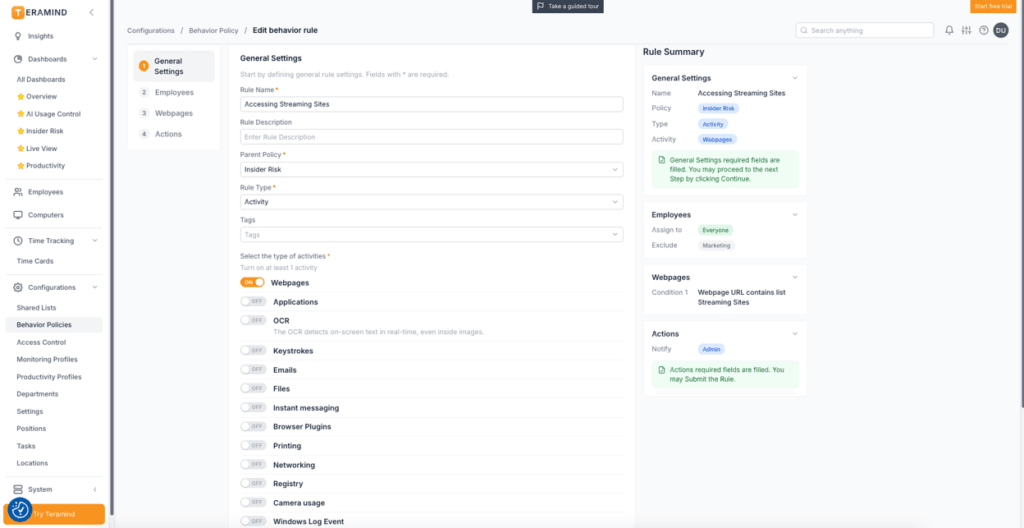
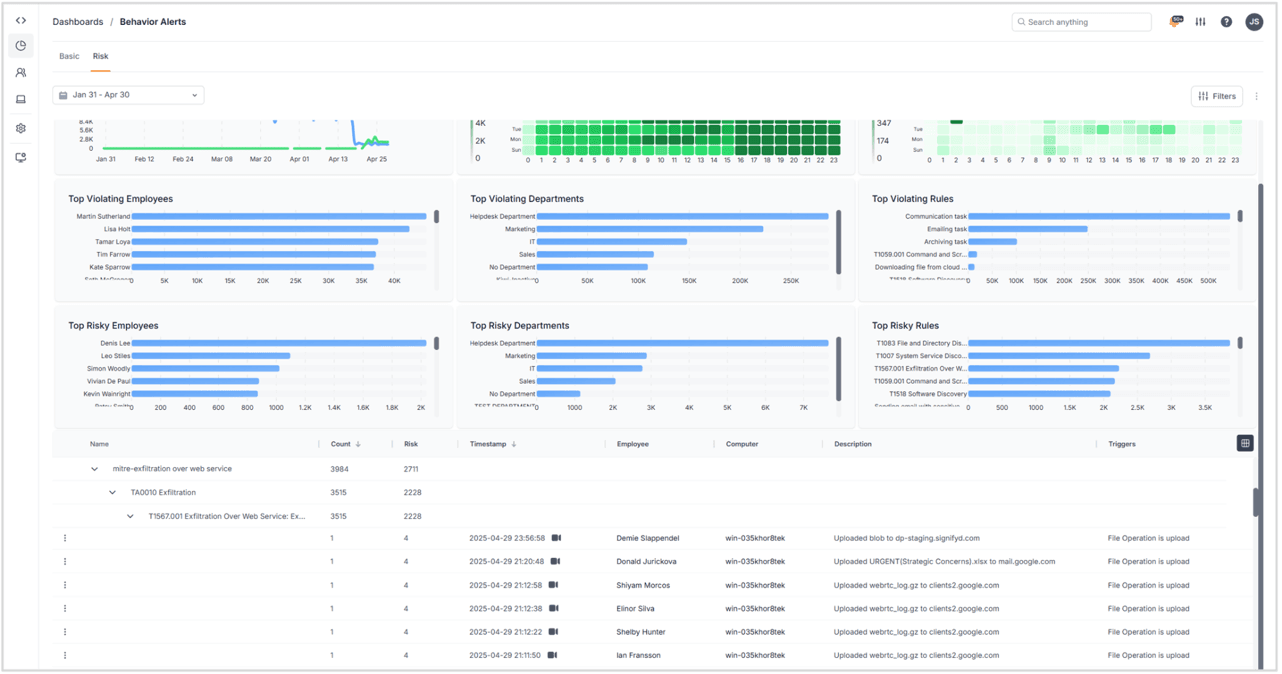
Teramind offers detailed reports that help you see how employees spend their time and where potential security risks are cropping up. You can review employee activity, track policy violations and see which users pose the greatest risk to your organization. We especially like the advanced filtering options, which let you narrow reports to specific employees, activities or time periods. Color-coded charts make it easier to spot patterns, including repeated violations of company rules.
You can also set up notifications when employees break certain rules, so you’ll know when something needs your attention. This may be especially valuable for businesses handling sensitive information, including employers subject to HIPAA privacy requirements. Teramind also tracks active and idle time, which can come in handy when you’re managing employees who work from home.
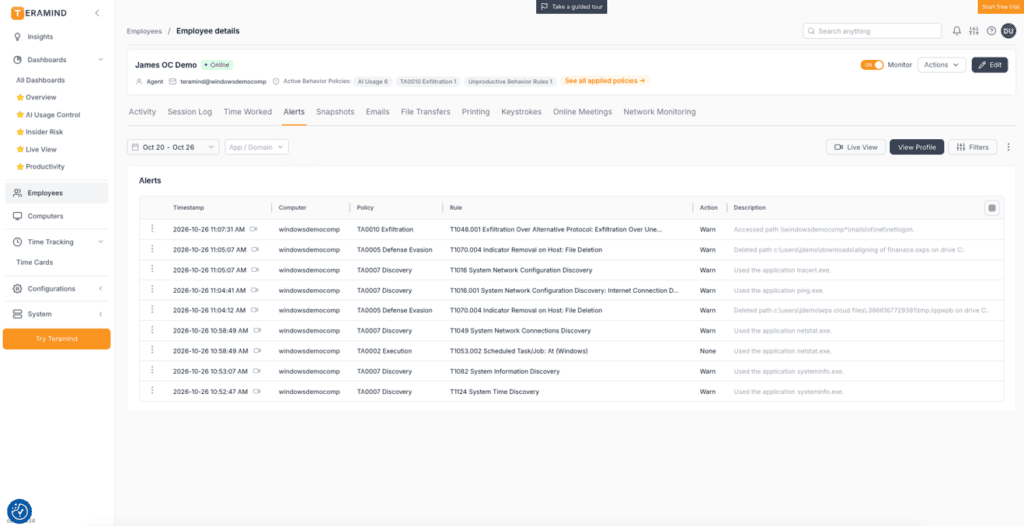
Teramind tracks the websites and applications employees use, including how much time they spend on each one. You can also watch their activity through live screen monitoring or review recorded sessions later. Teramind offers audio recording as well, which isn’t something every competitor provides.
The software can also monitor employee communications, including emails, social media activity, instant messages and online meetings. Supported platforms include Slack, Microsoft Teams, WhatsApp Web and Zoom, although monitoring capabilities vary by operating system. This gives businesses another way to spot suspicious activity or investigate potential security issues.
With the UAM plan and above, you get additional monitoring tools for things like file transfers, printing, camera usage and employee geolocation. For example, administrators can track print jobs and review copies of printed documents. They can also see when employees transfer files to removable devices, such as USB drives, or upload files to cloud storage services. The DLP plan adds clipboard monitoring, so you can track copying and pasting activity.
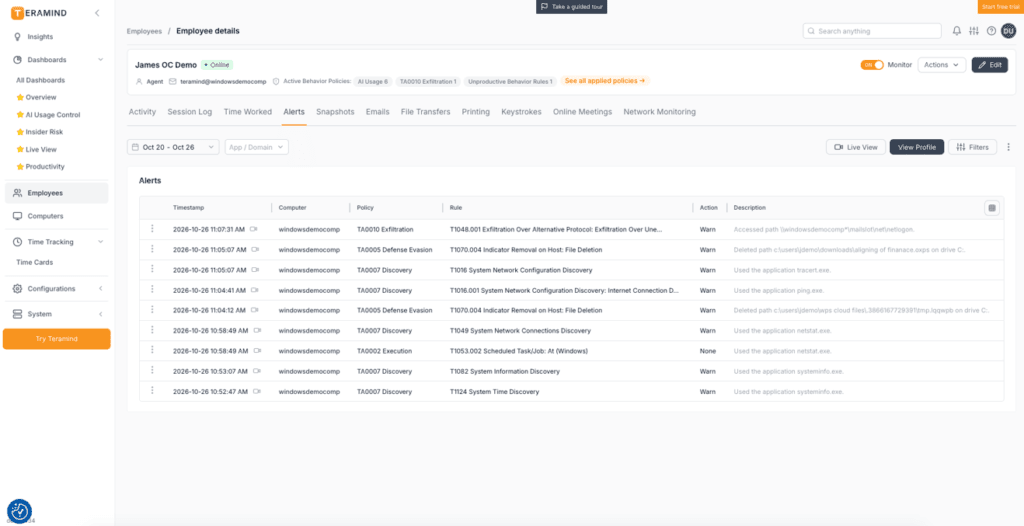
Teramind can also track employee attendance, breaks, sick time, late shifts, absences and time spent on projects. However, if tracking hours is your main concern, you may be better off considering one of the best time and attendance software platforms instead.
Teramind offers three standard employee monitoring plans, plus a customizable Enterprise and Government package. Note that all three standard plans require at least five seats, so you’ll pay for five employees even if you only need to monitor two or three. Teramind offers cloud-based, on-premises and private cloud deployment options. You can try the cloud version free for seven days without a credit card, while on-premises and private cloud deployments typically come with a 14-day evaluation period.
Here’s how the plans compare.
Plan | Pricing | Key Features |
|---|---|---|
Starter | $14 per seat per month (billed annually) $15 per seat per month (billed monthly) |
|
UAM | $28 per seat per month (billed annually) $30 per seat per month (billed monthly) | Everything in Starter, plus:
|
DLP | $32 per seat per month (billed annually) $35 per seat per month (billed monthly) | Everything in UAM, plus:
|
Enterprise and Government | Custom quote | Everything in DLP, plus:
|
For businesses primarily interested in employee productivity, Starter may be enough. However, we think UAM is worth the extra cost if you’re concerned about insider threats. Its risk scoring, anomaly detection and more extensive monitoring tools can help administrators spot suspicious activity. The DLP plan is the better fit if you need to prevent employees from sharing confidential information or moving sensitive files to unauthorized locations.
Keep in mind that OCR and custom website and application field capture are reserved for Enterprise and Government customers. If you need those capabilities, you’ll have to contact Teramind for a quote. Monthly subscriptions can be canceled at any time, but annual payments are nonrefundable.
Even Teramind’s Starter plan lets you set rules for employee behavior. These can help you enforce your company’s acceptable use policy, such as restricting access to websites employees shouldn’t visit during work hours.
You’ll need to install a Teramind agent on the computers you want to monitor, but you have some choices about how it works. For example, the Revealed Agent gives employees control over starting and stopping monitoring. The Standard Agent requires them to acknowledge that they’re being monitored during installation. Teramind also has a Stealth Agent that runs in the background without employees knowing it’s there, although you’ll have to go through a verification process with the company before you can use it.
Setup depends on how you deploy the software. Teramind says its cloud dashboard can be ready in 10 to 30 minutes, while an on-premises or private cloud setup may take about an hour. Installing agents on individual computers takes only a few minutes, although a companywide rollout will take longer. Businesses that want more hands-on help can opt for Teramind’s white-glove deployment and onboarding service, which typically takes one to four weeks.
Once the agents are installed, you can manage employee monitoring from a central dashboard. You can also create monitoring profiles for individual employees, computers or entire departments, choosing which activities to track and when monitoring should take place. Teramind also provides guided tours, webinars and detailed setup instructions. Its interactive demo is particularly helpful for exploring the software before putting it to work.
Teramind provides free technical support around the clock, so you can reach out for help with installation problems, monitoring settings or other issues at any time. You can contact the support team through live chat or email, and cloud customers can also submit tickets directly through the software. Businesses on the Enterprise plan or using on-premises or private cloud deployments can receive additional support through a service-level agreement (SLA), which sets out the company’s commitments for responding to and resolving technical issues.
If you prefer to troubleshoot problems yourself, Teramind has an extensive knowledge base with installation instructions, troubleshooting guides and articles explaining how to configure monitoring settings and behavior rules. There’s also Teramind Academy, which offers free training courses and certifications. You don’t need a Teramind subscription to take the courses, so prospective customers can explore the software before committing to a plan.
Teramind has an impressive collection of employee monitoring and security tools, but there are a few potential drawbacks to consider:
We researched and analyzed dozens of systems to identify the best employee monitoring software on the market. We compared pricing, contracts, platform compatibility, monitoring features, content filtering and blocking, reporting capabilities, integrations, security tools, ease of use and customer support. We also watched product videos and conducted demos when possible.
When choosing the best employee monitoring software for security threat protection, we paid particular attention to how well each system could detect suspicious employee activity and help prevent data leaks. We looked for features such as keystroke logging, customizable behavior rules, anomaly detection, risk scoring, real-time alerts and data loss prevention tools. We also considered how easily administrators could investigate potential threats and take action before sensitive information was compromised.
Yes. Teramind can record employees’ computer screens, allowing administrators to watch activity live or review recordings later. You can customize when recording takes place, such as when employees use certain websites or applications. On the UAM plan and above, you can also trigger recording when employees violate company rules. Teramind can pause recording when employees access designated private content, helping protect sensitive information from being captured.
Yes. Teramind can continue monitoring certain employee activities and enforcing security rules when a computer loses its internet connection. With offline recording enabled, the Stealth Agent stores activity locally and sends the data to Teramind once the connection is restored. The recording buffer is set to 24 hours by default, but administrators can adjust it. Keep in mind that offline recording isn’t available with every agent type, and some features are limited on Macs.
Yes. Teramind can record audio from a monitored computer, including sound coming through its speakers and picked up by its microphone. Administrators can turn audio recording on or off in the monitoring settings, although screen recording must also be enabled. Keep in mind that audio recording is available only on Windows devices.
Yes. Teramind offers lower monthly rates when you pay annually. Starter drops from $15 to $14 per seat per month, UAM goes from $30 to $28 and DLP decreases from $35 to $32. Keep in mind that annual subscriptions are paid upfront and are nonrefundable. If you’re considering an Enterprise package, you’ll need to contact Teramind for a custom quote.
We recommend Teramind for …
We don’t recommend Teramind for …
