Table of Contents
Every website design and development project includes a few crucial steps, whether you’re building a new website or undergoing a website redesign. While each project is unique, you must perform specific tasks to get a business website up and running.
Following a well-defined and documented web design process not only reduces the time needed to complete the project but also improves efficiency and ensures you don’t miss vital components. Here, we’ll explore an effective five-step web design process. We’ll also share common web design mistakes to avoid and highlight top website builders and design services to consider.
Not sure where to start? Tell us a little more about your business and get customized quotes from qualified providers
5-step web design process
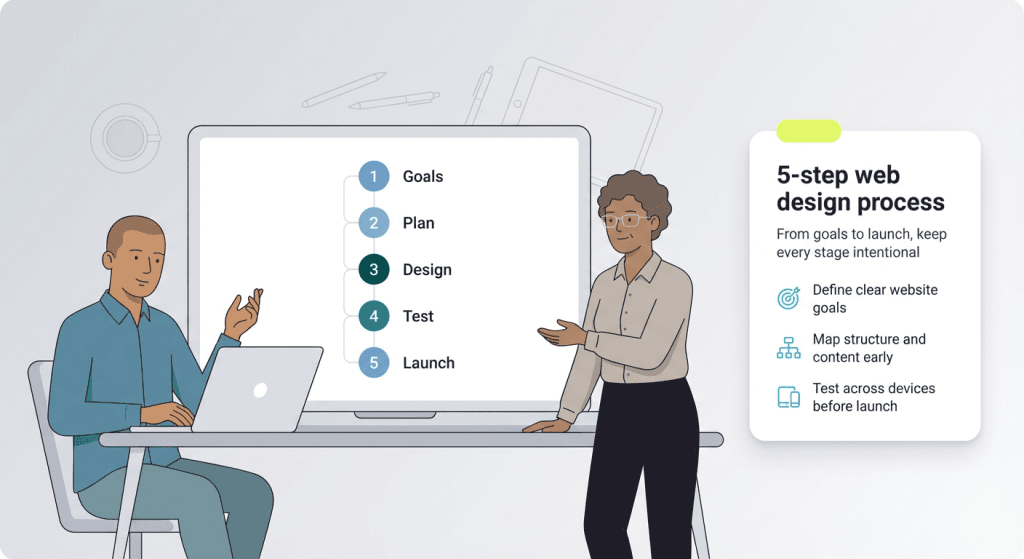
Stellar website design isn’t just about a pretty visual interface. It integrates a well-thought-out strategy with the design and development process to fulfill the website’s ultimate purpose.
Follow this five-step process to create a winning website.
- Define your website's goals
- Plan your website design strategy
- Design and develop the new website
- Test your website
- Launch and maintain your new website
1. Define your website’s goals.
When starting the website design process, build a creative brief outlining the website’s goals. Ask yourself and your team the following questions, and include your answers in the creative brief to give your design project clarity and direction.
- What objective or objectives should this website accomplish?
- What problems does it solve?
- Who are the website’s target users?
- What benefit will users receive from interacting with your website?
- What is the website’s primary aim? Is it to inform, sell, prompt users to sign up for a service, or something else?
- Is there a competitor website that operates in your niche? What are its strengths and weaknesses?
- Should the website integrate with your database, accounting software or other systems?
You must pinpoint your target audience to answer these questions properly. Here’s how to identify your target audience:
- Classify prospects and build distinct customer personas.
- Work on your value proposition and the benefit your website offers the target audience.
- Prepare a market research plan.
- Conduct a competitor analysis.
2. Plan your website design strategy.
Scope creep is a common web development issue. The project’s scope keeps expanding during the web design and development phase — extending the estimated timelines and eventually requiring budget increases.
Strategic planning with realistic timelines can help you avoid scope creep and set up your website for success. You’ll need to address three primary elements when planning your website design strategy:
- Programming language and technology stacks
- Sitemap and wireframes
- Content strategy planning
Programming language and technology stacks
In this stage, you must decide on the project’s technical aspects, such as selecting a technology stack. First, you’ll choose a website builder or platform that can help you accomplish your goals and stay within your budget. Content management systems like WordPress will likely suffice if you want your website to act as an information source for users. However, if you want to set up an online store, robust web frameworks may better suit your needs.
Conduct a detailed analysis of programming languages and tech stacks and study the pros and cons of adopting each technology. Perform a comparative analysis of available technology choices to help you better understand the advantages and disadvantages of one framework over another.
Sitemap and wireframes
The sitemap and wireframes comprise your website’s blueprint:
- Sitemap: The sitemap provides insight into the website’s information architecture. Building a sitemap before the design phase helps you plan website navigation and content development more effectively.
- Wireframes: Wireframing is the foundation of a well-designed website. It provides a framework for the website’s visual design and content elements and serves as a guide to the site’s final look. Many prototyping tools exist for designing your website’s wireframe.
The wireframe and sitemap guide your content’s distribution and placement within the website. Focus your design on the most essential pages and design content silos for efficiency to help achieve the site’s objectives.
Content strategy planning
Content is a website’s raison d’etre. Your content’s value is why users visit the site, so the importance of a well-planned content strategy cannot be stressed enough.
Content development must incorporate an SEO strategy to ensure the website content reaches its target audience. A well-planned content strategy boosts a site’s search engine visibility and rankings. Optimization using tools like Google Analytics is also crucial for content creation.
3. Design and develop the new website.
Your existing brand elements should influence the new website’s design. Incorporate your color scheme, fonts, imagery and company logo so website visitors instantly recognize you. Startups can give their web developers more design freedom.
After handing off the design to your development team, it’s time for the coding process. The platform, database and framework you decided on earlier all play a role in translating your design into functioning web pages.
You’ll conduct front- and back-end development during this phase as you incorporate website content into the design.
- Front-end coding: Front-end coding involves compiling HTML/CSS code and deploying it to run across the server.
- Back-end coding: Back-end coding includes advanced functionality, integrations, plug-ins and other behind-the-scenes features. For example, when building an e-commerce business, you’ll incorporate a payment gateway or payment processor.
4. Test your website.
Testing is a critical step in the website design process; it must happen concurrently with development. End-to-end website testing includes functionality, user experience (UX), interface, compatibility, performance and website security testing.
Primary testing categories include the following:
- Functional testing: Functional testing ensures all website features are validated against what’s included in the functional specifications document.
- Usability testing: Usability testing focuses on ease of use while browsing, including accessibility, searchability and usefulness.
- Compatibility testing: Compatibility testing ensures the website functions uniformly across a range of devices and operating systems, including mobile devices.
Thorough testing ensures users don’t experience problems while browsing the website. Rigorous testing is crucial for discovering and fixing issues or bugs before the website launches.
5. Launch and maintain your new website.
Your website launch involves transferring it from a local server to a live server. Web design is a tightrope between form and function; your design and development team must find the sweet spot between the two before launching the website.
Websites are dynamic, so you must continually update them and add new functionality and content.
Website design mistakes to avoid
Understanding the website design process is an excellent first step. However, it’s also crucial to familiarize yourself with the following common website design mistakes. This way, you can avoid them and maximize your site’s effectiveness.
- Poor communication with web developers: Websites sometimes suffer because of a communication disconnect between the business owners, marketing team and web development team. Whether you’re designing your site in-house or outsourcing this function, schedule meetings to discuss goals, technology choices, sitemaps, wireframes and content to ensure everyone is on the same page. Determine in advance how much time and money the project will take and make any necessary adjustments before development starts.
- Making SEO an afterthought: You can have the greatest website in the world, but if no one can find it, it won’t help your business. Incorporate technical SEO tips into your site design to maximize traffic. Conduct keyword research and understand the questions your target audience expects the website to answer. SEO is not limited to content; you should also bake it into the code in header tags, title tags, meta descriptions, ALT tags and page names. Ensure your web developer is well-versed in SEO best practices. This attention to detail will save you from having to retrofit your website for SEO.
- Being too generic: You’ve likely visited multiple websites with the same stock photos (e.g., young professionals sitting around a table, handshakes, and techno-looking abstracts). While this imagery is affordable, it’s also boring and forgettable. The same goes for vague copy, including overused words and phrases like “solution,” “excellence,” “your partner,” “innovation” and “actionable analytics.” This language doesn’t tell visitors what you do, how it will benefit them or why your way of doing it is better than your competitors’ ways. Use compelling images and copy, and consider adding video content to connect with visitors.
- Not closing the deal: While educating visitors and building credibility with content is great, a website should accomplish more. You should prompt visitors with a call to action (CTA) or two. A CTA may ask visitors to subscribe to a blog or newsletter. It may also ask them to buy something, follow a social media account or enter their email addresses as part of your strategy to generate sales leads. Make CTAs eye-catching and include them throughout your website. Placement options include headers, footers, sidebars and a space at the end of each content article.
- Setting and forgetting: Some companies create websites and consider the job finished. However, a website’s launch isn’t the development journey’s end — it’s just a milestone. The maintenance phase follows; diligently maintaining your website is crucial for its success. Web developers should test and fix broken links. They should also add and test new features and content, and incorporate customer feedback and current trends to make changes and ensure a stellar user experience.
- Not setting up and using analytics: Websites are easy to update, so you should commit to continuous improvement. Website analytics can show you what’s working and what needs to be tweaked, as well as where website visitors come from — geographically and from other sites. Analytics can also show how long the visitors stay, where they visit within the site, how many are returning visitors and plenty of other helpful information. These insights can help you reduce bounce rates, identify slow page-load speeds and pinpoint your audience’s interests and needs.
Jennifer Dublino contributed to this article.