Business.com aims to help business owners make informed decisions to support and grow their companies. We research and recommend products and services suitable for various business types, investing thousands of hours each year in this process.
As a business, we need to generate revenue to sustain our content. We have financial relationships with some companies we cover, earning commissions when readers purchase from our partners or share information about their needs. These relationships do not dictate our advice and recommendations. Our editorial team independently evaluates and recommends products and services based on their research and expertise. Learn more about our process and partners here.
If you’re searching for HR outsourcing services, an ASO can provide great benefits in a flexible service model.

As a small business owner, you’re pulled in many different directions. You must develop a compelling product or service, manage staff, handle business logistics and find funding for your business. As your company grows, managing all areas of your operation can become increasingly challenging, especially from a human resources (HR) perspective.
An administrative services organization (ASO) or a professional employer organization (PEO) can handle your business’s HR needs while helping with the hiring process and providing payroll, employee benefits administration and employee training services. We’ll explain ASO services and compare them to PEOs to help you choose the right outsourcing partner for your business’s HR needs.
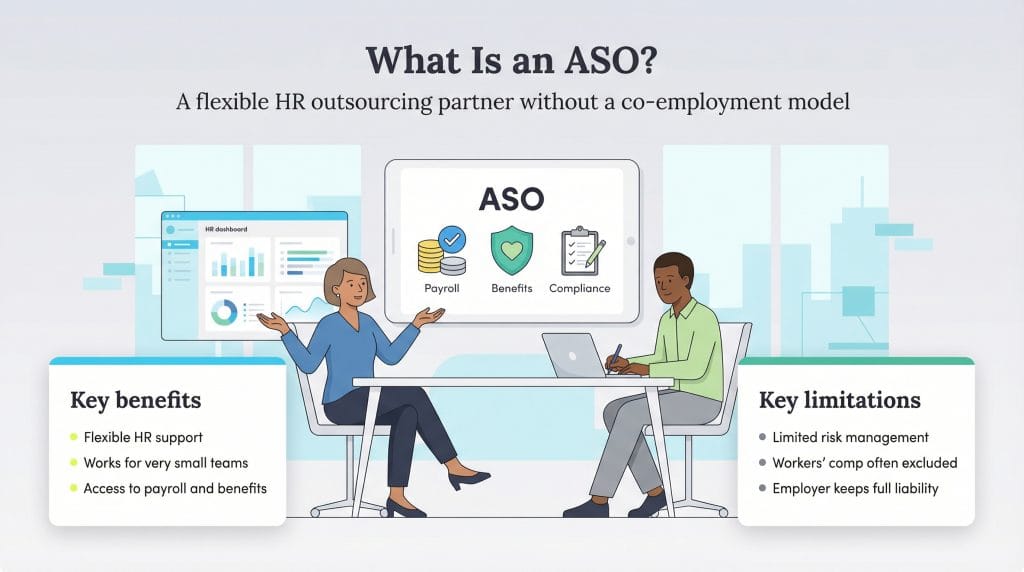
An ASO is a business outsourcing service specializing in core HR functions, including employee benefits and payroll processing. However, it doesn’t directly provide these services to your small business under a co-employment model — meaning it doesn’t share legal responsibilities and liabilities pertaining to your employees.
Working with an ASO means outsourcing your HR to a partner that can facilitate services and provide excellent HR service options for your business. According to the National Association of Professional Employer Organizations, businesses that outsource HR functions increase their annual ROI about 27 percent. However, because it lacks the co-employment model, ASOs can’t help in some areas. For example, most ASOs don’t provide workers’ compensation services and an ASO’s overall HR risk management offering is limited compared to a PEO.
Still, ASOs can provide excellent services to smaller companies with less commitment than PEOs require.
To better understand what it’s like to partner with an ASO, it helps to see how they’re structured and what they offer. The following are some upsides and key offerings of ASOs:
The primary downsides of working with an ASO include the following:
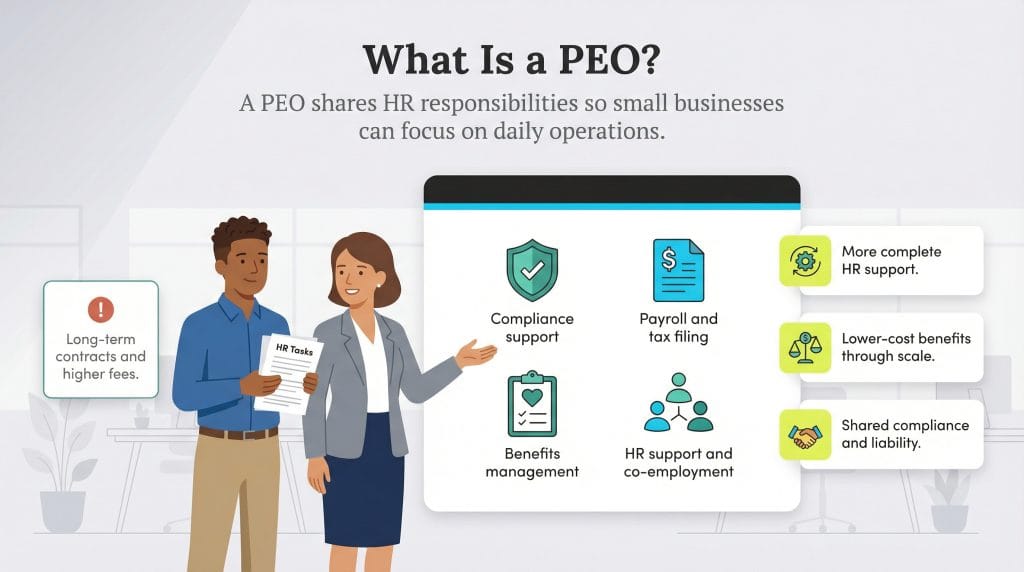
A PEO is a business outsourcing service that provides extensive HR support to small companies under a co-employment model, meaning it shares some employee legal responsibilities. PEOs often provide ASO-type services to client businesses until they grow and require more extensive assistance under a co-employment model.
PEOs operate as small business conglomerates, providing top-level services to a wide range of businesses without the high logistical overhead. Your business is still yours and your employees still work for you.
Partnering with a PEO means working with a representative assigned to your company who handles all your business’s HR needs. PEOs help with benefits administration and rolling out new HR service offerings, allowing you to scale your services as a company.
When you partner with a PEO, you release certain HR responsibilities to another organization, allowing you to focus more on the day-to-day operations of your business instead of administrative tasks.
Like ASOs, PEOs have upsides and downsides that businesses must consider before deciding to work with them. Consider the following PEO pros:
The following may be seen as PEO downsides for some businesses:
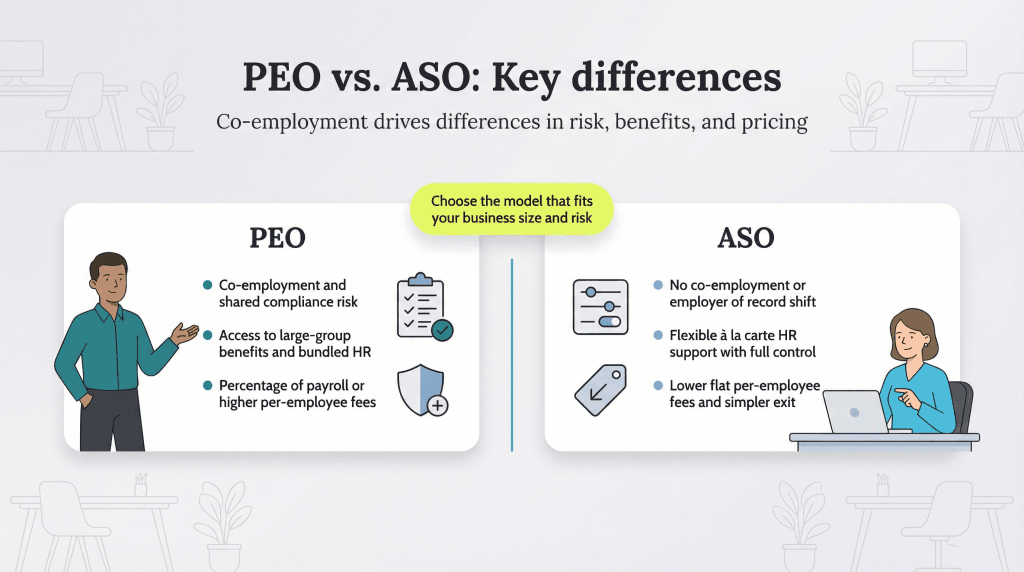
The co-employment model is the primary difference between PEOs and ASOs and their offerings. Because of this model, PEOs assume significant risk when they partner with small businesses. In contrast, ASOs assume much less risk.
When you partner with a PEO, you remain in complete control of your business. The PEO acts as a conglomerate organization for thousands of other small businesses nationwide, leading to efficient HR offerings. When working with a PEO, the following occurs:
In contrast, when you partner with an ASO:
ASO offerings tend to be ideal for companies with 10 to 50 employees who need administrative support but want to maintain full control. However, PEOs now serve businesses of all sizes, with some specializing in companies with as few as five employees.
ASOs and PEOs have different pricing structures that reflect their service models. PEOs typically charge 2 to 12 percent of gross payroll or an annual flat fee per employee, while ASOs usually charge a lower flat fee per employee than PEOs, billed monthly.
The best outsourcing partner for your business depends on several factors including company size, industry, growth trajectory and risk tolerance. If your company is smaller and requires flexible HR services, an ASO may be the right choice. If you run a larger small business that needs extensive HR support, benefits administration and risk management planning, a PEO may be a better fit.
The good news is that shopping for HR outsourcing services lets you explore both options. Many of the best PEOs usually have an ASO offering, so if you’re unsure, you can always start with an ASO service suite and graduate to a full-fledged PEO solution.
When considering providers, request price quotes, check references and ensure the provider understands your state’s employment laws. The right partner can help your business save time and money as you build a stronger workforce together.
Jennifer Dublino contributed to the reporting and writing in this article.