Business.com aims to help business owners make informed decisions to support and grow their companies. We research and recommend products and services suitable for various business types, investing thousands of hours each year in this process.
As a business, we need to generate revenue to sustain our content. We have financial relationships with some companies we cover, earning commissions when readers purchase from our partners or share information about their needs. These relationships do not dictate our advice and recommendations. Our editorial team independently evaluates and recommends products and services based on their research and expertise. Learn more about our process and partners here.
Learn how implementing a flextime policy can benefit your business.


Flexible work arrangements have become a major factor in how employees evaluate job opportunities. While salary and employee benefits still matter, many workers also want greater control over when they work and how they balance their professional and personal responsibilities.
One way employers can meet those expectations is through flextime. A well-designed flextime policy gives employees more flexibility over their schedules while ensuring the business continues to operate effectively. When implemented thoughtfully, flextime can improve employee satisfaction, support retention and help create a culture focused on results rather than rigid work hours.
Here’s what employers need to know about flextime, including how it works, its benefits and drawbacks, and how to build a policy that supports both employees and business goals.
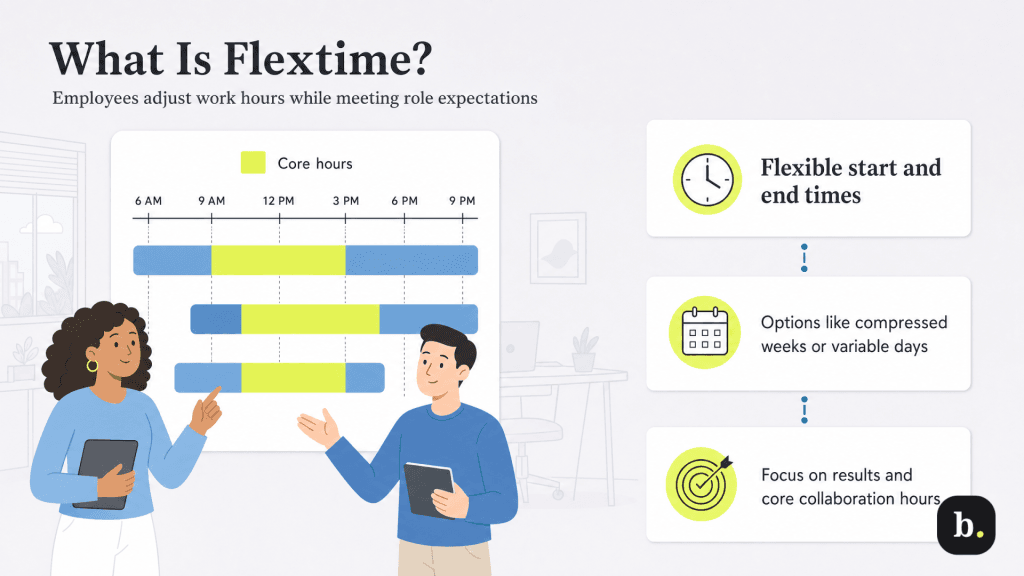
Flextime is a work arrangement that allows employees to adjust when they start and end their workday while still meeting their required hours and job responsibilities. Employers typically set guidelines, such as core hours or availability requirements, so employees have flexibility without sacrificing collaboration and team coordination.
Flextime — also referred to as “flexible scheduling” or “flexible working hours” — can take several forms depending on a company’s needs and the level of flexibility it wants to offer employees. Common arrangements include the following:
While flextime focuses on when employees work, many employers also pair it with remote work plans or hybrid work policies that provide even more leeway over where employees work.
Flextime can help employees better manage their professional and personal responsibilities. By giving people more control over their schedules, employers can reduce stress, improve job satisfaction and make it easier for employees to handle commitments outside of work.
One of the biggest advantages of flextime is that it allows employees to build their work schedules around their lives rather than the other way around. Whether someone needs to attend a doctor’s appointment, pick up a child from school or avoid a long commute during peak traffic hours, flexible scheduling can make those responsibilities easier to manage, helping to create a better work-life balance.
“At the heart of flextime is the ability for employees to be in control of their work and personal life,” explained Darrell Rosenstein, founder and managing partner of recruiting firm The Rosenstein Group.
Flextime can make it easier for employees to take care of their physical and mental health. Instead of squeezing appointments, exercise or caregiving responsibilities into evenings and weekends, employees can build schedules that better fit their needs. Over time, that flexibility can reduce stress, support healthier routines and help prevent burnout.
Flextime can also make it easier for employees to continue learning and building new skills. Flexible schedules give workers more opportunities to attend classes, earn certifications or complete training that might otherwise conflict with traditional work hours. For employers, supporting professional development can strengthen employees’ skills and help them advance within the organization.
“With a flexible schedule, employees can pursue professional development opportunities, such as attending college — something that can be difficult to do with a traditional nine-to-five schedule,” Rosenstein said.
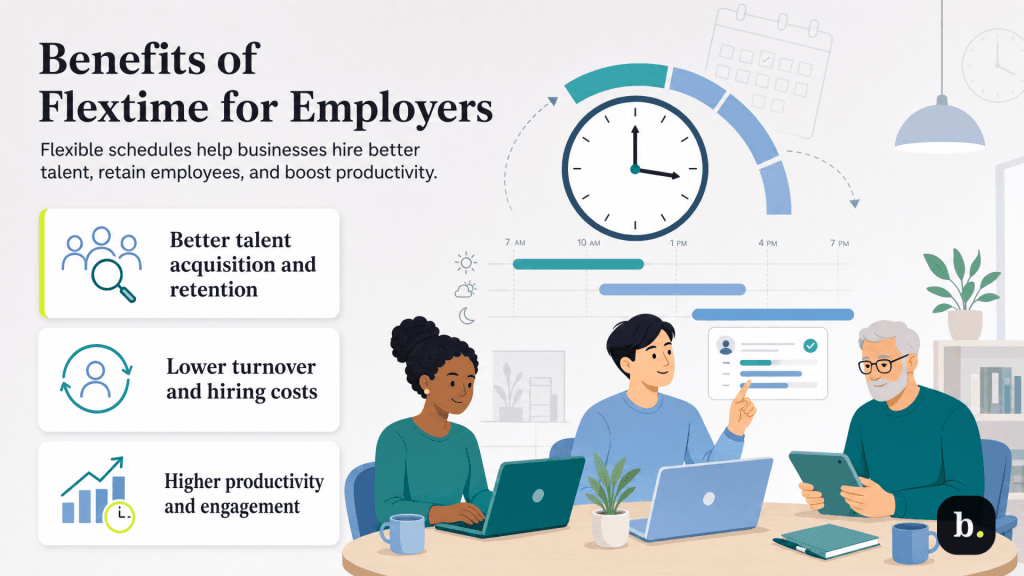
Giving employees more control over their schedules doesn’t just benefit staff; it can also support hiring, retention and overall business performance. Here’s how flextime can help employers meet key business goals.
Flexible scheduling can help employers attract a wider pool of candidates during the hiring process and improve retention among existing employees. For many workers, schedule flexibility has become an important consideration when evaluating job opportunities, particularly when balancing family responsibilities, education or other commitments outside of work.
“Offering flextime can open up a candidate pool for high-demand roles you otherwise would not have had access to because of time demands,” said Todd Brook, managing director at the employee engagement platform Empowered. “It gives you a level of differentiation, and you can end up with incredible, high-performing and loyal employees.”
Flextime can also help employers retain valuable employees through different stages of life. Whether someone is raising children, caring for an aging parent or pursuing additional education, schedule flexibility can make it easier to stay with an employer rather than look elsewhere for a more accommodating arrangement.
Rosenstein emphasized the importance of keeping employees happy when trying to boost retention. “It goes without saying that when employees are happy, they are more likely to stay with you for longer,” Rosenstein said. “Every employer understands the high cost of losing and hiring a valuable employee. Allowing them to initiate a work arrangement that works for them directly minimizes turnover and the disruption it causes.”
Flextime allows employees to work during the hours when they’re most focused and effective. While some people prefer starting early in the morning, others do their best work later in the day. Giving employees flexibility to align their schedules with their natural work rhythms can help them accomplish more in less time, helping improve productivity all around.
“When they can plan their time in a way that aligns with their needs, employees are more likely to feel less stressed and burnt out, which leads to greater productivity,” Rosenstein said.
The benefits often extend beyond individual performance. Employees who have more control over their schedules may be better able to manage stress, stay focused and remain engaged in their work.
Flexible schedules have real benefits, but they can also complicate management on a day-to-day basis. Before rolling out flextime, consider these potential downsides.
Managing a team with varied schedules requires careful planning. When employees work at different times, it can be harder to coordinate meetings, answer questions quickly and keep projects moving. Clear expectations around availability, communication and coverage can help prevent those issues and safeguard workplace teamwork.
“Without a tight arrangement, allowing employees to choose their working hours can lead to operational disruption, such as inadequate staff at any given time,” Rosenstein cautioned. “If several employees are unavailable at certain times, projects might delay and customer service might take a blow, all of which have negative consequences for the company’s bottom line.”
Flextime can be especially challenging for teams that depend on frequent collaboration or real-time customer support. If employees work very different schedules, it may become harder to coordinate meetings, solve problems quickly or maintain consistent coverage throughout the day.
Not every role can have the same level of flexibility. For example, customer support and manufacturing teams often require fixed coverage, so they may have less scheduling flexibility than employees in departments such as marketing or IT. That difference can frustrate employees and lower morale if it isn’t addressed.
“If your policy only offers certain employees a flexible work schedule, others who are left out might feel resentful [and] less valued, and this could have negative implications for their productivity and long-term commitment to the company,” Rosenstein warned.
To reduce the perception of favoritism, be transparent about who is eligible for flextime and why. When employees understand how scheduling decisions are made, they’re less likely to assume certain teams or individuals are receiving special treatment.
Flextime tends to work best in roles where performance is measured by results rather than time spent at a desk. Jobs that involve independent work, project-based responsibilities or client-driven schedules are often the easiest to adapt to flexible working hours.
Roles that commonly work well with flextime include:
Some positions that require continuous staffing — such as customer support, healthcare, manufacturing, retail and hospitality roles — may still offer limited flexibility through shift scheduling, compressed workweeks or shift-swapping programs.
In general, flextime works best in roles that emphasize trust, self-management, accountability and clear communication.
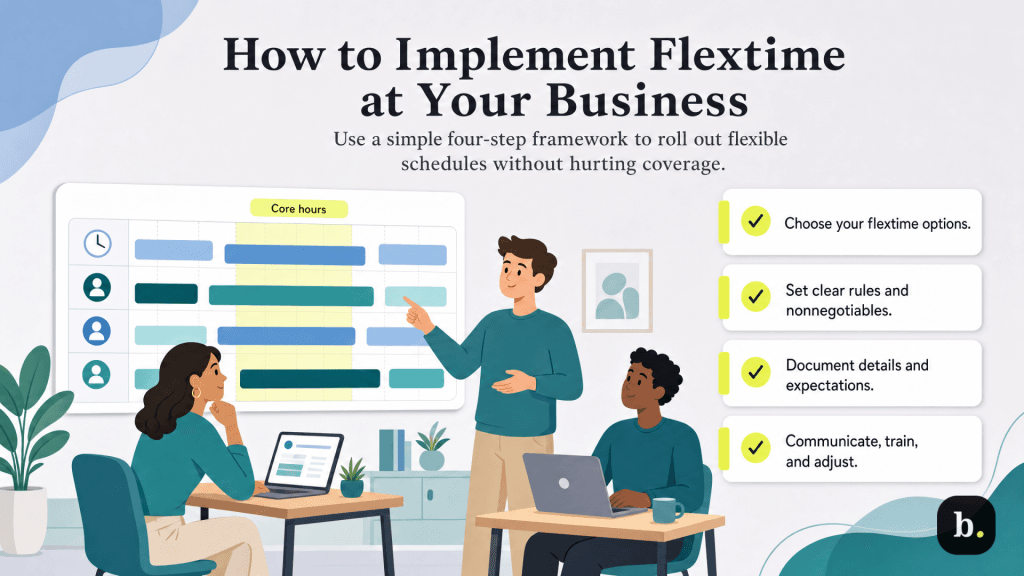
Implementing flextime takes planning, communication and clear expectations. After speaking with Brook and Rosenstein, we recommend a simple four-step approach to help you roll out flexible schedules while keeping operations running smoothly.
Start by evaluating what your business can realistically support. For example, a retail business may not be able to offer fully flexible schedules, but it could allow flexible start and end times or compressed workweeks. Consider your staffing needs, customer expectations and coverage requirements before deciding which approach makes the most sense.
It’s also helpful to gather input from managers and employees. Ask which scheduling options would have the greatest impact on productivity and work-life balance while still supporting business operations.
Rosenstein recommends offering several flexible scheduling options to determine what works best for your team. For example, you might pilot flexible start and end times, compressed workweeks or core-hour schedules and refine your approach based on employee feedback and business needs.
Flextime works best when employees understand exactly what’s flexible and what isn’t. Establish clear expectations around availability, communication and coverage so employees can adjust their schedules without disrupting business operations.
Brook recommends identifying any nonnegotiable times when team members need to be available, such as weekly meetings, major events (like an IT deployment) or peak business periods (such as the holiday season). You should also decide how many employees from each team or department need to be available at any given time.
Document your flextime policy clearly so employees understand how the arrangement works and what’s expected of them. Specify who is eligible for flextime, how employees should request schedule changes and how work hours or availability will be tracked.
Brook advised employers to set clear expectations around how, when and where communication should happen, as well as what to do if a flexible schedule isn’t working. It’s also important to establish performance metrics so managers can evaluate results and ensure the arrangement supports business goals.
Addressing these details upfront can help prevent misunderstandings, improve accountability and make schedules more predictable for everyone involved.
Before rolling out flextime, review your policy with legal counsel to ensure it complies with applicable labor laws covering overtime, breaks, scheduling and timekeeping requirements. Once the policy is finalized, add it to your employee handbook and have employees acknowledge the terms in writing or through your HR platform.
Make sure new hires learn about the policy during the onboarding process so expectations are clear from day one. It’s also a good idea to revisit the policy periodically and make adjustments based on employee feedback, business needs and operational challenges.
Source interviews were conducted for a previous version of this article.