Business.com aims to help business owners make informed decisions to support and grow their companies. We research and recommend products and services suitable for various business types, investing thousands of hours each year in this process.
As a business, we need to generate revenue to sustain our content. We have financial relationships with some companies we cover, earning commissions when readers purchase from our partners or share information about their needs. These relationships do not dictate our advice and recommendations. Our editorial team independently evaluates and recommends products and services based on their research and expertise. Learn more about our process and partners here.
Automated email sequences are a powerful tool for maintaining customer engagement by delivering the right message at the right time without constant manual intervention.


Automated email sequences are sent to users after they take specific actions, such as signing up for an email newsletter or completing a purchase. These perfectly timed and crafted emails may seem like they were created just for you. However, automated email sequences are part of a brand’s carefully planned email marketing campaign.
Below, we define the mechanics of email sequencing, explore its core benefits for small businesses, and analyze successful real-world examples you can adapt for your own strategy.
Email sequencing is a strategic automation practice where a series of pre-written emails are deployed to subscribers triggered by specific behaviors or time-based intervals. This method allows businesses to nurture leads, improve customer retention, and drive revenue at scale without needing a marketer to hit “send” for every message.
The following actions may prompt automatic email sequences:
The best email marketing software platforms include robust email sequencing tools to help you segment your audience, automate and personalize messaging, and connect with your target customers. Email sequences are a scalable marketing tactic that can grow as your business does.
There are five common types of automated email sequences: onboarding, engagement, cart abandonment, launch and nurture.
An onboarding email sequence is sometimes called a welcome email sequence. It’s the first series of emails your subscribers receive after signing up for your email list, app or other offerings.
This initial sequence sets the tone for your relationship. To create a lasting positive connection and deliver on your value proposition, considering including the following elements:
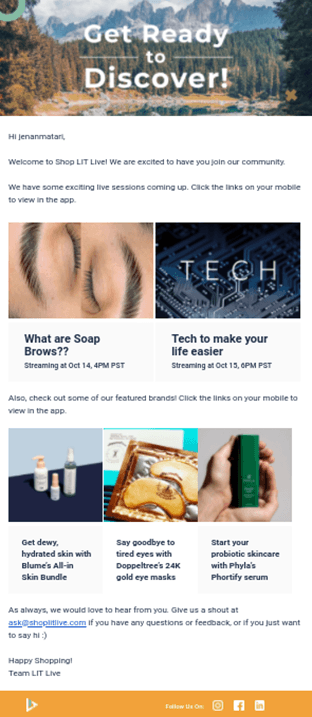
The following onboarding email example is from Shop LIT Live, an interactive livestream shopping platform:
Source: Shop LIT Live.
“The welcome email (the first in a series) welcomes customers into our community,” explained Toby Zhang, founder of Shop LIT Live. “We personalize communications to each member of our community to help them discover brands, products and content that are most relevant to them.”
As the name suggests, engagement emails aim to keep your contacts engaged. You can use them to persuade prospects to make a purchase or to reengage past customers who haven’t purchased recently.
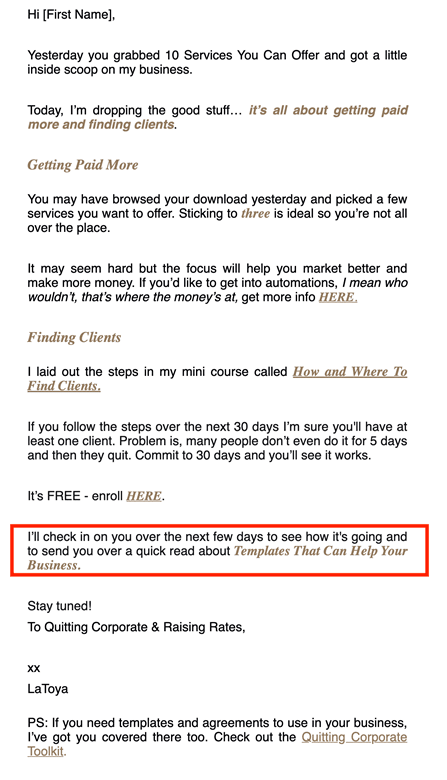
In this example, LaToya Russell, founder of Quitting Corporate, entices prospects to move further along in the sales process by providing valuable information in the form of a free minicourse:
Source: Quitting Corporate.
“The goal is to get them to purchase,” Russell explained. “In the online space, many individuals are often skeptical to purchase from brands that are not widely known, because of scams. Communicating early helps individuals realize that you are a real business, and this minimizes support emails and refund requests. You also want to give some encouragement. Let them know it was a wise decision (because sometimes, spending money is hard).”
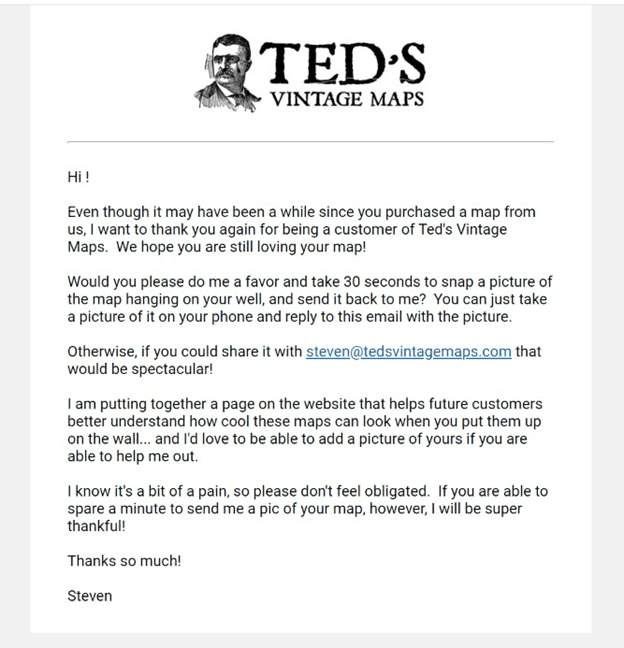
Ted’s Vintage Art has a sequence designed to engage customers who have not purchased in a while. The company sends an email thanking them for their business and asking them to participate in a process that helps to educate future customers.
Source: Ted’s Vintage Art.
This type of email serves as a reminder about your company and can trigger repeat purchases.
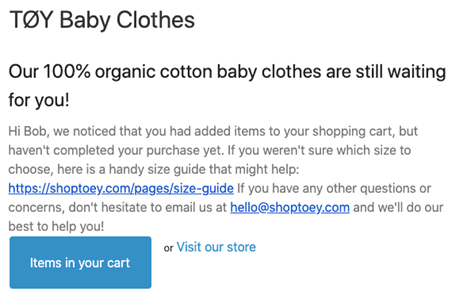
Abandoned shopping cart emails are effective tools that are easy to set up with your email marketing software or on platforms like Shopify.
According to Iwona Ordon, the founder and CEO of organic baby clothing brand TØY Baby Clothing, the company emails shopping cart reminders to address two situations.
Source: TØY Baby Clothing.
Ted’s Vintage Art includes product images in its abandoned shopping cart emails, as in the following example:
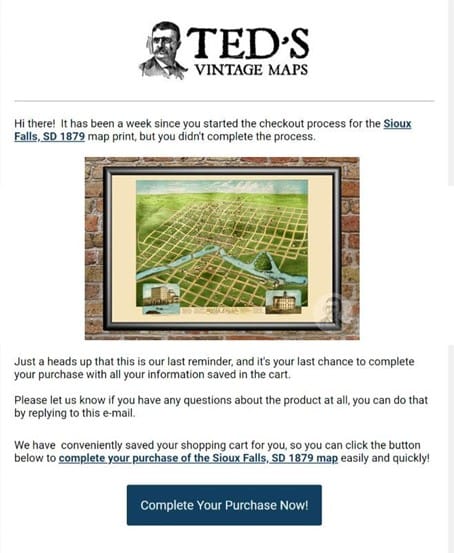
Source: Ted’s Vintage Art.
The company’s founder, Justin Blase, uses the following process to encourage customers to revisit their abandoned shopping carts:
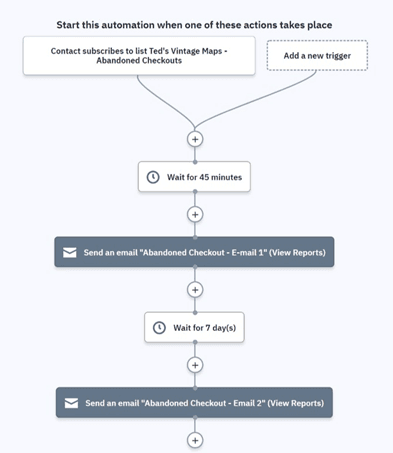
Source: Ted’s Vintage Art.
Launch sequences are focused campaigns designed to build hype. Whether unveiling a new product line or a seasonal service, these emails aim to create awareness and urgency. They are instrumental in helping you earn repeat customers by giving loyal fans early access to what is coming next.
Cuddle Clones introduces prospects and customers to its new products through a series of automated emails. In the following example, the company highlights its new holiday-themed face masks to generate interest and drive sales.
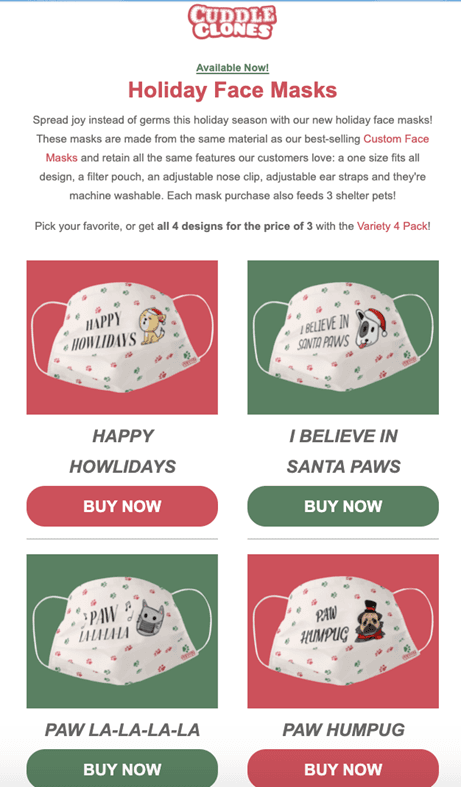
Source: Cuddle Clones.
Nurture emails, often referred to as post-purchase or follow-up sequences, are crucial for increasing Customer Lifetime Value (CLV). The goal is to transition a one-time buyer into a loyal advocate by encouraging secondary actions, such as writing a review, sharing user-generated content (UGC) on social media, or browsing complementary products.
These sequences nurture the relationship and ensure a great customer experience beyond the checkout page.
Blase explained the process Ted’s Vintage Art uses for nurture emails:
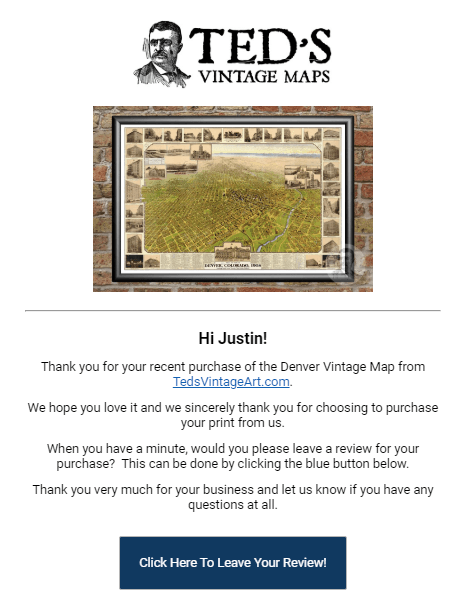
Source: Ted’s Vintage Art.
To maximize open rates and conversions, apply the following strategies when building your automated workflows.
Because every business is unique, you may need to experiment with the frequency of your email sequences to see what works best. Consider sending emails at the following rates:
There is no universal rule for sequence length; it correlates directly with the complexity of your customer journey and the price point of your product. High-ticket items often require longer nurture sequences to build trust, while low-cost impulse buys may only need two or three touchpoints.
Leverage the A/B testing and reporting features in your email marketing software to optimize this. If your open rates remain high but click-through rates (CTR) drop off after the third email, you may have found your optimal sequence length.
Consider the following frequency guidelines submitted by Russell.
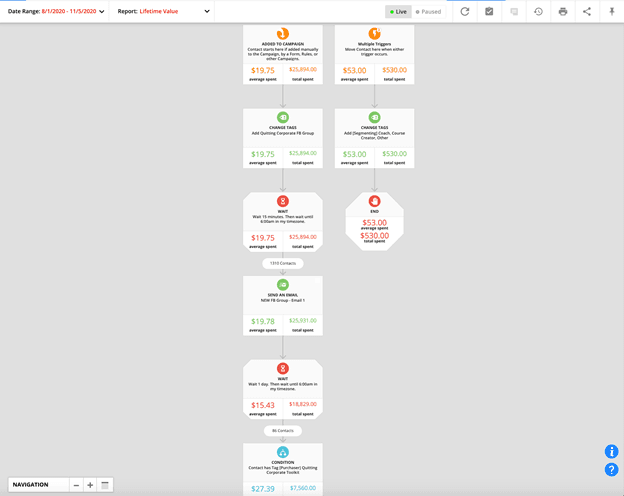
Source: Quitting Corporate.
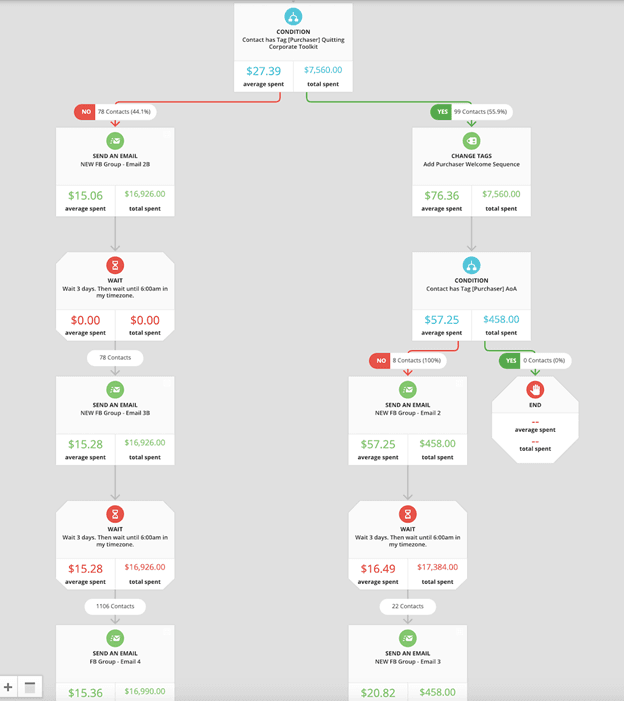
Source: Quitting Corporate.
Successful automation feels personal. Segment your list and tailor your tone to match specific buyer personas—fictional representations of your ideal customers. Consider the following applications of targeted language:
In an era of high digital volume—where global daily email traffic exceeded 347 billion messages in 2023—email sequencing is essential for cutting through the noise and generating new leads. Consider the following benefits:
Effective email marketing relies on consistency and timing—two things that are difficult to perfect manually. By setting up automated sequences for key actions like onboarding, engagement, and purchasing, you ensure that every prospect receives a VIP experience that drives growth, all while you focus on running your business.
Max Freedman contributed to this article.