Business.com aims to help business owners make informed decisions to support and grow their companies. We research and recommend products and services suitable for various business types, investing thousands of hours each year in this process.
As a business, we need to generate revenue to sustain our content. We have financial relationships with some companies we cover, earning commissions when readers purchase from our partners or share information about their needs. These relationships do not dictate our advice and recommendations. Our editorial team independently evaluates and recommends products and services based on their research and expertise. Learn more about our process and partners here.
C-Suite Job Titles: What Do They Really Mean?
The number of C-suite titles has exploded lately — here's what each of these executives does.
Business.com earns commissions from some listed providers. Editorial Guidelines.
Table of Contents
You’re likely familiar with executive titles like chief executive officer (CEO), chief financial officer (CFO) and chief operating officer (COO). But what about roles like chief experience officer or chief relationship officer?
The number of C-suite titles has grown significantly in recent years as companies add new roles and place greater emphasis on different parts of their organizations. Below, we break down traditional and modern C-suite job titles and what they mean in today’s business environment.
What does C-suite mean?
The C-suite refers to an organization’s top senior executives, typically those with the word “chief” in their titles. These high-ranking leaders oversee big-picture strategy across departments and make high-stakes decisions that affect the entire organization. C-level executives also work together to ensure the company stays aligned with its broader goals and direction.
For decades, the C-suite was a relatively small group with fairly predictable roles from one organization to the next. Over the past several years, however, new titles have emerged as established companies rethink their organizational charts and startups introduce new ideas and leadership priorities.
Where there were once only a handful of C-suite roles, there is now something closer to an alphabet soup of executive positions. Organizations are adding more roles while also expanding what those roles are responsible for.
Traditional C-suite titles and their responsibilities
How many C-suite positions a company has depends on its size, industry and mission.
“The traditional C-suite roles like CEO, CFO, CMO and COO are more or less indispensable to most businesses,” explained Jason Marshall, chief growth officer at AG1. “It’s common for smaller businesses to exist without a C-suite, with some even taking deliberate steps to avoid this clear hierarchy. However, there usually comes a time when investing in experienced leaders is needed to take an organization to the next level.”
Traditionally, most companies have included at least some of the following roles in their C-suite.
Chief executive officer (CEO)
The CEO is the highest-ranking C-suite member and serves as the face of the organization. They may have different leadership styles, but they typically consult other C-suite members before making major business decisions.
Even when a company has many executives, the CEO is ultimately the leader who ties the team together. It’s the CEO’s responsibility to set the overall agenda and guide company-wide strategy while staying informed about what the rest of the C-suite is doing.
Tip
CEOs should have five presentations ready at any given moment, including an investor pitch, vision pitch, board update, announcement speech and thought leadership keynote.
Chief operating officer (COO)
The COO is typically the second in command (after the CEO) and focuses on business operations and human resources (HR)-related functions. The COO oversees operations related to employee recruitment, payroll, employee training, compliance and administration.
“Historically, at its most heavyweight, the COO role would lead a broad portfolio that could include technology, operations, procurement, real estate and other corporate services,” said Chris Rowe, co-founder of pltfrm search.
“With technology now a dedicated, stand-alone C-suite role, this means a different profile for today’s COO, where the role is more administrative,” Rowe added.
Chief financial officer (CFO)
The CFO works closely with the CEO and oversees the organization’s finances and financial accounting. They help the organization weigh the financial benefits and risks of potential opportunities. All members of the finance and accounting team ultimately report to the CFO.
“If we go back, the CFO was the most powerful position — other than the CEO — in the 1980s and 1990s,” said Naeem Zafar, a CEO coach, professor and director of the Alliance of Chief Executives. “You can’t run a business without a CFO to guide the financials.”
Today, the CFO’s prominence has been somewhat diluted by the rise of newer C-suite roles — such as the chief human resources officer and chief information security officer — but Zafar noted that the CFO remains an indispensable part of any leadership team. As financial complexity grows alongside regulatory demands and global economic uncertainty, the CFO’s role in steering long-term growth is more important than ever.
Chief marketing officer (CMO)
The CMO heads the marketing department. They set the organization’s marketing goals, create marketing plans and oversee marketing operations related to advertising, branding and public relations.
“To me, the CMO’s primary responsibility is to generate demand for the company,” Marshall said. “As a revenue-focused CMO, I’m responsible for creating strategies that generate interest in our products and services, with the ultimate goal of fueling business growth. This involves deeply understanding our target audience, leading effective campaigns and aligning promotional strategies with measurable revenue goals.”
Chief information officer (CIO)
The CIO leads the organization in information technology (IT). In addition to possessing leadership and business skills, this executive has project management skills and, typically, experience in coding and programming.
Because the CIO role often overlaps with other technical leadership positions, it’s sometimes confused with the chief technology officer (explained below).
“Confusion arises on the interchangeability of the chief technology officer and chief information officer titles,” Rowe said. “For clarity, [the CIO handles] the role of owning and building the corporate IT applications, platforms and infrastructure, and owning the engineering teams that build the products and services offered by the firm.
“Confusingly … the CTO is often a direct report of the CIO and leads the technical side of the domain,” Rowe added.
Did You Know?
There's also some overlap between CMO and CIO responsibilities. CIOs implement the organization's tech stack, while CMOs use tech tools like marketing automation and analytics platforms to run campaigns and track performance.
Chief technology officer (CTO)
A CTO, often discussed alongside the CIO, focuses on how a company builds and uses technology. They help identify and solve tech-related challenges and put new tools and systems in place. In companies that have both roles, the CTO may report to the CIO or operate as a peer, depending on the organization. In smaller organizations, these two roles are often combined into one.
“Over time, the C-suite has come to include many more positions, reflecting the size and complexity of heaps of modern organizations,” Marshall said. “We saw this happen in the 1980s and 1990s when IT became important to how many companies function — which then saw the introduction of the CTO role.”
Chief human resources officer (CHRO)
The CHRO is similar to the COO in that both roles focus on internal operations. However, their focus is directly on HR management and company culture initiatives rather than overall business operations. Smaller organizations may need only a COO, while larger organizations tend to have both.
“The CHRO leads talent acquisition and retention efforts, making the important choices about how a company will attract and hire employees,” Marshall said. “From creating career development paths and mentorship programs to establishing inclusive workplace initiatives, CHROs help shape an organization’s goals and culture.”
General counsel (GC)
Also known as “chief counsel” or “chief legal officer,” the general counsel is a corporate attorney who heads an organization’s legal matters, including business lawsuits. This highly specialized C-suite position is narrowly focused on legal matters and is generally reserved for larger businesses that need a dedicated lawyer on hand.
FYI
Smaller companies may opt to develop a relationship with a business lawyer instead of having a general counsel on staff.
Modern and emerging C-suite roles
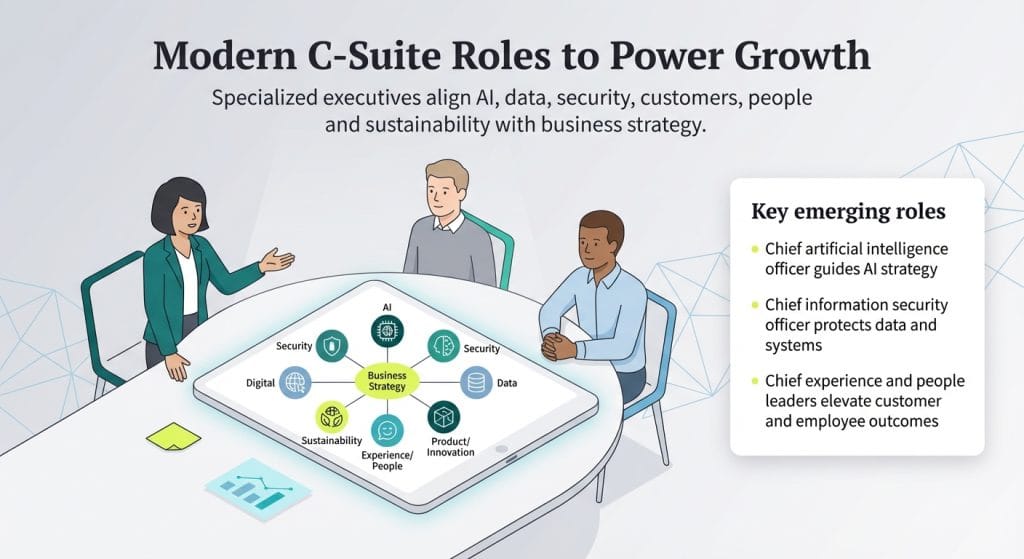
As technology, customer experience and sustainability have become central to competitive strategy, organizations have responded by creating new C-level positions to oversee these functions. Elevating someone to one of these roles sends a clear signal to employees, customers, vendors and investors alike that the company treats that area as a strategic priority, not an afterthought.
“As a business becomes larger and more complex, hiring additional C-suite positions can help spread responsibility and lead to better decision-making,” Marshall said. “Which C-suite positions make the most sense will depend on the organization’s goals and purpose.”
Below are some of today’s most prominent modern C-suite roles that growing businesses can consider based on their strategy and day-to-day needs.
Chief artificial intelligence officer (CAIO)
As artificial intelligence (AI) becomes increasingly common, so too is a dedicated role for understanding and managing AI tools throughout businesses. The CAIO is an executive leadership role that has emerged in recent years as machine learning has become more commonplace in business software. Now, with the rise of large language models (LLMs) and AI agents, the CAIO role is becoming more important as businesses navigate this rapidly evolving technology.
“[CAIO] has been gaining steam over the past few years as GenAI increases its impact,” said David Radin, CEO of Confirmed LLC. “The CAIO role should be responsible for creating corporate-wide AI policies, determining the tools and limits that accompany these policies, and to give them and their teams authority to enforce those policies.
“These are particularly important in that the types of concerns are broad, from productivity to licensing of technology to cost/budget to copyright issues,” Radin added.
The role is also gaining formal recognition at the federal level. In March 2024, federal guidance directed U.S. agencies to designate Chief AI Officers to coordinate AI governance within their departments, a sign that this role is quickly moving from niche to mainstream.
Chief information security officer (CISO)
The CISO is the chief of cybersecurity and risk management in an organization. They are responsible for devising and implementing data security policies, monitoring the threat landscape and continuously updating software and hardware to mitigate data breaches and other network threats.
“Most of the companies I have encountered over the past few years have implemented a CISO role,” Radin said. “[This role] has grown in favor as the number of threats to data infrastructure, such as ransomware, has grown.”
Radin said the CISO reports directly to the CEO in some organizations and to the CTO or CIO in others. The precise hierarchy depends on each business’s org chart, but most modern companies appoint a CISO to ensure their cybersecurity practices are strong and able to adapt to evolving threats.
The stakes couldn’t be higher. According to IBM’s 2025 Cost of a Data Breach Report, the global average cost of a data breach has reached about $4.4 million, underscoring why a dedicated security executive is no longer optional for organizations of any size.
Chief data officer (CDO)
The CDO is responsible for overseeing data-related business functions, including data management, data quality, data strategy, data analytics and business intelligence. They use data as a business asset to draw valuable insights. This role may sometimes be called the chief analytics officer.
“The CISO and CDO have become really important in the last few years. As data becomes more valuable and as cybersecurity threats advance, these positions are now essential for the very survival of the organization,” Zafar said.
In some organizations, the CISO and CDO roles may be combined. In larger organizations, though, they are often separated. The CDO focuses on collecting, organizing and managing data, while the CISO focuses on its security.
“Traditionally, the CDO position has largely been about compliance and risk management,” said Chris Jones, chief technology officer at Nightwing. “However, CDOs must juggle their traditional data management responsibilities while also demonstrating to leadership the opportunities for growth and efficiencies data analytics can hold if the right strategies are put in place.”
Chief product officer (CPO)
The CPO, also known as the head of product or vice president of product, oversees product-related business activity, including product creation, product labeling, product launches and product quality. They are responsible for ensuring the organization creates a valuable product for both customers and the business.
“A company’s CPO guides product development and strategy by defining and carrying out its product roadmap,” Marshall said. “That means overseeing product development from start to finish alongside detailed market research, ranging from emerging consumer trends to new competitor offerings. CPOs also implement strategies that generate and incorporate customer feedback to improve trust and satisfaction.”
Chief experience officer (CXO)
The CXO, also known as the customer experience officer, focuses on delivering a strong customer experience. Their responsibility is to ensure that the organization’s customers have a consistent, positive experience with the products or services offered.
“A few years ago, the main C-suite roles were the CEO, CFO and COO. But now, many companies have added new roles, like chief experience officer (CXO) or chief sustainability officer,” said Kristan De Graaf, CEO of Elite Rentals Dubai. “These new roles are important because they help companies focus on things like customer experience and environmental responsibility — things that are becoming more and more important.”
Did You Know?
A great customer experience often depends on an integrated, omnichannel approach that meets customers where they are, whether that's online, in-store or through support channels.
Chief sustainability officer (CSO)
The CSO is responsible for overseeing an organization’s environmental programs and sustainable business model. They analyze the business’s current processes and create strategies to improve sustainability efforts and long-term impact.
Demand for this role has grown considerably in recent years. According to the 2025 Forbes Research State of Sustainability survey, 79 percent of large companies have a CSO, reflecting how ESG accountability has moved from the margins to the boardroom.
“If an organization is focusing on sustainability, it may need to promote its chief sustainability officer,” Zafar said. However, he also noted that if your organization isn’t especially focused on sustainability, it may not be necessary to promote someone to the C-suite to focus on that role.
“The future of the C-suite will be characterized by a continued need for specialized expertise, paired with a trend towards more streamlined, execution-focused leadership,” he added.
Chief happiness officer (CHO)
Businesses that want to improve employee retention are increasingly employing CHOs. These executives focus on ensuring that employees are engaged, supported and satisfied.
As the chief happiness officer role continues to gain traction, some companies are giving it a formal place in the C-suite. “This shows that the company cares about the well-being of its employees,” said Kraig Kleeman, founder and CEO of The New Workforce and Build AUM.
“With so much focus today on mental health, work-life balance and employee satisfaction, there is a lot to be said for a member of senior management whose primary responsibility is to ensure employee satisfaction.”
Chief digital officer (CDO)
The chief digital officer — another type of CDO — leads an organization’s digital transformation efforts, overseeing the adoption of new technologies and digital practices that help the business adapt and stay competitive. The CDO’s core mission is to guide how the company evolves in response to shifting market demands and emerging digital trends.
The chief digital officer helps management make technology and investment decisions and works closely with teams across the organization. They oversee digital strategy implementation, monitor digital trends and innovations and define performance indicators to measure the success of digital transformation initiatives.
Chief people officer (CPO)
The primary role of a chief people officer — another type of CPO — is to develop and implement strategies that improve employee experience and engagement. They manage teams responsible for talent acquisition, corporate culture, the onboarding process, offboarding and other aspects of human resources.
Chief people officers work closely with the CEO and other company leaders to roll out programs that support employees’ day-to-day needs and long-term professional development. They often act as the link between leadership and employees, helping ensure that policies and workplace practices reflect what the company says it values. In some organizations, this role is merged with or overlaps significantly with the CHRO.
Chief innovation officer (CINO)
A CINO is a senior executive responsible for leading innovation efforts across the organization. The CINO defines the company’s innovation strategy and ensures it aligns with business goals. This includes setting priorities for new products, services and business models.
The CINO also helps build a culture that supports experimentation, accepts failure as part of the learning process and rewards creative thinking. They manage innovation portfolios and project pipelines, deciding where to invest time and resources while balancing risk and potential return.
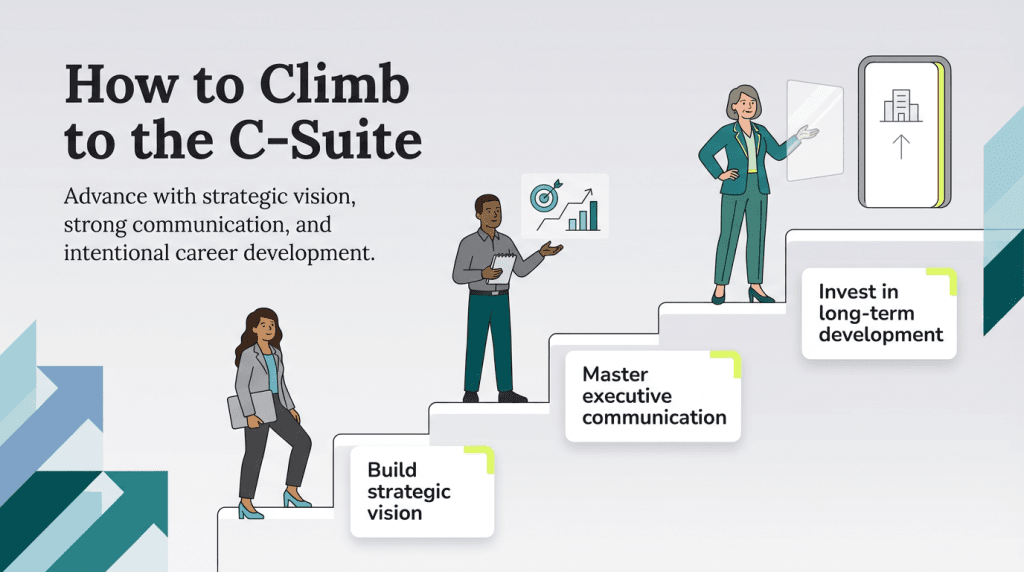
How to climb to the C-suite
Reaching the C-suite takes a mix of strategic thinking, specialized expertise and strong leadership skills. Today’s executives are expected to balance long-term vision with adaptability as organizations navigate rapid technological change and economic uncertainty.
Here are three ways to start positioning yourself for the C-suite:
1. Build strategic leadership skills.
C-suite leaders need to see the big picture and set a clear direction for the organization. That means pulling insights from across the business and using them to make decisions that balance risk and reward.
To build these skills, take on cross-functional work (such as collaborating with teams outside your department), get involved in long-term planning discussions and step up to own projects that directly impact business results.
2. Master communication and change management.
Top executives must communicate clearly and confidently, whether they’re presenting to the board or aligning teams around a new initiative. Strong communication goes beyond slide decks; it includes persuasion, influence and the ability to guide teams through change.
Practically, that means presenting your ideas to senior leaders, leading team discussions and getting comfortable explaining complex ideas in simple terms. In today’s environment, that also means being comfortable working with data and AI-driven tools.
3. Invest in long-term development.
Building these skills takes time. Many future executives strengthen their leadership capabilities by taking on work across different parts of the business, pursuing advanced education such as MBAs or specialized master’s degrees and participating in executive training programs. Seeking out mentors and asking for feedback can also help you identify gaps and accelerate your growth.
Developing experience across multiple areas of the business can help prepare leaders for the complexity of C-suite roles.
Tip
Look for resources that support your growth, including mentorship programs, executive training courses and leadership books that offer real-world perspectives on business decision-making and strategy.
C-suite structure across industries
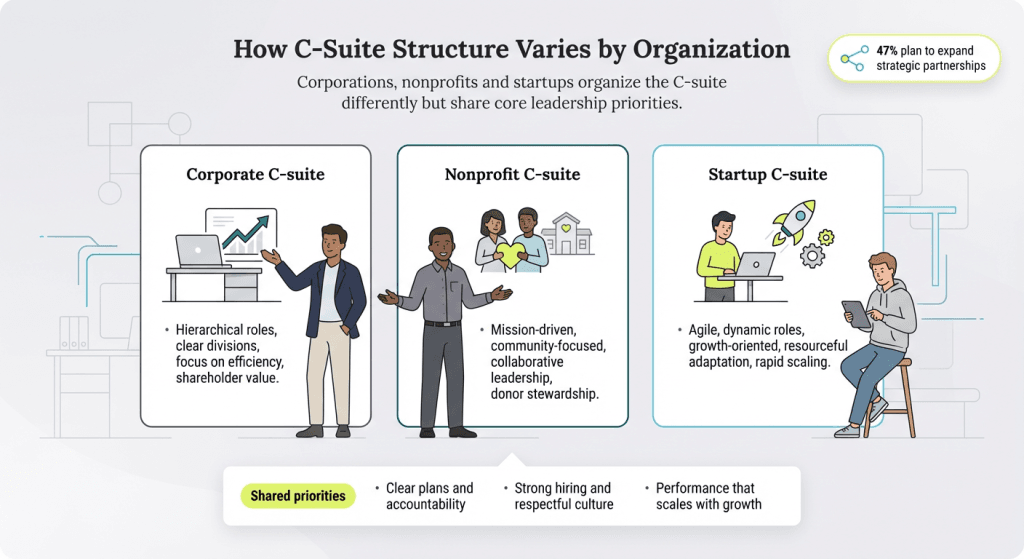
C-suite structures vary significantly depending on the type of organization, with corporate, nonprofit and startup entities taking different approaches to executive leadership.
Corporate vs. nonprofit management
While both corporate and nonprofit organizations prioritize strong management and financial stability, they differ in how leadership is structured and measured. Corporate organizations typically focus on profit generation and shareholder returns, while nonprofits emphasize mission fulfillment and community impact.
Despite these differences, many leadership priorities overlap, including the following:
Creating clear departmental plans and accountability
Articulating results to stakeholders
Taking calculated risks
Making strong hiring decisions
Treating employees with respect
Ensuring performance scales with growth
Startup leadership structure
Startups take a different approach to leadership structure, often relying on smaller, more flexible teams in their early stages. The roles and type of leadership required to run a startup successfully depend on the company, its industry and its size. Startup C-suite executives often wear multiple hats, making high-level decisions while staying closely involved in day-to-day operations.
Startups typically begin with fewer C-suite positions, often combining multiple executive functions under a few job titles until the organization grows large enough to justify more specialized leadership positions.
FYI
According to LHH's 2026 C-suite research, 49 percent of executives say AI and emerging technology are their biggest leadership skill gaps. This is a reminder that even senior leaders are still working to keep up with the pace of change.
C-suite reference tables
C-suite titles can vary by company, but the core roles tend to follow a similar structure. The table below offers a quick reference to common positions, their responsibilities and typical career paths.
Leads AI strategy, governance, integration, ethics, risk
AI/ML, data science, tech, product innovation; advanced degree (PhD or MS) common; federal agencies are directed to designate a CAIO under recent AI governance guidance
Adam Uzialko, the accomplished senior editor at Business News Daily, brings a wealth of experience that extends beyond traditional writing and editing roles. With a robust background as co-founder and managing editor of a digital marketing venture, his insights are steeped in the practicalities of small business management.
At business.com, Adam contributes to our digital marketing coverage, providing guidance on everything from measuring campaign ROI to conducting a marketing analysis to using retargeting to boost conversions.
Since 2015, Adam has also meticulously evaluated a myriad of small business solutions, including document management services and email and text message marketing software. His approach is hands-on; he not only tests the products firsthand but also engages in user interviews and direct dialogues with the companies behind them. Adam's expertise spans content strategy, editorial direction and adept team management, ensuring that his work resonates with entrepreneurs navigating the dynamic landscape of online commerce.