Business.com aims to help business owners make informed decisions to support and grow their companies. We research and recommend products and services suitable for various business types, investing thousands of hours each year in this process.
As a business, we need to generate revenue to sustain our content. We have financial relationships with some companies we cover, earning commissions when readers purchase from our partners or share information about their needs. These relationships do not dictate our advice and recommendations. Our editorial team independently evaluates and recommends products and services based on their research and expertise. Learn more about our process and partners here.
Learn how AI and machine learning are improving the manufacturing process.


Companies worldwide are investing in artificial intelligence (AI) and machine learning to drive business growth. While adoption has expanded across many industries, manufacturing has emerged as a clear leader, using these technologies to unlock measurable gains in efficiency, quality and cost control.
Machine learning is proving to be a game-changer for manufacturers, helping improve product quality, reduce waste and prevent costly equipment failures by analyzing massive datasets that would be impossible for humans to process manually. We’ll explain how machine learning works, explore the key ways it’s transforming manufacturing operations and look at what the future may hold.
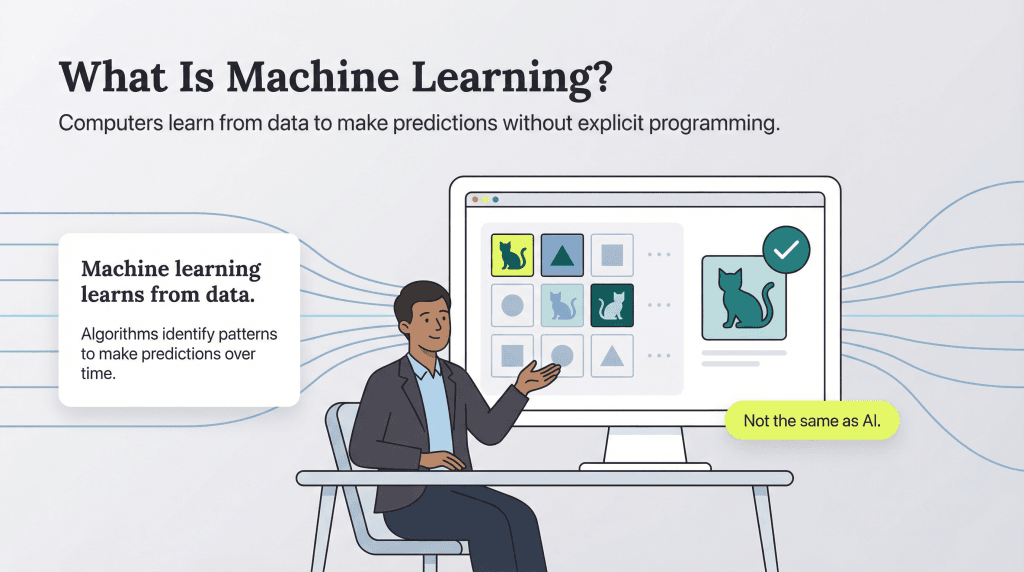
Machine learning (ML) is the process of teaching computers to learn from data so they can make decisions or predictions without being explicitly programmed.
For example, you don’t tell an ML system how to recognize a cat. Instead, you show it thousands of images with and without cats. Over time, the system learns which characteristics must be present for an image to be identified as a cat. The computer isn’t programmed to know what a cat is; it’s programmed to learn what a cat is.
ML is used to solve specific problems based on data patterns. AI, by contrast, focuses on getting computers to perform tasks that typically require human intelligence. ML algorithms are a key part of AI systems, but ML itself is not AI.
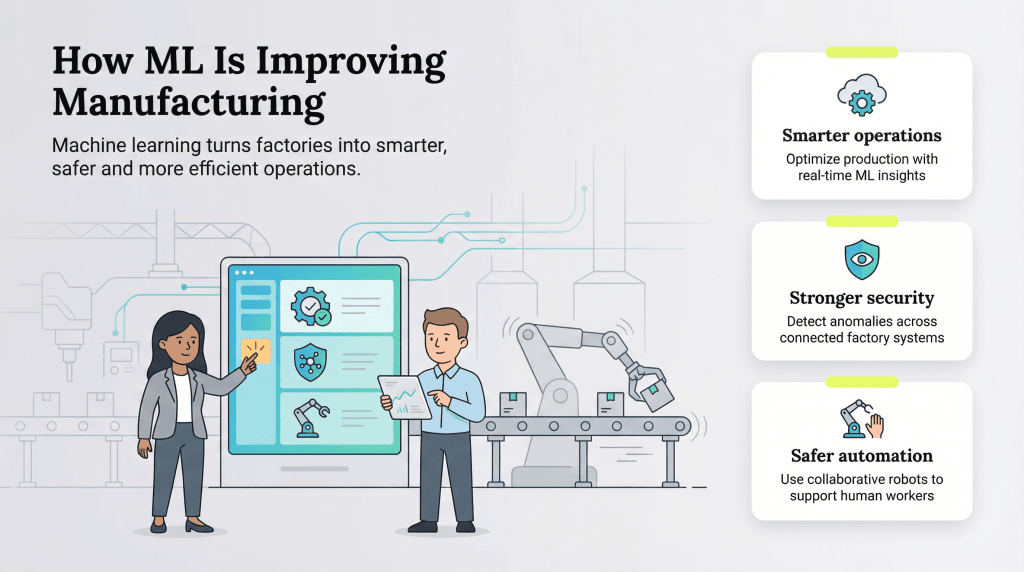
Manufacturers are increasingly using machine learning because it delivers highly accurate predictions and can anticipate production anomalies before they occur.
John Rossman, managing partner at technology and innovation consultancy Rossman Partners, says ML’s impact on manufacturing will be significant. “The adoption of ML in manufacturing is setting the stage for a future where efficiency, precision and customer-centric innovation thrive,” Rossman explained. “As manufacturers invest in these capabilities, the true differentiator will be their ability to ‘think big, but bet small’ and take a systematic approach to experimentation.”
Consider the following five ML use cases that are transforming manufacturing today.
Manufacturers are using ML-based solutions across the entire production cycle. These data-driven systems help uncover hidden inefficiencies in existing operations, including production bottlenecks, underperforming lines and quality control gaps that can impact profitability.
The combination of ML and Industrial Internet of Things (IIoT) technologies — such as sensors — creates powerful new opportunities. Together, they give manufacturers deeper visibility into logistics, inventory, business assets and supply chain operations. This integration supports “smart factory” environments, where data reveals high-value insights related to production speed, packaging integrity and distribution routing.
A well-known example is Intel’s use of ML in microchip manufacturing. During production, the company captures high-resolution images of the thin silicon wafers used to make each chip. ML then scans those images for defects, such as scratches or bubbles, that are easy for human inspectors to miss.
When an anomaly is detected, the system can immediately pause production, allowing teams to identify and correct the issue before additional defective chips are produced.
Product development is one of the most widely adopted use cases for machine learning. Launching successful, unique new products often requires analyzing large volumes of historical data alongside current market trends, which is something ML is well-suited to handle.
ML solutions help manufacturers gather and analyze consumer data to better understand demand, uncover unmet needs and identify new business opportunities. These insights allow companies to refine existing products and develop new ones, opening additional revenue streams while reducing the risks tied to innovation.
ML is particularly effective at lowering product development risk because its insights inform early planning decisions, leading to more confident and data-backed choices.
Val Neicu, CEO and co-founder of SmartSKN, shared how her company uses ML to transform skincare product development. “By analyzing vast amounts of consumer skin data, ML enables us to create hyper-personalized formulations that align precisely with each customer’s needs, reducing the risks associated with launching new products,” Neicu explained.
At SmartSKN, customers use an AI-powered dermoscope to assess their skin condition. ML then helps formulate a personalized skincare product tailored to each customer’s profile. “Our manufacturing system is powered by ML to produce products on demand, minimizing waste and ensuring efficient inventory management,” Neicu added. “This dynamic approach allows us to respond in real time to customer demands without overproducing.”
This approach improves production efficiency while delivering a highly interactive customer experience that blends advanced technology with convenience.
ML can improve final product quality significantly in two ways:
A real-world example comes from Carlsberg, which uses ML-powered quality control to detect subtle taste differences between beers that human testers often miss. During production, the company collects detailed data on each beer’s aroma and flavor profile. ML models analyze this data to flag inconsistencies or defects much earlier in the process, reducing the number of subpar products leaving the factory and helping ensure consistent quality for customers.
General Electric offers another example of ML-driven quality control at scale. The company has deployed ML-based tools across more than 100,000 assets spanning industries such as aerospace, power generation and transportation. These systems identify early warning signs of manufacturing anomalies and provide long-term prognostics to help estimate equipment performance and lifespan.
ML solutions operate across applications, operating systems, networks, cloud computing platforms, on-premise systems and other potential attack surfaces. This level of connectivity makes device and data security a top priority for modern smart factories. ML also plays an important role in zero trust security (ZTS), a framework that tightly controls access to systems and data to reduce exposure to threats and protect your business’s sensitive information.
ML strengthens security by analyzing user behavior and access patterns. It evaluates how individuals interact with protected data, which applications they use and how they connect to them. By enforcing strict access controls around digital assets, ML systems can detect unusual activity and trigger alerts or automated responses when anomalies occur.
As factories adopt more connected systems, security risks are rising alongside them. IBM’s 2025 X-Force Threat Intelligence Index shows that manufacturing was the most targeted industry for the fourth year in a row, accounting for 40 percent of all security incidents and leading all sectors in ransomware attacks. For manufacturers, the message is clear: Stronger safeguards are no longer optional.
AI enables robots to handle routine tasks that are complex, repetitive or dangerous for humans. With ML capabilities, robots can move beyond traditional assembly-line roles and take on more intricate manufacturing processes.
Manufacturers are increasingly adopting collaborative robots, or “cobots,” that are designed to work safely alongside human employees. That’s the approach taken by KUKA, a German robotics manufacturer majority-owned by a Chinese parent company. KUKA builds industrial robots meant to operate safely next to people, including its LBR iiwa model. Advanced sensors allow the robot to handle complex tasks while sharing workspace with human workers, improving both productivity and safety.
Peter Gorm Larsen, vice head of section at Aarhus University and coordinator of the RoboSAPIENS project, is pursuing similar goals through academic research.
“Adaptive robots usually behave by continuously monitoring their environment, analyzing the data collected, changing [their] plans, if needed, and then executing the new plans, accumulating knowledge as it goes along,” Larsen explained. “This is called a MAPE-K (Monitor-Analyze-Plan-Execute-Knowledge) control loop.”
However, Larsen noted that this approach still lacks a built-in mechanism to verify whether certified safety and trustworthiness guarantees are preserved as robot behavior changes. “The future of safety and trustworthiness of automated industrial robots comes when the robot can change its behavior while maintaining — or even increasing — its expected performance and staying at least as safe and robust as before it made the change,” he said.
Larsen’s work on the RoboSAPIENS project focuses on developing the underlying technologies needed to make adaptive robotics safer and more efficient. Over time, these advances could help reduce human error, increase productivity and deliver value across the manufacturing supply chain.
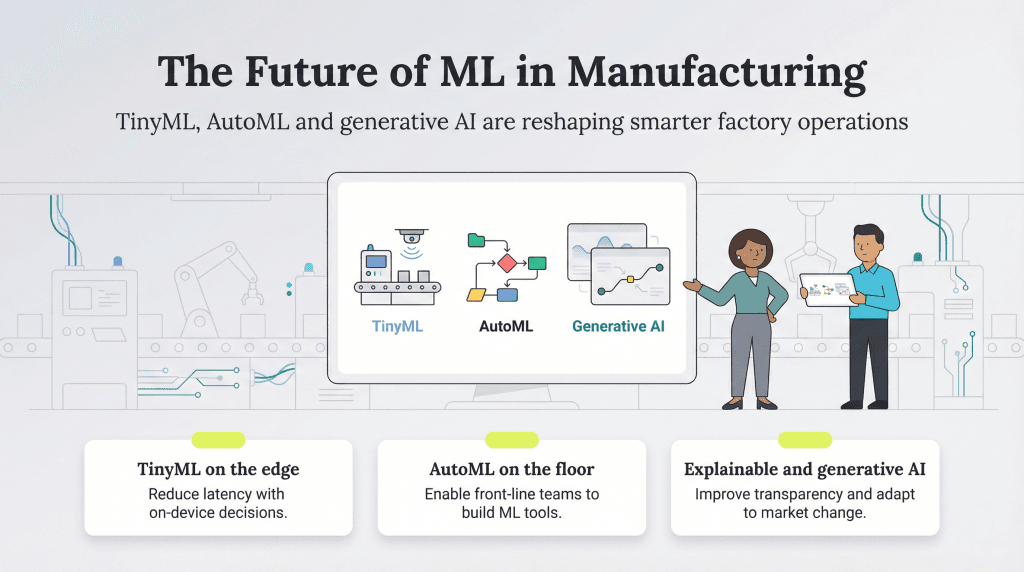
ML and AI applications in manufacturing continue to attract strong interest from investors, entrepreneurs and product developers. Several emerging trends are shaping where the technology is headed next:
Looking ahead, ML’s impact will depend heavily on skilled personnel who can translate insights into action. “Data integration and the need for skilled personnel persist,” Johnson cautioned. “Companies need to ensure data quality throughout each project and create a culture that embraces technological change to see the greatest returns.”
As adoption continues, manufacturers can expect ongoing gains in productivity and fewer equipment failures. Over the next several years, ML and generative AI are likely to become standard infrastructure in most competitive manufacturing operations rather than emerging technologies.
Nacho De Marco contributed to this article. Source interviews were conducted for a previous version of this article.