Business.com aims to help business owners make informed decisions to support and grow their companies. We research and recommend products and services suitable for various business types, investing thousands of hours each year in this process.
As a business, we need to generate revenue to sustain our content. We have financial relationships with some companies we cover, earning commissions when readers purchase from our partners or share information about their needs. These relationships do not dictate our advice and recommendations. Our editorial team independently evaluates and recommends products and services based on their research and expertise. Learn more about our process and partners here.
High levels of employee motivation are linked to strong employee engagement. Here's how that connection can benefit your business.

In today’s competitive business landscape, employee motivation is no longer a nice-to-have — it’s a necessity. While business owners often focus on the bottom line, motivated employees can have a meaningful impact across the organization. For example, employee motivation is closely tied to engagement, which, in turn, can increase retention. Here’s a closer look at why it’s important to motivate your employees and how to do it effectively.
Every business owner should strive to have a highly motivated workforce. A company that focuses on motivating its employees and enhancing the employee experience will see meaningful benefits, including the following:
A highly engaged workforce can have a significant impact on your bottom line. If an employee feels motivated to complete a specific task, they’re also likely to feel more engaged while completing it.
There are three levels of employee engagement:
Unfortunately, employee engagement has been declining in recent years. According to Gallup’s State of the Global Workplace report, global employee engagement has fallen to just 20 percent. Gallup found that 64 percent of employees were not engaged and 16 percent were actively disengaged, and that low engagement cost the world economy approximately $10 trillion in lost productivity, or 9 percent of GDP.
It can be helpful to understand each employee’s level of engagement to identify what’s driving their motivation and where it may be falling short. For example, when employees feel unappreciated, they’re more likely to disengage or withdraw from their work. In that case, you might motivate them extrinsically through an employee recognition program, which can help reengage them with their work and the company.
“Recognition triggers dopamine, the brain’s feel-good chemical,” explained Edel Holliday-Quinn, chief leadership psychologist at the Centre for Leadership Psychology. “Whether it’s a shoutout in a meeting or a bonus, simple acts of acknowledgment have an outsized impact on engagement.”
Highly motivated employees are often more productive and better performers than their unmotivated colleagues. They tend to stay focused and follow through on their work, which can lead to stronger output for the business.
“Neuroscience tells us that motivation activates the brain’s reward centers, boosting energy and perseverance,” Holliday-Quinn said. “In short, when people care, they perform.”
When you understand what’s driving an employee’s behavior, you can apply that insight to motivate them more effectively and improve productivity, performance and overall efficiency.
While company culture plays a key role in retention, many organizations struggle to build a strong, cohesive environment. According to Gallup research, only about two in 10 employees feel connected to their company’s culture. That disconnect often shows up in how employees interact with one another and approach their work. Employee motivation plays an important role in strengthening that connection and encouraging workplace collaboration across teams.
“Highly motivated employees are more likely to volunteer to help out when someone needs help, are more collaborative and tend to cheer their co-workers on,” said Jennifer Recla, a leadership coach and trainer at Recla Coaching & Consulting.
When employees feel motivated and connected to their jobs and the company, their attitude and work ethic can have a ripple effect on those around them. Over time, that kind of momentum can help shape a more positive, collaborative culture where employees are invested in both their individual contributions and the company’s long-term goals.
Motivated employees tend to handle uncertainty more easily, solve problems more effectively and contribute more innovative ideas. When an employee is motivated to achieve a goal, they’re less likely to get stuck on obstacles and more likely to look for new ways to move forward. This is a mindset that helps encourage innovation across the team.
“When people feel invested in their work, they think creatively,” Holliday-Quinn said. “Motivation sparks the kind of risk-taking and idea-sharing that drive progress — a trait every competitive business needs.”
A workforce that can adapt quickly to change is essential to any successful company, particularly for fast-moving small businesses and startups where employees often wear many hats. A motivated team is more likely to experiment, adapt and push through challenges that might otherwise stall growth.
Problems with leadership are a common reason employees quit. According to LinkedIn's Workforce Confidence survey, nearly seven in 10 U.S. employees say they would leave a job if they had a bad manager. That makes improving manager-employee relationships a key part of long-term retention. Managers can build those relationships by learning what motivates their team members and aligning work opportunities with those drivers.
This approach encourages stronger performance while also showing employees that their managers understand and value what drives them — which can deepen trust and improve employee retention.
“When employees are motivated, they foster a more cooperative and encouraging environment at work,” said Damien Filiatrault, founder and CEO of software staffing agency Scalable Path. “They tend to develop better bonds with colleagues, support team objectives more actively and have positive relationships with their superiors.”
When employees are motivated to perform well in customer-facing roles, it often translates to a stronger customer experience. This can lead to higher customer satisfaction and increased sales over time. In an environment where online reviews spread quickly and customer expectations keep climbing, delivering a consistently positive customer experience has never mattered more. Motivated employees remain one of the most dependable ways to make that happen.
Filiatrault emphasized the connection between motivation and excellent customer service. “Employees who are well-motivated are even willing to do extra work to please clients,” Filiatrault said. “They are always willing to contribute positively and strive for distinction, which in turn leads to better engagements, better analysis of customers’ issues and quick turnaround.”
A workforce of motivated, satisfied employees can strengthen your company's reputation. Motivated employees are more likely to speak positively about your organization, which can help attract new talent. And when that enthusiasm carries over into customer interactions, it can also shape how the public perceives your brand.
“Satisfied clients are more loyal and likely to recommend the business to others, thus directly boosting reputation and revenue,” Filiatrault said.
Motivated employees tend to show up consistently and stay on top of their responsibilities, resulting in lower levels of workplace absenteeism and higher productivity. They’re also more likely to stay with the organization long term, which can reduce turnover and strengthen retention.
“Employees who feel valued and driven are less likely to job-hop, saving companies the steep costs of turnover and creating a more stable, experienced workforce,” Holliday-Quinn said.
According to the Work Institute's Retention Report, replacing an employee costs about 33 percent of their salary. That means losing someone earning $50,000 could cost $16,500 or more once you factor in recruiting, training and lost productivity, making lower turnover not just a cultural goal but a financial one.
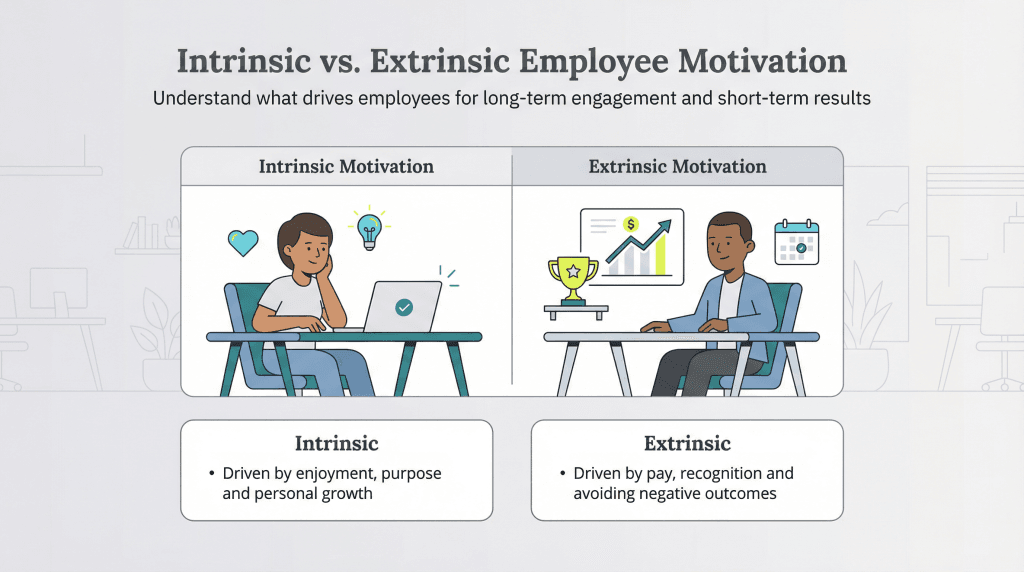
Motivation is the force that drives people to start, continue or stop certain behaviors to achieve a goal. Employee motivation refers to how driven your workforce is to perform tasks that help your organization reach its goals. Employees can draw on two distinct types of motivation — intrinsic and extrinsic — and understanding the difference between them is key to building strategies that work:
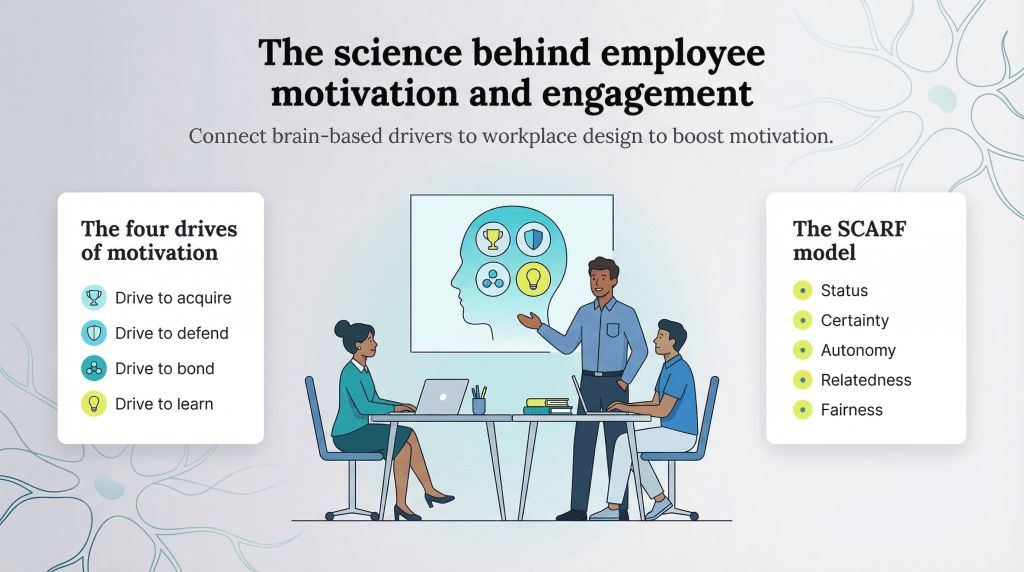
The UNC Kenan-Flagler Business School summarized a white paper by Kimberly Schaufenbuel, then an executive development program director at the school, to show how brain-based insights can be applied to improve employee motivation.
Schaufenbuel highlighted the work of Harvard University professors Nitin Nohria, Boris Groysberg and Linda-Eling Lee, who studied the neuroscience behind motivation and how the brain can be “retrained to increase a person’s motivation for rewards.” These insights can translate into higher engagement, productivity and retention.
The research identified four behavioral drivers that influence human behavior:
“When HR and talent managers understand what drives a person’s behavior in this context, they can design systems, policies, procedures and practices that will appeal to each driver,” Schaufenbuel said.
Another expert Schaufenbuel referenced was David Rock, co-founder of the NeuroLeadership Institute, whose SCARF model also examines motivation through a neuroscience lens. SCARF (status, certainty, autonomy, relatedness and fairness) is a “framework for understanding how the brain responds to perceived threats and rewards,” she said.
According to Rock, “A job should not be viewed as a business transaction — do the work and get paid — but rather as a part of a social system in which the brain is rewarded (or punished) based on how well the business environment is meeting an employee’s need for status, certainty, autonomy, relatedness and fairness.”
Understanding these frameworks gives business owners a practical lens for diagnosing motivation problems. When employees seem disengaged, the root cause often traces back to one or more of these unmet psychological needs — whether that’s a lack of autonomy, unclear expectations or feeling undervalued. Addressing those gaps deliberately, rather than relying on blanket perks or one-size-fits-all incentives, is what helps companies retain top talent instead of cycling through constant turnover.
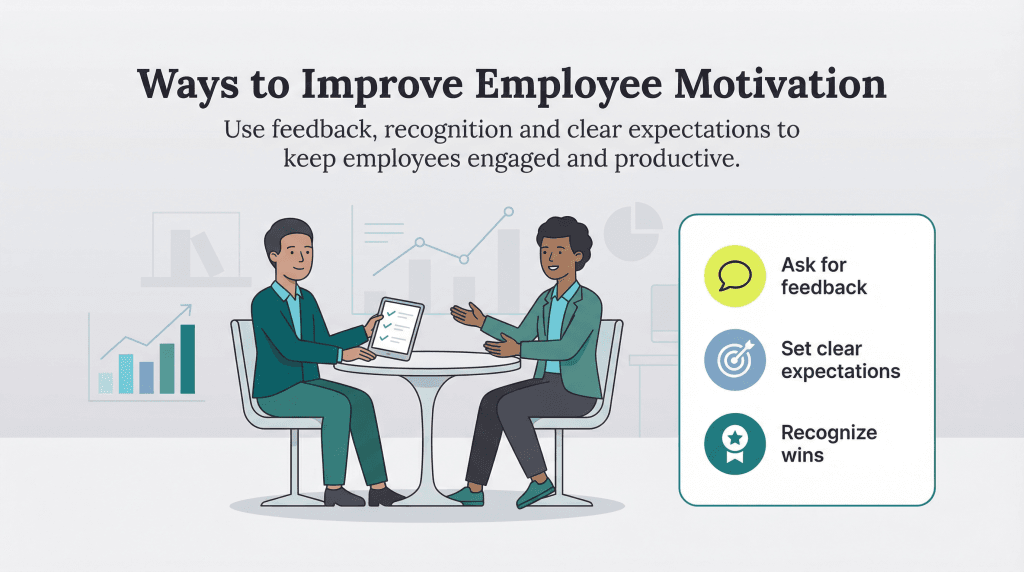
If you’re looking to boost motivation at your organization, these approaches can help you get started:
When you focus on what motivates your employees and take steps to support it, you create a stronger culture and can enjoy better business results.
Alison Napolitano contributed to the reporting and writing in this article. Source interviews were conducted for a previous version of this article.