Business.com aims to help business owners make informed decisions to support and grow their companies. We research and recommend products and services suitable for various business types, investing thousands of hours each year in this process.
As a business, we need to generate revenue to sustain our content. We have financial relationships with some companies we cover, earning commissions when readers purchase from our partners or share information about their needs. These relationships do not dictate our advice and recommendations. Our editorial team independently evaluates and recommends products and services based on their research and expertise. Learn more about our process and partners here.
Protect your brand by staying on top of deadlines and avoiding mistakes.


Congratulations! You’ve successfully submitted your trademark and taken the first step toward protecting your brand and assets. But the work doesn’t end there, despite the lengthy application process you’ve already completed.
Safeguarding and enforcing your trademark after registration requires continuous attention and strategic action. However, maintaining your trademark’s strength is essential for your brand’s long-term success. We’ll explain what you must do after registering a trademark. We’ll also outline damaging trademark mistakes to avoid at all costs.
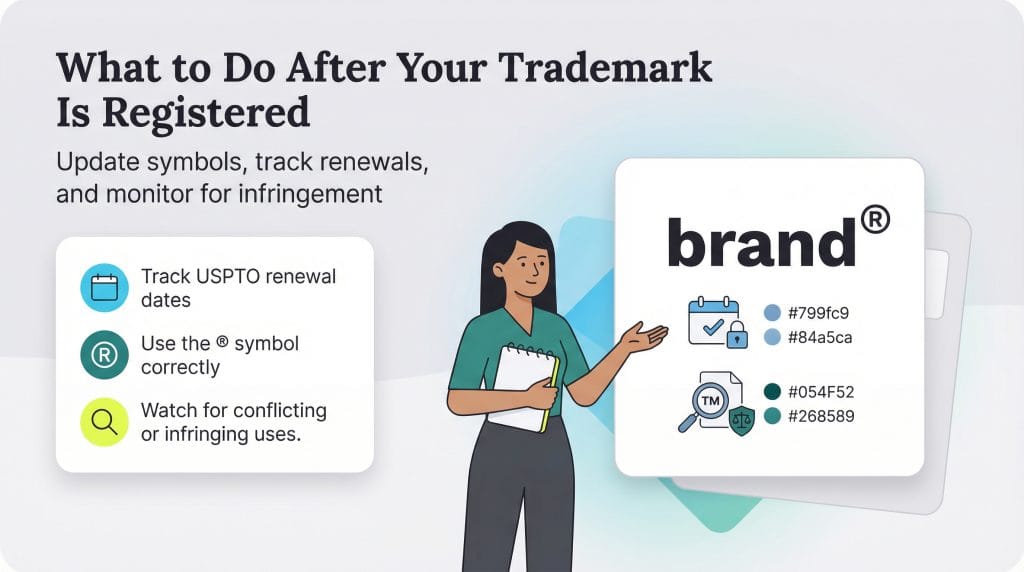
You must focus on the following six crucial actions to properly use, maintain and protect your registered trademark.
Trademark protection depends on continued use — it’s not a one-and-done registration process. The United States Patent and Trademark Office (USPTO) requires periodic maintenance filings to confirm that your trademark is still in use and eligible for protection.
Be aware of these key deadlines:
You can track USPTO forms and applications via your USPTO.gov account. Trademark holders can check the status of their trademarks at any point by entering their serial or registration number in the Trademark Status and Document Retrieval (TSDR) system on the USPTO website.
You’ve likely used the ™ symbol with your mark before and during your trademark application process. However, after successfully registering, you should begin using ® — the small, circled “R” — for goods and services covered under the registration.
This serves as public notice of your registration and reflects proper trademark use under U.S. trademark law. Remember, improper use can weaken trademark rights and make marks more vulnerable to challenge or narrowing.
Here are a few areas you must address to enact proper use of the ® symbol:
It’s important to monitor new trademark applications that could be confusingly similar to your registered mark. While the USPTO examines applications, ultimately, trademark owners are responsible for protecting their rights.
As a registered trademark owner, you’re entitled to formally oppose new trademark applications that could cause confusion or infringe on your brand. Staying proactive helps prevent dilution and reduces the risk of future disputes.
Trademark rights are generally based on use in commerce, with federal registration providing additional legal protections. To keep your business competitive and protect your trademark, go beyond USPTO filings and monitor the marketplace for entities using your mark — or confusingly similar ones — without authorization.
David Spears, host of the Everything Intellectual Property podcast and YouTube channel, says vigilance is vital. “Be prepared to enforce your trademark by monitoring the mark for misuses,” Spears advised. “Not doing so can result in a weakening of the mark and loss of distinctiveness, which can lead to a loss of the trademark.”
If you don’t enforce your mark actively and promptly, an infringing party may attempt to establish priority rights through continuous use or challenge your rights on the grounds of abandonment or laches (unreasonable delay in enforcement).
Your business or product offerings may evolve after your original trademark registration. When that happens, you may need to file additional trademark applications to ensure new branding, goods or services are properly protected. In general, the earlier you secure protection for changes, the better.
Common situations that may require expanded trademark coverage include:
You may encounter a situation where someone infringes on your trademarks. While you want to take action, you must tread carefully. A cease-and-desist or other formal notice can open up a legal can of worms. You must be sure you’re within your enforcement rights; don’t say anything that could come back to haunt you in the event of a business lawsuit or other litigation.
Consult an attorney or legal support services to protect you and your mark and resolve things as efficiently as possible.
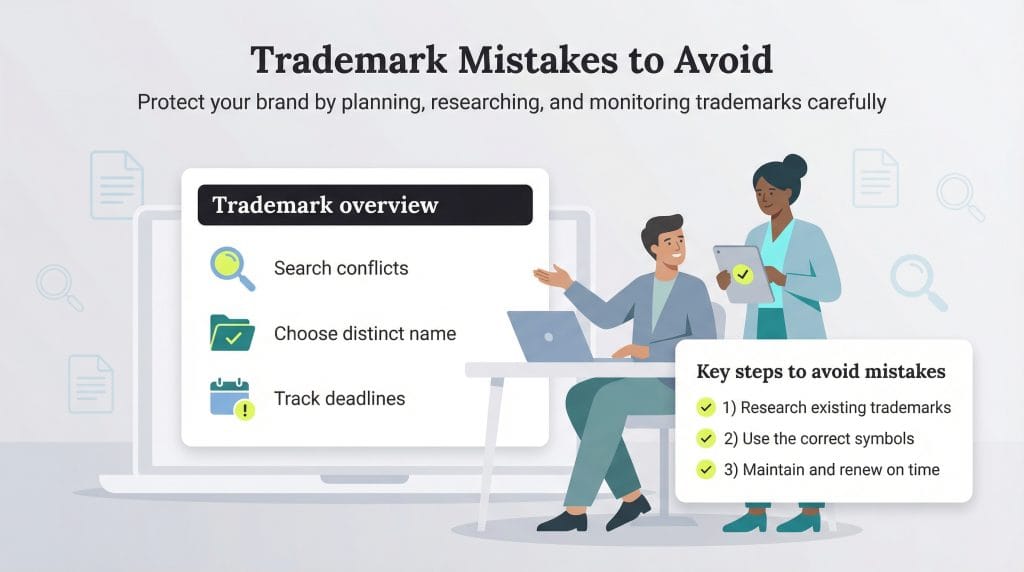
Securing federal trademark registration requires thorough research, strategic planning and close attention to detail. Even so, trademark law is complex, and mistakes are common — and often costly.
Consider the following trademark missteps and how to avoid them.
Some businesses place a ™ symbol next to a brand name, logo or tagline and assume that alone provides strong protection. While ™ can signal a claim of common-law trademark rights, it does not provide the legal benefits of federal registration.
Once your trademark is officially registered with the USPTO, you may use the ® symbol for the goods and services covered by the registration, indicating federal trademark protection.
Using the ® symbol incorrectly — such as before a trademark is registered or on unregistered goods or services — can expose businesses to legal consequences, including liability under 15 U.S.C. § 1120 for false or fraudulent trademark claims. If you’re unsure which symbol applies, consult a business lawyer before using ®.
If you’re developing a business plan and want to protect a brand name, logo or slogan before you begin selling goods or services, you’ll need to file an intent-to-use (ITU) application with the USPTO.
An ITU application allows you to reserve rights in a trademark before it’s used in commerce. However, your registration won’t be finalized until you actually begin using the mark. Once use starts, you must file a Statement of Use showing how the trademark is being used in commerce.
Trademark owners generally have six months from the Notice of Allowance to file a Statement of Use. Up to five additional six-month extensions may be requested, allowing a total of up to three years from the Notice of Allowance to prove use.
Failing to research a potential trademark can lead to serious problems. You may complete the application process only to discover that someone else is already using a confusingly similar mark. That mistake can trigger legal disputes, force an expensive rebranding process or derail a product launch.
Before starting the process, carefully research existing and pending trademark applications through the United States Patent and Trademark Office’s Trademark Electronic Search System (TESS). It’s also a good idea to search the World Intellectual Property Organization’s Global Brand Database to look for potentially conflicting international marks.
Your search should extend beyond names alone and include logos, taglines and similar variations. Keep in mind that trademark rights can arise from use in commerce, even without federal registration, so thorough research is essential before adopting a new mark.
U.S. trademark law does not allow the registration of generic words or phrases because doing so would give one business unfair control over common industry terms. Strong trademarks rely on distinctiveness; the more unique a mark is, the easier it is to protect and enforce.
Marks that are overly descriptive or generic are difficult, if not impossible, to register and defend. Choosing a distinctive word or phrase helps differentiate your brand, strengthens legal protection and reduces the risk of competitors copying your identity.
Personal names can also present challenges. While surnames may be registered as trademarks, they typically require proof of secondary meaning — evidence that consumers associate the name specifically with your goods or services rather than viewing it as a general identifier.
Intellectual property specialist Rebecca Reil emphasized the importance of following USPTO distinctiveness rules carefully. “One way to preserve trademark clarity is to use your mark as an adjective, not a noun,” Reil advised. “For example, saying FedEx® delivery services rather than just FedEx helps reinforce that the term is a brand, not a generic product.”
Failing to do this can weaken a trademark over time. “Think of how people use aspirin today,” Reil added. “It was once a protected trademark, but widespread generic use caused it to lose trademark protection.”
Understanding the five trademark distinctiveness categories can help you avoid choosing a mark that’s too generic:
More likely to qualify for federal registration:
Weak or unregistrable marks:
Many businesses make costly mistakes when selecting trademark classes. The U.S. trademark system uses a classification structure with 45 total classes — 34 for goods and 11 for services — to define the scope of protection for each registration. Within each class are numerous specific descriptions that must closely match how the mark is actually used.
Spears notes that trademark registration does not provide unlimited protection. “If you register your mark for clothing but later use it for medical supplies, you’re operating outside the scope of that registration,” Spears explained. “To protect the mark in that new category, you’d need to register it in the appropriate class.”
Selecting the wrong class can leave parts of your business unprotected. In most cases, correcting a class issue requires filing a new trademark application with the United States Patent and Trademark Office, along with a filing fee of $350 per class (plus any applicable additional fees).
“You have to make sure you’re obtaining protection in every class where you’re actually using the trademark if you want to protect it properly,” Spears added.
After filing a federal trademark application, it’s important to monitor communications from the USPTO. If the USPTO issues an Office Action or requests additional information and you fail to respond, your application can be marked abandoned.
Missing a response deadline — even unintentionally — can cost you time and filing fees and may require starting the process over. Regularly checking your application status helps ensure you don’t overlook requests for clarification or corrections.
Even with good intentions, it’s easy to make mistakes when completing a federal trademark application. Errors such as listing the wrong owner, misidentifying goods or services, or providing inaccurate information can trigger problems during examination.
If these issues aren’t corrected in response to an Office Action from the USPTO, the application may ultimately be refused or abandoned. If you’re unsure how to complete the application correctly, consulting an experienced trademark attorney can help you avoid costly delays and re-filing fees.
Once approved, you must monitor your trademark and its usage. You are responsible for how you use the trademark and maintain paperwork and renewals.
You also must protect your business from trademark infringement by conducting regular market surveillance and tracking competitor activities. According to 2025 data from the Red Points Counterfeit Buyer Teardown report, 61 percent of consumers have accidentally purchased counterfeit goods, underscoring how widespread trademark violations have become. While the USPTO reviews applications for potential conflicts, it does not police the marketplace — leaving business owners responsible for monitoring misuse of their trademarks and taking action when infringement occurs.
Legal action may require a formal business email or a cease-and-desist attorney notification to stop using the trademark. As mentioned earlier, it is crucial to go about this the right way and get legal advice. If the issue persists, further legal action may be required to protect your brand’s reputation.
Renewing your trademark requires submitting proof that your mark is still in active use in commerce, including specimens, which are samples showing how your trademark appears in real-world use. “A declaration of use is submitted at the time of renewal, which is to prove to the USPTO consistent and proper use of the trademark registration over the years,” Reil explained.
However, submitting improper, misleading or fabricated specimens at renewal can carry serious consequences. In recent years, the USPTO has increased scrutiny of renewal filings due to a rise in fraudulent or altered specimens, which can result in registration cancellation and, in cases involving willful false statements, potential legal penalties.
“As part of the declaration of use, a specimen is submitted, which can include a website screenshot, images of products with the trademark showing, and similar materials,” Reil noted. “Something I unfortunately came across that wasn’t appropriate was a fake website or fake image created to make it appear as if the mark was being used. With today’s AI tools, generating these materials has become far easier — and far riskier — for trademark owners.”
Acceptable trademark specimens may include the following:
For goods:
For services:
Busy entrepreneurs and business owners have a lot on their plates, and attending to trademark details may be overwhelming without help. Hiring a professional to oversee your trademark may be well worth the cost for the peace of mind it provides.
Importantly, professional help can remove the fear of missing deadlines. “I think the biggest benefit is [professional trademark assistance] takes the burden off of you as the trademark owner to remember important dates associated with maintaining the mark with the USPTO,” Spears said.
Spears recalled a case where a business owner neglected to renew a long-held trademark. “Upon filing a new trademark application for the mark, another company opposed her trademark application, which is costing her tens of thousands of dollars in an ongoing battle,” Spears shared. “She had to close down stores due to having to spend money on legal costs fighting to get her trademark registered again.”
A professional handling your trademark process would make such a costly oversight unlikely. “The chances of this situation happening when a professional oversees your trademark are very slim, as professionals typically have systems in place to pay maintenance fees as they come due,” Spears said.