Business.com aims to help business owners make informed decisions to support and grow their companies. We research and recommend products and services suitable for various business types, investing thousands of hours each year in this process.
As a business, we need to generate revenue to sustain our content. We have financial relationships with some companies we cover, earning commissions when readers purchase from our partners or share information about their needs. These relationships do not dictate our advice and recommendations. Our editorial team independently evaluates and recommends products and services based on their research and expertise. Learn more about our process and partners here.
Education comes in many forms, from formal schooling to hands-on experience.


For decades, a college degree was viewed as a reliable path to career success, and for many roles, it still is. But as hiring practices evolve and the cost of higher education continues to climb, the assumption that a degree is required for professional success no longer holds true in every field.
Today, many job seekers are weighing whether a college education is worth the investment or if entering the workforce directly, gaining experience or pursuing alternative training offers a better return. While some industries and businesses continue to prioritize formal degrees, others focus more on skills, experience and demonstrated ability and are perfectly willing to hire someone who didn’t go to college. We’ll examine when a college degree matters, when it doesn’t and what options exist for building a successful career without one.
A college education is still a common path to career success, and for many professionals, it plays an important role. According to Statista, 2.02 million students earned bachelor’s degrees in the United States during the 2021-2022 academic year, a figure projected to grow to 2.46 million by the 2031-2032 academic year. That steady increase suggests higher education remains a popular and influential option.
That said, a degree isn’t the only route to success, especially in business. Many industries place greater value on practical skills, real-world experience and results than on formal credentials alone. Whether college is the right choice depends on your goals, the field you want to enter and how you prefer to learn and build expertise.
For many job seekers, a college degree is still a prerequisite for getting a foot in the door. While its value varies by role and industry, most employers continue to view a degree as an important hiring signal. A college degree can bring the following benefits:
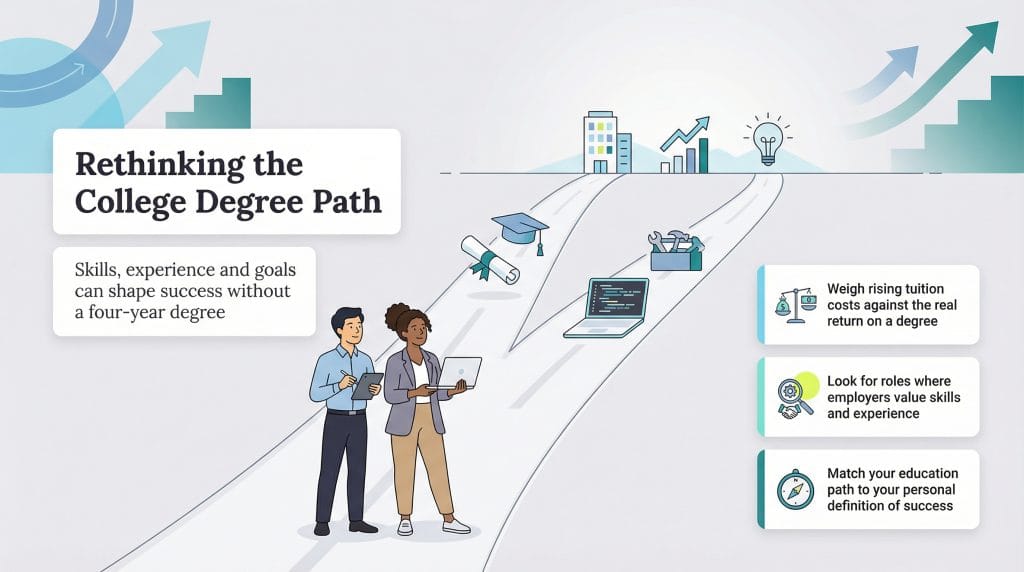
While a college degree still offers clear advantages, it isn’t the only path to success. For many people, the rising cost of higher education and shifting employer expectations have changed how valuable a four-year degree feels in practice. Here’s why many professionals aren’t going the college route:
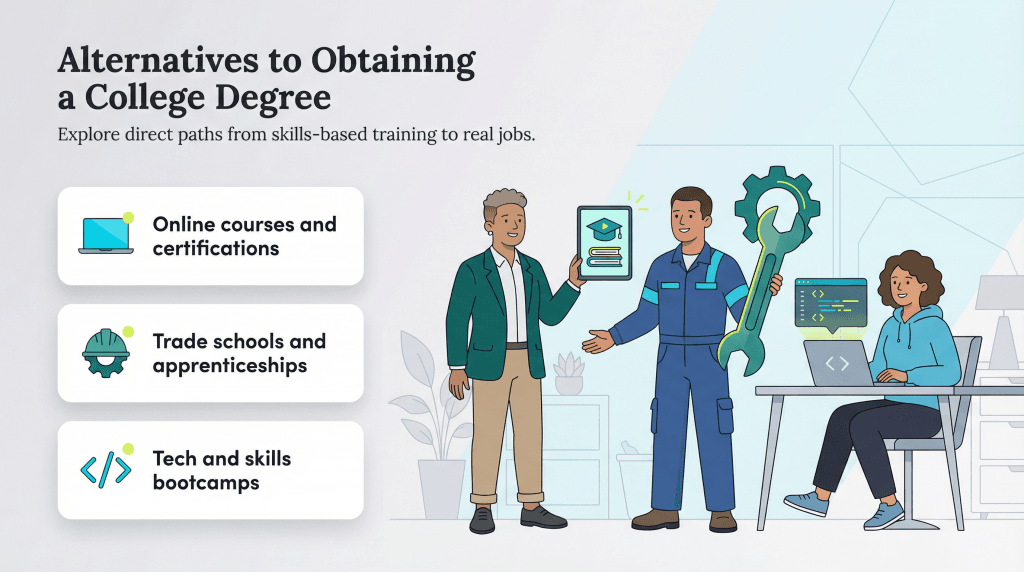
There are other viable paths to building a career. For many people, these alternatives offer faster entry into the workforce and a clearer connection between training and job outcomes. Here are a few to consider:
For people who don’t have the resources or desire to attend college, trade schools offer a more direct path into the workforce. These programs focus on practical, job-specific training in fields such as HVAC installation, dental hygiene and culinary arts, often allowing graduates to begin working far sooner than those pursuing four-year degrees.
Most trade school programs can be completed in six months to two years and lead to a diploma or industry certification. For students who want faster entry into paid work and a clearer connection between training and job outcomes, this shorter timeline can be a major advantage.
For those who prefer hands-on work and structured career paths, trade schools can be a practical alternative to a four-year degree — one that emphasizes employable skills over credentials alone.
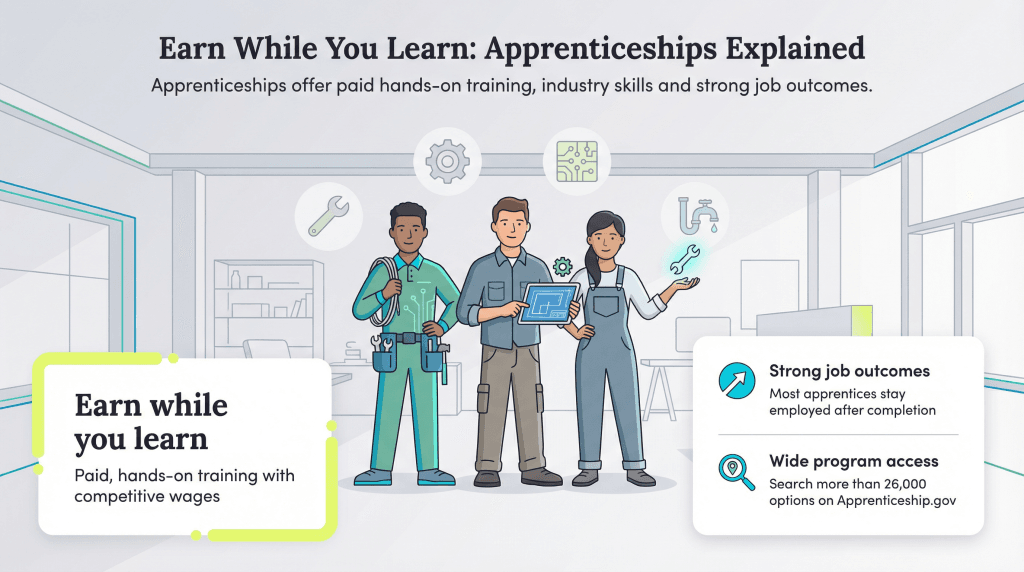
Apprenticeships are similar to trade schools but place a stronger emphasis on paid, hands-on experience. Instead of paying tuition, apprentices typically earn wages while learning job-specific skills, making this an attractive earn-and-learn option for people who want to enter the workforce quickly.
Pay during an apprenticeship can be competitive, especially when working in skilled trades. According to Indeed’s 2025 data, some of the highest-paying apprenticeship roles include plumbers, elevator technicians, carpenters, electricians and mechanics. Many apprentices in these areas earn roughly $41,500 to more than $51,700 per year while still in training. They also gain valuable real-world experience, mentorship and access to industry networks that can help ease the transition into full-time roles.
Apprenticeship program participation is enormously popular. U.S. Department of Labor data shows there were about 680,000 active registered apprentices in fiscal year 2024, up from prior years. Things tend to work out well: Roughly 93 percent of apprentices who finish their programs remain employed, underscoring apprenticeships’ effectiveness as a pathway to long-term work.
For people who don’t pursue college, trade school or apprenticeships, success often depends on initiative, networking and real-world experience. Building a personal brand, developing a reputation or learning directly from industry peers can open doors that formal education may not.
For some entrepreneurs and professionals, it’s possible to get rich without college by building in-demand skills, growing a business or leveraging industry experience instead of formal credentials.
“I had a financial advisor who was a retired PGA club pro,” Membrillo recalled. “While he did not have a college degree, he had over 25 years of business experience running a large golf club and pro shop. When he transitioned to financial advising, he obtained all the needed certifications and training from the national investment company he worked for.”
For many workers, experience speaks louder than degrees. Short-term professional and business certifications, online courses and bootcamps, such as those offered by Coursera, LinkedIn Learning and Google Career Certificates, can help build job-ready skills without a four-year commitment.
“If you start out by working for small businesses through personal connections and build up a strong reputation and a long résumé of experience, you’ll reach a point where no one will question your education,” Streif said.
Sean Peek and Sammi Caramela contributed to this article. Source interviews were conducted for a previous version.