Business.com aims to help business owners make informed decisions to support and grow their companies. We research and recommend products and services suitable for various business types, investing thousands of hours each year in this process.
As a business, we need to generate revenue to sustain our content. We have financial relationships with some companies we cover, earning commissions when readers purchase from our partners or share information about their needs. These relationships do not dictate our advice and recommendations. Our editorial team independently evaluates and recommends products and services based on their research and expertise. Learn more about our process and partners here.
Learn how to qualify, what lenders look for and where to find funding early on.

Starting a business takes money, but getting funding usually requires an established business. That’s the fundamental catch-22 of startup financing: Lenders want to see revenue, financial statements and a track record before extending credit, and a pre-revenue startup has none of those things.
Traditional bank loans are largely off the table for founders who haven’t started generating income yet. But that doesn’t mean financing is out of reach. Several alternative lending options evaluate startups on different criteria — personal credit, business plans, collateral or the strength of an idea — instead of relying on revenue history a new business simply doesn’t have. In this guide, we’ll walk through the most accessible funding options for pre-revenue startups, what lenders actually look for when revenue isn’t in the picture and how to improve your odds of getting approved.
Banks assess lending risk through financial statements, tax returns, cash flow history and business credit profiles. A startup with no revenue provides none of these signals, which makes the business look like a high-risk borrower — regardless of how strong the underlying idea may be.
The numbers reflect that reality. According to the Federal Reserve Banks’ 2026 Report on Employer Firms, 42 percent of applicants receive full funding, while 36 percent receive partial funding and 22 percent are denied outright. The picture is even more challenging for startups. Lenders that might approve a five-year-old business with steady cash flow will often decline a six-month-old venture that hasn’t yet made its first sale.
This doesn’t mean startup funding is out of reach, but it does mean the path may look different. When a business can’t show revenue, lenders shift their focus to the founder’s personal financial profile — particularly personal credit score, available assets and willingness to provide a personal guarantee.
That shift opens the door to a different set of loan options, including the following.
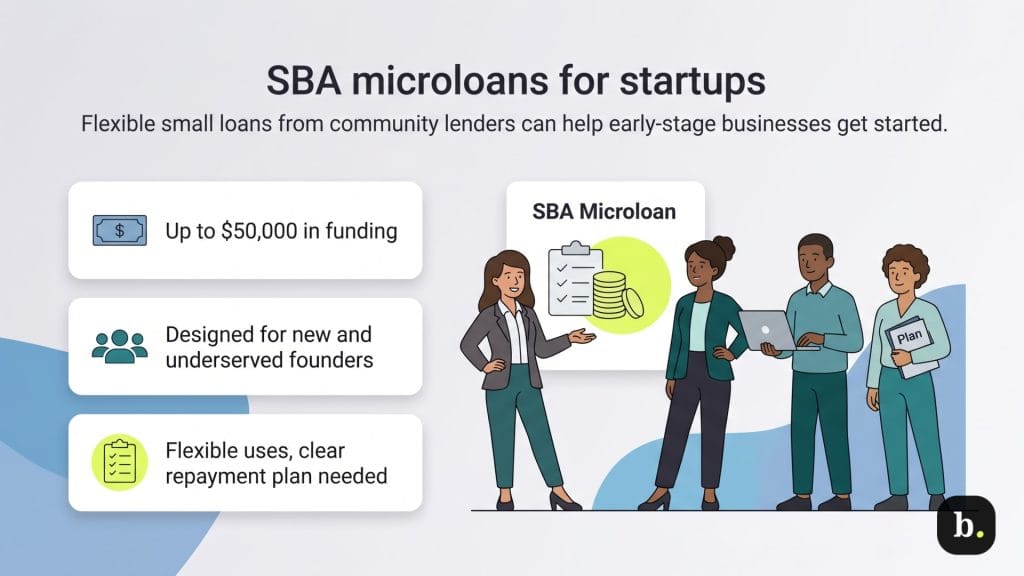
SBA microloans are one of the most startup-friendly lending options available through the federal government. The program offers loans of up to $50,000 — with an average loan size of about $13,000 — through nonprofit, community-based intermediary lenders that specialize in working with underserved and early-stage businesses.
What makes microloans particularly accessible to pre-revenue startups is how they’re underwritten. The SBA doesn’t review individual microloans for creditworthiness. Instead, each intermediary lender sets its own eligibility criteria, and many are specifically designed to serve new businesses, women-owned businesses, minority entrepreneurs and low-income founders. While intermediaries typically require some form of collateral and a personal guarantee, their standards are often more flexible than what you’d encounter when applying for a small business loan at a bank.
Interest rates generally range from 8 percent to 13 percent, with repayment terms of up to seven years. Funds can be used for working capital, inventory, supplies, furniture, fixtures and equipment, but not for purchasing real estate or refinancing existing debt. Many intermediaries also offer technical assistance and business mentoring alongside the loan, which can be especially valuable for first-time founders.
When a business doesn’t have credit history or revenue yet, many founders turn to personal loans to get started. Instead of looking at the business, lenders focus on your personal credit score, income and debt-to-income ratio, not whether the business is already bringing in money.
The advantages are straightforward: fast approval, flexible use of funds and no need to show business revenue or a business credit score. Additionally, many lenders can fund loans within a few business days.
The trade-offs are just as clear:
Personal loans tend to work best as a bridge, for example, when you need a modest amount of capital to launch a service business, fund initial marketing or cover early operating expenses and overhead costs until revenue starts coming in.
Business credit cards are one of the most accessible financing tools for new businesses. Most are approved based primarily on the owner’s personal credit, which means a pre-revenue startup can qualify as long as the founder has a solid credit profile (and there are still ways to get a business credit card with bad credit if your score isn’t perfect). Many cards also offer introductory 0 percent APR periods of 12 to 18 months, which can act as short-term, interest-free financing for early expenses if you pay off the balance before the promotional period ends.
Beyond financing, business credit cards help you build a business credit history, which becomes important when you apply for larger loans later. They also make it easier to keep track of expenses and often come with perks like cash back or travel points.
However, there are some very real risks to this strategy. Standard APRs typically jump to 23 percent or higher once the introductory period expires. Carrying a balance at those rates can get expensive quickly, especially if revenue hasn’t picked up yet. It’s also easy to take on more business debt than you can reasonably manage in the early stages.
Used carefully, business credit cards can be a helpful short-term tool, but they’re not a long-term funding solution.
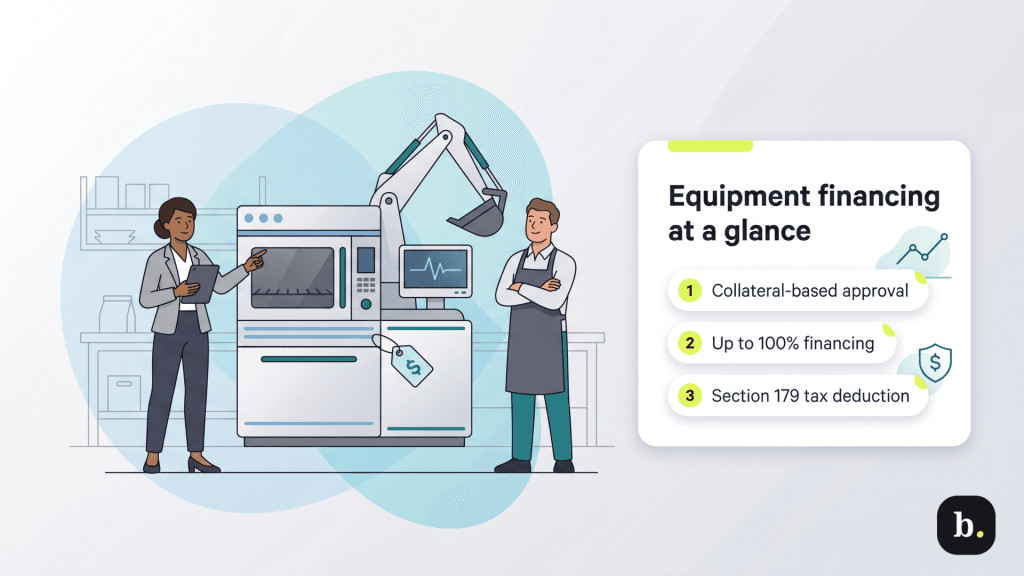
If your startup needs equipment to operate, whether it’s a commercial oven, construction machinery, medical devices or manufacturing tools, equipment financing is often one of the more accessible options, even if your business is short on revenue. The key advantage is that the equipment itself serves as collateral, so approval is based largely on the value of the business asset being purchased rather than the business’s financial history.
Some lenders advertise programs designed specifically for startups, and a portion of these require no down payment. Approval tends to hinge on the owner’s personal credit score and the equipment’s resale value. Equipment with a strong secondary market — meaning it can be resold relatively easily if the borrower defaults — is more likely to qualify for favorable terms.
There’s also a meaningful tax benefit. Under IRS Section 179, businesses can deduct up to $2,560,000 in qualifying equipment purchases in the year the equipment is placed in service for the 2026 tax year. (up from $2,500,000 in 2025, with limits adjusted annually for inflation). That can significantly reduce the effective cost of financed equipment in the first year — but only if you have income to deduct against. The Section 179 deduction is capped at your taxable income from active business operations and cannot create a loss, so a startup with no revenue often sees no first-year benefit. We’d recommend walking through the timing with a tax professional before counting on a first-year write-off.
Equipment financing tends to work best for startups in industries like restaurants, healthcare, construction and manufacturing, where the business can’t operate without the right equipment.
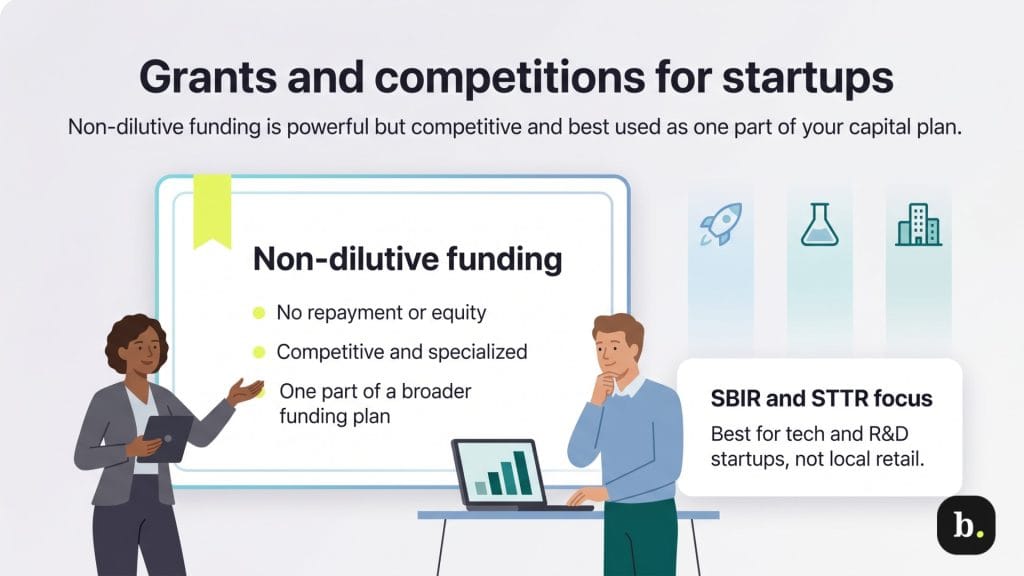
Small business grants are one of the most appealing forms of startup funding for a simple reason: They don’t need to be repaid. Unlike loans, grants provide capital with no interest, no repayment schedule and no equity dilution. The trade-off is that they’re highly competitive, often come with restrictions on how funds can be used and can involve lengthy application processes.
At the federal level, two programs come up most often: the Small Business Innovation Research and Small Business Technology Transfer programs (usually shortened to SBIR and STTR). Both were reauthorized when the Small Business Innovation and Economic Security Act was signed into law on April 13, 2026. These programs fund small businesses doing research and development with clear commercial potential, without requiring founders to give up equity.
Phase I awards typically range from $50,000 to $275,000 for proof-of-concept work, while Phase II awards can reach $750,000 to $1.8 million for further development. Eleven federal agencies participate, including the Department of Defense, the National Institutes of Health and NASA.
However, SBIR/STTR funding is geared toward technology and R&D-focused startups; it’s not a fit for a new restaurant or retail shop.
Beyond federal programs, many states and municipalities offer small business grants tied to economic development goals, and private organizations run startup competitions and accelerator programs that provide cash prizes, mentorship and resources. These opportunities are worth pursuing, but they shouldn’t be your only plan. The odds of winning any single grant or competition are low, and the timeline from application to funding can be long.
If you can’t get a business loan through traditional channels, borrowing from friends and family is one of the oldest forms of startup funding, and it’s still popular for a reason. People who know and trust you may be willing to back your idea before any institutional lender will.
The key is to treat these arrangements like real business transactions. Put everything in writing, including the loan amount, interest rate (if any), repayment terms and what happens if the business doesn’t work out. Informal agreements can quickly strain relationships when expectations aren’t clearly defined upfront.
Crowdfunding offers another path to early-stage capital, and it comes in a few different forms. If you’re weighing a business loan vs. crowdfunding, the trade-offs usually come down to repayment versus giving up equity or offering perks.
Reward-based crowdfunding through platforms like Kickstarter and Indiegogo lets you raise money by pre-selling a product or offering perks to backers. It can also serve as a form of market validation: If people are willing to pay for your product before it exists, that’s a strong signal.
Equity crowdfunding, available through platforms like Wefunder, StartEngine and Republic, allows you to raise up to $5 million in a 12-month period from both accredited and non-accredited investors under SEC Regulation Crowdfunding (Reg CF). In exchange, backers get equity in your company. This route means dealing with regulatory requirements, including SEC filings and ongoing reporting, so it’s smart to get legal guidance ahead of time.
No matter which funding path you pursue, there are a few steps you can take to strengthen your position as a pre-revenue borrower.
Not having revenue doesn’t mean you’re out of options; it just means the options look different. SBA microloans, personal loans, business credit cards, equipment financing, grants and crowdfunding can all provide a path to capital without an established track record. Each comes with its own costs, requirements and trade-offs, and the right choice depends on how much you need, what you need it for and what you’re willing to put on the line.
This is one of the core challenges of starting a business: You need funding to get off the ground, but most traditional lenders want to see proof that you’re already generating income. That’s why preparation matters. Build your personal credit, put together a solid business plan, understand the true cost of each option and start with an amount you can realistically manage. Early-stage financing isn’t always cheap or easy, but it’s what gets you from idea to revenue — and once revenue starts coming in, your options expand quickly.
