Business.com aims to help business owners make informed decisions to support and grow their companies. We research and recommend products and services suitable for various business types, investing thousands of hours each year in this process.
As a business, we need to generate revenue to sustain our content. We have financial relationships with some companies we cover, earning commissions when readers purchase from our partners or share information about their needs. These relationships do not dictate our advice and recommendations. Our editorial team independently evaluates and recommends products and services based on their research and expertise. Learn more about our process and partners here.
Need a Business Phone Number, but Not a Business Phone?
You already have a phone to make calls — what you really need is a business number that works on it.
Written by: Max Freedman, Senior AnalystUpdated Nov 12, 2025
Editor Verified:
Editor Verified
A business.com editor verified this analysis to ensure it meets our standards for accuracy, expertise and integrity.
Gretchen Grunburg,Senior Editor
Business.com earns commissions from some listed providers. Editorial Guidelines.
Table of Contents
In today’s digital landscape, a physical phone system is often unnecessary for modern businesses. According to FCC data, over 75 percent of business landlines in the U.S. now rely on Voice over Internet Protocol (VoIP) technology, underscoring how quickly companies are moving away from traditional phone systems. Entrepreneurs today have more flexible, scalable and cost-effective options than ever before. A traditional business phone system — or even a landline, as we once knew them — is no longer the only option.
If you’re looking for a business phone number but are on the go — or your company doesn’t handle enough calls to justify a full office setup — then a VoIP mobile app or call-forwarding service is the perfect solution.
Searching for a business phone system and not sure where to start? Tell us a little more about your business and get customized quotes from qualified providers.
Why you need a business phone number
As you’ve likely already experienced since starting your company, a business phone number helps your company appear more professional than it would if you listed your personal cell phone number as your only point of contact. A dedicated business number can:
Building trust with potential customers may be the most important benefit. According to 2024 TransUnion survey data, nearly 80 percent of consumers consider the phone an important channel for communicating with businesses, and a 2025 Transaction Network Services survey found that 76 percent prefer to engage with companies that clearly identify their calls. A dedicated business number signals credibility and helps ensure customers feel confident answering your calls.
That said, you don’t necessarily need physical desk phones to gain these benefits — just a reliable business number that works wherever you do. A VoIP system can provide this flexibility while adding advanced communications features such as AI-powered call transcription, sentiment analysis, video conferencing, a virtual receptionist, intelligent call routing through IVR systems, and seamless CRM integrations.
Did You Know?
Businesses can reduce operational costs by up to 60 percent when they switch from traditional phone systems to VoIP, according to Nextiva.
5 types of business phone numbers
As your business grows, you may want to add new phone numbers without maintaining a full physical phone system. Thanks to modern communication technology, companies now have more flexibility in how they set up, manage and route calls. Here are five types of business phone numbers to consider.
1. Local business phone numbers
Local business phone numbers can be part of your local marketing strategy, helping you establish a presence in specific geographic markets and build trust with nearby customers. These numbers use a local area code, so when someone calls, it feels like they’re reaching a business right in their community.
Many providers also offer vanity numbers — customized digits that make your number easy to remember, such as one that spells a word related to your business or service.
2. Toll-free business phone numbers
Toll-free business numbers — often starting with 800, 888, 877, 866, 855, 844 or 833 — project credibility and give your company a national presence. They also make it easy for customers to reach you without paying long-distance charges, which can help encourage more inbound calls. Like local numbers, toll-free lines can also be set up as vanity numbers to make them more memorable and on-brand.
3. Cell phone business numbers
A cell phone business number connects directly to a mobile phone you already own, so you can answer work and personal calls without carrying multiple devices around. Thanks to the dual-SIM technology in most modern smartphones, you can easily separate your personal and professional lines while staying reachable wherever you go. You can receive business calls directly on your cell number or have calls from your local business line automatically forwarded to it for convenience. For many entrepreneurs, this flexibility makes it easy to run an entire business from a smartphone.
4. Virtual business phone numbers
A virtual business phone number isn’t tied to any one location or device. These cloud-based numbers offer complete flexibility, allowing you and your team to stay connected and maintain consistent communication from anywhere. With a virtual phone number, you can make and receive secure calls over the internet without paying long-distance fees, all from your computer, tablet or smartphone. Because virtual phone numbers don’t require extra hardware, they’re an easy, cost-effective way to support clear and reliable business communication.
5. VoIP business phone numbers
VoIP has become the most popular choice for setting up new business phone numbers. Unlike traditional landlines, VoIP numbers are assigned to users rather than physical phone lines. The system converts your voice into a digital signal that travels securely over the internet, making it easy to manage calls from virtually anywhere.
VoIP platforms also come packed with advanced features that go well beyond what a standard phone line offers. These include AI-powered voicemail transcription, intelligent call routing based on customer history, automatic call forwarding, and real-time analytics dashboards that help teams monitor and improve customer interactions.
FYI
When it comes to VoIP vs. landlines, VoIP wins on cost, flexibility and features. Landlines depend on physical infrastructure and offer limited scalability, while VoIP runs entirely online, making it easy to add users and integrate tools as your business grows.
Best vendors for business phone numbers
Many of the best business phone system providers make it easy to set up and manage VoIP-based business phone numbers. The best choice for your company depends on your size, call volume, and communication needs. Whether you’re looking for advanced call-routing tools, strong CRM integrations or simple mobile access, there’s a provider that fits your workflow.
Google Voice
Cost: Free for personal use; business plans start at $10 per user per month for Google Workspace subscribers.
Google Voice is a popular entry-level option for solopreneurs and small teams. You can set up a Google Voice number and connect it to your existing lines — mobile, home or office — without needing a dedicated phone or device. Calls can be made and received from your computer or smartphone through the Google Voice app, keeping communication simple and flexible.
Core features include custom call forwarding, voicemail-to-text transcription, caller blocking, and text-to-email transcription. The business version adds advanced tools such as multi-level auto-attendants, ring groups, desk phone support, and seamless integration with Google Workspace apps like Calendar and Meet.
Because the free plan is designed for individual users, businesses will need to upgrade to Google Workspace for commercial tools and shared access. If you’re running your business on your own, though, Google Voice offers an easy and affordable way to establish a dedicated number.
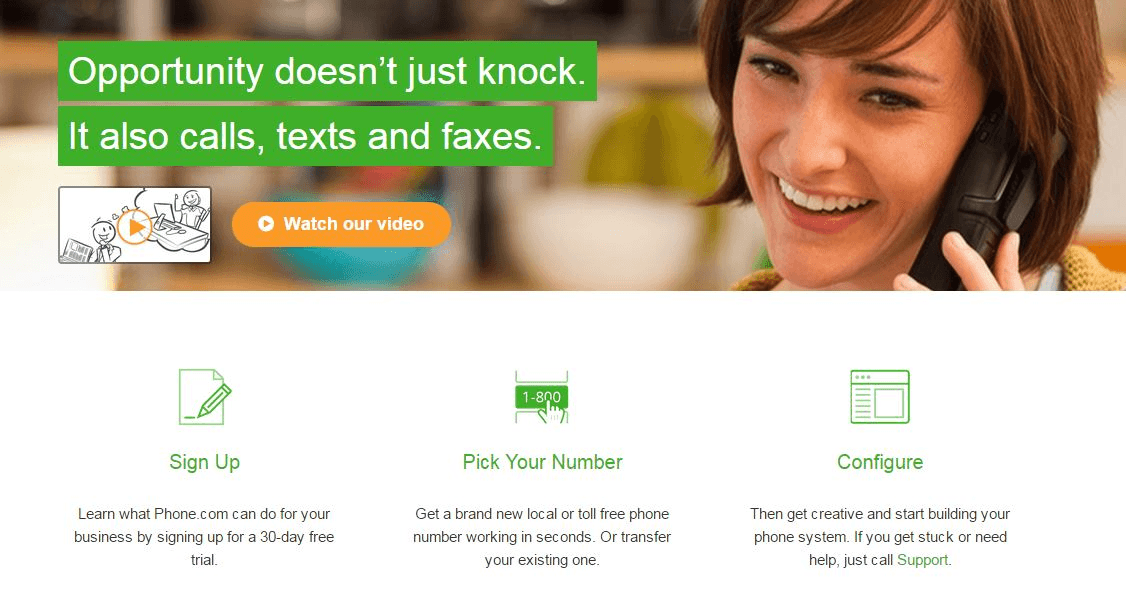
Phone.com
Cost: $15 to $33.33 per user per month with annual billing; all plans include unlimited calling minutes.
Phone.com strikes a good balance for growing teams that need an affordable, flexible solution. Its cost-effective VoIP system runs on mobile and desktop devices, so you won’t need physical office phones. Through the app, users can handle calls, check logs and organize contacts with ease.
You can also set up an auto-receptionist, schedule or queue calls, enable find-me/follow-me routing, host conference calls, transcribe voicemails to email, and send or receive faxes — all from the same platform. Most plans include additional tools such as video conferencing and an automated attendant to greet and route callers. For a personalized touch, custom phone numbers are available for $4.99 per month, per device.
Source: Phone.com
Tip
You don't need costly hardware to manage multiple lines. Many VoIP providers, including Phone.com, offer multiline phone system features built right into their software.
Grasshopper
Cost: $14 to $55 per month with annual billing (True Solo, Solo Plus, and Small Business plans with varying numbers and extensions)
Grasshopper is a business VoIP service built for entrepreneurs who want to run their phone system entirely from mobile and desktop devices. The platform’s mobile-first design functions like a business softphone, letting you make and receive calls through the Grasshopper app instead of relying on physical handsets.
All plans include unlimited domestic calling, voicemail and transcription, call forwarding, custom greetings and Wi-Fi calling. Higher-tier plans add simultaneous call handling, call recording and unlimited extensions. Optional add-ons include international calling, virtual receptionist service and digital listings management.
Grasshopper doesn’t include video conferencing or advanced team collaboration tools, but its simplicity and flexibility make it a good fit for smaller teams that want a cost-effective solution.
RingEX (formerly RingCentral MVP)
Cost: $20 to $35 per user per month with annual billing for the Core, Advanced and Ultra plans
RingEX gives you more than a business phone number. It unifies calling, messaging and video meetings in one streamlined platform, making it easy for teams to collaborate and stay connected. The system supports unlimited domestic calling in the U.S. and Canada, on-demand call recording and enhanced business SMS, all accessible from the RingEX desktop and mobile apps.
The Core plan includes 100 toll-free minutes, 25 SMS messages per user each month and HD video meetings for up to 100 participants. The Advanced plan adds CRM integrations, multi-site management, core reporting and insights, and increases your monthly allowance to 1,000 toll-free minutes and 100 SMS messages per user. The Ultra plan expands that even further with RingCentral Webinar, real-time analytics dashboards, unlimited cloud storage, device monitoring and alerts, 10,000 toll-free minutes and 200 SMS messages per user each month.
AI-powered tools like transcription, automated notes and summaries help your team work smarter, while HD voice and AI noise cancellation keep conversations clear. With 99.999 percent uptime, your business number remains reliable no matter where your team works.
Did You Know?
Check out our RingEx review to learn more about the platform's expanded AI and automation add-ons, including the AI Receptionist, Business SMS Booster and Call Queues Booster. These tools help teams automate workflows and handle higher messaging volumes with ease.
Nextiva
Cost: $15 to $75 per user per month with annual billing for Core, Engage and Power Suite CX plans
Nextiva’s VoIP service goes beyond standard calling to deliver an all-in-one communications and customer engagement platform. The Core plan includes inbound and outbound voice, business SMS, video meetings, call routing, screensharing and file sharing. Teams also get unlimited audio conferencing, team chat and desktop and mobile apps for unified calling, messaging and video.
The Engage plan adds customer-to-team SMS, toll-free numbers and minutes (up to 2,000), advanced reporting, and inbound sales and service call center capabilities. It also supports live chat and web bots, plus CRM and social integrations with Salesforce, HubSpot and Zendesk.
At the top tier, the Power Suite CX plan supports up to 100 agents and expands automation features with AI-driven transcription, summarization and skills-based routing. It’s designed for businesses that want to combine voice and web chat with intelligent customer journey management.
Across all plans, Nextiva guarantees 99.999 percent uptime for dependable service. [Learn more in our Nextiva review.]
For almost a decade, Max Freedman has been a trusted advisor for entrepreneurs and business owners, providing practical insights to kickstart and elevate their ventures. With hands-on experience in small business management, he offers authentic perspectives on crucial business areas that run the gamut from marketing strategies to employee health insurance.
At business.com, Freedman primarily covers financial topics, including debt financing, equity compensation, stock purchase agreements, SIMPLE IRAs, differential pay, workers' compensation payments and business loans.
Freedman's guidance is grounded in the real world and based on his years working in and leading operations for small business workplaces. Whether advising on financial statements, retirement plans or e-commerce tactics, his expertise and genuine passion for empowering business owners make him an invaluable resource in the entrepreneurial landscape.