Your free business.com+ membership unlocks exclusive tech deals and advisor support
Join Free
BDC Hamburger Icon

Menu

Close
BDC Logo with Name
Search Icon
Search Icon
Advertise with us
Advertising Disclosure
Close
Advertising Disclosure

Business.com aims to help business owners make informed decisions to support and grow their companies. We research and recommend products and services suitable for various business types, investing thousands of hours each year in this process.

As a business, we need to generate revenue to sustain our content. We have financial relationships with some companies we cover, earning commissions when readers purchase from our partners or share information about their needs. These relationships do not dictate our advice and recommendations. Our editorial team independently evaluates and recommends products and services based on their research and expertise. Learn more about our process and partners here.

Minimum Requirements for Business Credit Cards

From credit scores and income requirements to secured cards and corporate cards, here's what you need to know before applying.

author image
Written by:
Adam Uzialko, Senior Editor
author image
Editor verified:
Gretchen Grunburg,Senior Editor
Last Updated Jun 05, 2026
Business.com earns commissions from some listed providers. Editorial Guidelines.
Table Of Contents Icon

Table of Contents

Open row

Getting approved for a business credit card isn’t always as straightforward as meeting a single credit score requirement. Issuers look at a combination of factors, including your personal credit history, business revenue, time in business and overall financial profile. The good news is that approval standards vary widely, which means there are options for startups, newer businesses and owners who are still building credit.

This guide breaks down the requirements most issuers consider, what credit scores and financial qualifications they typically look for, and what you can do if you’re not quite there yet.

What issuers look at first

For most business credit card applications, your personal credit score matters more than your business credit score. While issuers may look at some details about your business, your personal credit history is often the first thing they look at.

That surprises a lot of applicants, especially business owners who have spent time building business credit. The reality is that many small businesses simply don’t have much borrowing history for an issuer to evaluate. A personal credit report, on the other hand, often provides years of payment and borrowing data, giving lenders a clearer picture of how an account is likely to be managed.

Most small business credit cards also require a personal guarantee. That means you’re personally responsible for repaying the balance if the business can’t. Because of that added risk, issuers typically place significant weight on your personal credit history and credit score.
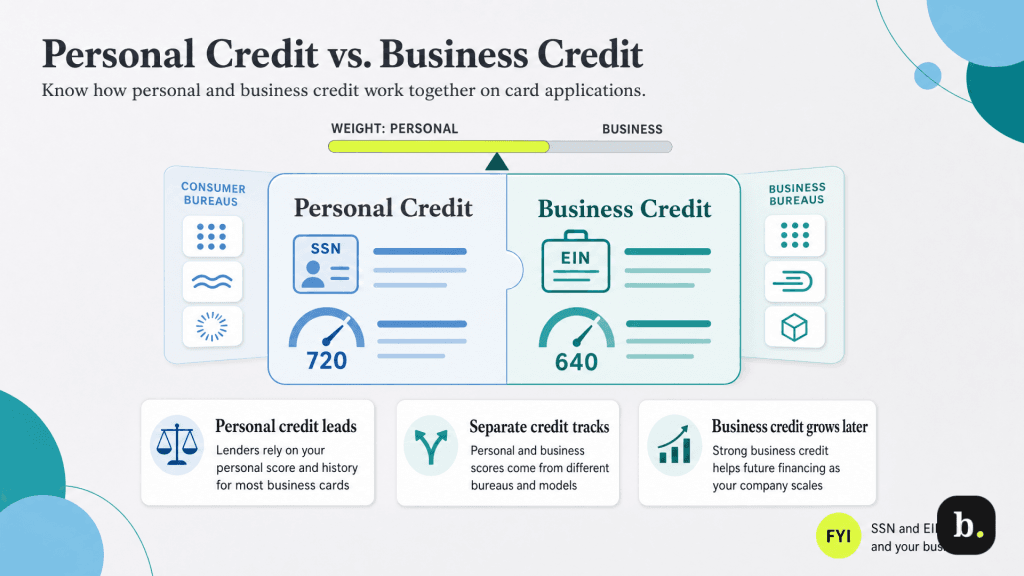
Personal credit vs. business credit

personal credit vs. business credit

Personal and business credit serve different purposes, are tracked by different bureaus and use different scoring models. Understanding how they differ can help explain why most issuers focus on personal credit during the application process. Here’s what to know:
  • Personal credit is usually the deciding factor. Most business credit card issuers review the owner’s personal credit score and credit history when evaluating an application. Because you’re often personally guaranteeing the account, your personal credit profile carries significant weight.
  • Personal and business credit are tracked separately: Personal credit scores are maintained by Equifax, Experian and TransUnion and generally range from 300 to 850. Business credit is tracked by commercial bureaus such as Dun & Bradstreet, Experian Business and Equifax Business, which use different scoring models and ranges.
  • New businesses often have limited business credit history: Even established small businesses may have thinner business credit files than their owners have personal credit histories. That’s one reason issuers frequently rely on personal credit when making approval decisions.
  • Business credit still has a role: A strong business credit profile and business credit score can support future financing applications and may become more influential as your company grows. For most business credit card applications, however, personal credit remains the primary factor issuers evaluate.
FYIDid you know
Most business credit card applications ask for both an SSN and an EIN. Your Social Security number helps issuers evaluate your personal credit and verify your identity, while your Employer Identification Number links the account to your business.

What credit score do you need for a business credit card?

What credit score do you need

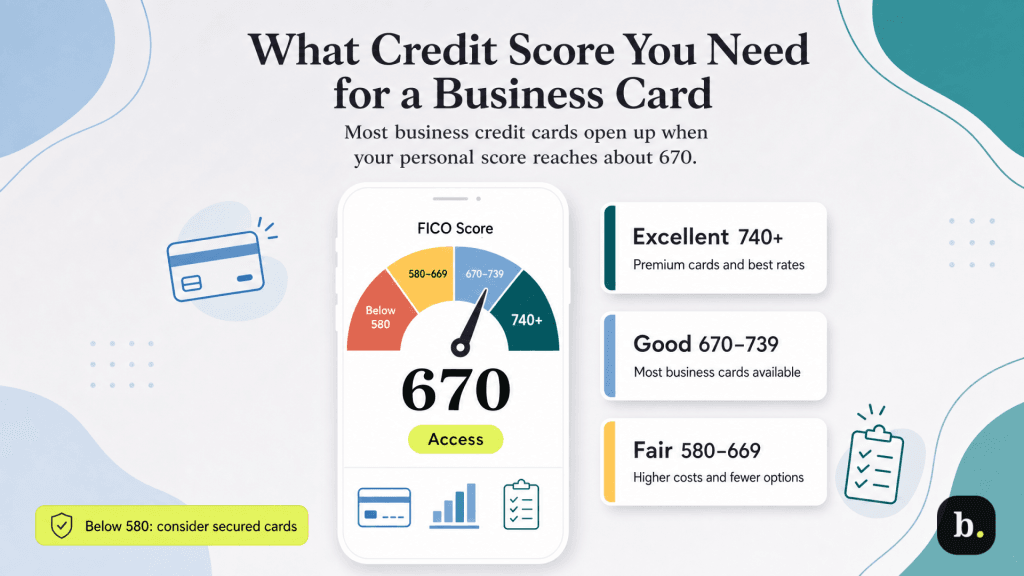
There’s no single credit score requirement that applies to every issuer or every card. However, most business credit cards fall into fairly predictable credit-score ranges. As a general guide:

  • Excellent credit (740+): The broadest access, including premium cards with the richest rewards, the highest limits and the lowest rates.
  • Good credit (670-739): Qualifies for most standard business credit cards. Many issuers, including Chase, generally look for a personal FICO score of about 670 or higher. This is where most mainstream business cards become accessible.
  • Fair credit (580-669): Options become more limited, but they don’t disappear. You may qualify for entry-level unsecured cards, though they’re more likely to come with higher rates, lower limits and fewer perks.
  • Below 580: Traditional unsecured business credit cards can be difficult to obtain. At this stage, secured cards are often the most realistic option (more on secured cards below).

These ranges should be viewed as guidelines rather than hard rules. Note that some issuers may impose a slightly higher benchmark of around 690 for business credit cards, while others place more emphasis on factors such as income, existing debt and overall credit history. In practice, a personal credit score of about 670 or higher will generally give you access to the largest selection of business credit cards.

Do you need business revenue to qualify?

One of the biggest misconceptions about business credit cards is that you need substantial business revenue to qualify. In reality, many issuers don’t publish minimum revenue requirements for traditional small-business credit cards. For most applicants, personal credit is far more important than revenue.

That means startups, side hustles and newer businesses can often qualify even if revenue is modest or inconsistent. Revenue may still influence your credit limit, but it isn’t always the deciding factor in whether you’re approved.

What income should you report on your application?

Most business credit card applications ask for annual income or business revenue. What you report depends on your business structure and circumstances:

  • Established businesses: Report your actual business revenue. If you don’t have the figure readily available, check recent financial reports such as your profit and loss statement. (Revenue reported on a cash flow statement may differ depending on timing and accounting methods.)
  • Sole proprietors and very small businesses: Many issuers let applicants include total income, not just business income. For those applying for a business credit card as a sole proprietor, money you’ve earned outside the business may also count, depending on the card issuer.
  • Startups: If you’re just starting a business and have little or no revenue yet, personal income and credit history often become more important factors.

Whatever income figure you provide, make sure it’s accurate. Issuers may verify application information, and intentionally overstating income on a credit application can create legal problems.
TipBottom line
If you're applying for a business credit card with bad credit and want to improve your odds, focus on cards designed for fair-credit or credit-building applicants instead of applying for premium rewards cards.

When revenue matters more

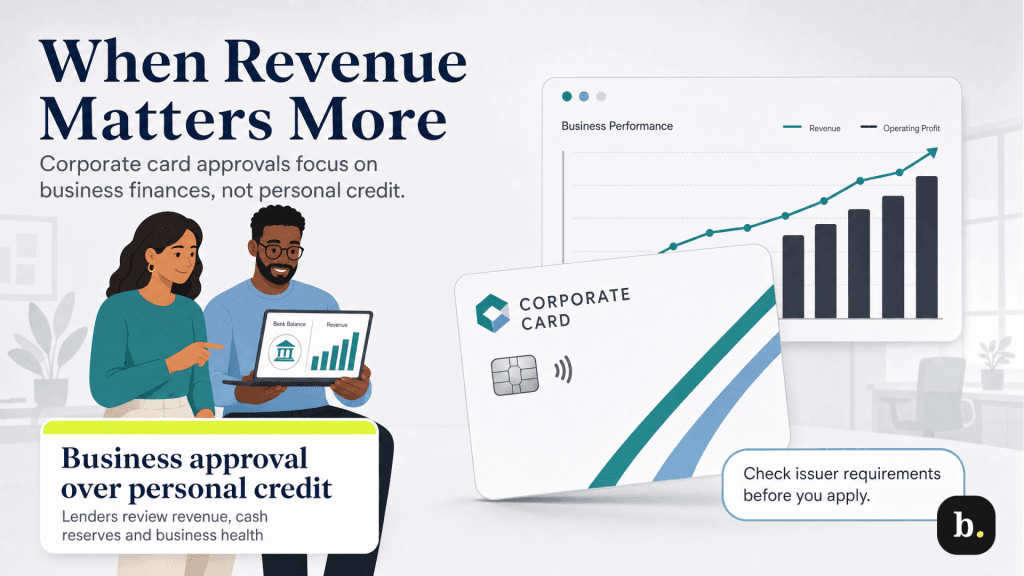
when revenue matters more

Revenue and cash reserves become much more important when applying for corporate cards that are underwritten based on the business rather than the owner.

Unlike traditional business credit cards, corporate cards from providers such as Brex and Ramp generally don’t rely on a personal credit check. Instead, they evaluate the financial strength of the business itself.

As a result, these products often require minimum revenue levels, cash balances or funding thresholds. Requirements vary by provider and can change over time. For example, Ramp has generally looked for a minimum balance of about $25,000 in a U.S. business bank account, while Brex has cited minimum cash requirements for startups and higher financial thresholds for more established companies. Always confirm current requirements directly with the issuer before applying.

What else can affect approval?

Credit score and income tend to get the most attention, but they’re not the only factors issuers consider. Depending on the card and issuer, details such as how long you’ve been in business, your existing debt and even your relationship with the lender may influence the decision.

Here are a few things to keep in mind:

  • Time in business matters, but it isn’t always a dealbreaker. Many issuers will work with startups and newer businesses, especially when the owner’s personal credit is strong. More established businesses may have an easier time qualifying for higher limits or premium cards.
  • You don’t need a formal business entity to apply. Sole proprietors can generally apply using their SSN and business information. While incorporated businesses may have access to additional products, many small-business credit cards are available to freelancers, consultants and side-hustle owners.
  • Existing debt can affect approval. Issuers look at your overall financial picture, including your personal and business debt. A business owner who recently financed equipment, opened new credit cards and took out a loan may be viewed differently than someone with fewer outstanding obligations.
  • An existing relationship may help. If you already have a personal or business checking account, savings account or credit card with the issuer, that history can sometimes work in your favor, particularly if you’ve managed the account responsibly.

What to do if you don’t meet the requirements

Not every business owner applies with excellent credit, years of business history or strong revenue. If your qualifications are borderline, there are several steps you can take to improve your approval odds before submitting an application.

1. Start by checking your credit.

Because personal credit is usually one of the most important factors in a business credit card approval decision, it’s worth reviewing your credit before you apply. Many banks, credit card issuers and free credit-monitoring services provide access to your score at no cost. Checking your own credit is considered a soft inquiry, so it won’t affect your score.

Some free services provide a VantageScore rather than a FICO score. The two scores are often similar, but don’t be surprised if the numbers aren’t an exact match. A free score can still give you a good sense of where you stand before applying.

You can also review your business credit reports with commercial bureaus such as Dun & Bradstreet, Experian Business and Equifax Business. Business credit typically plays a smaller role in most small-business credit card applications, but monitoring it can help you identify errors and track your progress over time.

2. Strengthen your application.

If you’re close to qualifying but not quite there yet, a few changes can strengthen your application:

  • Pay down existing balances. If you’re using a large share of your available credit, paying down balances may help your score and make your application look stronger.
  • Review your credit reports for errors. Incorrect late payments, duplicate accounts or other inaccuracies can hurt your score unnecessarily. Disputing mistakes on both your personal and business credit reports may help improve your profile.
  • Continue building business credit. The longer your business credit history becomes, the more information future lenders have to work with. Vendor accounts that report to commercial credit bureaus can help establish that track record.
  • Apply strategically. If an issuer offers prequalification, take advantage of it. These tools typically use a soft inquiry and can help you gauge your approval odds before submitting a formal application. It’s also wise to avoid submitting multiple applications within a short period.

3. Consider a secured business credit card.

If traditional business credit cards are out of reach right now, a secured card may help you get your foot in the door. These cards typically require a refundable security deposit and can provide an opportunity to build a stronger credit history over time.

While secured cards generally offer fewer rewards and benefits than unsecured cards, they can provide a path forward. By making on-time payments and using the card responsibly, you may be able to strengthen your credit profile and eventually qualify for a traditional unsecured business credit card.

Did You Know?Did you know
According to the 2026 Small Business Credit Survey, 62 percent of employer firms regularly use business credit cards. For many businesses, qualifying for the right card becomes an important part of managing cash flow and everyday expenses.

Getting approved starts with knowing where you stand

Many business owners assume they need years of business history or substantial revenue to qualify for a business credit card. In reality, personal credit is often the biggest factor. That’s good news for startups, side hustles and newer businesses that may not have an extensive financial track record yet.

Wherever you’re starting from, the goal isn’t to qualify for every card on the market. It’s to find the cards that fit your current profile, use them responsibly and build toward better options over time.

Did you find this content helpful?
Verified CheckThank you for your feedback!
author image
Written by: Adam Uzialko, Senior Editor
Adam Uzialko, the accomplished senior editor at Business News Daily, brings a wealth of experience that extends beyond traditional writing and editing roles. With a robust background as co-founder and managing editor of a digital marketing venture, his insights are steeped in the practicalities of small business management. At business.com, Adam contributes to our digital marketing coverage, providing guidance on everything from measuring campaign ROI to conducting a marketing analysis to using retargeting to boost conversions. Since 2015, Adam has also meticulously evaluated a myriad of small business solutions, including document management services and email and text message marketing software. His approach is hands-on; he not only tests the products firsthand but also engages in user interviews and direct dialogues with the companies behind them. Adam's expertise spans content strategy, editorial direction and adept team management, ensuring that his work resonates with entrepreneurs navigating the dynamic landscape of online commerce.