Business.com aims to help business owners make informed decisions to support and grow their companies. We research and recommend products and services suitable for various business types, investing thousands of hours each year in this process.
As a business, we need to generate revenue to sustain our content. We have financial relationships with some companies we cover, earning commissions when readers purchase from our partners or share information about their needs. These relationships do not dictate our advice and recommendations. Our editorial team independently evaluates and recommends products and services based on their research and expertise. Learn more about our process and partners here.
Radio frequency identification technology has become an accessible and essential tool for modern inventory management.


RFID, or radio frequency identification, has come a long way since the early 2000s. At that time, Walmart was the first big retailer to experiment with the new tracking technology, which cost an astounding $1.50 per tag. RFID was a sparkling new concept used primarily to improve inventory accuracy.
Fast-forward to today, and the landscape has shifted entirely. RFID tags now cost mere cents when purchased in bulk, making them a viable option for businesses of all sizes. The technology is now widely used across retail and delivers benefits that go well beyond basic inventory tracking. We’ll examine how retailers use RFID today and break down the pros and cons to help determine whether it’s the right solution for your business.
RFID for retail is a technology that uses radio waves to automatically identify and track products. It enhances inventory management, reduces theft and improves the shopping experience. By creating a wireless link between a tag and a reader, retailers can capture data without requiring direct line-of-sight scanning.
Instead of using a printed barcode, RFID relies on a tiny computer chip called a tag that stores detailed product information, including the item number, inventory entry date, size, location, color, type, origin and price.
When items with an RFID tag pass through an RFID reader, the reader records and stores this data. Unlike barcodes, which must be scanned individually, RFID readers can capture data from hundreds or even thousands of tags on a pallet in seconds.
Today’s brick-and-mortar and e-commerce retailers leverage technologies such as RFID, barcodes and near-field communication (NFC) to improve inventory management, streamline operations and ultimately create a better shopping experience. Each technology serves a different purpose and has its own ideal use cases.
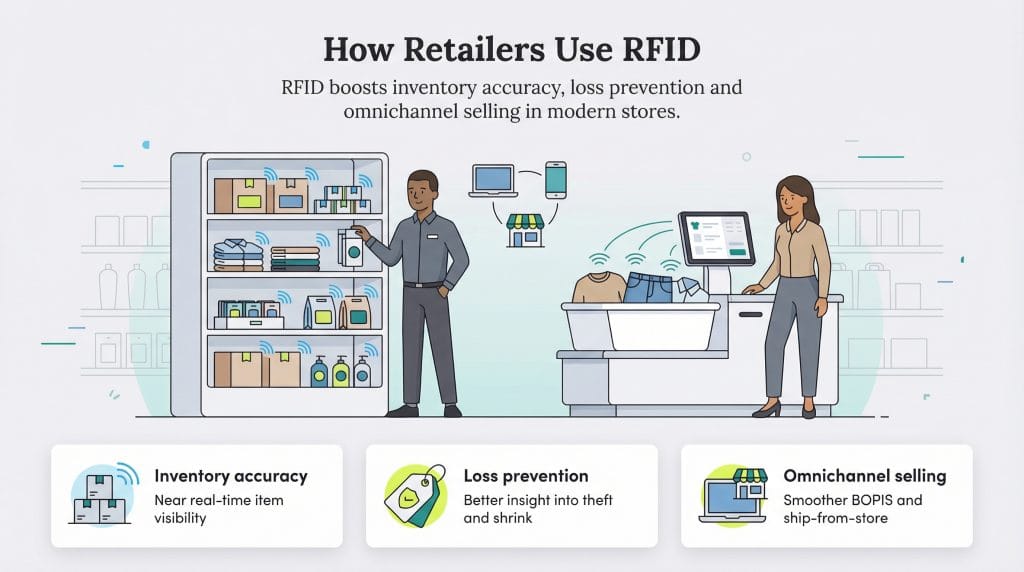
Retail adoption of RFID is accelerating as the technology becomes more cost-effective. According to a 2025 Zebra Technologies study, 54 percent of retail decision-makers plan to deploy RFID technology within the next five years to improve inventory visibility and reduce shrinkage.
Here are some of the most common ways retailers use RFID technology:
As with any new technology, you need to understand how you’ll use it before you adopt it. “RFID is meaningless if it’s not used as an enabler,” said Holden Bale, a former principal at Thoughtworks, a global consultancy focused on using technology to drive business innovation in retail. “If a company buys it without clear use cases, then there’s no ROI [return on investment].”
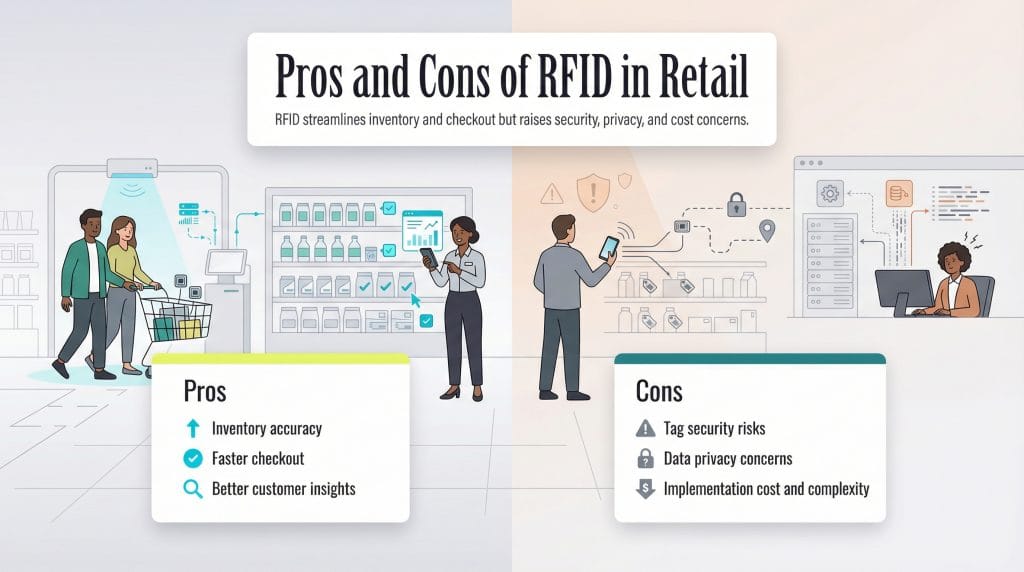
To ensure a strong return, consider the following pros and cons before investing in RFID for your retail business.
RFID can offer several advantages for retailers, including the following:
Inventory control
Better inventory control improves the customer experience, especially for retail chains with multiple locations and omnichannel fulfillment. For example, for online orders picked up in store, inventory accuracy matters. RFID helps retailers maintain more reliable stock data and fulfill omnichannel orders with fewer errors.
“RFID can be most beneficial when it comes to enhanced inventory control and loss prevention, where RFID gives retailers much greater visibility into their inventory,” noted cybersecurity consultant Emily Mitchell. “Traditional barcodes can only identify products at a basic level, and all products of the same type share identical barcodes.”
Enhanced data and inventory detail
Straightforward inventory control is valuable, but RFID improves inventory control with information far beyond generic descriptions.
“RFID tags carry unique identification numbers and can store a moderate amount of data, which can be used to identify and track items on an individual level anywhere in the store,” Mitchell said.
“This is especially helpful for apparel, where a barcode might say, ‘This is a $300 sundress,’ and an RF security tag might say, ‘Someone just walked off with something,'” she explained. “An RFID tag can tell you, ‘This is a $300 sundress in a size 0; it’s coral pink. This is the one with a small snag by the hem, but it’s still super cute; it arrived in the store three weeks ago, you just put it on the rack last week, and now it’s walking out the front door.'”
Smart shelving
RFID helps retailers keep track of where products are located in a store. When item locations are accurate, employees can direct customers to products more quickly and confidently.
Consider a large retailer like Lowe’s Home Improvement, where customers may struggle to find specific items such as tools or fixtures. RFID-powered systems can help guide shoppers to the right aisle or shelf. “Lowe’s has an app that can route customers through the store and guide them to specific products because the inventory data is updated in real time,” Bale said.
Shorter checkout wait times
RFID can scan multiple items at once, which helps retailers move customers through checkout faster. Shorter lines and quicker transactions improve the customer journey.
“While traditional barcodes require line-of-sight scanning and must be read one item at a time, RFID allows an entire shopping cart to be scanned at once, without removing items from the basket,” Mitchell said.
Improved customer experience
By reducing stockouts and overstocks and supporting omnichannel selling, RFID contributes to a better overall customer experience. Improved experiences often lead to stronger customer loyalty and lower acquisition costs.
Smart fitting rooms are another example. RFID readers and smart mirrors can show customers size availability, color options and suggested accessories while they try items on.
Store teams can also use fitting-room data to understand which items are being tried on and which ultimately make it to checkout. These insights help retailers refine buying decisions, stock more in-demand items and reduce stale inventory.
Before implementing RFID technology, retailers should weigh these potential drawbacks:
Security risks
RFID can support a wide range of customer-facing improvements, but it may also introduce vulnerabilities if it’s not deployed carefully. In some cases, RFID systems can create a weak link in a retailer’s cybersecurity plan.
“RFID tags can be very easy to clone, especially if the chip has no authentication mechanism,” Mitchell cautioned. “Using practically any smartphone, one can walk over to a lower-priced item and read the tag, then walk over to a higher-priced item and write the information from the lower-priced item to its tag. That $300 coral pink size 0 sundress can easily become a $5 tank top with two quick and inconspicuous gestures on a smartphone.”
Lack of privacy and transparency
RFID tracking doesn’t stop when a customer leaves the store, unless the tags are removed or deactivated. Although RFID is a game-changer for understanding your inventory, customers may not want you to continue tracking them after the sale.
“If consumers pay for products with a credit or debit card, or scan a loyalty discount card at checkout, retailers can then link the purchases to the recorded RFID data and use the information to map out individual customers’ movements throughout the store, or even an entire shopping complex,” Mitchell explained.
Cost and integration
RFID can support new customer experiences, deeper data insights and more efficient operations, but adoption requires meaningful investment. Implementing RFID takes time, planning and upfront spending.
RFID tags are only one part of the overall cost. Retailers should also factor in the following expenses:
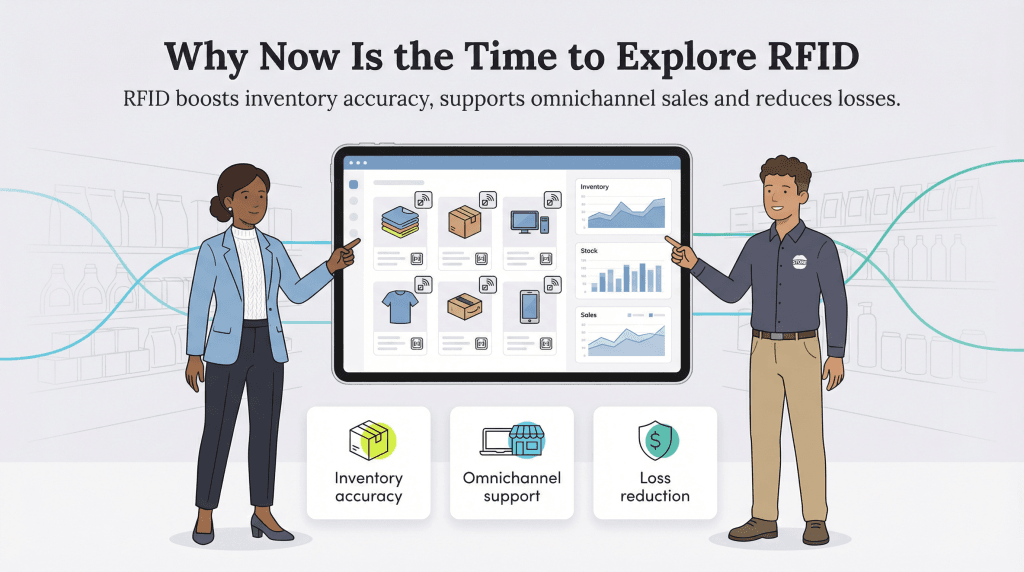
If your store hasn’t explored RFID yet, it may be worth taking a closer look. Many retailers are already using RFID to improve inventory accuracy, support omnichannel selling and reduce losses. RFID can also integrate with other systems, such as supply chain and inventory management platforms, making it easier to manage data across the business.