Business.com aims to help business owners make informed decisions to support and grow their companies. We research and recommend products and services suitable for various business types, investing thousands of hours each year in this process.
As a business, we need to generate revenue to sustain our content. We have financial relationships with some companies we cover, earning commissions when readers purchase from our partners or share information about their needs. These relationships do not dictate our advice and recommendations. Our editorial team independently evaluates and recommends products and services based on their research and expertise. Learn more about our process and partners here.
For some people, confidence isn’t something that comes easily. We have provided the following steps to help foster confidence in sales.


In today’s competitive business landscape, mastering the art of the sales pitch has become more critical than ever. Whether you’re presenting in a boardroom, on a video call, or at a networking event, your ability to project confidence can make or break the deal.
A sales pitch represents your first meaningful interaction with a potential customer. It’s a crucial moment that sets the tone for your entire business relationship. Smart entrepreneurs know that preparation is key: understanding your client’s pain points, industry challenges and growth objectives allows you to position your solution as the perfect fit from the very first word.
The most effective pitches are the ones that solve an issue for your client. By demonstrating genuine understanding of their challenges and presenting your product or service as the clear solution, you build trust while showcasing value. This approach transforms a standard sales conversation into a collaborative problem-solving session.

If you’ve noticed that your sales pitches are falling flat, check out our seven top tips for upselling and cross-selling. Find out if your go-to moves are turning off clients and how to make corrections so you can close the sale.
Practicing consistently brings about a sense of familiarity and comfort. Whether you’re getting ready for your very first public performance, planning to propose to a loved one or advocating for additional vacation days at work, regular practice makes these tasks more manageable. There’s wisdom in the saying “Practice makes perfect.” Even if perfection isn’t your goal, practicing regularly will undoubtedly improve your skills.
Since humans first roamed the Earth, practicing a skill or task has been vital for survival, mastering a craft, promoting oneself and earning a livelihood. Exceptional communication skills aren’t innate for most of us, they’re learned over time. The key to this learning is practice. If you want to come across as confident during business pitches, you need to practice continuously.
It’s crucial to remember that practice involves making mistakes. Practice isn’t about achieving perfection — it’s about improvement and growth, which often involves failing and learning from those failures. Embrace what psychologists call “productive failure” — the deliberate process of making mistakes in practice to accelerate learning. When you stumble during practice sessions, you’re actually strengthening your ability to recover gracefully during actual presentations. Remember to be kind to yourself when you make mistakes and utilize these instances as learning opportunities. At the end of the day, remember that practice might not make perfect, but it surely brings us closer to it.
Staying determined is a crucial aspect of conveying confidence during a sales conversation. By being steady and resolved, you display your commitment and resilience, showing you’re not someone who backs out easily. You’re motivated and prepared to do whatever it takes to bring about results. Even if sometimes, you have to fake your determination, it’s still a worthy quality as long as it’s not too forceful.
React to your client’s responses with supporting data and queries to show how valuable your product is. Promote it with confidence. Use what sales experts call “intelligent persistence” — each follow-up should provide new information, address a different concern or offer additional value. This approach shows determination while respecting your prospect’s time and decision-making process.
Assure them of the need for your product and explain its benefits. Be relentless in your approach ─ ask questions, share facts, maintain eye contact, offer helpful information and demonstrate personalized care. These will all help you in building a trustworthy relationship.
Authentic belief in your offering translates directly to sales success. If you believe in what you are trying to sell and stand behind every word of your sales pitch, you are more likely to make others feel the same. Your genuine enthusiasm becomes contagious, creating what psychologists call “emotional contagion” — where your positive emotions transfer to your prospect.
Remember, a smile can make the difference in making your business welcoming. Keep a balance between professionalism and being approachable. Nobody wants to purchase from a business where the owner seems uninterested. Potential customers are more likely to engage with you if they feel they are talking with a real person, not just another business owner.
True, your income depends on the sales you make but don’t let that become your reason to push a sale haphazardly.
When communicating, be alive with expressions. Strategic use of gestures can emphasize key points, create visual anchors for complex concepts, and maintain audience engagement throughout your pitch. Conversely, speaking to someone while standing still, maintaining a rigid expression, is not the best way to demonstrate your confidence while pitching your products.
It’s true. Everyone knows whether you make a sale has a direct effect on how much money you take home that day, but that cannot be your continual excuse to fudge your way through sale after sale.
Pay attention to your body language during a sales pitch. According to Shapiro Negotiations, “The best sales negotiators are the people who listen effectively.” By listening, we mean more than just words. What your body says ─ and especially what your client’s body is saying ─ should be an indicator for your next step. For example, did your customer raise their eyebrows at a particular comment you made or lift their chin? These are signs of interest and you’ve got their attention.
Beyond just the body language, ensure you are tuning into any verbal cues. Your ability to identify their interest or disinterest and respond effectively shows you are both prepared and confident. Additionally, it will give your client a chance to trust you, which is typically one of the first and most important steps in making a sale.
Storytelling is essential for connecting with your audience. Stories have a beginning, middle and end. Whether we are reading or watching them, a good story engages our attention in its entirety.
Storytelling can help the client identify pain points, failures and successes. Clients will “lean in” as you convey relatable characters and situations. Structure your stories using the proven STAR method: Situation (set the scene), Task (identify the challenge), Action (describe the solution), and Result (quantify the outcome). This framework ensures your stories remain focused while delivering maximum impact.
Researching clients before each pitch can also help you personalize the story. For example, include people in their inner circle, a challenge they had to work through or how their success story could look by using your product or service.
Business leaders frequently listen to a variety of sales pitches. You must stand out from the crowd if you want them to listen to your pitch. Many successful salespeople create what’s called a “pattern interrupt” — a unique element that breaks the monotony and captures attention within the first 30 seconds. You can also engage emotionally with your customer, whether through humor or empathy, to help break the ice.
Another way to create a unique pitch is to master the “hook and pause” technique: Open with a provocative statistic, surprising insight or compelling question relevant to their business. Then pause for three seconds. This creates what psychologists call the “Zeigarnik effect” — an open loop that compels the brain to seek closure, ensuring your prospect remains engaged throughout your pitch.
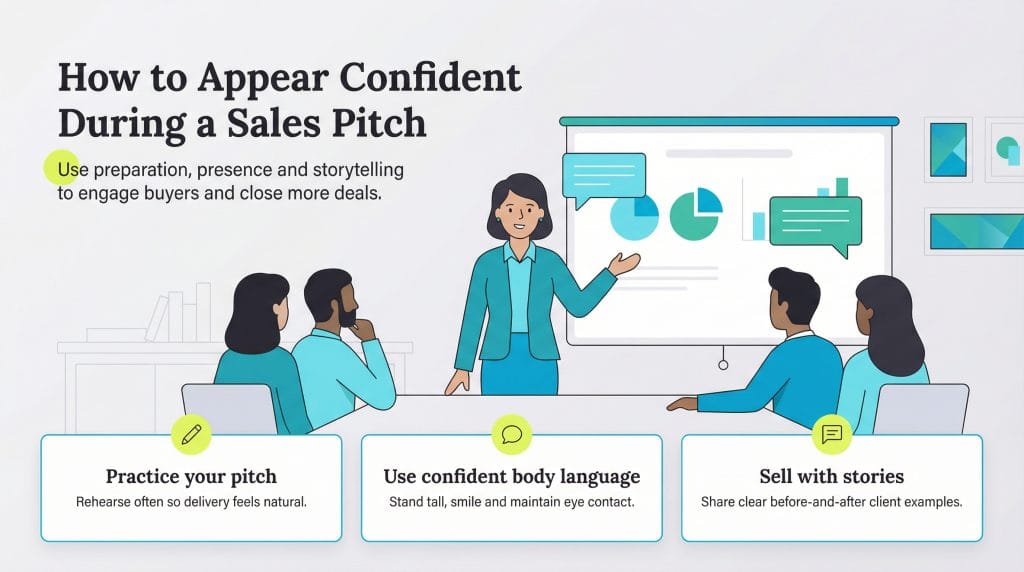
Mastering the sales pitch involves understanding the product or service’s value, not just the product or service itself. Therefore, confidently communicating involves not only persuasiveness but also active listening.
If you are missing opportunities or lacking sales, check out the following sales pitch mistakes that could hinder your success.
You may believe getting every last detail of your sales pitch out is the most important goal, but finishing your pitch shouldn’t be your end game.
Most sales pitches fail because the speaker is doing all the talking and not listening. A failure to listen prevents connection ─ whether the meeting is in person or virtual.
Don’t plan your next move. Be present. A good salesperson is an active listener, so they can adapt to the client’s custom needs and provide solutions, not just noise.
When presenting a sales pitch, put yourself in the client’s shoes. You only get one shot to make an excellent first impression. But, if they are learning about your company, product or service, do they need an in-depth presentation or a brief overview so they can ask questions?
Most of the time, engaging a client takes a conversation, not a presentation. Focus less on the details and more on active listening. The client is more likely to follow along if you include them in the presentation, rather than just talking at them.
Use storytelling to connect with your listeners; don’t overwhelm your customers with too many points. Be open to their questions during the pitch and be transparent with your answers. Trust is an integral part of sealing the deal.
It’s wise to research clients that you will be pitching to, and use this research to identify specific trigger events, growth initiatives or competitive pressures that make your solution timely and relevant.
The research applies to one-on-one pitches, virtual sales presentations and cold leads. First, do your homework to ensure your potential clients have a problem you can solve. Then, tailor your sales pitch to meet their needs.
Passion for your product or service is essential. However, no matter how much enthusiasm you put behind it, your ego can sometimes get in the way. When you put everything behind your product or service, you expect everyone else to do the same. But that won’t always happen. No one closes a sale 100 percent of the time ─ no matter what your product or service provides.
When a sales pitch doesn’t go your way, don’t blame the client for missing out on a once-in-a-lifetime opportunity. Instead, look at your product, service and sales pitch to see how you can improve.
Constructive criticism can be hard to swallow, but it will make you a better salesperson and help your company grow. Focus on the relationship. You may not always make a sale, but the ability to go back to the client when you have a new pitch is priceless.
A sales pitch can’t be successful without a call to action (CTA). Unfortunately, while CTAs are prominent on landing pages, social media posts and email newsletters, inexperienced salespeople often forget that they must lead a conversation to the next step.
Once a client is interested in your pitch, clearly identify what to do next. Use the “assumptive close” technique: Instead of asking if they want to proceed, present two options that both move forward: “Would you prefer to start with a pilot program next month, or would you rather begin with the full implementation in Q2?” Providing the next steps keeps the client engaged and helps you follow up appropriately.
To have a successful business, you must learn to sell your product or service. [Related article: What Is Insight Selling? A Beginner’s Guide] You will constantly need new and repeat clients for your business to thrive. Mastering the sales pitch will help create your dream business. So be an active listener and encourage constructive criticism to improve and nurture more profound relationships. The more trust you can build with your clients, the easier it will be to engage them in a conversation that leads to a successful ─ and repeated ─ deal.
Kimberlee Leonard and Carol Evenson contributed to this article.