Business.com aims to help business owners make informed decisions to support and grow their companies. We research and recommend products and services suitable for various business types, investing thousands of hours each year in this process.
As a business, we need to generate revenue to sustain our content. We have financial relationships with some companies we cover, earning commissions when readers purchase from our partners or share information about their needs. These relationships do not dictate our advice and recommendations. Our editorial team independently evaluates and recommends products and services based on their research and expertise. Learn more about our process and partners here.
This wearable tech combines traditional protection with data-driven features to improve your construction team's safety and efficiency.


A smart helmet combines the traditional safety structure of a hard hat with built-in technology designed to improve productivity, communication and especially safety on busy jobsites.
Historically, electronic devices didn’t hold up well on construction sites, where dust, impact and debris could quickly damage consumer electronics. However, today’s smart helmets are built for tougher environments, protecting both the wearer’s head and the technology inside. This advanced wearable tech uses built-in sensors and augmented reality (AR) features to help crews work more safely and efficiently. Here’s what to know about smart helmets, how they work and the features that matter most on today’s jobsites.
Smart helmets are hard hats with built-in technology designed specifically for construction workers. Depending on the make and model, smart helmets can include features like impact detection, real-time health monitoring, early warnings that help employees avoid dangerous situations, data visualization, and livestreamed audio and video.
Clark Lowe, president and CEO of the O’Connor Co., a North Carolina-based construction firm, said adopting smart helmets can improve safety and reduce workplace accidents. According to Lowe, smart construction helmets can even replace multiple pieces of personal protective equipment (PPE).
“Traditionally, employees may have a helmet for eye and ear protection, and keeping track of all the equipment can be a pain,” Lowe explained. “Having all this protection fixed to the helmet makes employees more likely to use the PPE.”
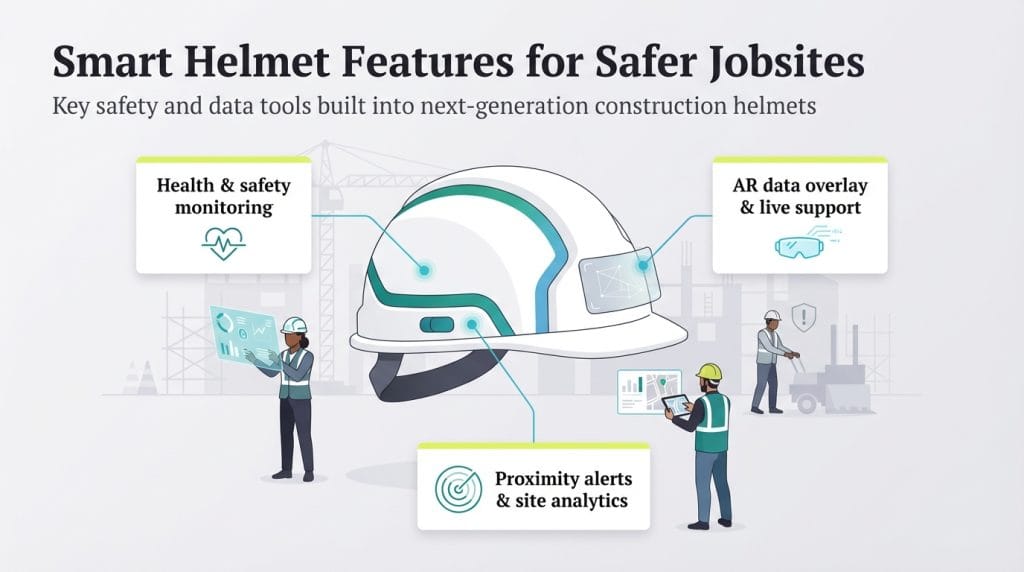
Smart helmet features vary by model, but most focus on safety and data collection. Here are some of the helpful functions you might find on smart helmets.
Smart helmets may allow you to monitor workers’ vitals to help ensure they stay safe on the job. This technology can provide early alerts about potentially hazardous conditions or environments and may flag when a user shows signs of fatigue that could affect performance. Data is typically tracked in real time and accessed through a central dashboard.
Working in tight spaces or at height while carrying devices like tablets can create safety risks. Some smart helmets address this by projecting critical information, such as Building Information Modeling (BIM) data, onto a visor or monocle display. This setup lets workers view information without taking their hands off the task.
People working on construction sites or around heavy machinery face a significant risk of accidents. According to the Bureau of Labor Statistics, the construction industry recorded 1,075 fatal work injuries in 2023, the highest total of any industry sector. To help address these all-too-real risks, some smart helmets include forward- and rear-facing depth-sensing cameras that can alert workers when they get too close to equipment or obstacles. These alerts trigger an audible or visual warning that may help reduce collisions and give workers critical extra seconds to react, which can improve safety outcomes on busy jobsites.
Data overlay or visualization gives workers access to real-time information, reducing the need to travel back and forth to computer terminals. For example, if a worker needs to restart a system or piece of machinery, they don’t have to return to the office for a status update; they can view it directly through the smart helmet’s visor.
Another way to use this feature is by integrating it with construction estimating software or construction asset management platforms, which can track labor, equipment usage and project data while teams are on the go.
Thermal vision can improve worker safety by helping crews visualize, record and analyze temperature changes in their immediate environment.
With intuitive AR guidance, smart helmets can display processes or tasks that need to be completed and how to perform them. Supervisors can also send instructions from a central system directly to a worker’s visor.
Serious problems can arise if a worker attempts a task they aren’t trained to perform. Waiting for an expert to arrive on-site can slow progress, so some smart helmets include remote support features that let workers make or receive calls through their visor. In some cases, remote specialists can provide visual guidance to help walk a worker through a task.
Outfitting workers with smart helmets gives companies another way to collect real-time information about what’s happening on a jobsite. Data from sensors and health monitoring tools can help supervisors spot potential safety issues early, while usage data may reveal where crews are slowing down or need additional support.
Using AR, built-in cameras and sensors, smart helmets can help workers visualize project data directly in their field of view.
“There are a few smart helmets available in the market space that offer features like augmented reality displays,” said Yaeir Moinzadeh, a licensed contractor and owner of Blue Rise Roofing in Baltimore. “Using such features, workers can complete tasks more accurately and efficiently.”
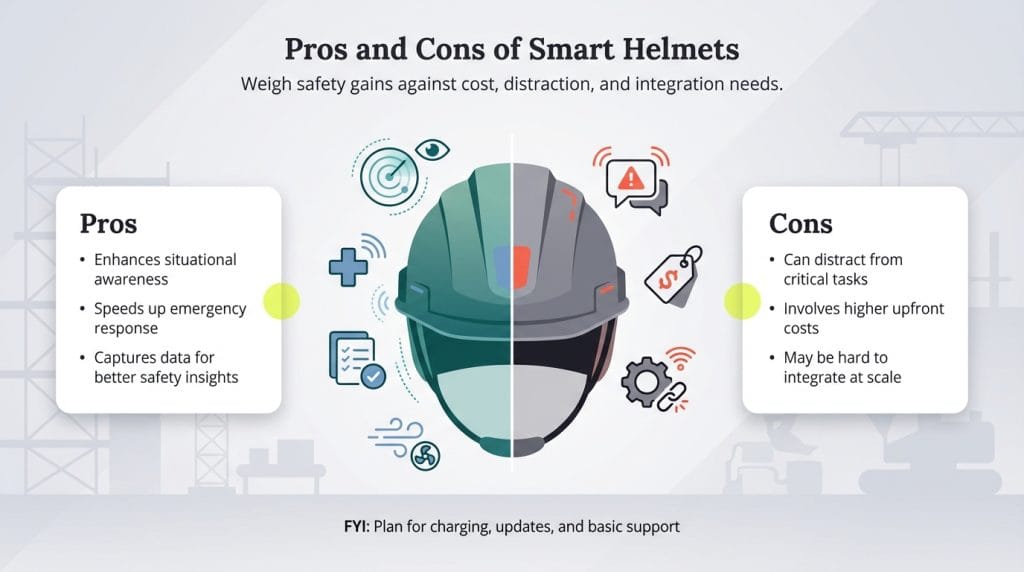
As with any tool, smart helmets come with both benefits and tradeoffs. Here are a few of each.
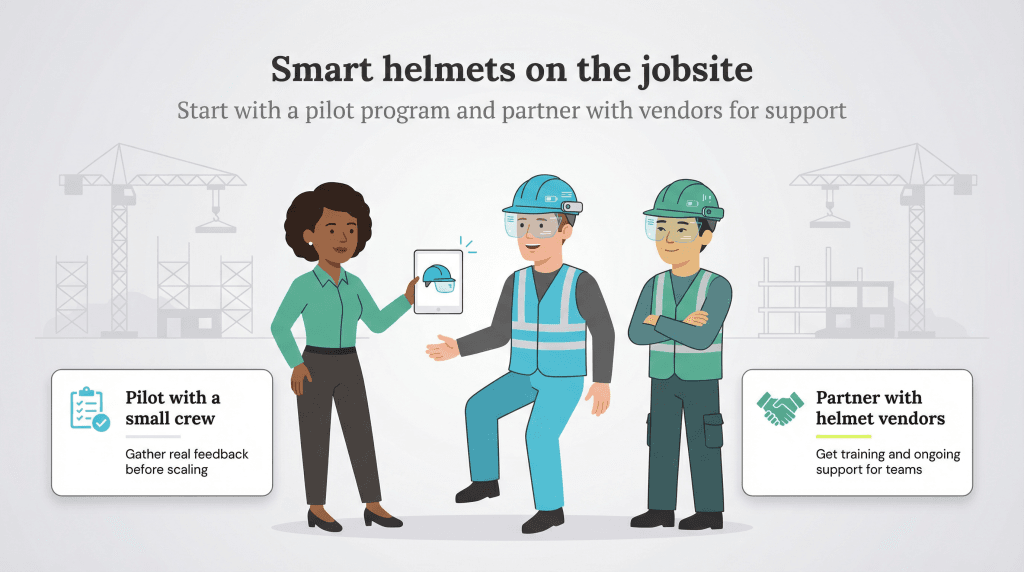
As more construction teams begin testing wearable tech on jobsites, smart helmets are becoming a more practical option rather than a niche experiment.
For construction businesses looking to incorporate smart helmets into their operations, Moinzadeh recommended starting with a pilot program and exploring partnerships with manufacturers that can offer training and ongoing support.
“Business owners can begin by equipping a small team with smart helmets and, afterward, collect their honest feedback regarding its effectiveness,” Moinzadeh advised. “By following this approach, you can understand the benefits and challenges before making a larger investment.”
Source interviews were conducted for a previous version of this article.