Business.com aims to help business owners make informed decisions to support and grow their companies. We research and recommend products and services suitable for various business types, investing thousands of hours each year in this process.
As a business, we need to generate revenue to sustain our content. We have financial relationships with some companies we cover, earning commissions when readers purchase from our partners or share information about their needs. These relationships do not dictate our advice and recommendations. Our editorial team independently evaluates and recommends products and services based on their research and expertise. Learn more about our process and partners here.
Startups don't have to compete with industry giants when collaboration is on the table.


Large, established enterprises and rising startups often sit on opposite ends of the business spectrum, but magic can happen when the two work together to merge innovation and resources. Still, collaboration isn’t always easy. Many startups face ongoing funding pressures, while large organizations must navigate complex structures and slower decision-making, which can make partnerships difficult to get off the ground.
We’ll explore the benefits of big and small players working together and share practical tips for overcoming common collaboration challenges to form strategic partnerships that are mutually beneficial.
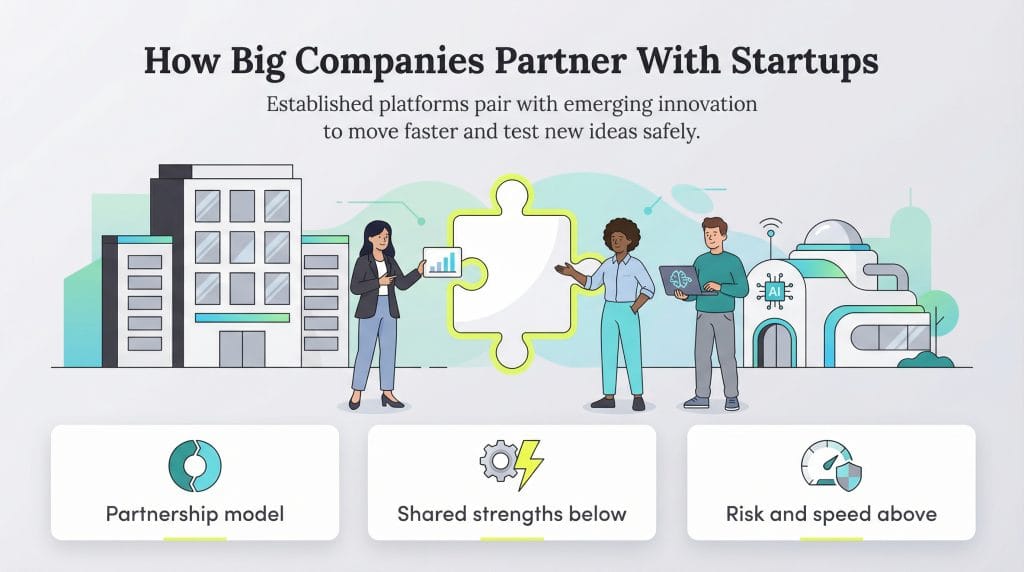
When rising startups and big companies combine resources, they can experience the best of both worlds, pairing innovation with scale and influence. This helps each side complement the other’s strengths and weaknesses.
Here are some enterprise strengths and weaknesses:
Paul Robson, a serial entrepreneur, investor and business consultant, says enterprises have much to gain from a startup’s fresh, innovative perspective and approach. “Startups are inherently more nimble, so they’re faster and more efficient at improving existing products or services,” Robson explained. “They often spot pain points corporations take longer to identify and can create new products or services to address them.”
In contrast to the enterprise experience, startups typically bring the following strengths and weaknesses to the table:
When partnerships form, Robson says big companies can benefit from giving startup partners a more direct line to the boardroom. “[Great] ideas within big companies often get bogged down in corporate bureaucracy,” he explained. “They have to filter up through multiple layers of management and may be diluted or discarded before they ever reach the CEO.”
By contrast, a startup partner with a fresh perspective often has a clearer path to senior leadership. “If [an enterprise’s] startup partner has a great idea and shares it directly with the CEO, it’s more likely to be acted upon quickly and decisively,” Robson noted.
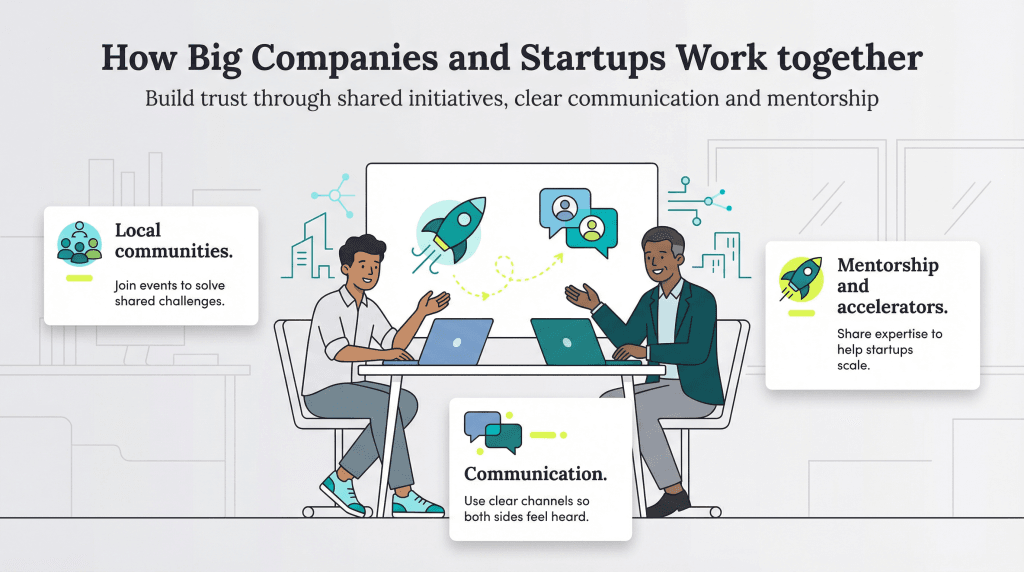
After forming a startup-enterprise partnership, the two sides need to spend quality time together, well beyond emails and phone calls, to build trust and establish a genuine working relationship.
Consider the following ways to collaborate and strengthen the partnership:
Startups aren’t strangers to collaboration. They work with business investors, customers, contractors and partners to keep operations moving forward. Similarly, enterprises collaborate internally and externally to support growth.
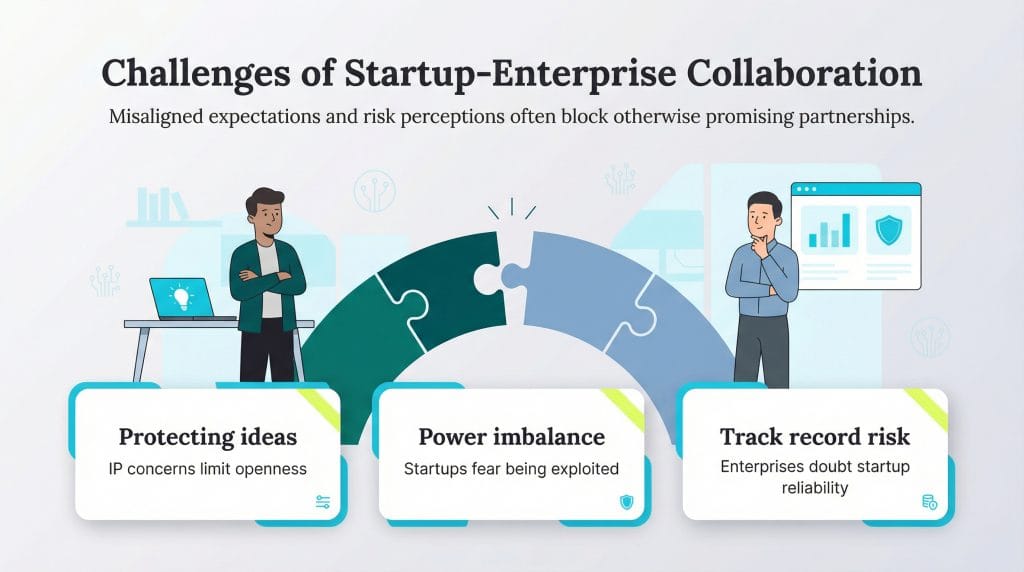
However, startup-enterprise collaboration isn’t always smooth sailing. Here are a few common challenges these partnerships face:
These barriers — some real and some rooted in misperception — have kept many promising partnerships from moving forward. Successful collaboration requires both sides to accept some risk and invest in the relationship, trusting that each party is working toward a shared, mutually beneficial goal.
Several high-profile partnerships show how large enterprises and startups can work together to drive innovation without starting from scratch.
Microsoft’s partnership with OpenAI is one of the most closely watched enterprise-startup collaborations in recent years. Microsoft first invested $1 billion in OpenAI in 2019, followed by a reported multiyear investment worth approximately $10 billion in early 2023.
Through the partnership, OpenAI gained access to Microsoft’s Azure cloud infrastructure and enterprise reach. Microsoft, in turn, brought OpenAI’s models into several of its own products, including Azure, Bing and Microsoft 365 Copilot.
Rather than building competing AI systems entirely in-house, Microsoft used the partnership to move faster in a rapidly evolving market. For OpenAI, the collaboration provided the computing power, scale and commercial reach needed to bring its technology to market. The relationship is a good illustration of how established companies can pair their infrastructure and customer base with startup innovation to create practical, real-world applications.
In 2022, Walmart announced a partnership with electric vehicle startup Canoo, outlining plans to test up to 4,500 all-electric delivery vehicles, with options for additional units. The agreement gave Walmart early access to Canoo’s purpose-built delivery vehicles as part of a broader effort to evaluate electric options for last-mile delivery.
The vehicles were designed with configurable cargo space to support delivery efficiency, allowing Walmart to pilot emerging EV technology without developing vehicles in-house. For Canoo, the partnership put its modular platform in front of a major enterprise customer and allowed the company to test its technology in real delivery conditions.
The collaboration never moved beyond pilot testing, and Canoo later shut down operations, highlighting the financial and execution risks that often come with early-stage startup partnerships. Still, the arrangement shows how large companies typically work with startups: testing new ideas without taking on unnecessary risk upfront.
During the COVID-19 pandemic, vaccine development moved at an unprecedented pace. Pfizer and BioNTech were among the first companies to bring an mRNA COVID-19 vaccine to market, securing emergency authorization in multiple countries as governments raced to slow the virus’s spread.
Their collaboration didn’t begin with COVID-19. The two companies had already been working together since 2018 on mRNA-based influenza vaccines. BioNTech contributed its mRNA research capabilities, while Pfizer brought experience in clinical trials, manufacturing and global distribution. When COVID-19 emerged in early 2020, that groundwork made it possible to pivot quickly.
The result was Comirnaty, an mRNA COVID-19 vaccine that was distributed worldwide and later updated as new variants emerged. At its peak, the Pfizer-BioNTech vaccine generated tens of billions of dollars in annual revenue, including roughly $36 billion in 2021 alone — enough to make it one of the highest-selling vaccines in history.
General Motors invested in Lithion Recycling, a battery-recycling startup working to recover materials from end-of-life lithium-ion batteries. For GM, the investment tied into broader efforts to build a more sustainable EV battery lifecycle as production ramps up.
Lithion developed a recycling process designed to recover a high percentage of battery materials, including lithium, nickel and cobalt, so they could be reused in future battery production. From GM’s perspective, the relationship offered early insight into emerging recycling technologies that could help reduce reliance on newly mined materials over time. For Lithion, the partnership provided capital and access to industry expertise as it worked to scale its technology.
The collaboration later stalled as Lithion faced financial challenges, and the partnership did not advance beyond exploratory work.
Partnerships between startups and large companies aren’t always easy, and there are no guarantees, but they can be worth the effort when both sides go in with clear expectations. Startups bring speed, new ideas and a willingness to experiment. Enterprises bring resources, experience and access to markets that are hard to reach alone.
When those strengths line up, collaboration becomes less about big promises and more about practical progress. The companies that get the most out of these relationships tend to focus on trust, communication and shared goals, and they build partnerships that make sense for where both businesses are today, not where they hope to be someday.
Alex Goryachev contributed to this article.