Your free business.com+ membership unlocks exclusive tech deals and advisor support
Join Free
BDC Hamburger Icon

Menu

Close
BDC Logo with Name
Search Icon
Search Icon
Advertise with us
Advertising Disclosure
Close
Advertising Disclosure

Business.com aims to help business owners make informed decisions to support and grow their companies. We research and recommend products and services suitable for various business types, investing thousands of hours each year in this process.

As a business, we need to generate revenue to sustain our content. We have financial relationships with some companies we cover, earning commissions when readers purchase from our partners or share information about their needs. These relationships do not dictate our advice and recommendations. Our editorial team independently evaluates and recommends products and services based on their research and expertise. Learn more about our process and partners here.

Strategies for Building Brand Trust Through Video

Video marketing can help set the tone for your entire brand.

Written by:
Joe Forte, Senior Writer
author image
Editor verified:
Gretchen Grunburg,Senior Editor
Last Updated May 14, 2026
Business.com earns commissions from some listed providers. Editorial Guidelines.
Table Of Contents Icon

Table of Contents

Open row

Building trust with customers makes them far more likely to buy your products and services and continue doing business with you long term. Established businesses succeed because they’ve earned trust in their brand and built genuine relationships with their customers. Newer and smaller companies must do the same to show customers they can deliver a quality product or service, handle payment data securely and resolve customer service issues professionally.

That’s where video marketing can prove invaluable. Video creates a level of authenticity and connection that’s hard to match with other forms of marketing, making it especially effective for building trust. We’ll walk through effective trust-building strategies businesses can incorporate into their video marketing campaigns, share common mistakes to avoid and highlight excellent video marketing platforms.
Did You Know?Did you know
Video helps businesses connect emotionally with customers by fostering brand intimacy and creating shared bonds.

How to build brand trust through video marketing

brand video graphic

Building trust is about more than customer satisfaction. It’s a long-term commitment to meeting customers’ needs and consistently delivering a quality experience. Here are five ways to use video to build trust and strengthen customer loyalty.

1. Tell your brand’s story through video.

Your marketing campaigns should include “cornerstone videos” — foundational videos that establish your brand’s identity, voice, mission and values by telling your story.

Here are some tips for creating videos that tell your brand’s story:

  • Tell customers what they can expect: Storytelling videos typically don’t highlight specific products or services. Instead, they show customers what your business stands for and how you differ from the competition.
  • Create a narrative around your business: Customers don’t want to hear a list of facts about a business. They want to understand how the business started, how it grew and what challenges it overcame. Those details make your story feel more human, memorable and relatable.
  • Introduce your employees, customers and relationships: Storytelling videos can highlight your employees, customers, workplace culture and the impact your business has on the community.

Storytelling videos can shape your other advertising messages, creating a foundation of timeless content you can use throughout your brand’s marketing efforts.

TipBottom line
To become a better brand storyteller, share struggles as well as successes, incorporate testimonials and use compelling language to capture viewers' interest.

2. Create customer testimonial videos to build trust.

Customers tend to trust other customers, which is why third-party review sites and word-of-mouth advertising are so effective. When customers become aware of your business, they’ll want to know how other consumers feel about you.

Video testimonials are a powerful way to show that real customers trust your business. A strong video testimonial should include the following elements:

  • The initial problem: The customer should begin by explaining the challenge they faced.
  • How your business helped: The customer should discuss how your business worked with them to solve that problem.
  • The ultimate results: They should wrap up by sharing the results of your solution and how they feel about your business. They can explain why they value your company or why your product or service stands apart from the competition.

Above all, a strong customer testimonial must feel genuine and unscripted. It should come from real customers with real challenges.

To find people willing to create video testimonials, reach out to customers with whom you already have strong, established relationships. They’ll often become your most valuable advocates and may even become the foundation of a future brand advocacy program.

Did You Know?Did you know
Creating video testimonials takes more effort than collecting positive customer reviews online, but the added authenticity and emotional connection can make that investment worthwhile.

3. Engage your customers directly with video.

Video shouldn’t be a one-way street. The more interactive and engaging your videos are, the more your customers will get to know your business and trust your brand. Without context or ongoing engagement, video content can start to feel impersonal.

Here are a few ways to strengthen your video engagement:
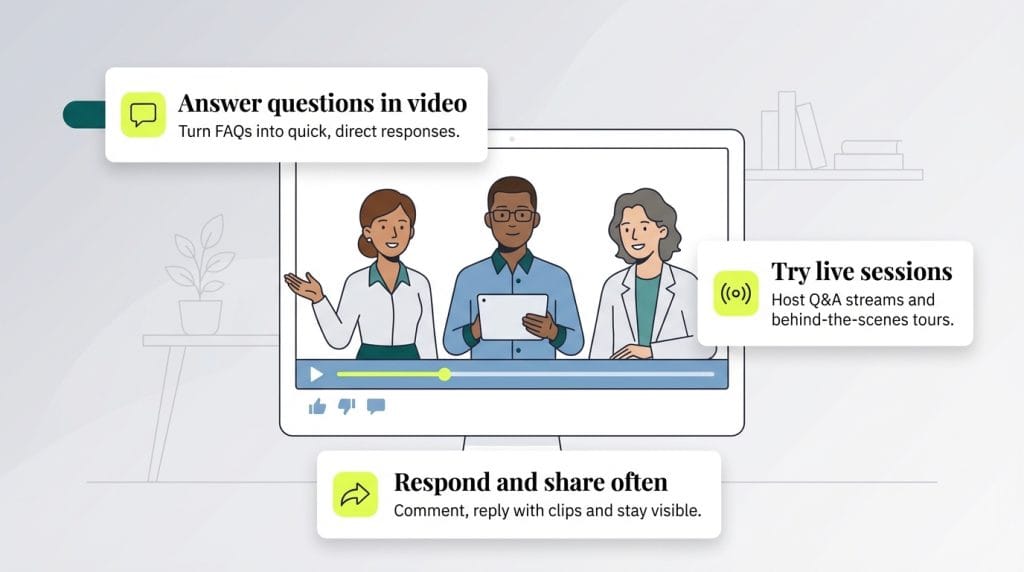
  • Answer questions in video format: If customers ask questions, post a follow-up video and address them directly. Answer questions and post clarifications or corrections as needed. This type of response helps customers feel heard and included in the conversation.
  • Start using live videos: Live video streams are an excellent way to interact with your audience. On many platforms, you can see comments and reactions as you record. Use live video for question-and-answer sessions, explainer videos or behind-the-scenes looks at your company’s day-to-day operations.
  • Always respond to comments: Most video platforms allow comments. Responding to them shows your personality and helps establish you as an expert in your products, services and industry.
  • Share videos directly: Share helpful videos when customers ask product questions, and post relevant videos across your social media channels. Doing so can increase visibility and expand your audience.
  • Respond to other videos: If others make videos about your product or service, chime in with helpful tips, corrections or extra context. Never respond harshly or take feedback personally. Criticism will happen; how you respond shapes how others see your business.
  • Interact consistently: Don’t post videos and forget they exist. Keep interacting, replying and sharing with your audience. The more often people see your brand and hear from you, the more familiar you become. Over time, those repeated touchpoints can create positive associations customers remember and mention to others.
Bottom LineBottom line
Using video in your content marketing strategy can help humanize your brand, build trust, boost brand recognition and generate more sales leads.

Video marketing mistakes to avoid

video marketing mistakes

Video can be incredibly effective, but only when it’s backed by a clear strategy. Be sure to avoid these video marketing mistakes, along with other challenges that can derail your trust-building efforts.

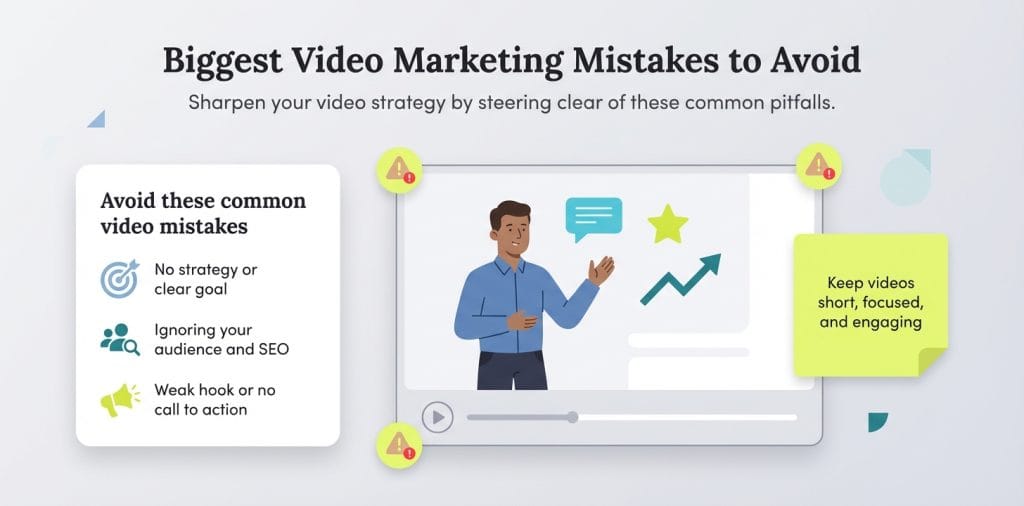
1. Don’t create videos without a clear goal.

Start by defining what you want your video marketing to accomplish, and then create specific objectives for each video. Decide how many videos you’ll need for each objective and map out the topics you want to cover.

For the trust-building stage of the customer journey, consider creating videos about the following topics:

  • Company history
  • Company values
  • Behind-the-scenes processes
  • Customer testimonials
  • Industry insights
  • Answers to common customer questions

To reinforce authenticity, feature your business’s owners, managers and key employees on screen.

2. Don’t create videos without knowing your target audience.

If your company has been in business for a while, you likely understand your customer base well. However, if you’re new, it’s essential to research your target audience and learn what interests them.

For example, if your audience consists of people who are already familiar with your product category, skip the basic introductory content. If your audience is made up mostly of new users, focus on explainer videos. According to Wyzowl’s 2026 State of Video Marketing survey, 68 percent of video marketers have created explainer videos, making them one of the most widely used video formats.

You should also create video series for different customer personas so each group gets content tailored to its needs. Watch your direct competitors’ videos to spot topics that may resonate with your audience. Just as importantly, ask customers what problems they’re trying to solve or what questions they still have so you can address them in future videos.

3. Don’t make your videos too long.

Keeping videos concise is key to holding viewers’ attention. According to the Wyzowl survey cited above, 63 percent of consumers say they’d most like to learn about a product or service by watching a short video, and 71 percent of marketers say videos between 30 seconds and two minutes are the most effective length.

If you have very long videos, you’ll lose viewers’ attention — and they’ll be less likely to return for more video content. You can always make another video if you have more information to cover. Bite-sized video content tends to work best. 

4. Don’t neglect video SEO.

Like your written online content, video should be part of your small business SEO strategy. When optimized correctly, video can improve your website’s visibility in search results, increase engagement and help more potential customers discover your brand.

Here are some tips for optimizing your videos for SEO:

  • Include relevant keywords in your titles and descriptions.
  • Add captions and transcripts.
  • Make your videos mobile-friendly.
  • Create compelling thumbnail images.
  • Use relevant tags and categories.
Did You Know?Did you know
As Wyzowl's 2026 survey (cited earlier) shows, 85 percent of marketers say video has helped them generate leads, 83 percent say it has directly increased sales, and 82 percent say it delivers a positive digital marketing ROI.

5. Don’t forget to tell viewers what you want them to do.

Just as every video should have a clear purpose (whether that’s creating awareness, building trust or answering product questions), it should also include a call to action (CTA): something you want viewers to do after watching.

That next step might be watching another video, visiting your website, calling your company, leaving a comment, filling out a form or scheduling an appointment. Your CTA can appear at the end of the video, be woven in throughout the content or show up as an on-screen prompt.

6. Don’t bore your video viewers.

Even if your product isn’t inherently exciting, find something about it (or about your company) that is. For example, you may deliver a truly delightful customer experience or exceptionally responsive customer service. You may offer an industry-leading warranty or have a longstanding track record in your field. Viewers may also connect with details such as your company being family-owned or your products being first of their kind.

To keep your videos engaging, choose a presenter who’s comfortable in front of the camera. Use visual aids, demonstrations and live video feeds to avoid the “talking head” effect, where viewers see little more than someone speaking on screen. Finally, a little humor — when it fits your brand — can make your videos more memorable.
Best platforms for video marketing

video marketing platforms

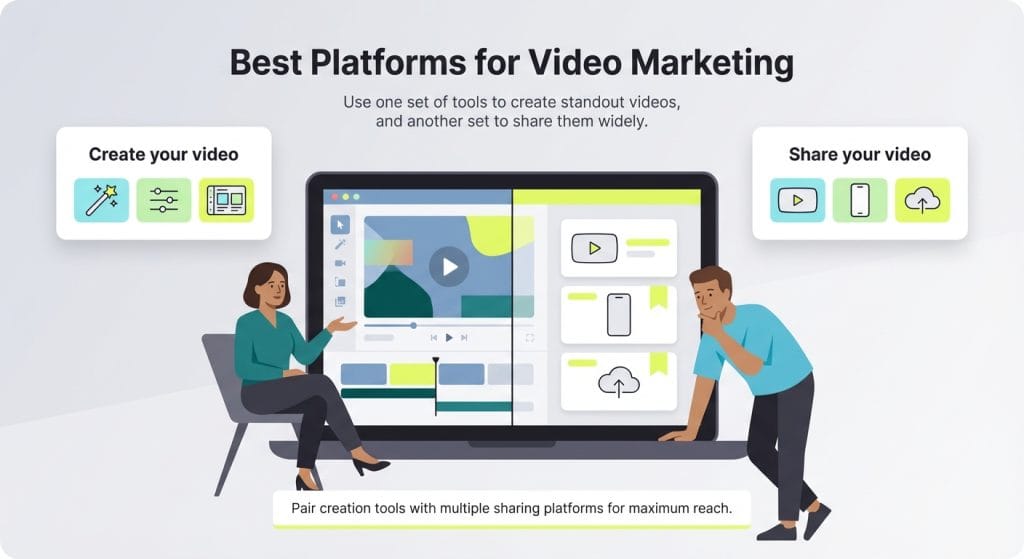
To get started with video marketing, you’ll need tools to create and distribute your videos.

Best platforms for creating videos

Once you know what kind of video you want to create and have a script, props and a camera, shoot the raw footage. Then, use one of the following video creation platforms to edit, polish and enhance your video so it’s ready to post:

  • FlexClip: FlexClip has extensive artificial intelligence (AI) capabilities that allow you to create a new video from as little as a prompt, generate voiceovers from written text, write scripts, remove backgrounds from still images or videos and more. It offers over 6,000 templates, millions of video clips and photos, and a wide range of effects and filters to help you create a polished finished product. Visit the FlexClip website to learn about its free tier and paid plans ($11.99 to $19.99 per month, paid annually).
  • Visme: If your marketing team isn’t full of graphic designers, Visme can help employees build those skills quickly. The platform offers a large library of graphic elements and thousands of professionally designed templates. Its built-in AI capabilities also help teams create custom graphics and interactive content without coding knowledge. Visit the Visme website to learn about its free tier and paid plans ($12.25 to $24.75 per user, per month, paid annually).
  • Loom: If you need to create video content featuring yourself or your team through screen capture, Loom is an excellent platform that simplifies the process. This tool works especially well for sales videos, customer service content, product demonstrations and use-case walkthroughs. Visit the Loom website to learn about its free plan and paid options ($18 to $24 per user, per month, with annual discounts available).
  • Animoto: Animoto started as a platform focused on animated videos but has since expanded to support live-action content as well. You can upload clips, insert stock video, use its screen recorder, gather viewer feedback and share finished videos across multiple platforms. Visit the Animoto website to learn about its free plan and paid options ($9 to $39 per month, billed annually).

Best platforms for sharing videos

When your video is ready to go, it’s time to distribute it to your audience. Consider the following top video-sharing platforms (note that using two or more can help you reach a broader audience):

  • YouTube: YouTube is the original video-sharing platform and, by far, the biggest. It has more than 2.7 billion monthly active users worldwide, making it one of the most visited websites on the internet. You can use YouTube to build community as well as share videos. It’s free to post and create a branded YouTube channel, although your videos may be interrupted by ads.
  • Vimeo: Vimeo helps businesses host ad-free videos and livestream events, create screen-capture content, edit videos and monetize content through subscriptions or member-only access. While Vimeo offers a free plan, its paid plans unlock more storage and features, including auto-closed captioning, custom URLs and analytics. Paid plans start at $12 per month, billed annually.
  • TikTok: TikTok is an excellent platform for short-form video, especially if you’re targeting digitally engaged consumers who spend time discovering brands through social media. TikTok is free for organic posting, although paid video advertising is also available.
  • Instagram and Facebook: You may already know that using Instagram for business can be highly effective. Instagram Reels is a powerful way to get your brand videos in front of your audience organically. Similarly, Facebook remains an effective platform for sharing videos, livestreaming (e.g., Facebook Live Q&As) and community engagement. Both platforms also offer paid video advertising options.
  • Google Drive and Microsoft OneDrive: These cloud-storage platforms can be useful for hosting longer videos that take up significant storage space, such as training videos, internal presentations and thought leadership sessions.

Connecting with your customers through video

Adding video to your marketing plan isn’t just about brand and product exposure. It’s a way to foster trust and build long-term customer relationships. A well-executed video marketing campaign can help you establish genuine rapport with customers and strengthen that connection over time. That investment can pay dividends as customers return to your business, recommend your brand and become long-term advocates.

Jennifer Dublino contributed to this article.

Did you find this content helpful?
Verified CheckThank you for your feedback!
Written by: Joe Forte, Senior Writer
Joe Forte is the owner and producer at D-Mak Productions, an award winning professional video production company specializing in corporate, commercial, digital and branded media content. Clients include Intel Corporation, Barrow's Neurological Clinic, Cold Stone Creamery, Ticketmaster, CBS Local, Rodale (Men's Health), CBRE, Talking Stick Resort, CyraCom International and RIESTER Advertising Agency.