Business.com aims to help business owners make informed decisions to support and grow their companies. We research and recommend products and services suitable for various business types, investing thousands of hours each year in this process.
As a business, we need to generate revenue to sustain our content. We have financial relationships with some companies we cover, earning commissions when readers purchase from our partners or share information about their needs. These relationships do not dictate our advice and recommendations. Our editorial team independently evaluates and recommends products and services based on their research and expertise. Learn more about our process and partners here.
Tech is at the heart of every business, helping to streamline processes and better serve customers.


Most companies equate their identity with the products or services they sell. When asked what your business does, you may reply, “We’re an e-commerce organization,” “We’re an apparel company,” “We’re a fashion brand” or “We’re a biotechnology firm.”
But those labels rarely tell the full story. Forward-thinking business leaders understand that — in today’s digital ecosystem — they are a technology company selling products or services. When asked about their identity, they might say, “We’re a technology company that happens to sell [product or service].”
We’ll explain why adopting a tech company mindset can reshape your business’s culture and identity.
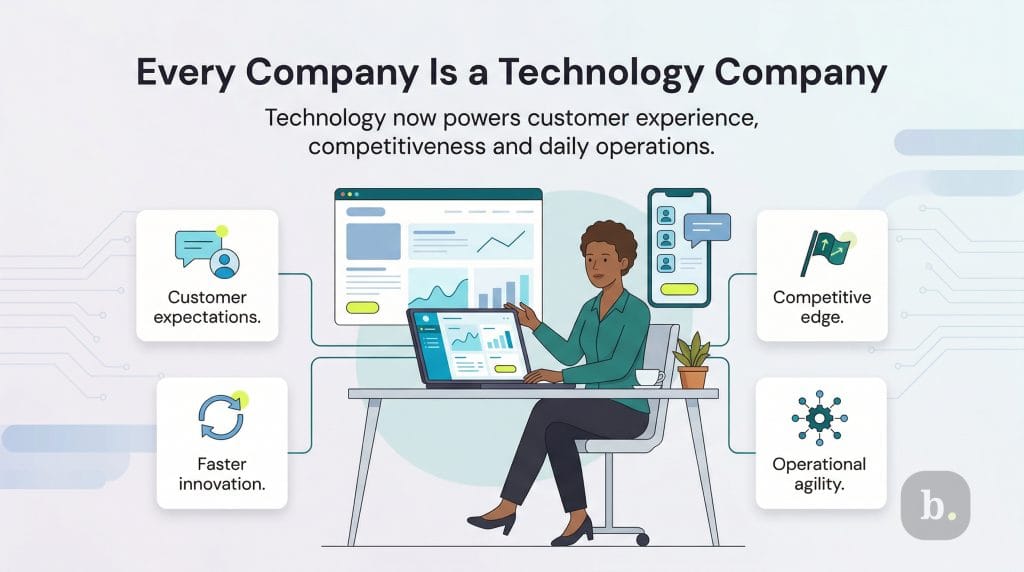
Technology now touches nearly every part of how businesses operate and how customers interact with them. Consumers use tech to move faster, compare options and make smarter buying decisions. Businesses use it to serve customers more efficiently, shorten customer service cycles and improve the sales process.
Because of that reality, it makes sense to prioritize the technological components that shape how your business operates.
Here are four primary reasons every company is, at its core, a tech company.
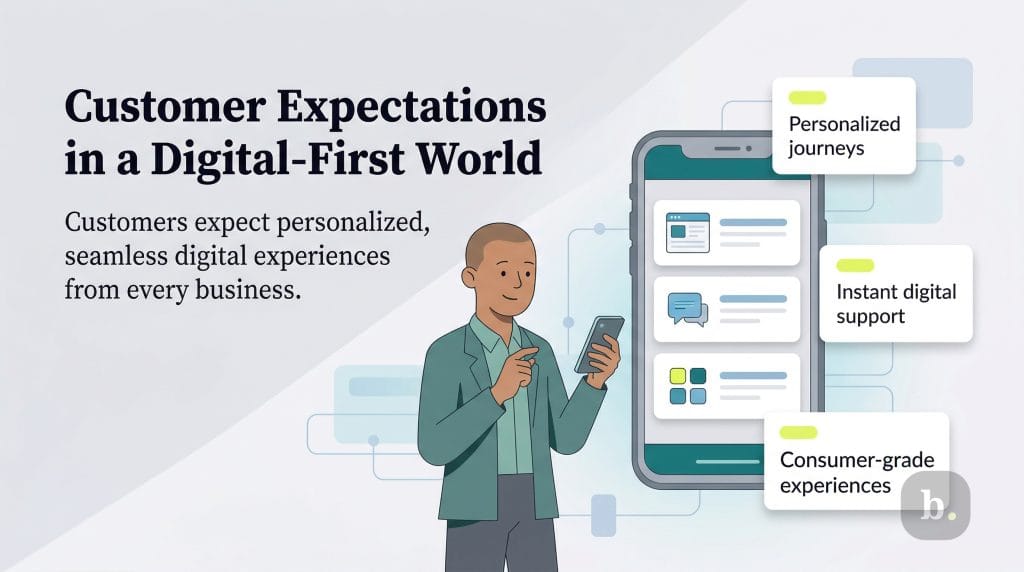
Whether you sell to consumers or focus on B2B sales, customers’ expectations have fundamentally shifted in our increasingly connected economy. Your clients expect your business to offer the latest tech advancements and strategies. For example, according to McKinsey research, 71 percent of consumers expect personalized interactions, and 76 percent get frustrated when this doesn’t happen. They likely also expect you to have a website and mobile app, offer live chat services and provide instant account information. One of the reasons for these tech expectations is the continuing cross-pollination of consumer and business technologies.
Historically, serious enterprise technologists would disregard consumer technology. Today, most leading-edge enterprise technology methods and practices come from the consumer world. Whether it’s mobile payment options, social media trends or advances in design and interaction, there is significant crossover between consumer and business tech.
Your customers, partners and employees live in the consumer tech ecosystem. They’re used to seamless apps, instant updates and intuitive design, and they expect the same from the businesses they interact with. According to Verint’s 2025 State of Customer Experience report, 36 percent of consumers say their service expectations are higher than last year — and that number jumps to 64 percent among 18-34-year-olds.
Delivering personalized experiences can strengthen customer loyalty and drive repeat business. The challenge is keeping pace, which requires systems flexible enough to evolve alongside rising expectations.
A fiercely competitive landscape is the new normal in business. Companies must be able to rapidly adopt and integrate new technologies to stand out from the competition.
Consider what happened to companies that didn’t evolve with the latest technology, such as Kodak, Blockbuster and Research in Motion (RIM). More recently, traditional retailers have struggled against e-commerce giants, and legacy automakers have raced to keep up with electric vehicle startups. You may not think your business model will become obsolete, but neither did these companies. When faced with innovations around them, they were so wedded to their current business model that they failed to anticipate the future.
These companies faced numerous challenges amid a rapidly changing tech landscape. They were wary of cannibalizing their existing business model for what could have been temporary fads. And they were so massive that changing would have required years of effort.
So what can you do differently? Many innovation leaders recommend carving out a defined portion of your budget and team capacity for experimentation and new initiatives, even if it means moving more cautiously in the short term. In an evolving tech landscape, your company must manage its current business while systematically probing new models. That means developing solutions and infrastructure that let you explore new spaces — and ramp up quickly if the opportunity proves real.
With software embedded in nearly every industry, innovation no longer unfolds over five- or seven-year horizons. Companies are expected to iterate constantly. Updates roll out in months, sometimes weeks — and for some teams, multiple times a day.
That speed isn’t theoretical. According to the 2025 DORA survey, 16.2 percent of teams now deploy code on demand, meaning they can push updates as soon as they’re ready. Another 9.4 percent report lead times for changes of less than one hour. When teams can move from commit to production that quickly, the gap between idea and customer shrinks dramatically.
This isn’t just about software companies. Retailers adjust their online stores in real time. Financial institutions refine fraud detection models continuously. Manufacturers update connected products long after they leave the factory floor. Even physical products now evolve through ongoing software and AI enhancements.
Innovation isn’t a seasonal initiative anymore. It’s built into how modern businesses operate — or they fall behind.
Outsourcing technology work has been a major trend over the past decade. For example, many company owners have outsourced large portions of their software development and technology implementation to third parties.
But the trade-off is control. When you outsource core technology functions, you reduce internal capability while often locking yourself into multiyear agreements. That can slow your response to market shifts, competitive threats or emerging opportunities.
The highest-performing companies don’t separate business strategy from technology strategy. For them, tech isn’t a support function — it’s embedded in how they operate. In fact, in its 2025 analysis Unlocking Industry Advantage Through Tech Investment, Deloitte found that companies that embed technology into business strategy report stronger revenue growth, innovation and resilience than their peers.
That alignment matters. When technology and business leaders build solutions together, companies move faster, experiment more confidently and adapt without waiting on external vendors.
Across industries, the most successful organizations tend to share a few business-tech habits:
Digital transformation isn’t a destination. It’s ongoing. Companies that build internal engines of innovation — teams, systems and processes that continuously evolve — position themselves to stay competitive rather than react defensively.
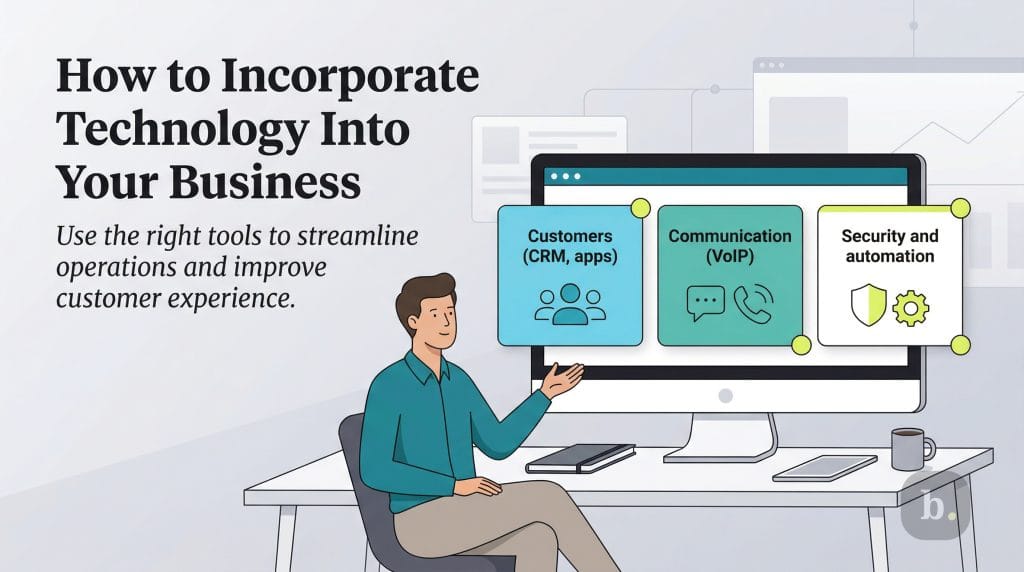
There are many ways to incorporate technology into your business’s day-to-day operations. The changes can be small or large, but they should be meaningful. Done well, they help your company operate more efficiently and compete more effectively.
Here are a few areas where technology can have a measurable impact:
These are just a few examples. The real opportunity is figuring out where technology can remove friction in your own operations. Pay attention to where your customers are headed, and make sure your systems keep up.