Business.com aims to help business owners make informed decisions to support and grow their companies. We research and recommend products and services suitable for various business types, investing thousands of hours each year in this process.
As a business, we need to generate revenue to sustain our content. We have financial relationships with some companies we cover, earning commissions when readers purchase from our partners or share information about their needs. These relationships do not dictate our advice and recommendations. Our editorial team independently evaluates and recommends products and services based on their research and expertise. Learn more about our process and partners here.
A thoughtful combination of tactics yields the best results.


Marketing is most effective when creativity is paired with a data-driven strategy. Reaching the right customers — and generating consistent revenue — requires understanding how people actually discover, engage with and respond to a brand. Businesses that rely on a single marketing approach often struggle to sustain results. In practice, stronger strategies blend proactive outreach with content that draws audiences in at different stages of the buying journey.
Most marketing strategies fall into two core categories: push marketing and pull marketing. Digital marketing agencies and in-house marketing teams use both approaches, each serving a distinct role. They aren’t interchangeable, but when used together, they help businesses reach prospects more effectively across the entire buying journey.
Push marketing is an outbound marketing approach in which businesses control when promotions run, what they say and how often they appear. Rather than waiting for buyers to go looking for a solution, push marketing puts the message in front of them first. The goal isn’t subtle discovery; it’s to grab attention, create awareness and encourage quick engagement.
“Push marketing is any kind of marketing that pushes your message or company out to the world,” explained Mackenzie Deater, content director at Budget Dumpster. “Push marketing is inherently disruptive — a telemarketer, a door-to-door salesman, even the Girl Scouts asking if you’d like to buy some cookies outside the supermarket. [They] all get their message out by somehow interrupting the natural flow of your day.”
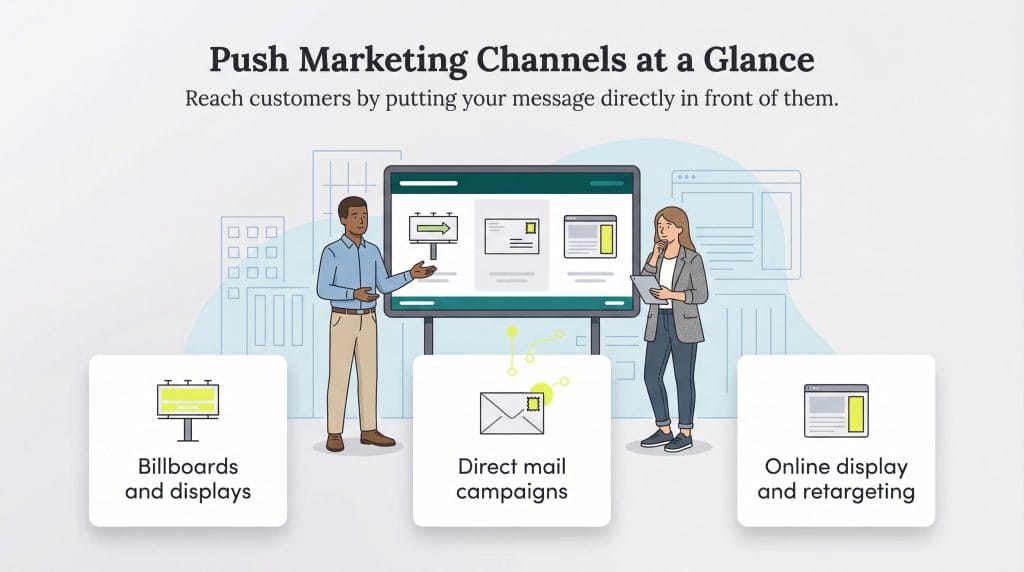
Push marketing includes a range of tactics designed to reach buyers through direct outreach.
“Consumers are not actively seeking your services; instead, you’re placing your product or service directly in front of them,” noted Shagun Chauhan, sales business development manager at Kology. “Push marketing can take many forms, including cold emailing, display advertising, face-to-face sales and trade show promotions.”
Common examples of push marketing include:
While some consider push tactics old-fashioned, they can still be effective when executed well. For example, despite the shift toward digital channels, direct mail continues to deliver strong returns. Research from the Association of National Advertisers found that direct mail sent to house lists generated an average return on investment of 161 percent, making it one of the highest-performing channels included in the study.
Pull marketing, also known as inbound marketing, makes your product or service easier for prospects to find while they research possible solutions. Instead of interrupting buyers, pull tactics focus on showing up at the right moment in the decision-making process.
“Pull marketing works to draw consumers into your brand by offering valuable content — how-to videos, infographics, step-by-step blog posts or webinars — that puts the consumer’s needs first,” explained Mackenzie Deater. “The consumer decides whether the content is right for them and explores it on their own time.”
Pull marketing requires strategic foresight. Instead of forcing engagement, businesses focus on building value that encourages prospects to seek them out on their own.
“[Pull] marketing is when the customers come to you,” Chauhan noted. “It usually generates interest in a product or company, prompting customers to explore your offerings on their own. Pull marketing strategies are often digital, with examples including social networking, sales promotions and word-of-mouth marketing.”
Additional examples of pull marketing include:
Most successful businesses don’t treat push and pull marketing as an either-or decision. Instead, they use a mix of both. Push marketing is often used to create immediate awareness and support short-term sales goals, while pull marketing helps build brand credibility, increase sales and boost customer loyalty over time. Used together, these approaches allow businesses to meet customers at different stages of the buying process and drive more consistent results.
Push marketing tends to work best when visibility is the immediate goal. It’s often used to put goods or services in front of prospects quickly, particularly when a brand is new, awareness is low or timing is critical. For that reason, push strategies are common among newer companies building an audience and established businesses rolling out a new product or offer.
“Push marketing is most beneficial for startup companies or when one is launching a new product or service,” Chauhan noted. “Raising awareness is crucial because, without push marketing, consumers may not know about your new product or services.”
Push marketing is also better suited for driving immediate engagement than for nurturing long-term relationships.
You may want to use push marketing in the following situations:
Today’s buyers tend to seek out information before making a purchase. They research products and services, ask friends for recommendations and read online reviews. Once a need becomes clear, many prospects turn to search engines, social platforms or trusted content sources to explore their options.
To support this behavior, your website should be current, informative and supported by credible customer reviews. Encouraging satisfied customers to share their experiences can help, as can publishing helpful, relevant content across multiple channels, including social media.
Pull marketing is especially effective in the following situations:
Even businesses in their early stages can start building a pull strategy. Prioritizing your website and gradually building online communities helps lay the groundwork for long-term visibility and trust.
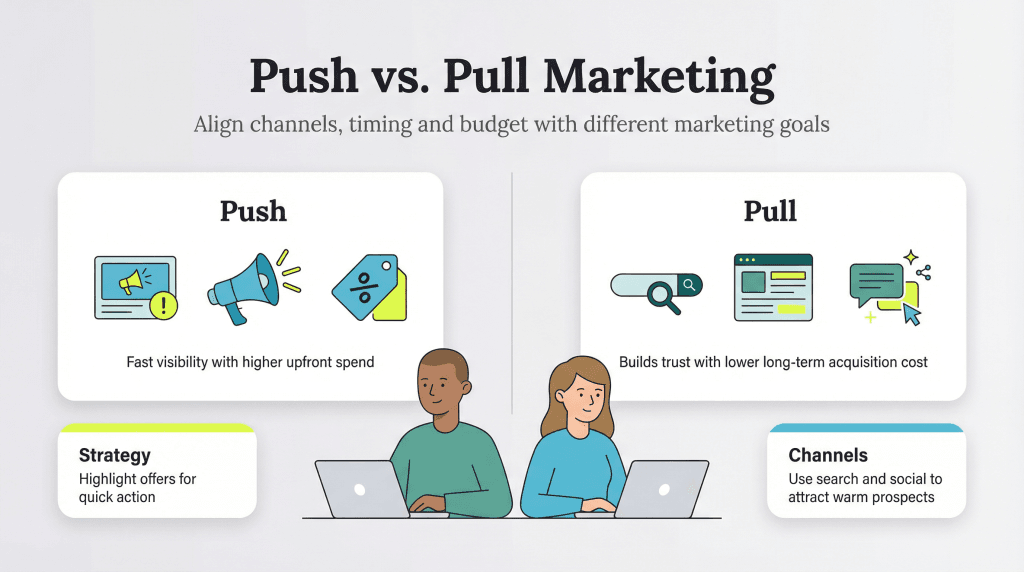
“Looking at push and pull marketing side by side, pull marketing tends to be more relationship-focused,” explained Deater. “It works by offering consumers the information or answers they’re actively seeking. When they have a positive experience with that content, they’re more likely to return to the brand when they’re ready to take the next step.”
By contrast, Deater noted that push marketing is more disruptive by design and often encourages consumers to act quickly, which can lead to faster sales.
Chauhan highlighted three core differences between the two approaches:
Push and pull marketing both play a role in helping businesses grow while better managing the sales pipeline. Push tactics tend to generate early interest, while pull marketing helps buyers research their options and decide when they’re ready to move ahead.