Business.com aims to help business owners make informed decisions to support and grow their companies. We research and recommend products and services suitable for various business types, investing thousands of hours each year in this process.
As a business, we need to generate revenue to sustain our content. We have financial relationships with some companies we cover, earning commissions when readers purchase from our partners or share information about their needs. These relationships do not dictate our advice and recommendations. Our editorial team independently evaluates and recommends products and services based on their research and expertise. Learn more about our process and partners here.
What is the difference between your personal and business credit score, and when does your business credit score matter?

Many businesses need good credit to be fiscally successful. With good business credit, you’re likely to get more favorable terms with your vendors, credit card processors and lenders. A business credit score measures the overall creditworthiness of a business, much like a personal credit score measures the overall creditworthiness of an individual. While the concept behind each credit score is similar, there are significant differences every business owner should understand.
While distinct from your personal credit score, your business credit score is similar in concept. A business credit score is used to demonstrate how financially sound and reliable a business is. It also shows how likely the business is to make its payments on time.
Like personal credit scores, a business credit score is a numerical measure representing a business’s creditworthiness. However, unlike personal scores that usually range from 300 to 850, business credit scores use a scale of 0 to 100.
Three major credit bureaus determine business credit scores: Dun & Bradstreet, Equifax and Experian. The scores determine creditworthiness for several things, including availability and rates of business loans, credit cards, and payment terms. Strong business credit and a responsible payment history can also reduce the cost of borrowing money.
“Each credit bureau will collect data and information about a company’s financial history and attach a score, but each bureau has a different set of criteria they value when attaching a score,” Jeffrey Bumbales, a marketing consultant, told business.com.
Searching for funding and not sure where to start? Tell us a little more about your business and get customized quotes from qualified providers.
FICO (Fair Isaac Corporation) provides a three-digit credit score that lenders use to assess risk and determine your creditworthiness. While FICO is primarily known for personal credit scores, they also offer the FICO Small Business Scoring Service (SBSS), which combines personal and business credit data. Your score dictates the type of business loan you can get, as well as how much you can borrow, for how long and at what cost. It helps companies make quick lending decisions. The higher your score, the greater your chances of getting approved for a loan and the lower your interest rate.
FICO SBSS scores range from 0 to 300, with most lenders considering scores above 140 acceptable for small business loans. The Small Business Administration (SBA) typically requires a minimum score of 165 for its 7(a) loans.
This chart shows personal FICO score ranges commonly used by lenders when evaluating business owners for loans:
FICO score | Ranking |
|---|---|
Under 580 | Poor |
580-669 | Fair |
670-739 | Good |
740-799 | Very good |
800 and up | Excellent |
While the concept behind a business credit score and a personal credit score is similar, they are distinct. A business credit score does not impact one’s personal FICO score, for one. If the business can’t pay back a loan, it won’t affect the owner’s personal credit score. But that is not the only difference between the two. Here’s a look at some more:
Unlike private personal credit scores, business credit scores are publicly available and are attached via an employer identification number (EIN). A personal credit score is tied to your Social Security number. You can obtain an EIN instantly through the IRS website at no cost, and this number becomes the foundation of your business credit profile.
Business credit scores are also determined by a different (though sometimes overlapping) set of criteria than personal credit scores, said Luke Voiles, CEO of Pipe.
“Personal credit scores are determined through FICO’s algorithms based on your personal credit history,” he said. “Business credit scores, however, are typically determined by looking at payment history, amounts owed, length of credit history, credit mix and new credit. On the business score side, there is not the same consistency you get with FICO. There are many providers of business scores that are measured and scaled differently, so it can be confusing for small businesses to understand their scores.”
According to Mike Ross, managing partner at commercial collection agency Miller, Ross & Goldman, a business credit score often reflects whether a business pays its vendors and creditors early, on time, or late.
“A perfect score of 100 indicates that the subject company typically pays 30 days before agreed terms or invoice payment due dates,” he said. “A 90 indicates 20 days before, and an 80 indicates payment on time. Scores below 80 are then progressively reflective of the number of days a company typically pays beyond agreed invoice terms. For example, a 70 is indicative of an average 15 days beyond agreed terms. There are other relevant factors and scoring models on how business credit is calculated, including industry risk, average debt load, years in business and company size.”
Much like how a personal credit score determines an individual’s borrowing eligibility, a business credit score is primarily useful when a company needs financing. Beyond lending decisions, business credit scores influence insurance premiums, supplier relationships, and even potential partnerships or acquisition opportunities.
“A business’s credit score is usually most important when trying to secure financing,” Bumbales said. “The better a business’s credit score, the more lucrative options it will have when applying for a loan or other financing products.”
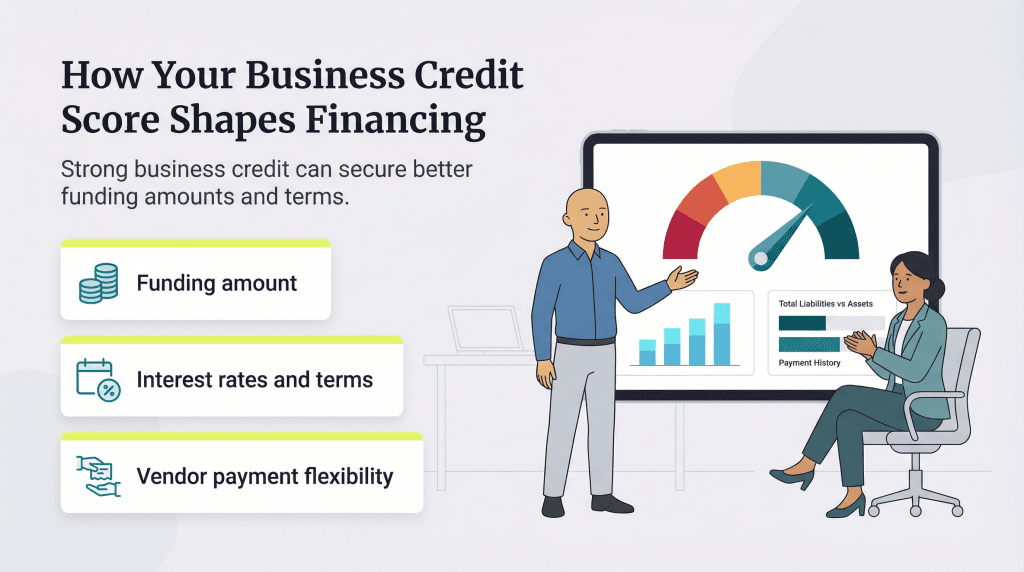
A business credit score can influence multiple pieces of financing a company can obtain, including the amount of funding, repayment terms and interest rate. The score is used to determine whether the lender should extend business credit, how much to lend and the terms.
Other companies you do business with may also use your business credit score to decide whether to extend more generous payment terms.
Considering financing a purchase or borrowing money? It’s essential to understand your current business credit score and how any new funding might impact it in the future.
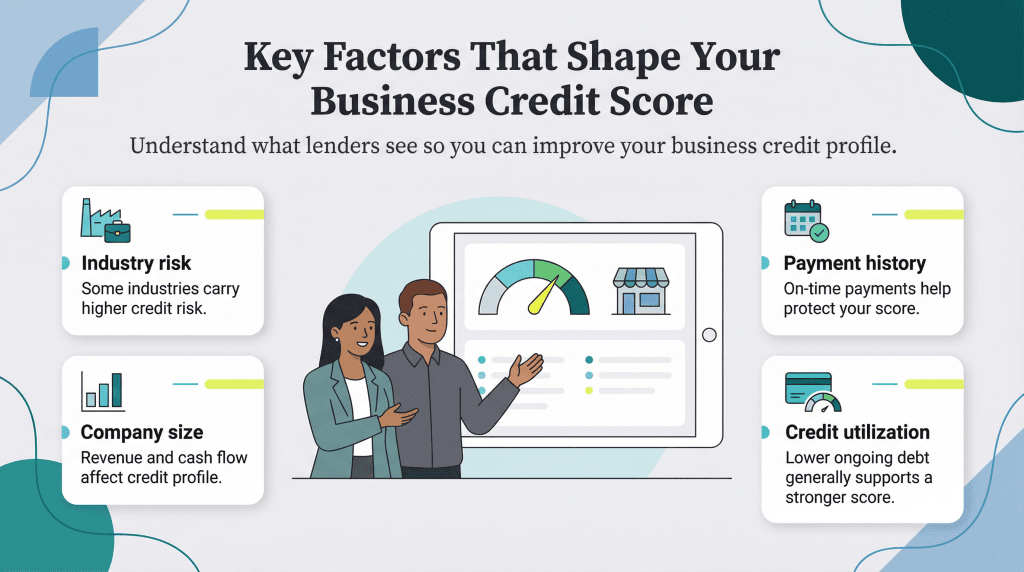
While each credit rating agency has its own methods of calculating a business credit score, there are a few common factors.
To obtain your business credit score, you have to request a credit report from the three major credit bureaus by visiting their respective websites. While this report is free for personal credit scores, you will usually pay to get your business credit score.
Credit bureau | Business credit report and score | Starting price for one-time purchase |
|---|---|---|
Dun & Bradstreet | Yes | $61.95 |
Equifax | Yes | Around $40 |
Experian | Yes | $49.95 |
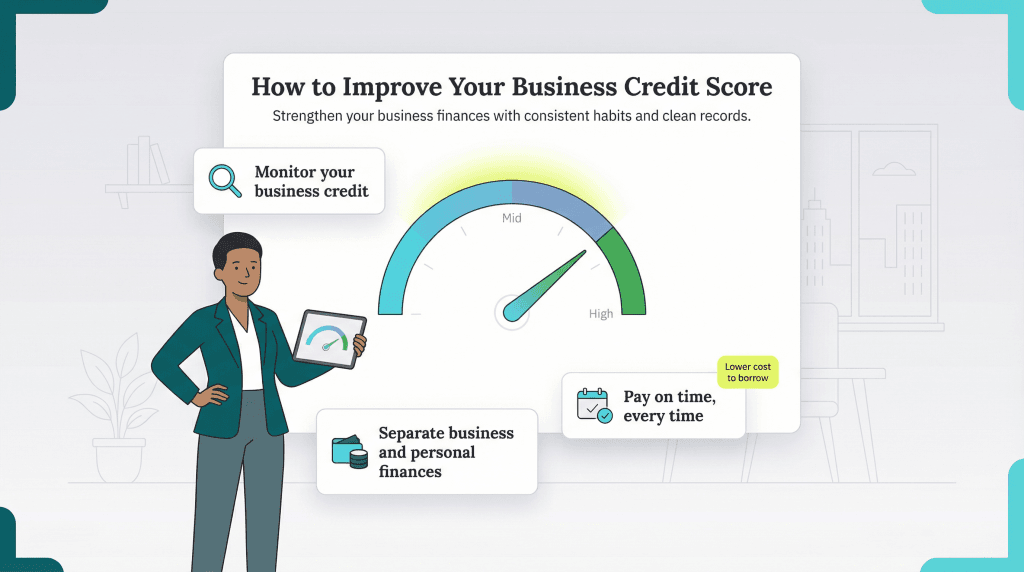

If your business credit score isn’t as good as you were hoping, don’t worry. These are some steps you can take to improve it.
Even with a healthy business credit score, a lender might require a business owner to personally guarantee a loan. According to Ross, this typically includes a personal credit check and is especially common when the business is a sole proprietorship or has only recently launched.
While a business credit score and a personal credit score are distinct, it is best to maintain a good mark for both; they can sometimes complement one another. Business credit reports can be just as important in securing business financing as a strong personal credit score can guarantee. Maintaining good business credit reduces the cost of borrowing money. Also, it avails your business to more favorable payment terms with creditors and vendors alike.
“While one doesn’t necessarily impact the other, with some exception, the benefits of habitual early and on-time payment practices on both fronts will have broad and positively impactful benefits over the course of time — for both the business and the individual,” Ross said.
Kimberlee Leonard contributed to the reporting and writing in this article. Source interviews were conducted for a previous version of this article.