Check out The Best Employee Monitoring Software of 2026 business.com recommends.
Business.com aims to help business owners make informed decisions to support and grow their companies. We research and recommend products and services suitable for various business types, investing thousands of hours each year in this process.
As a business, we need to generate revenue to sustain our content. We have financial relationships with some companies we cover, earning commissions when readers purchase from our partners or share information about their needs. These relationships do not dictate our advice and recommendations. Our editorial team independently evaluates and recommends products and services based on their research and expertise. Learn more about our process and partners here.

Check out The Best Employee Monitoring Software of 2026 business.com recommends.
Veriato offers multiple employee monitoring plans designed for large organizations and enterprises. It can support thousands of endpoints and charges per user, not per device. The software uses advanced technology and artificial intelligence (AI) to help employers track employee behavior and maintain company security. Key features include risk scoring, anomaly detection, application and website monitoring, psycholinguistics and insider threat detection. It’s because of these capabilities and more that Veriato is our choice as the best employee monitoring software for larger organizations.
Monitoring thousands of employees at once can be tough to do without the right software. Veriato has the necessary features to not only perform but also simplify the process. We like that it can monitor a wide range of user activities, including websites, applications, network usage, documents, printer and USB usage, file transfers, keystrokes, instant messages, email and psycholinguistics.
It can also detect anomalies and generate user risk scores — capabilities not all competitors offer. Risk scoring and anomaly detection are especially valuable for large organizations that need to quickly identify which employees pose the greatest risk to the business. Veriato also provides screenshots, alerts and reports, all of which can be essential for protecting an organization in the event of litigation or a security incident.

When we tested the software, we found the display and navigation to look slightly more technical than competing platforms. This is largely due to how advanced some of the settings can be. Since Veriato offers advanced technology and security settings, some users say it can be a bit difficult to learn. However, this is rarely a significant obstacle for larger organizations with experienced IT and security teams already in place.
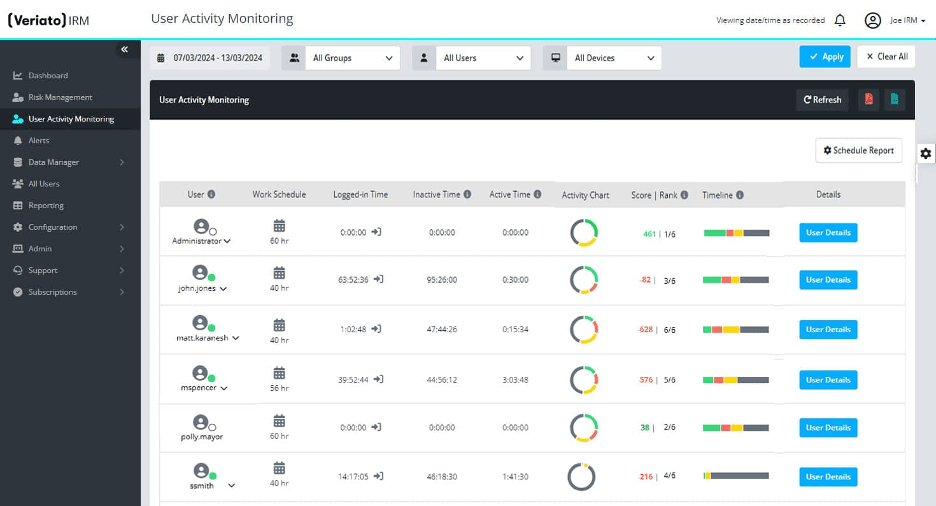
Veriato is comprehensive and has virtually all the features you need to monitor your employees. However, the specific features you gain access to will depend on which Veriato service plan you sign up for.
Veriato has several customizable settings to meet the needs of each business, which is especially helpful for larger organizations that need to monitor several employees across various locations. For example, we like that you can limit the type of information each employee or type of user can access based on a variety of things. It offers role-based access, feature-based access and event-based access. The extent of access customizations wasn’t something offered by all competitors we reviewed, but it can be useful for large organizations that need to set specific and unique access permissions.
When testing the software, we found Veriato offers a variety of other setting configurations. For example, administrators can customize the software to track specific hours only, if needed. Establishing settings, like which types of activity need to be recorded, is as easy as toggling a button on or off.
We’re impressed with how comprehensive Veriato is when it comes to the types of user activity it can monitor, as it continuously collects endpoint data across more than 60 activities. For example, it can track network usage, user status (when an employee logs on and off), productivity, engagement, applications, documents, printer and USB usage, outbound cloud activity, file transfers, keystrokes, chat and instant messaging, and online searches. When it comes to email monitoring, we liked that it can track the email body, recipients (including CC and BCC recipients) and email attachments.
We also like that Veriato provides geolocation tracking capabilities, allowing administrators to determine the physical location of a device at any given time. This is particularly beneficial for recovering lost devices and monitoring remote workers. When combined with geofencing, alerts can be triggered if a device enters or exits a predefined area, enhancing security measures.
One especially unique feature stood out during our testing: the software can track user psycholinguistics, a capability otherwise known as sentiment analysis or language and tone monitoring. The software logs user sentiment over time — noting whether someone generally communicates with a positive or negative tone — and can flag psycholinguistic deviations within emails. This is particularly useful for identifying potential insider threats or employee concerns before they escalate.
Maintaining company security and legal compliance are major necessities for any business, especially large organizations and enterprises as each additional employee can be considered a potential threat. When we tested the Veriato platform, we found that it had a number of valuable security features, such as insider threat detection, user and entity behavior analytics, artificial intelligence and a whole suite of alerts.
One tool we want to call attention to is risk scoring. The software tracks user activity and then compiles a risk score for each user. Scores are categorized as high risk (red), possible risk (yellow) and low risk (blue). Users are ranked based on their scores so you can easily see who is the highest risk to your organization. It also highlights whether a user potentially engaged in an accidental leak, espionage, financial fraud, opportunistic data theft or sabotage. When we tested the scoring tool, we found it easy to navigate and understand. You can dive deeper into a specific user’s risk behavior by clicking into their risk profile. You will be able to access their top indicators of risk as well as their seven- and 30-day risk histories.
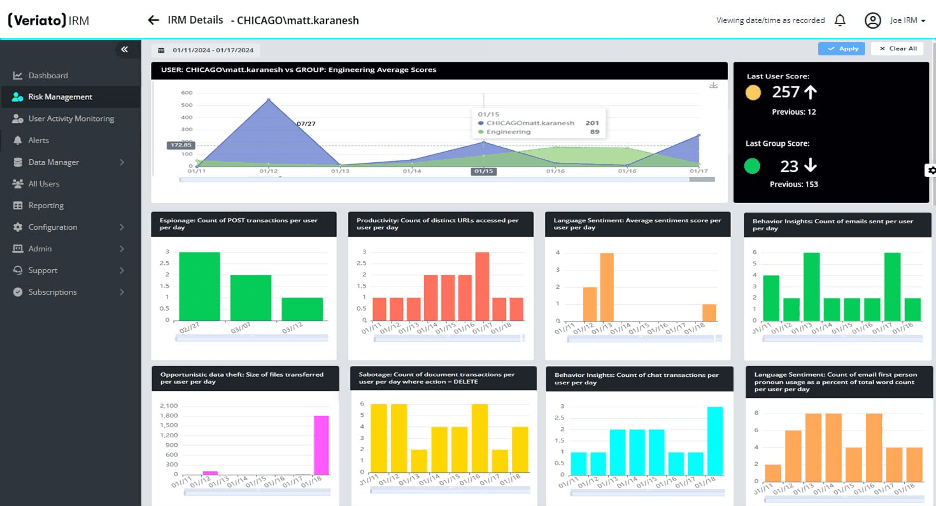
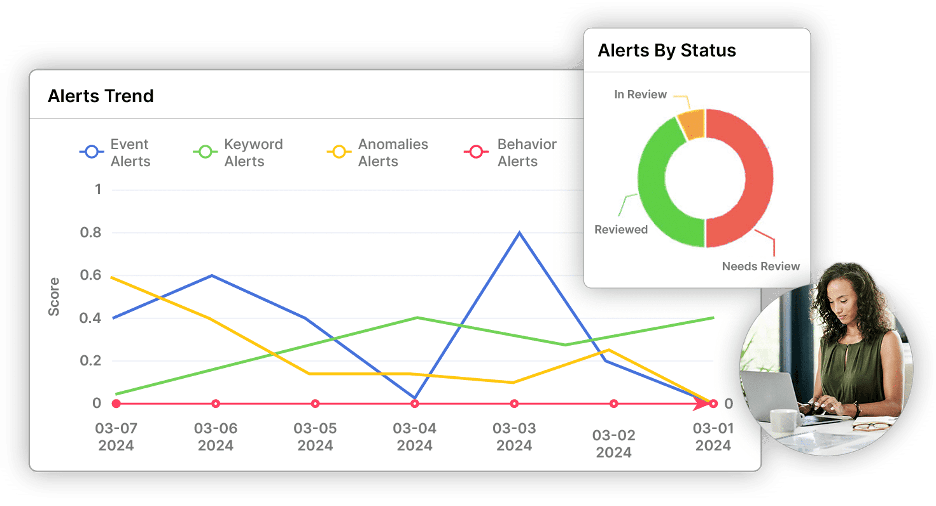
Veriato offers a variety of alerts and reports to help you track employee behavior. In addition to the risk scoring mentioned above, you can also set up keyword, policy violation, event, compliance and anomaly alerts. When we tested the software, we found it was easy to configure anomaly tolerance by toggling your alert threshold within the system. This will impact the number of alerts you receive. You can also run anomaly reports on individual users to receive detailed information on when their activity deviates from established behavior patterns. Each deviation is automatically flagged and recorded, giving you a clear, time-stamped audit trail that can be particularly useful for compliance documentation or internal investigations.
Veriato offers two primary monitoring service plan options: User Activity Monitoring (UAM) and Insider Risk Management (IRM). Both plans are available via cloud or on-premise.
Service Plan | Key Features | Cloud Price | On-Premise Price |
|---|---|---|---|
UAM | User activity monitoring across websites, applications, email and documents; keystrokes logging; screenshot captures; productive and idle device time monitoring; productivity scores; real-time alerts based on anomalies, events or keywords | Starting at $18/user/month (billed annually) | Custom quote |
IRM | Predictive behavior analytics, risk scoring, risk detection with AI, behavior pattern identification, anomaly detection, language and sentiment analysis, automatic personally identifiable information/protected health information identification, alert triggers (based on tone, language sentiment and more), user behavior analysis | Custom quote | Custom quote |
It’s important to note that this pricing is per user, not per device. So, if an employee has a laptop, desktop, tablet and Android phone, those would all be combined to equal one user. This pricing model is especially valuable for large organizations that want to keep their costs low, since paying for each additional employee device would quickly add up. However, Veriato also has a five-user minimum requirement for annual and monthly subscriptions.
Veriato offers a seven-day free trial, giving businesses enough time to evaluate core features before committing to a plan.
Veriato offers multiple monitoring software options to choose from. If you opt for an on-premise UAM plan or any IRM plan, then you need to contact Veriato directly to get a quote. From there, a Veriato representative will work with you to start deploying the software.
It’s worth noting that implementing Veriato’s software requires administrator-level credentials for installation. While the deployment process is well-structured, having IT personnel with administrative access ensures proper setup and configuration. Because Veriato’s platforms are so advanced, there can be a slight learning curve during the initial rollout — but once your team gets comfortable with the platform, it offers a wealth of information.
Veriato customers can submit a support ticket online 24/7, and phone support is available between 7 a.m. and 7 p.m. Eastern time. When we spoke with a company representative, we were advised that the best way to reach support is to first submit an online ticket and then give the company a call once you have your support ticket number. This helps to arm the support team with the information they need to best assist you.
Veriato can run on standard platforms like Windows, Mac, Chrome and Android. However, it can’t be used to monitor iOS mobile phones. Another potential drawback we found was that Veriato doesn’t offer audio monitoring, meaning that it can’t record sound from a user’s device. This type of feature can be useful for organizations that need to monitor sales calls. If this is a feature you require, check out our review of Teramind, as it offers that option.
We researched and analyzed dozens of systems to identify the best employee monitoring software on the market. We looked at pricing, contracts, hardware, platform compatibility, tracking features, content filtering and blocking, reports, integrations, security and compliance, usability and customer support. We even watched product videos and conducted demos when possible. When evaluating the best employee monitoring software for larger organizations specifically, we prioritized features like security, compliance, scalability, endpoint tracking, application and website monitoring, and reporting capabilities.
We recommend Veriato for …
We don’t recommend Veriato for …
Check out The Best Employee Monitoring Software of 2026 business.com recommends.