Business.com aims to help business owners make informed decisions to support and grow their companies. We research and recommend products and services suitable for various business types, investing thousands of hours each year in this process.
As a business, we need to generate revenue to sustain our content. We have financial relationships with some companies we cover, earning commissions when readers purchase from our partners or share information about their needs. These relationships do not dictate our advice and recommendations. Our editorial team independently evaluates and recommends products and services based on their research and expertise. Learn more about our process and partners here.
The right UX designer can help small businesses become more efficient, user-friendly and innovative.

Product aesthetics matter, but user-friendly experiences drive customer loyalty and business growth. To achieve exceptional user experience (UX), companies are investing in UX designers who can transform how customers interact with their products and services.
The main benefit of having a UX designer is gaining a strategic partner who improves every customer touchpoint with your brand. This investment can lead to measurable business outcomes including reduced customer churn, lower development costs and increased conversion rates. Read on to learn what UX designers do, how employing one helps your business, and what our predictions are for the future of UX.
A UX designer is an employee or contractor who’s responsible for optimizing a product’s user experience. Whether you’re building a website, developing a mobile app or creating a physical product, it should be as easy as possible for your client to use.
A UX designer constantly seeks ways to improve your products and services. They do this by amassing a deep understanding of your company and the problem you’re aiming to solve.This reduces the chances of product failures and other issues.
UX designers conduct in-depth user research to discover the target customer’s pain points and identify their needs. They gather survey data, assemble focus groups, schedule individual interviews and conduct A/B testing.
Throughout the product development cycle, UX designers create prototypes and conduct testing to observe how real users interact with the product. Based on this feedback, they modify the design to eliminate friction points and enhance the overall experience.
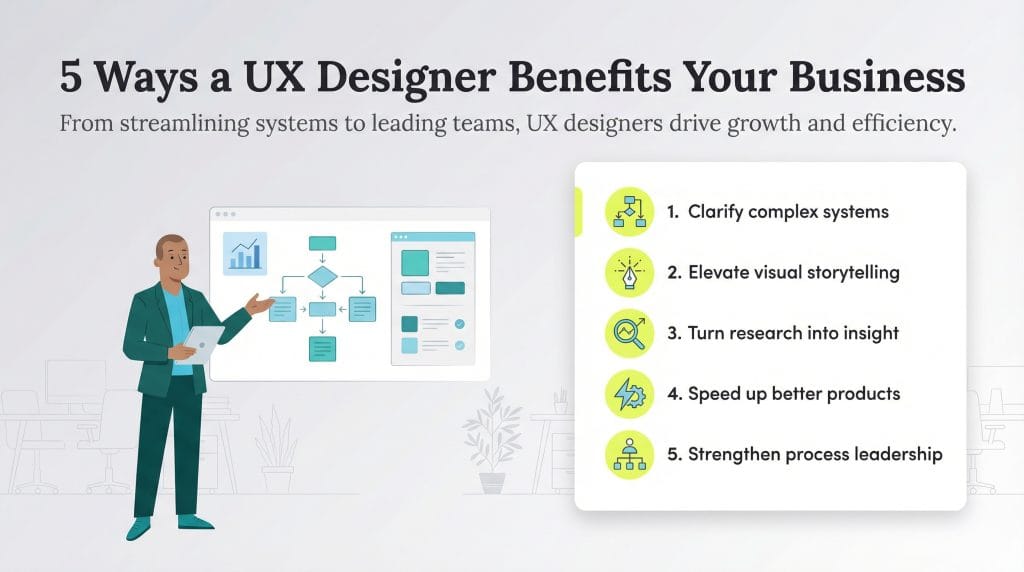
The right UX designer can help your small businesses become more efficient, user-friendly and innovative. If you’re still not sure you need one, consider these five benefits of hiring a UX designer.
UX designers can see the big picture and organize complex processes into simple solutions. When they talk about design thinking, they get excited about conquering major obstacles — even for innovative, enterprise-level solutions.
If you work in an industry with complex workflows and multiple stakeholders, you need someone who can evaluate and streamline these systems. Once on your team, UX designers will interview stakeholders and users, follow the customer journey and identify opportunities for optimization.
In your hiring process, look for candidates who can turn confusing problems into simple solutions. To sharpen their skills, give them challenging, complex problems to work on across different departments.
Some UX designers lean toward artistic thinking. They come with portfolios full of sketches, drawings or digital animations, and they often have an innate talent for compelling visual work.
These candidates might need someone to guide them on technical tasks. But given how heavily UX design relies on sight, these individuals make great candidates for companies that need eye-catching prototypes.
Creative UX designers excel at visual storytelling and can communicate complex ideas. Their artistic sensibility helps create emotional connections between users and products, which is crucial for brand differentiation. Consider building more creative time into your UX designers’ schedules to maximize their value for your small business.
Some companies have entire positions or departments dedicated to the user experience. But for smaller businesses, the designers must know how to research, and UX designers know how to do this well.
When you’re interviewing candidates, inquire about their user outreach experience. Ask for examples of their customer interview skills, and see if they ask good questions and show empathy as they research customer insights.
Build research and testing into every product development cycle to allow these designers to improve the product using their unique skills. They know how to find the answers, but they need organizational support and dedicated time for research activities to deliver maximum value.
Some companies, like corporate innovation centers with agile teams, need to see working prototypes as quickly as possible. As natural tinkerers, UX designers are perfect for that role. [Read related article: Metrics for Measuring Your Agile Team’s Productivity]
If you prioritize speed above all else, seek UX designers who demonstrate proficiency in collaborative tools, such as Figma or Framer, and show enthusiasm for emerging technologies. Within your team, open lines of communication between designers and developers. This will give the designers an opportunity to create even more efficient processes.
These designers can test new tools you’re considering. If the team wants to implement technology for a new feature, let a UX designer team up with a developer to take a crack at it first.
The best managers are process-oriented people. They stay up to date on trends by reading blogs, following thought leaders and attending meetups with fellow designers. Sure, UX designers know how to do the design work, but they also see how that work fits into your organization’s broader picture.
If your small business wants designers who could step into other roles in your company one day, look for people with a passion for human-centered design, a history of organized efficiency and leadership skills. These designers can speak capably with stakeholders from across departments, and they’ll show an interest in the data their work produces. These high-potential UX designers are introspective about processes and are always ready to pursue improvements.
As a business leader, you should allow UX designers to adjust the processes around them after they get some experience in the environment. This improves operational efficiency in the short term and helps designers take steps toward leadership responsibilities.
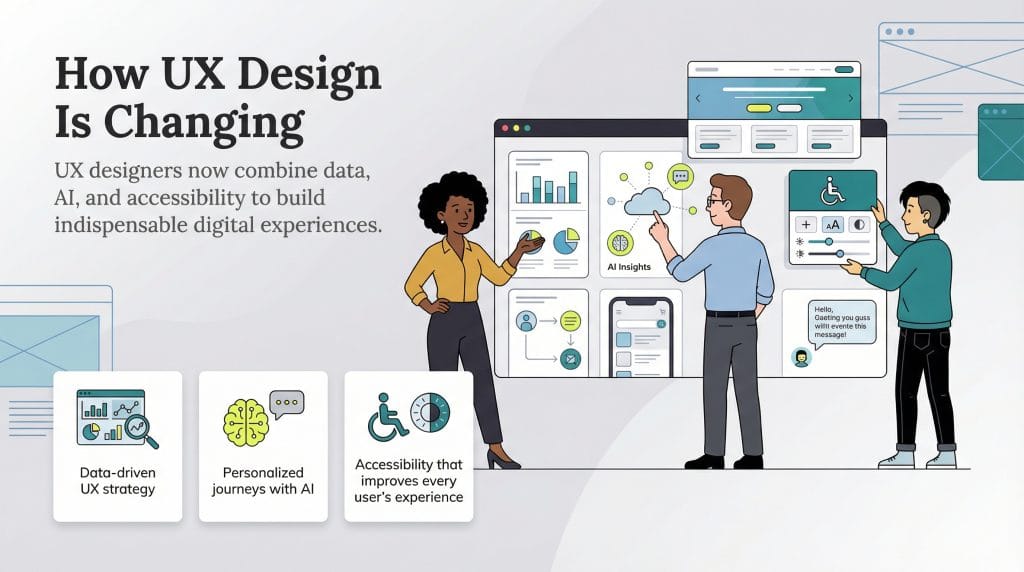
UX designers are evolving beyond traditional design roles to become strategic business partners who leverage data analytics, behavioral psychology and emerging technologies. Previously, UX was largely the domain of designers. Today, UX professionals create designs based on data from websites, apps and customer research, with the aim of solving users’ problems. Their ultimate goal is to create a website, product or service that becomes indispensable to the user.
Many UX designers have carved out their own niches in particular industries. So, if you’re thinking about hiring a UX designer, consider looking for candidates with specific knowledge of your sector. They’ll have a deeper understanding of what your customers want and the challenges specific to your business.
Artificial intelligence, particularly generative AI and machine learning algorithms, has revolutionized UX design workflows and capabilities. For e-commerce firms, in particular, you need to customize your website or app so visitors immediately see what interests them. Expect increasing personalization on websites and apps, coupled with the use of AI-powered chatbots that can answer customer questions and provide recommendations.
For years, there have been attempts to make the internet and mobile apps more accessible for people with disabilities and impairments.The fluid structure of UX design tools makes this task easier than it was 10 years ago. Businesses that focus on accessibility will not only broaden their market of potential customers but also improve the experience for all users. That’s because accessible sites or apps are easier to navigate, have optimized color contrast, use legible fonts and are compatible with screen readers.
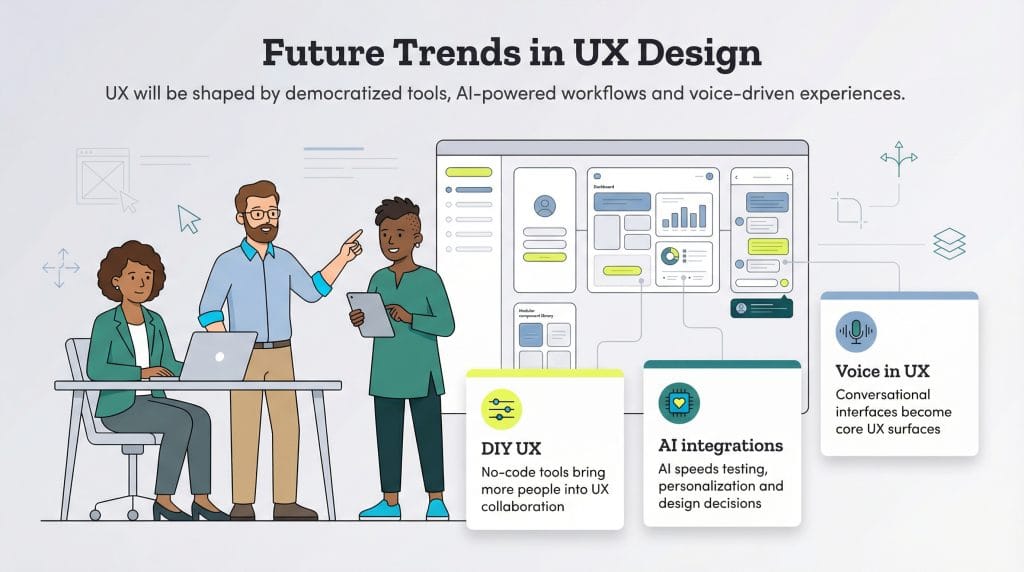
There are reasons for companies to optimize the UX design of their products and services. A good customer experience can result in more sales; in PwC’s Voice of the Consumer Survey, 86 percent of buyers are willing to pay more for a better customer experience. Given such figures, businesses will continue to invest in UX. Here are three dominant UX industry trends that analysts expect in the near future.
No-code and low-code platforms are democratizing UX design. Such UX-focused tools will make it possible to plan layouts and test prototypes using logic-driven, drag-and-drop-type interfaces.
Just as website builders didn’t eliminate the need for web developers, these tools won’t replace UX professionals. In the future, they’re more likely to take on a more consultative role and guide the people they manage through the more complex aspects and applications of UX that software won’t quite capture.
Earlier, we mentioned how AI would help transform the user experience. AI has already begun to change how UX designers do their job by not only generating suggestions and providing feedback on live projects but also actively contributing ideas and solutions to design and workflow decisions.
Modern AI-powered design tools can now analyze thousands of design patterns, predict user behavior fairly accurately and generate personalized interface variations in real-time based on individual user preferences and accessibility needs.
Again, this won’t replace UX professionals, but it will allow them to focus their vision and talents on the bigger picture rather than on repetitive, time-sapping design tasks.
Voice commands seemed to be the next big thing back when Siri, Cortana and Alexa came to market, but they never really took off because their interactions were formulaic and stilted. But voice interfaces have matured significantly with the advent of large language models (LLMs), so voice might be the next frontier for UX designers.
Building in voice interactivity powered by generative AI could be revolutionary. That’s because, unlike the older system, generative AI can engage in full conversations with humans and remember previous interactions.
UX designers now face the challenge of creating conversational experiences that feel natural while maintaining brand consistency. This includes figuring out how to make systems reply to users without compromising privacy, and moving beyond simple commands and responses to make the voice and personality of the AI likable.
Mark Fairlie and Rudy Mutter contributed to the reporting and writing in this article.