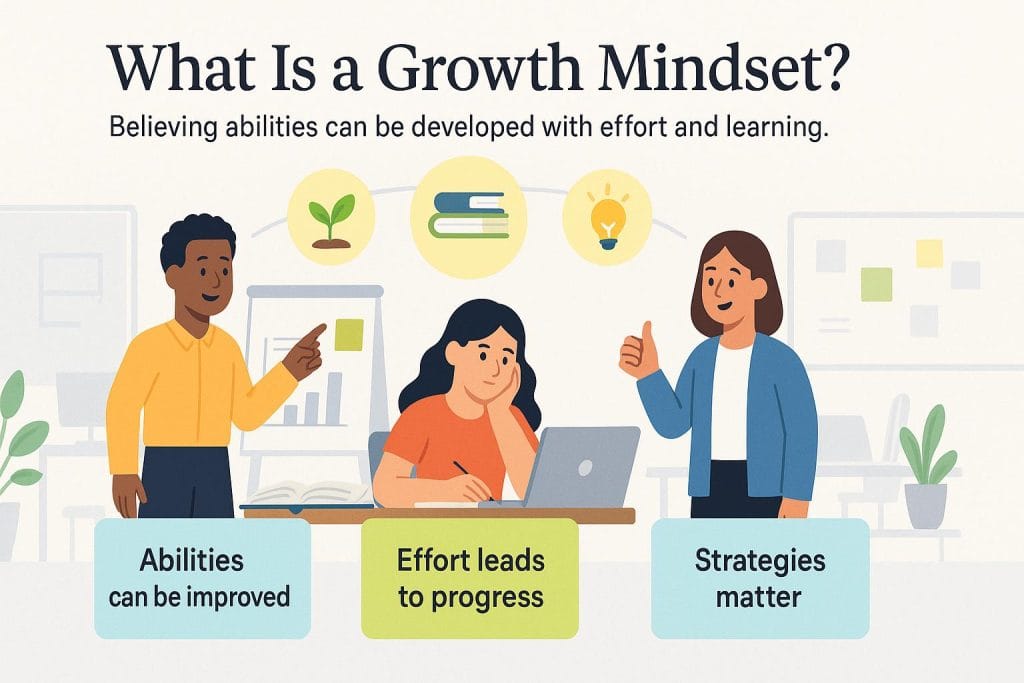
Psychologist Carol Dweck coined the term “growth mindset” to describe a new approach to learning. Dweck and her team observed that some students were troubled by even the smallest setbacks, while others were able to rebound from failure and keep going.
Although the growth mindset was originally developed to transform classroom learning, it can be applied in many areas, including business. We’ll explain what a growth mindset is, why it matters in business, and share practical tips on how you can develop one to boost your company’s success.
How to have a growth mindset and apply it in business
In a 2014 Harvard Business Review article, Dweck explained how a growth mindset shapes organizational culture, noting that companies that value learning over proving themselves tend to foster greater innovation, resilience and long-term performance.
Dweck said leaders with a fixed mindset tend to “place greater value on looking smart and are less likely to believe that they or others can change.” In contrast, leaders with a growth mindset “place a high value on learning, are open to feedback and are confident in their ability to cultivate their own and others’ abilities.”
Andrea De Jager-Jackson, founder of Limitless Growth Partners, a coaching and culture advisory firm, has seen this firsthand with her clients. “Leaders who role model a growth mindset reward learning and curiosity, not perfection,” De Jager-Jackson explained. “They experiment, speak up and take smart risks. In contrast, fixed-mindset leadership often leads to risk aversion, protecting the status quo, which slows innovation, prevents agility and [impacts] the organization’s ability to deliver against customer and consumer expectations.”
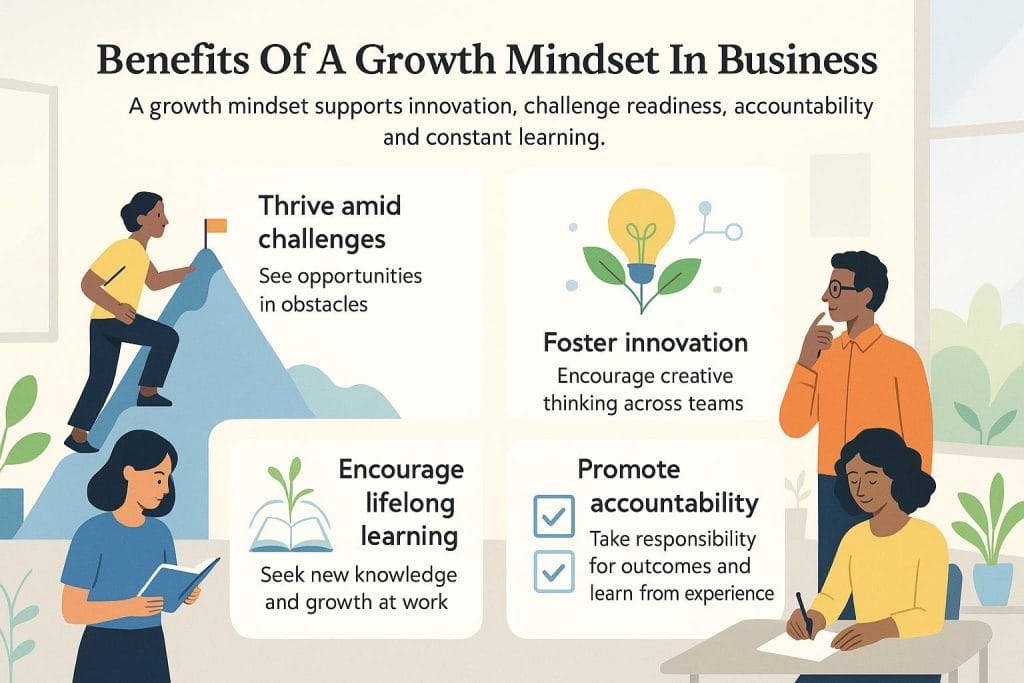
In her research and writing, Dweck has outlined how fixed and growth mindsets play out in real-world organizations. We’ll build on those insights and explore four key ways to foster a growth mindset in your organization.
1. Accept mistakes.
In her book Mindset: The New Psychology of Success, Dweck pointed to the collapse of Enron as an example of a culture that emphasized talent and intelligence over learning. In that kind of environment, people feel pressure to look capable, so they’re less likely to admit mistakes or speak up. As Dweck sees it, when failure isn’t tolerated, problems don’t get addressed early — they just grow.
In contrast, businesses that adopt a growth mindset create an environment where mistakes are viewed as part of the learning process — opportunities to learn from failure. Instead of trying to hide them, team members can acknowledge issues openly and take steps to improve.
Daniel Olexa, founder and leadership development coach at Transcendent Living LLC, explained that organizations with a growth mindset have the freedom to be curious and embrace the unknown. “They’re willing to take risks, knowing that perceived failure is actually just feedback for navigating forward,” Olexa noted. “They also recognize that if mistakes are not being made, new territory is not being explored.”
In other words, a growth mindset in business means treating “failure” as feedback. “What can you learn from a perceived setback? How can that help you move forward more effectively and efficiently?” Olexa added.
Paul Robson, a serial entrepreneur, investor and business consultant, believes that mistakes can lead to growth. “There’s a well-known phrase that states, ‘I’ve failed over and over, that’s why I succeed!’ Society has overlooked that mistakes are no different,” Robson said. “[To] get it right, it may take a few mistakes along the way.”
Sally Zimney, author, business coach and keynote speaker on mindset and confidence, emphasized that repetition and experience lead to competence — but with inexperience, mistakes are inevitable. “We have to learn those skills by doing, which is the harder path, but much more efficient. So, we often learn in public, learn through failure, and learn by first flopping — and then getting better, little by little,” Zimney noted. “The key is not avoiding the tough (sometimes embarrassing) challenges. The more you learn by doing, the faster you’ll improve.”
2. Focus on skill development.
Business leaders with a growth mindset are more likely to invest in employee training and create professional development opportunities for their teams. This focus on skill development is more likely to produce engaged, effective team members than simply checking boxes in a traditional performance review or legacy performance management system.
Dweck’s research also found that employees in fixed-mindset organizations were more concerned about failure than those in growth-oriented environments. That anxiety can contribute to a culture of cutting corners, secrecy and diminished trust — both in leadership and in the organization itself. In those settings, employees are less likely to take risks, ask questions or seek out opportunities to improve their skills.
In contrast, in organizations that embrace a growth mindset, that dynamic shifts. Employees are more willing to take on challenges and develop new capabilities, and supervisors tend to view them as more collaborative and innovative.
Katie Manasse, director and executive coach at Sea and Sky Coaching and Consulting, emphasized the importance of not developing a fixed mindset about your team members, especially in fast-paced workplaces where everything can feel urgent.
“If you, as a leader, have a growth mindset, you are more likely to foster this in your team,” Manasse explained. “Providing opportunities to develop skills gives team members [a] healthy challenge and agency, and encourages honesty about what skills they feel they want to develop.”
To create a
strong company culture that supports a growth mindset, be supportive of your team members' goals and progress so they feel more comfortable asking questions, offering feedback and contributing to the team.
3. Celebrate effort, not talent.
Recalling her experience with former English Premier League champions the Blackburn Rovers, Dweck observed that some young athletes avoided practice because participating was seen as a sign they lacked natural ability. This reflected a mindset that viewed star athletes as born, not made, so training hard suggested you weren’t truly talented.
Dweck found that this mindset hindered the team’s development and recommended prioritizing continuous improvement over innate talent.
This idea translates directly to the business world. Instead of placing the highest value on employees who appear naturally gifted or deliver quick results, recognize and reward those who consistently put in the effort to build their skills.
In other words, shift your focus away from praising inherent talent and quick wins toward effort and persistence. Over time, this approach helps create a culture that supports a growth mindset and long-term success.
Olexa pointed out that many high performers in sports — and in business — succeed because of discipline and dedication, not just natural ability. “Tell a young Michael Jordan or Steph Curry that they weren’t born with the skills to be a champion, and you would lose,” Olexa said. “Their training regimens, their intense practice schedules and their dedication to greatness are the epitome of champions being made, not born.”
Jon Logan of Greenlit Growth Strategies echoed the risk of overvaluing perceived talent at the expense of real potential. “Believing greatness is something you either have or don’t have creates a ceiling on potential,” Logan cautioned. “In business, like in sports, those who train with purpose will always outperform those who rely on natural ability alone.”
4. See challenges as learning opportunities.
Dweck’s research showed that people with a growth mindset approach difficult tasks differently. For example, she found that elementary school students who viewed setbacks as temporary and useful tended to perform better over time than those who saw them as a form of personal failure.
She described one boy who enthusiastically approached difficult problems by saying, “I love a challenge.” He reframed setbacks as puzzles to solve rather than a sign of his inability, demonstrating a growth mindset at an early age.
In business, this translates to normalizing the idea that not overcoming an obstacle right away is an opportunity to grow — not a sign of incompetence. Encourage managers to discuss challenges openly in team meetings, reframing potential setbacks as chances to experiment, innovate and improve.
De Jager-Jackson put it this way: “When challenges are framed as opportunities to grow rather than problems to avoid, employees shift from fear to creativity and ownership. It changes the internal dialogue from ‘I’m failing’ to ‘I’m learning.'”