Business.com aims to help business owners make informed decisions to support and grow their companies. We research and recommend products and services suitable for various business types, investing thousands of hours each year in this process.
As a business, we need to generate revenue to sustain our content. We have financial relationships with some companies we cover, earning commissions when readers purchase from our partners or share information about their needs. These relationships do not dictate our advice and recommendations. Our editorial team independently evaluates and recommends products and services based on their research and expertise. Learn more about our process and partners here.


Many small business owners purchase insurance when they launch their business and then treat it as a fixed expense that runs quietly in the background. The policy renews each year automatically, the premium is paid and the coverage details don’t get a second look until something goes wrong or a new policy is needed. Perhaps a claim is filed, a landlord requests an updated certificate or a new client contract demands coverage the business doesn’t have.
The problem with this approach is that businesses change. Revenue grows. Employees are hired. New locations open. Equipment is purchased. Service offerings expand. Contracts impose new requirements. The insurance program that was perfectly adequate two or three years ago may have significant gaps today, and those gaps remain invisible until a loss occurs that exceeds or falls outside your coverage.
An annual insurance review is the most reliable way to catch these gaps before they cost you money. This guide provides a structured, repeatable framework for conducting that review — from gathering your current policies to implementing changes and preparing for next year.
Before learning how to execute an annual insurance review, it’s important to understand why they matter. The core purpose of an annual review is to ensure your coverage keeps pace with your business. Several specific risks emerge when it doesn’t.
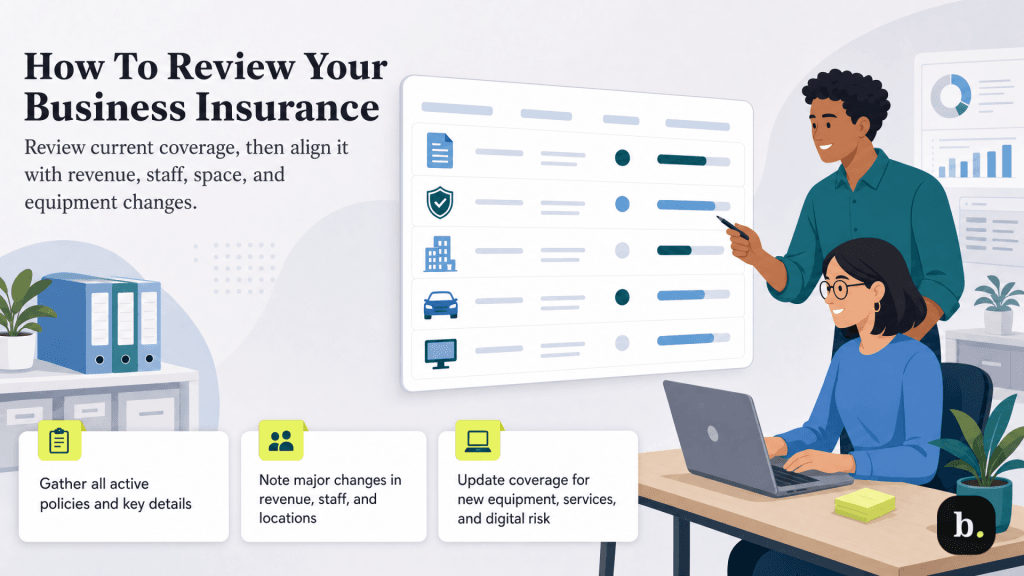
To review your business insurance annually, follow these steps.
Begin by assembling every active insurance policy your business carries. This includes your business owner’s policy or standalone general liability, commercial property, workers’ compensation, commercial auto, professional liability, cyber liability, umbrella or excess liability, employment practices liability and any other specialty coverages. If you’re unsure whether you’ve captured everything, your insurance agent can provide a summary of all policies they manage on your behalf.
For each policy, document the coverage type, insurance carrier, policy number, coverage limits (per-occurrence and aggregate), deductibles, annual premium and renewal date. Having this information organized in a single summary document makes the rest of the review process significantly more efficient.
Also gather any certificates of insurance (COIs) you’ve issued to landlords, clients, lenders or other third parties over the past year. These certificates represent coverage commitments you’ve made, and they need to remain accurate and up to date. If you’ve changed carriers, adjusted limits or modified coverages, any outstanding certificates may need to be reissued.
This is the most important step in the entire review process. Your insurance program was built around a snapshot of your business at a specific point in time. This step determines whether that snapshot still matches reality.
Walk through each major dimension of your business and note any changes since your last review.
>> Learn how cyber insurance can help your business.
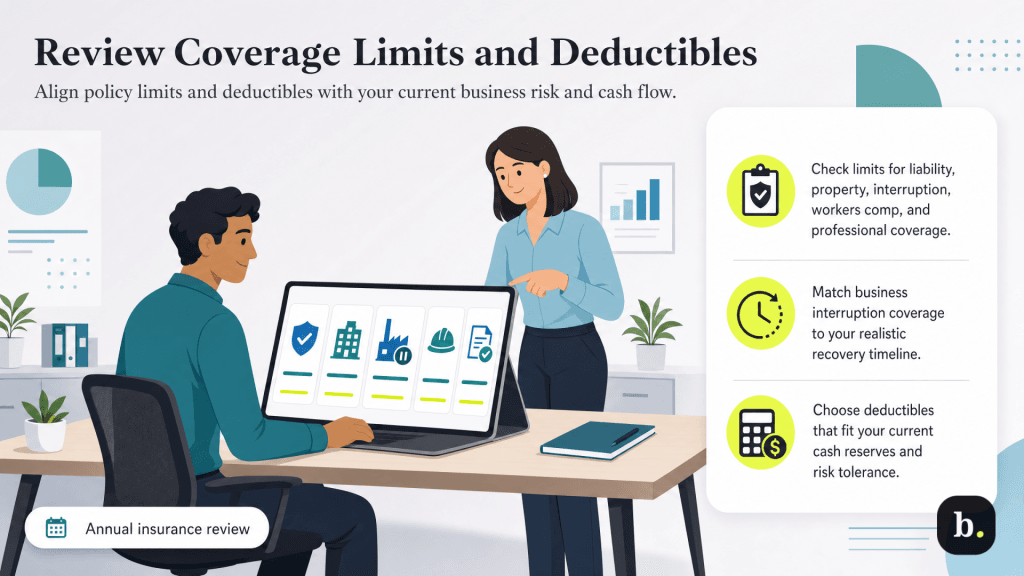
With a clear picture of how your business has changed, evaluate whether your current coverage limits are still adequate for each policy.
Additionally, evaluate whether your current deductibles still make sense given your financial position. A higher deductible reduces your premium but increases your out-of-pocket exposure when a claim occurs. If your business has grown and your cash reserves are stronger, you may be comfortable with a higher deductible in exchange for premium savings. Conversely, if cash flow is tight, a lower deductible provides more predictable costs when a loss occurs.
Based on your assessment of business changes and your coverage limit review, identify risks that are currently uninsured or underinsured and coverages you may no longer need.
Common gaps that surface during annual reviews include:
On the other side, look for coverage you’re paying for that no longer applies:
Eliminating unnecessary coverage isn’t just about saving money — it frees up budget that you can redirect toward closing genuine gaps.
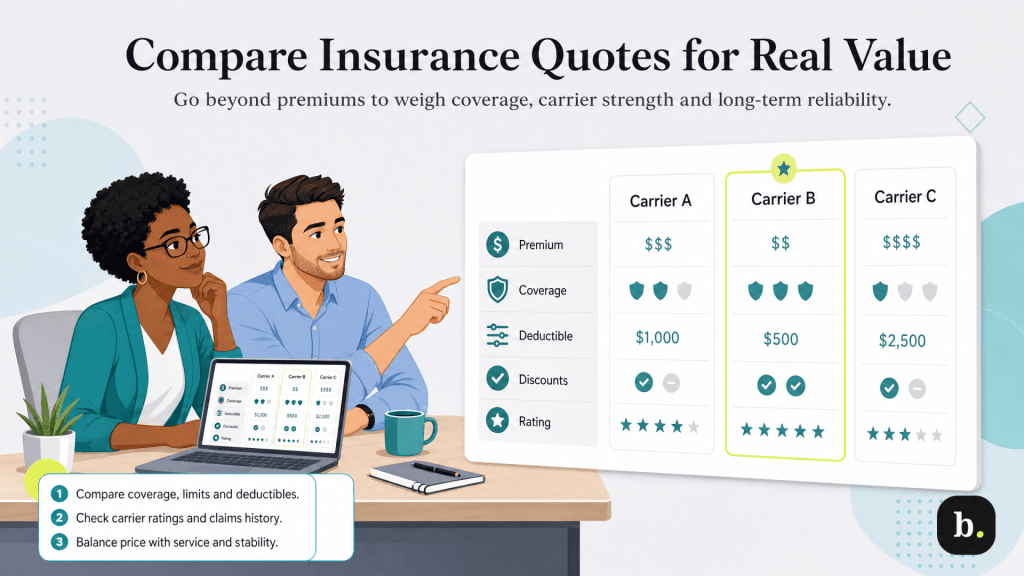
Your annual review is the natural time to ensure you’re getting competitive pricing for your coverage. This doesn’t necessarily mean finding the cheapest premium — it means finding the best value for the protection you need.
Request renewal quotes from your current carrier and comparison quotes from at least two or three additional carriers. If you work with an independent insurance agent or broker, they can access multiple carriers on your behalf, which is significantly more efficient than contacting carriers individually. Independent agents are particularly valuable here because they’re not limited to a single insurer’s products.
When comparing quotes, resist the temptation to focus only on premiums. Compare the full picture: coverage types, limits, deductibles, exclusions, endorsements, and the carrier’s financial strength and claims reputation. A lower premium with lower limits, broader exclusions or a higher deductible may actually provide worse value than a slightly more expensive policy with stronger coverage. Check the carrier’s AM Best rating to assess financial stability — an insurer that can’t pay claims is worthless regardless of how low the premium is.
Ask about available discounts. Many carriers offer multi-policy discounts for bundling coverages, claims-free discounts for businesses with clean loss histories, industry association discounts and payment discounts for annual rather than monthly premium payments. Your agent can identify which discounts you qualify for and ensure they’re applied.
One important consideration: Switching carriers purely for a lower premium isn’t always the right move. If your current carrier has handled claims well, provides responsive service and offers competitive terms, the stability and reliability of that relationship have value. Factor in the full picture, not just the price tag.
Schedule a dedicated meeting with your insurance agent or broker to walk through the findings of your review. This is not a five-minute phone call — block enough time for a thorough conversation. Come prepared with your current policy summaries, your list of business changes, any new contracts or lease agreements with insurance requirements, and the competitive quotes you’ve gathered.
Ask your agent to review your findings and identify any gaps or redundancies you may have missed. A good commercial insurance agent will bring industry-specific knowledge and an understanding of emerging risks that you wouldn’t necessarily think to ask about. They can flag trends in your industry’s claims environment, recommend coverage adjustments based on how businesses similar to yours are being affected and help you prioritize which gaps to close first if budget is a constraint.
If you’ve filed any claims during the past year, discuss how they were handled, whether the claim revealed any coverage issues and how the claims may affect your renewal premiums. Claims experience is one of the most influential factors in your renewal pricing, and your agent can help you understand the impact and develop strategies to mitigate premium increases.
This meeting is also the time to review your certificates of insurance. Confirm that all parties who require additional insured status are properly listed, that the coverage limits on outstanding certificates match your current policy limits and that any new relationships requiring certificates are addressed.
Once you’ve made any decisions, implement all coverage changes, limit adjustments and carrier switches before your renewal date. Allowing changes to take effect at renewal avoids mid-term adjustments and keeps your policy periods clean.
Request updated certificates of insurance for every third party that requires them — landlords, clients, lenders and partners. Distribute them proactively rather than waiting to be asked. Proactive certificate distribution demonstrates professionalism and prevents the scramble that occurs when a third party discovers your certificate has lapsed or doesn’t reflect current coverage.
Update your internal records. Create or refresh a summary document listing all active policies, including the carrier name, policy number, coverage type, limits, deductibles, annual premium and renewal date. Store your policy documents in a secure, accessible location — both digital copies (using cloud storage or high-quality document management software) and physical copies if you prefer a paper backup. This summary document becomes the starting point for next year’s review.
Finally, set a calendar reminder for 60 to 90 days before your next renewal date. The most effective insurance reviews happen on a predictable schedule. If you make the annual review a standing item on your business calendar, it becomes a routine part of operations rather than a task that gets deferred until a problem forces your hand.
The ideal time to begin your annual insurance review is 60 to 90 days before your primary policy renewal dates. This window gives you enough time to gather information, consult with your insurance agent, request competitive quotes from other carriers and make informed decisions before the renewal locks in. Starting too close to the renewal date limits your ability to shop effectively and may force you to renew under suboptimal terms simply because you’ve run out of time.
If your policies have different renewal dates scattered throughout the year, consider asking your agent or broker about consolidating them to a common renewal date. This simplifies your annual review by allowing you to evaluate your entire insurance program at once rather than conducting multiple partial reviews throughout the year.
In addition to the scheduled annual review, certain business events should trigger an off-cycle review, such as:
Any of these changes can affect your coverage needs and shouldn’t wait until the next scheduled review to be addressed.
An annual insurance review is one of the highest-value hours you can invest in your business’s risk management. The framework is straightforward: Gather your policies, assess what’s changed in your business, evaluate your coverage limits, identify gaps and unnecessary coverage, shop for competitive rates, consult your agent and implement changes before renewal.
The businesses that get caught underinsured are rarely the ones that chose the wrong policy at the outset. They’re the ones whose business outgrew their coverage while they weren’t paying attention. Revenue doubled, but limits stayed the same. Employees were hired, but EPLI was never added. A new location opened, but property coverage wasn’t updated. Each of these gaps is entirely preventable with a structured annual review.
Treat your insurance program as a living document that evolves alongside your business, not a static expense that renews automatically. The annual review is the mechanism that keeps it current, and the cost of conducting it is negligible compared to the cost of discovering a gap the hard way.
