Business.com aims to help business owners make informed decisions to support and grow their companies. We research and recommend products and services suitable for various business types, investing thousands of hours each year in this process.
As a business, we need to generate revenue to sustain our content. We have financial relationships with some companies we cover, earning commissions when readers purchase from our partners or share information about their needs. These relationships do not dictate our advice and recommendations. Our editorial team independently evaluates and recommends products and services based on their research and expertise. Learn more about our process and partners here.
Use this step-by-step guidance to review finances, finalize deductions and prepare your business for a stronger new fiscal year.


Closing out the fiscal year is a pivotal moment for business owners, whether your books reset in December or follow a different tax timeline. While gathering tax paperwork is an important first step, this period is also an opportunity to make strategic tax-deductible purchases, set a realistic budget for the year ahead and take a fresh look at your long-term growth plans. Use the tips below to wrap up your fiscal year with clarity and step into the next one feeling organized, prepared and ready to move forward.
Here’s how to make sure the home stretch of your fiscal year goes smoothly and sets a strong foundation for the future.
Year-end closing starts with a careful review of your business’s transactions and financial records to confirm everything aligns. That includes, but isn’t limited to, income, revenue, expenses, investments, equity and business assets. Before moving forward, take time to review your books and make any necessary revisions so your numbers reflect reality.
Your finance team or certified public accountant (CPA) should examine accounts payable (A/P) and accounts receivable (A/R) closely and flag any discrepancies. If something doesn’t add up, they should follow up with the employee connected to the transaction and resolve the issue quickly. Addressing gaps early helps keep your general ledger accurate and prevents bigger problems later.
If this sounds time-consuming, that’s a fair concern. Still, many of the best accounting software solutions can simplify much of the process. For example, QuickBooks Online includes robust reporting tools that generate general ledger, A/R aging and A/P aging reports, giving you a clear snapshot of your fiscal year. (See our detailed QuickBooks Online review to learn more.) When transactions are organized in clean, structured reports, spotting inconsistencies becomes far easier and faster.
Ask yourself whether your business has been delaying any necessary purchases. If so, consider making them before your fiscal year draws to a close, as you may be able to deduct qualifying expenses in the current tax year.
For example, businesses may use the Section 179 deduction to immediately expense qualifying equipment instead of depreciating it over time. Section 179 limits change each year; in 2026, businesses can generally expense up to about $2.56 million before the deduction begins phasing out at roughly $4.09 million in qualifying purchases.
Making important purchases during your fiscal year’s home stretch can be especially helpful if your income reached new highs compared to last year. If your income was lower this year — or if you simply don’t need to buy anything — don’t feel pressured to spend just for a deduction. Lowering taxable income can help, but avoiding unnecessary expenses is just as important for long-term financial health.
In any case, for purchases you do make, keeping organized documentation is essential in case of a tax audit. Rather than worrying about a specific dollar cutoff, focus on keeping clear records that back up your deductions, whether that means saving receipts, invoices or digital copies. As you get everything organized, tools like QuickBooks Online can make it easier to categorize expenses and sort them into the right accounts, from travel to everyday office costs.
Not every asset will qualify for full expensing under Section 179, which means traditional depreciation still plays an important role in year-end planning. Over the course of a fiscal year, assets like office furniture, vehicles, buildings, equipment and machinery can lose value as they wear down or become outdated. This loss in value is known as depreciation, and it may be deductible depending on how the asset is classified and used in your business.
That said, calculating depreciation can get complicated quickly, so it’s usually best handled by your accounting team or CPA. They understand the different depreciation methods, useful life schedules and eligibility rules, helping ensure assets are categorized correctly and deductions are calculated accurately.
Take time now to gather and organize your tax documents. Doing this ahead of filing deadlines can help you avoid last-minute stress and reduce the chances of errors or missing information.
Key documents to review include IRS Forms W-2 and W-3, along with payroll tax forms such as Form 940 and Form 941. Many businesses also prepare Form 1099-NEC for independent contractors who earned $600 or more during the year, sending copies to both recipients and the IRS by the required deadlines. For teams that rely on payroll software, this step is often where the time savings show up. For example, our QuickBooks Payroll review explains how this platform can automate much of the process, from generating forms to organizing filing records.
Because filing expectations have changed over time, it’s worth double-checking how your information returns are submitted. Today, electronic filing often kicks in once you reach 10 total information forms, much lower than the old 250-return rule — something many small businesses don’t realize until year-end.
This step applies if your business sells physical products rather than offering services. Your goal is to confirm that your inventory records match your actual stock levels. If you already rely on inventory software or tools like QuickBooks Online, much of this work may already be done for you, since stock changes are tracked in the background. Businesses that don’t use automated systems should expect to spend more time on manual counts as part of their year-end close.
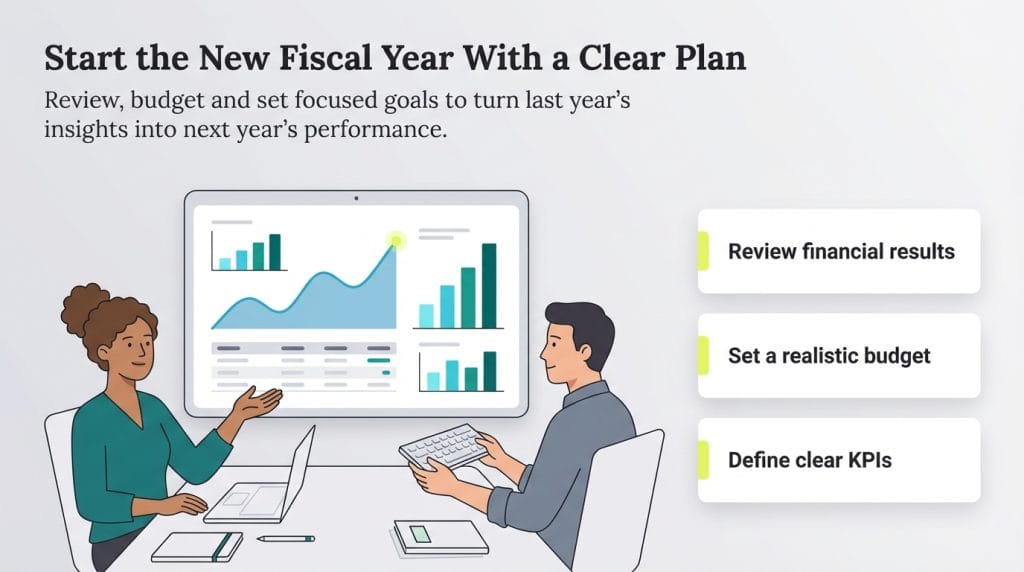
As your fiscal year wraps up, it’s worth stepping back to look at what’s working and what needs adjusting before the next one begins. Taking stock now can help you move into the new year with a clearer plan. Here are a few tasks to consider:
Every fiscal year brings a mix of wins and lessons, and your accounting team is well-positioned to help make sense of both. Start by reviewing core reports such as your balance sheet, income statement and cash flow statement to understand how the business performed and where adjustments may be needed. These insights can also shape realistic forecasts for the year ahead. Tools like QuickBooks Online can help streamline reporting and give you a clearer picture of your financial trends.
Budget planning often sits at the center of any financial forecast. A good starting point is reviewing what your business actually spent last fiscal year and using that as a baseline for the months ahead. Expected sales can also influence your projections; stronger revenue may give you room to invest more in profitable growth, while less optimistic forecasts may call for tighter spending and cutting business costs.
As you map out expenses, break them into clear categories such as wages, marketing and SaaS subscriptions, which can quietly creep up with annual price increases. Some businesses also set aside a cash buffer equal to a few months of typical operating costs so they’re better prepared for unexpected expenses during the new fiscal year.
Planning for growth in a new fiscal year starts with defining what success actually looks like. One helpful first step is reviewing how close you came to last year’s financial targets and deciding which business goals to expand, adjust or revisit with a more realistic timeline.
Many businesses rely on SMART goals (specific, measurable, attainable, relevant and time-based) to give their planning structure. For example, if your business ended the last quarter with around $300,000 in revenue, nudging that target to roughly $350,000 can feel like a manageable next step. Sales volume then becomes a clear key performance indicator (KPI), something you can track consistently as the year unfolds.
If your targets feel too ambitious, breaking them into shorter milestones can make them easier to manage. That $350,000 quarterly goal may feel more achievable when viewed as roughly $27,000 in weekly sales.
However, remember that not every goal needs to be overly structured. Sometimes it’s better to keep short-term priorities simple and flexible.
Vendor costs have a way of creeping up over time, which is why many business owners take a second look at contracts when a new fiscal year is around the corner. A price increase here or an outdated service plan there can quietly affect your budget. If lowering expenses is on your radar, this can be a good moment to ask current suppliers about pricing or compare what other providers are offering.
That said, if your current vendors already offer strong service at reasonable rates, there may be little reason to make a change. A lower-cost provider doesn’t always deliver the same reliability or support, so weigh potential savings against the quality you receive today. Instead of switching partners, you might focus on other ways to strengthen operations as the new fiscal year begins.
New fiscal years often bring plans for upgraded tools or replacement equipment, but timing matters just as much as need. As you finalize your budget, consider whether upcoming capital purchases fit comfortably within your projected spending. If the numbers feel tight, it may help to adjust priorities or delay less urgent expenses before committing to a large purchase.
At the same time, not every upgrade needs to happen right away. If your current equipment still meets your needs, waiting another year can be a practical decision, especially if it gives your business more flexibility to invest elsewhere.
Transitioning from one fiscal year to the next comes with plenty of moving parts, from closing the books to setting new priorities. With support from your accounting team and tools like QuickBooks Online in place, the process can feel far more manageable than it might at first glance. Taking the time to wrap up loose ends, review what worked and plan intentionally for the months ahead can help your business start the new fiscal year on steady footing.
