Business.com aims to help business owners make informed decisions to support and grow their companies. We research and recommend products and services suitable for various business types, investing thousands of hours each year in this process.
As a business, we need to generate revenue to sustain our content. We have financial relationships with some companies we cover, earning commissions when readers purchase from our partners or share information about their needs. These relationships do not dictate our advice and recommendations. Our editorial team independently evaluates and recommends products and services based on their research and expertise. Learn more about our process and partners here.
Influencers can play a crucial role in your marketing success.


Social media influencers can be valuable marketing tools that boost brand visibility, discoverability, SEO and more. Their content and endorsements can shape how customers see your brand. That’s why choosing the right influencer matters, as the wrong partnership can damage your reputation or create avoidable contract issues.
We’ll explore 12 ways influencer marketing can help your brand and share influencer caveats to watch out for to protect your organization.
Influencer marketing has become a core marketing strategy, not just a passing digital marketing trend. According to eMarketer, U.S. influencer marketing spending is projected to surpass $13 billion by 2027, reflecting the growing role creators play in how brands reach and engage audiences.
Here are 12 ways working with influencers can help your brand grow.
Influencers typically talk about themselves in their content, including their routines, surroundings, activities and ideas. When they promote a brand, they don’t sell it directly. Instead, they weave products or services into their content in a way that feels natural, placing your brand into an existing conversation so consumers notice and learn about it without feeling like they’re getting a sales pitch.
Consumers are bombarded daily with hundreds of pieces of promotional content, which can leave them tired, confused and often indifferent about ads. Over time, many people simply tune them out.
In contrast, influencer marketing focuses on the relationships influencers have established with their followers. Their content entertains, informs or solves a problem. The most effective influencers promote a brand’s products or services within the context of that content, making your offerings feel relevant rather than intrusive.
When you search for a hashtag on social media, the search results typically display the most popular content using that hashtag first.
Influencers create content to engage audiences on social media, and the posts they make for your brand are often easy to discover when someone searches for a relevant hashtag. This can help your content surface in trending or niche searches, particularly on platforms like TikTok and Instagram, where hashtags play a key role in content discovery.
Built-in search tools on Instagram, TikTok and X let you see which hashtags are trending or popular, and some creator tools like RiteTag or TikTok’s Creative Center can help you spot tags that are working well for similar content.
Influencers can be an essential element of your SEO strategy. Their content can provide multiple mentions across online channels that include a link back to your business website. These quality backlinks can help your website perform better in organic search and bring in more organic visitors.
As search engines continue to evolve, the impact of influencer activity extends beyond backlinks alone. Influencer-created content can reinforce credibility signals around a brand by showcasing real-world experience and authentic use cases — qualities often discussed in Google’s E-E-A-T (Experience, Expertise, Authoritativeness and Trustworthiness) guidance — especially as search platforms increasingly rely on AI-driven results to surface trustworthy information.
“Search engines have now started to value social content more as a [credible] source for consumer information, especially with the recent advent of AI-based search results,” said William Gasner, co-founder and chief marketing officer of Stack Influence. “Influencer collaborations are a must for optimizing a brand’s SEO.”
Social media’s widespread use makes influencers an effective channel for customer communication; they can act as both mediators and spokespeople, helping you reach the massive share of U.S. consumers who use social media.
Consider the following social media usage statistics for U.S. adults as of early 2025 from Pew Research Center:
Influencers cultivate communities, often on multiple platforms, and a well-executed collaboration can help your business reach untapped audiences. “Influencers often have large, engaged followings across social platforms, so when an influencer posts about a brand, that brand gains exposure to a broader audience it may not have reached otherwise,” said Kellyn Curtis, senior vice president at Peppercomm.
Plus, influencer content gets shared, liked and discussed. Sometimes, it even becomes news, extending your reach even further. This content can help drive real-time growth for your brand.
When an influencer shares positive customer feedback, product reviews or other types of user-generated content, people listen. Their input can encourage thousands of followers to try your product. Influencers can also alert you to areas that need improvement, since they pay close attention to your brand. For that reason, it’s worth listening to what they have to say — both the positive and the negative.
Ask influencers to share feedback from their followers as well. Influencers develop two-way relationships with their audiences and can be an excellent source of firsthand insight into how your campaign is faring online. “Our followers aren’t shy about letting us know what they think, whether it’s what they love about a brand or what could be better,” said Marlie Love, a content creator and co-founder of Traveling While Black. “In that way, influencers offer a direct line to your target audience.”
Influencers can help you build brand authority because they’re often viewed as experts within specific niches. That expertise is one of the reasons they’ve amassed sizable followings. “Influencers are often seen as trusted figures within their niche, so when they recommend a brand, it carries more weight than a traditional ad,” said Curtis.
Look for influencers with real expertise in your space. For example, when a cybersecurity software company partners with a trusted tech educator, that endorsement carries more weight than a generic promotion.
Influencers prioritize developing long-term relationships with their followers, which means they tend to produce honest, authentic content that keeps people engaged. Your brand can benefit from these established relationships. “They have earned the trust and loyalty of their followers,” said Alfred Goldberg, president of Absolute Marketing Solutions. “An influencer showing your product or speaking about your brand can pass some of their brand esteem to you.”
When an influencer endorses your brand thoughtfully, consumers may associate the influencer’s trustworthiness with your business. If all goes well, that loyalty can extend beyond the influencer and translate into lasting customer loyalty to your brand.
Viral videos and other breakout content aren’t everyday occurrences. However, influencer-generated content has a stronger chance of going viral, potentially driving a surge of website traffic and expanding your customer base. “There is no secret formula to increase a brand’s chances of going viral,” said Curtis. “However, influencers are skilled at creating content that maximizes engagement, which helps trigger the platform’s algorithm and boosts the chances of appearing on more people’s feeds.”
Influencers also understand that going viral isn’t just about views. It requires creating content that excites people and encourages participation. “It’s not just about that single post,” explained Love. “It’s about tapping into the influencer’s ability to create a ripple effect. A well-crafted video or trend-inspired campaign can quickly snowball when their audience starts sharing, remixing or engaging with the content.”
Influencer-generated content can play a role in rebuilding trust after negative publicity. While a full recovery takes time, working consistently with credible influencers can help strengthen your company’s reputation, or at least steady the narrative while you address the issue directly.
“They could create content that directly addresses the issue head-on, acknowledging the controversy while also noting how the brand is addressing it,” said Curtis. “Influencers can also shift focus away from a negative event by creating fresh content around a different topic and positive aspects of the brand to help rebuild its reputation.”
As social feeds become a constant stream of images and videos, brands need a steady flow of content to stand out. Influencers can help ensure you always have high-quality content ready to go by supplying a consistent stream of user-generated posts. This makes it easier to keep your social channels active without overloading your internal marketing team.
The more consistently you publish strong content, the more likely consumers are to remember your brand and associate it with quality.
“Building up a ‘war chest’ of content is a necessity for brands [today], especially user-generated content, as advertisement platforms need a wide range of content to test, social profiles need consistent post updates to stay relevant, and websites need to demonstrate lots of real consumer experiences,” said Gasner.
Many modern consumers — particularly Gen Z and Millennials — are more likely to support brands that align with their personal values. While there are many ways a company can show what it stands for, partnering with an influencer who genuinely embodies those principles can be especially convincing. When the right influencer vouches for your brand, that alignment can feel more authentic than a brand message alone.
That authenticity matters to audiences. According to a report from Sprout Social, 47 percent of consumers say authenticity is the most important quality in the influencers they follow, while 53 percent cite alignment with their personal values.
“Brands should prioritize influencers whose values align with their mission,” said Love. “Working with diverse influencers who reflect the communities you want to reach is essential — not just for representation, but also to create genuine connections that drive loyalty.”
Influencers don’t just get the word out about your brand. Their content can also direct consumers straight to your business and encourage a purchase. “Influencers can include calls-to-action in their content like discount codes or affiliate links, which can drive direct sales or web traffic,” said Curtis.
That influence shows up in buying behavior. According to IZEA’s 2025 Trust in Influencer Marketing report, 79 percent of consumers say they’ve purchased a product after seeing it used by an influencer, highlighting how creator content can directly support sales efforts.
“The most effective form of marketing has always been ‘word of mouth,’ and influencer collaborations are word of mouth marketing at scale,” said Gasner.
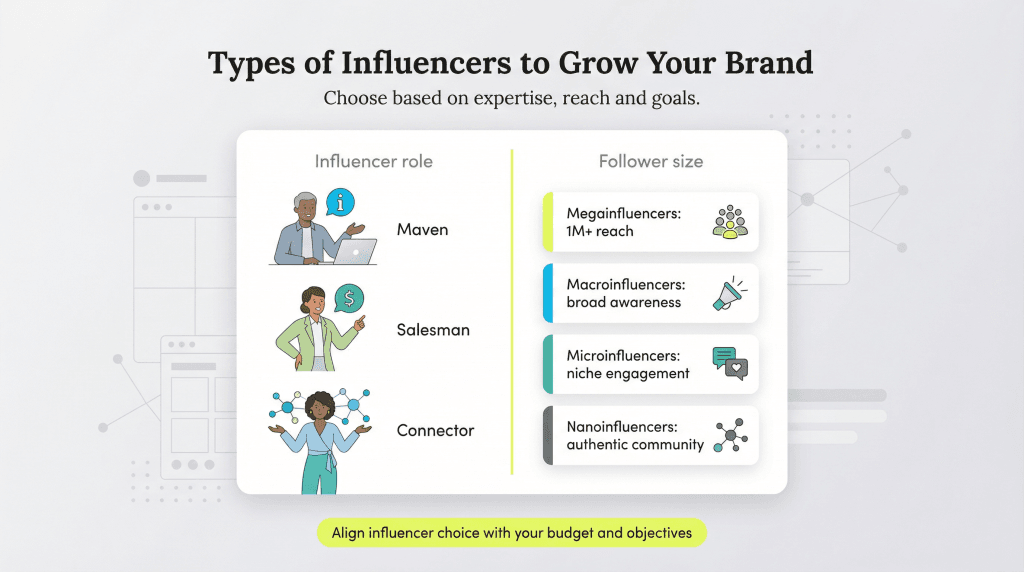
The value of influencer-generated content depends on an influencer’s style and the type of content they produce. Malcolm Gladwell identified three types of influencers in his book The Tipping Point:
When choosing influencers, consider your brand’s personality and campaign goals to determine which type (or combination) makes the most sense. In many cases, working with a mix of influencer styles can help you reach a broader audience and support different objectives.
While Gladwell’s three types can apply to influencers in any context, it’s also useful to break down social media influencers by follower count. Gasner explained that there are four general categories businesses should be aware of:
The “right” influencer for your brand depends on what you want your campaign to accomplish. Different types of influencers tend to deliver different outcomes, so it helps to start with your primary goal.
“Microinfluencers are great for niche markets and offer high engagement, while macroinfluencers or celebrities work well for broad brand awareness,” said Kristen Taggert, vice president of integrated marketing communications at Brunner. “The choice depends on the campaign goals, whether it’s boosting sales, building trust or increasing visibility.”
That shift toward smaller creators is already underway. In the State of Influencer Marketing 2025 report from Aspire, 61 percent of marketers said they now work with nanoinfluencers and microinfluencers, reflecting a growing emphasis on engagement and audience fit over follower count alone.
Influencer pricing depends on factors like audience size, platform and content format, but recent benchmarks give small businesses a clearer sense of what to expect.
A 2025 influencer rate guide from Impact.com shows that nanoinfluencers often charge a few hundred dollars to a couple thousand dollars per post, while microinfluencers commonly charge several thousand dollars. Costs rise quickly for macroinfluencers and megainfluencers, which can put those partnerships out of reach for many small businesses.
“As a small business’s marketing budget is usually tight, it’s better to work with (multiple) smaller creators to diversify risk as opposed to ‘putting all your eggs in one basket’ collaborating with macro/megainfluencers,” said Gasner.
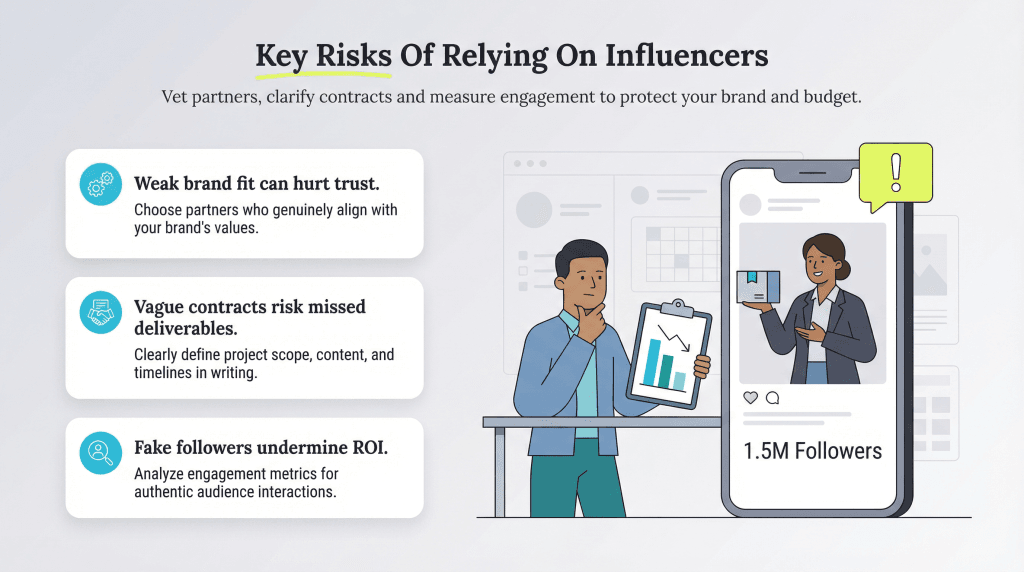
While influencers can be effective marketing tools, there are inherent risks to consider. Below are five caveats businesses should keep in mind when working with influencers.
Researching influencers is essential. If a creator has a history of campaigns going south because of poor or harmful content, missed deadlines or client ghosting, it’s best to keep looking.
Working with an influencer who doesn’t align with your brand’s mission, promotes just about anything or lets details fall through the cracks is unlikely to deliver the digital marketing ROI you’re looking for. In some cases, their actions can even damage your brand’s reputation and trigger an unnecessary public relations issue.
“Imagine you create a campaign with an influencer and, a year later, they get into a controversy or face legal problems,” said Vadym Nekhai, an angel investor and business advisor. “Your brand is already associated with that influencer, so you inevitably have to deal with the damage.”
Not every company benefits from influencer partnerships. Sponsored content can quickly shift from “everyone needs this” to an unrelatable influencer lifestyle post that feels disconnected from your audience.
An influencer’s followers may not connect with your product for several reasons, including:
One of the biggest risks businesses face when working with influencers is failing to clearly define expectations in a written, signed contract.
“Some businesses aren’t experienced with working with influencers, and a mistake they often make is to not agree in advance on what the influencer will deliver,” said Goldberg. “While most influencers will not guarantee metrics like views or engagement, you should be in agreement on how many posts, types of posts, schedule of posts, platforms, etc.”
If an influencer is unwilling to sign a contract, it’s best to walk away. Professional influencers generally welcome contracts and, when appropriate, non-disclosure agreements.
An influencer’s true reach and effectiveness depend on more than just follower count. Some creators have large audiences but low engagement, or their followers may fall outside your target demographic.
“It’s important to know how engaged their audience is,” said Beth Romer, founder and CEO of marketing agency L&L Collective. “You could find an influencer who has an ideal target audience for your brand but has low views, is hiding their likes or has low story views. All of this would result in a low return on investment for your campaign.”
Choosing the wrong influencer isn’t just a branding risk — it can be a financial one. If you pay for sponsored content upfront and fail to see meaningful results, influencer marketing can quickly become an expensive experiment.
To reduce risk, some businesses start with commission-based arrangements or product-only collaborations, especially when testing new influencers. This approach can help you gauge how well an influencer resonates with your audience before committing more budget.
Setting clear expectations with a defined strategy is essential to avoid wasted spend. “So often businesses think working with influencers will yield amazing results, and while that can be true, it’s like all other marketing initiatives — there needs to be a strategy, a purpose and a goal in place or it can fall flat,” said Romer.
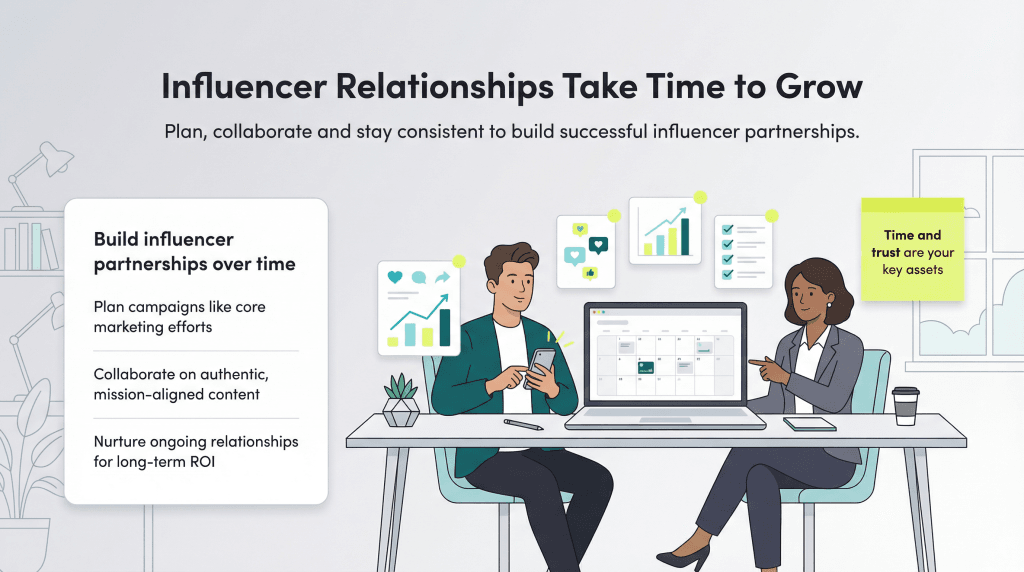
Working with influencers can boost online brand awareness, increase sales and help build long-term customer trust and repeat business. However, influencer marketing isn’t as simple as sending out free products and hoping for the best.
Like any other marketing channel, influencer partnerships take planning and follow-through. Finding creators who genuinely align with your brand, setting clear expectations and building authentic relationships all take time. If you’re willing to put in that effort, influencer marketing can become a meaningful and effective part of your overall strategy.
Tom Anziano and Shane Barker contributed to this article.