Your free business.com+ membership unlocks exclusive tech deals and advisor support
Join Free
BDC Hamburger Icon

Menu

Close
BDC Logo with Name
Search Icon
Search Icon
Advertise with us
Advertising Disclosure
Close
Advertising Disclosure

Business.com aims to help business owners make informed decisions to support and grow their companies. We research and recommend products and services suitable for various business types, investing thousands of hours each year in this process.

As a business, we need to generate revenue to sustain our content. We have financial relationships with some companies we cover, earning commissions when readers purchase from our partners or share information about their needs. These relationships do not dictate our advice and recommendations. Our editorial team independently evaluates and recommends products and services based on their research and expertise. Learn more about our process and partners here.

What to Include in a Promotion Letter

When employees are promoted, a clear, well-written promotion letter helps document the change and set expectations.

author image
Written by: Max Freedman, Senior AnalystUpdated Feb 06, 2026
Gretchen Grunburg,Senior Editor
Business.com earns commissions from some listed providers. Editorial Guidelines.
Table Of Contents Icon

Table of Contents

Open row

Facilitating employee growth is a hallmark of good leadership, and recognizing that growth matters. Promoting an employee is one clear way to do that. However, when a team member moves into a new role, you’ll also need to issue a promotion letter that puts the change in writing.

Beyond acknowledging the achievement, a promotion letter creates a clear record of what’s changing, including responsibilities, reporting structure and compensation. It also helps set expectations as the employee transitions into the position and beyond. Below, we’ll explain what to include in a promotion letter and why it matters, along with a template you can use as a starting point. We’ll also touch on promotion announcements, which are used to share the news more broadly across your organization.

What is a promotion letter?

A promotion letter is a formal document that confirms an employee’s move into a higher position within your company. It isn’t meant to introduce or negotiate a promotion. Instead, it follows conversations you’ve already had with the employee and puts the agreed-upon details in writing (whether by letter or email). 

In that sense, a promotion letter is about confirmation, not surprise. It records the employee’s new title, compensation package and responsibilities so there’s a clear, shared understanding going forward.

“A promotion letter is a formal document issued by an employer to an employee,” explained John Baldino, CEO of human resources consulting organization Humareso. “It serves as an official record of the employee’s advancement and recognition of their hard work and contributions.”

Beyond the paperwork, a promotion letter is also an opportunity to congratulate the employee and acknowledge the value they bring to your organization.

What should you include in a promotion letter?

what to include in a promotion letter
A promotion letter formally details an employee’s new, higher position within your company.

A promotion letter should clearly outline what’s changing for the employee and when those changes take effect. Clear communication matters here, especially during role changes that affect responsibilities, reporting lines and pay.

“A promotion is a cause for celebration, but if the communication of it misses the mark, it can cause an unnecessary distraction to that good news,” Baldino noted. “Knowing what to share and with whom is a great place to start.”

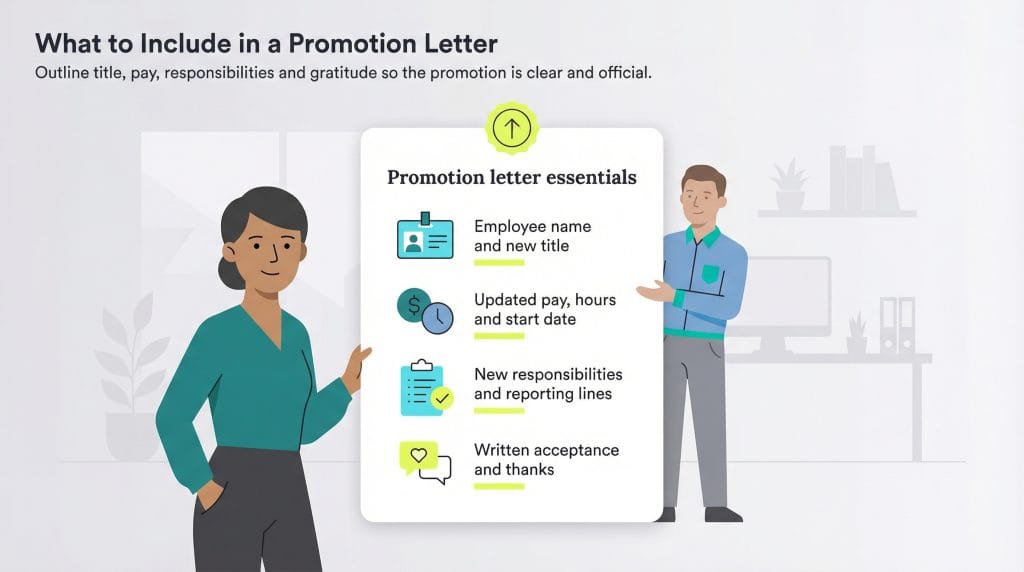
At a minimum, include the following details:

  • The employee’s full name and contact information: Even though a promotion letter can be relatively conversational, it’s still a formal document. Listing the employee’s contact information at the top helps keep the record clear and complete.
  • The employee’s new title: A new title often reflects a shift in responsibility or authority. Be explicit about the updated designation so the employee can update professional materials like their email signature and LinkedIn profile.
  • Pay, schedule or work arrangement changes: Even if compensation details have already been discussed, the promotion letter should confirm them in writing. Clearly note the new salary or hourly rate, pay frequency and any changes to work hours or location, along with the effective date.
  • Responsibilities in the new role: Promotions often come with added or shifted responsibilities. Outlining these expectations helps avoid confusion during the transition and ensures key duties don’t fall through the cracks.
  • Reporting structure: If the employee’s manager or reporting line is changing, include that information. This is especially important for leadership roles or department changes.
  • The promotion start date: Promotions don’t always take effect immediately. Stating the official start date helps align payroll, scheduling and internal communication.
  • Confirmation of acceptance: Even if the employee has already said yes, ask them to confirm their acceptance of the promotion in writing. This creates a clear paper trail and avoids confusion later if questions come up about timing, pay or responsibilities.
  • An expression of appreciation: A promotion letter is also a chance to recognize the employee’s contributions. A brief, genuine note of appreciation reinforces trust and signals that their work is valued.
TipBottom line
After the promotion is official, remember to update the employee's job title on your website and order new business cards as needed.

How do you write a promotion letter?

Now that you know what to include, it’s time to put it all together. Writing a promotion letter is less about creativity and more about clarity. The goal is to confirm what’s already been discussed, document the details and set expectations as the employee steps into the role.

Follow these steps to organize those details into a clear, professional promotion letter:

  1. Start with a simple, formal structure. Begin with a standard template or company letterhead. This helps ensure the letter looks official and includes the basics, such as the employee’s name, the date and your company information.
  2. State the promotion clearly and upfront. Open the letter by confirming the promotion and the employee’s new title. This removes any ambiguity and immediately establishes what the letter is about.
  3. Confirm the key details in writing. Include the specifics you’ve already discussed, such as compensation changes, reporting structure, work schedule and the official start date. This isn’t the place for new information, but for accuracy.
  4. Outline the expectations for the new role. Keep this high level and aligned with what you’ve already discussed.
  5. Acknowledge the employee’s contributions. This can be brief; the goal is recognition, not a full performance summary.
  6. Close with next steps and confirmation. End the letter by asking the employee to formally accept the promotion in writing. Be sure to mention any follow-up actions, such as employee onboarding.
  7. Review the letter before sending it. Proofread carefully and, if appropriate, have someone from your HR department review the final version to ensure everything is accurate and aligned with company policy.
Bottom LineBottom line
To write a strong promotion letter, focus on clarity over creativity. Confirm the details, keep the tone professional and review the final draft before sharing it with the employee.

Promotion letter example template

promo email template
Use a formal template to ensure you include all relevant details, but retain a warm tone.

To build your promotion letter, copy the example below and tailor it to your situation, including whether it will be sent by email or as a printed letter.

[Date]

To: [Name]

[New title]

[Address]

Subject: Promotion for [Name of employee]

Dear [Name]:

Congratulations on your promotion to [New title] at [Company name]! Your promotion is effective [Date on which promotion takes effect].

Your new salary will be [Salary] per year, paid [Pay schedule, e.g., semimonthly, monthly, etc.]. You will report to [Name of new manager and their title] and maintain your [work schedule or hours, if applicable]. [Name of new manager] is looking forward to working closely with you.

Your responsibilities will be to [Detail the employee’s new responsibilities]. Our employee handbook has additional details on what the [new title] role entails.

Again, congratulations on your promotion. The company and I are very grateful for all of the work you have done to date — and the work you’ll do in your new role. If you accept this promotion, please reply to this email and acknowledge your acceptance of the promotion.

Sincerest thanks,

[Your name]

[Your title]

Why is a promotion letter important?

Promotions often start with conversations, but relying on verbal agreements alone can leave room for confusion. A promotion letter provides clarity at a moment when roles, expectations and relationships are changing. Below are four reasons why putting a promotion in writing matters.

Ensuring clarity and formal documentation

It’s one thing for you and your employee to agree on a promotion in principle. It’s another to ensure you both have the same understanding of the new role, responsibilities and timing of the transition. A promotion letter captures those details in one place, helping prevent misunderstandings once the change takes effect.

“It serves as an official record of the promotion, which is important for HR recording purposes, future references and legal documentation,” said Baldino.

Outlining pay and benefit adjustments

Most promotions involve changes to pay or benefits, and those updates should be documented clearly to avoid payroll discrepancies or eligibility issues. A promotion letter is the place to confirm salary adjustments, changes to employee bonuses or commissions, and any updates to benefits tied to the new role.

“They help to clarify who’s in charge of making key decisions, who gets paid at what rates and what benefits they’re earning,” said Hayden Cohen, CEO and co-founder of Near.

FYIDid you know
When confirming a promotion, think beyond base pay. Total compensation includes salary, bonuses or commissions, benefits and any creative perks tied to the role, all of which should be reflected accurately in the promotion letter.

Defining new roles and responsibilities

Stepping into a new role can raise practical questions once the promotion takes effect. A promotion letter gives both you and the employee something concrete to refer back to as responsibilities change or new expectations come up. It helps keep follow-up conversations focused on what was agreed to in writing.

“They ensure that the employee is aware of their new role, responsibilities and any changes in compensation or benefits,” said Baldino.

Recognizing and motivating employees

It’s easy to focus on results and overlook the role recognition plays in keeping a high level of employee engagement. Promotion letters create a formal moment to acknowledge an employee’s work, not just the outcome of it.

Research consistently shows that recognition matters for engagement, and promotions are a natural opportunity to reinforce that connection. Taking a moment to express appreciation in writing helps employees feel seen as they step into a new role.

“[Promotion letters] provide formal acknowledgment of an employee’s achievements and contributions, hopefully boosting morale and motivation,” said Baldino.

What is a promotion announcement?

A promotion announcement is a message (typically an email or letter) shared with the broader organization to let colleagues, managers and other stakeholders know about an employee’s new role. In addition to sharing the news, it’s often used to recognize the employee’s contributions publicly.

“If a promotion letter is about making a promotion official, a promotion announcement is about making sure everyone knows about it,” said Cohen. “This is the kind of thing you’ll send to all relevant staff and potentially post on social media to congratulate the person being promoted.”

Baldino noted that promotion announcements can also play a role outside the organization. “It can be used in conjunction with messaging around the organization’s commitment to personnel development,” Baldino explained. “As a forward-facing strategy, the business community gets a sense of the type of talent found within the company, as well as serves to attract others to join in on the opportunities.”

What should you include in a promotion announcement?

A promotion announcement should be clear, professional and consistent with your company’s culture. Unlike a promotion letter, it’s meant for a broader audience and focuses more on visibility and recognition.

A strong promotion announcement typically includes the following:

  • A brief congratulations: Open by congratulating the employee on their promotion and setting a positive tone.
  • The effective date: State when the promotion takes effect so colleagues know when the role change is official.
  • An introduction to the employee: Include the employee’s name, new title and department. This is especially helpful if they’re not widely known across the organization.
  • Relevant background and accomplishments: Highlight a few key contributions or achievements that led to the promotion. Specific examples help reinforce why the employee earned the role.
  • Reporting structure changes: If applicable, note who the employee will report to in their new position.
  • An overview of the new role: Briefly explain the employee’s responsibilities or focus in the new role so others understand how the change affects the team.
  • An invitation to congratulate them: Close by encouraging colleagues to join you in congratulating the employee.

You can also personalize the announcement by including a photo, a short quote from the employee or a link to their LinkedIn profile, depending on your company’s norms.

Did You Know?Did you know
Promotion announcements are often shared by email, but they can also be reinforced in team meetings or posted in internal communication apps like Slack.

Promotion announcement example template

To build your promotion announcement, use the example below and adjust it based on how and where you plan to share it.

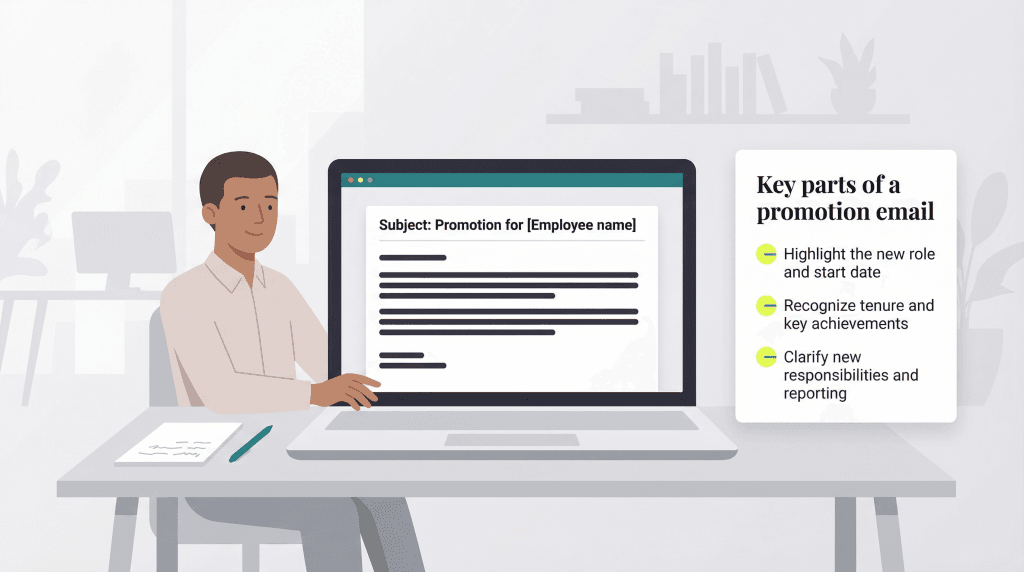
Subject: Promotion Announcement for [Employee name]

Dear team,

I would like to take a moment to congratulate [Employee name]! I am pleased to announce [Employee name]’s promotion to [New position] effective [Date on which promotion takes effect].

[Employee name] has been with [Company name] for [X] years and has worked in [Department name]. During their tenure here, [Employee name] has consistently exceeded expectations and made significant contributions to the team.

Some of [Employee name]’s key accomplishments include:

  • [List of accomplishments]

In their new role, [Employee name] will report to [Supervisor’s name] and will be responsible for [List of responsibilities].

I am confident that [Employee name] will excel in this new position and continue to be a valuable asset to our team. Please join me in congratulating [Employee name] on their well-deserved promotion!

Sincerely,

[Your name]

[Your title]

Be sure to proofread your promotion announcement carefully before sending it out.

What is the difference between a promotion letter and a promotion announcement?

  • Promotion letter: A promotion letter is a formal document sent directly to the employee being promoted. It confirms the promotion and outlines the details of the new role, including changes to pay, benefits and reporting structure. “This is a private, formal communication between the employer and the employee,” said Baldino. “These letters should not be posted in the breakroom or on an intranet-based company bulletin board.”
  • Promotion announcement: A promotion announcement is shared more broadly with the organization to inform colleagues and stakeholders about the employee’s new role and to recognize their contributions publicly. “If a promotion letter is about making a promotion official, a promotion announcement is about making sure everyone knows about it,” said Cohen.

Promotion letter vs. promotion announcement

Feature

Promotion letter

Promotion announcement

Audience

The promoted employee

The broader organization

Purpose

Confirm the promotion and document role changes

Share the news and recognize the employee publicly

Tone

Formal and private

Positive and celebratory

Content focus

Title, pay, responsibilities and reporting structure

New role, accomplishments and visibility

Distribution

Sent directly to the employee

Shared by email, meetings or internal channels

Skye Schooley contributed to this article. Source interviews were conducted for a previous version of this article. 

Did you find this content helpful?
Verified CheckThank you for your feedback!
author image
Written by: Max Freedman, Senior Analyst
For almost a decade, Max Freedman has been a trusted advisor for entrepreneurs and business owners, providing practical insights to kickstart and elevate their ventures. With hands-on experience in small business management, he offers authentic perspectives on crucial business areas that run the gamut from marketing strategies to employee health insurance. At business.com, Freedman primarily covers financial topics, including debt financing, equity compensation, stock purchase agreements, SIMPLE IRAs, differential pay, workers' compensation payments and business loans. Freedman's guidance is grounded in the real world and based on his years working in and leading operations for small business workplaces. Whether advising on financial statements, retirement plans or e-commerce tactics, his expertise and genuine passion for empowering business owners make him an invaluable resource in the entrepreneurial landscape.