Business.com aims to help business owners make informed decisions to support and grow their companies. We research and recommend products and services suitable for various business types, investing thousands of hours each year in this process.
As a business, we need to generate revenue to sustain our content. We have financial relationships with some companies we cover, earning commissions when readers purchase from our partners or share information about their needs. These relationships do not dictate our advice and recommendations. Our editorial team independently evaluates and recommends products and services based on their research and expertise. Learn more about our process and partners here.
If you’re in the habit of launching and operating multiple businesses, you may have faced some of these challenges—here’s how to solve them.


This article is sponsored by Intuit.
Owning more than one business is more common than it sounds. In the U.S. Census Bureau’s 2023 Annual Business Survey, which covers businesses with at least one paid employee, 35.9 percent of the owners who answered the question reported having a second business that was still operating.
Starting the second business is usually the easy part. You already know how to register a company, open a bank account, set prices and find early customers. But the challenges are different once you own multiple businesses, and they tend to revolve around organizing your calendar, hiring, submitting loan applications and managing the books across multiple businesses.
Below are six problems that come with owning several businesses at the same time, and what to do about each one.
When you run three businesses, your attention becomes a precious resource. Most owners handle this badly at first, deciding that whichever business is making the most noise gets the time. The business that is running well tends to get ignored, but that can allow unseen problems to fester.
Turning your attention from business to business has its drawbacks, too.. Each one has its own customers, staff and numbers, and turning your attention from one to another usually requires a briefing and some time to become familiar with the current situation. That takes both you and a team member out of the flow for a little while. When you’re doing that across multiple businesses a couple times each day, it adds up to a considerable amount of time.
Give each business a fixed place in your week and keep it there even when nothing is wrong. Tuesday belongs to one company whether or not it needs you that Tuesday. This may feel difficult at first, especially if another business is dealing with a crisis, but it will pay off when you start catching problems before they grow into crises.
Write down who decides what. Most questions that reach an owner do not need the owner’s attention, but if nobody has been delegated the authority to make that decision, it will come to you by default. Spending limits, hiring approvals, discount authority and refund authority are some of the most common examples.
Then, apply a test. If a business cannot get through a week without you, you do not really own it yet—you work there. That is normal for a first business, but it becomes a problem once you have three. Our time-management tips cover the scheduling side in more detail.
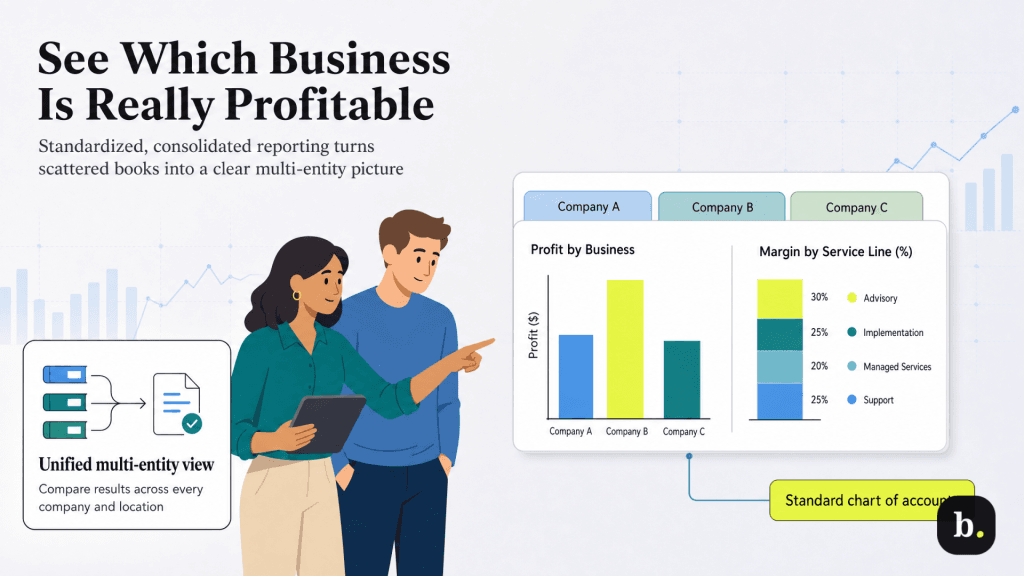
Each business keeps its own books, which is how it should be. The problem is what happens when you want one picture of all of them. For most owners that means pulling reports at the end of the month and stitching them together in a spreadsheet. It requires manual work and often ends up being wrong in an important way: if two companies categorize the same expense differently, the comparison between them is not real.
Shared costs make it worse. One bookkeeper, one insurance broker and one marketing contractor might serve three businesses. If those costs are recorded wherever the invoice happened to get paid, one business looks stronger than it actually is and another looks weaker.
A setup that handles this properly needs four things:
Most of this can be solved with the right software. For example, Intuit Enterprise Suite allows owners to move between companies from a single dashboard and run consolidated reports covering profit and loss, sales, expenses, accounts receivable and accounts payable. It supports a shared chart of accounts across entities, intercompany journal entries and elimination accounts managed from the parent company, along with permissions that control who can see the combined view. It also tracks results across dimensions such as region, department and project inside one ledger, which is what lets you see margin by service line rather than only by company.
The mechanics of combining books across companies are worth understanding before you change systems. Our guide to multi-entity accounting covers that. For a survey of what is available, see our picks for the best accounting software for multiple businesses.
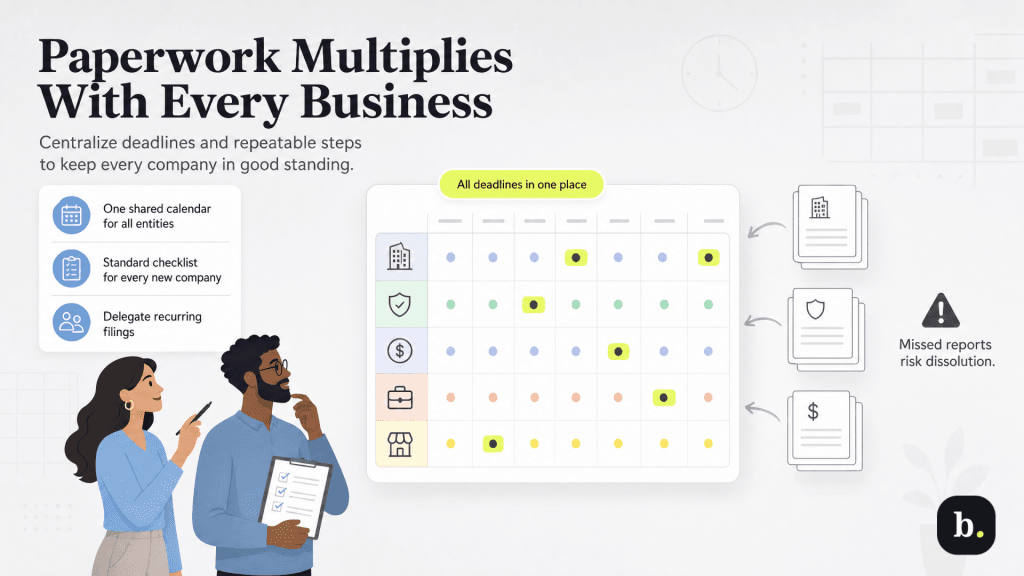
Every company comes with its own registration, annual report, registered agent, employer identification number, payroll filings, sales tax registrations, insurance renewals and tax deadlines. The paperwork multiplies with the number of companies, regardless of revenue. A third business doing a tenth of your total sales can carry nearly as much administrative work as your first one.
A skipped annual report can put a company out of good standing, and states can eventually dissolve a delinquent business administratively. Getting reinstated costs time and money, and while the company is in that state its liability protection may be open to question, which defeats the point of having set it up in the first place.
Three habits can help you stay on top of the admin work:
Consistency is the key. Companies set up piecemeal over several years tend to have mismatched fiscal years, registered agents and state registrations; cleaning that up later is more work than doing it the same way each time.

In one business, a good hire takes work off your plate. Across several businesses, you need someone who takes decisions off your plate. People who are excellent at the first are often uncomfortable with the second.
Owners tend to under-hire when it comes to management, usually due to financial motivations. A capable general manager costs more than any other staff member, but think of it as an investment in the business’s autonomy. If a manager at your smallest business frees up a day a week that you can spend on your largest, the hire is competing against whatever that day is worth, not other payroll line items. Measured against the whole portfolio, the expensive hire is often the cheaper option.
When you do hire, a few things matter more than they would for an ordinary role:
The first quarter is usually the hard part, because the manager is learning and you are watching. Our guidance on how to empower your employees covers the handover in more detail.
A business that breaks even and takes a third of your week is worse than one you closed, because that time could have gone somewhere it compounds. But shutting down or selling something you built feels difficult, so it stays open and continues demanding your time.
Instead, decide in advance what would make you let a business go, and to write it down while you are not under pressure. Reasonable criteria include a revenue floor, a margin floor, a limit on how much of your time the business can consume and a date by which it has to clear one of them. Then review against those criteria on a schedule, rather than in a bad month when you are feeling emotional.
The question to ask yourself is: if someone else owned this business and offered it to you today, at its current numbers and with its current demands on your week, would you take it?
Applying criteria like these honestly depends on numbers you can trust, which connects back to the reporting problem above. Shared overhead has to land on the business that consumed it, and your own time has to count as a cost. Otherwise a weak company looks acceptable on paper. A business that works only because you are subsidizing it with unpaid attention is not breaking even. Dimensional reporting of the sort Intuit Enterprise Suite provides is one way to get that visibility, though the discipline of setting the criteria matters more than the tool you use to check them.
If the answer is to exit, our guide to business exit strategy and what to know about selling your business cover the process and the timing.
