Business.com aims to help business owners make informed decisions to support and grow their companies. We research and recommend products and services suitable for various business types, investing thousands of hours each year in this process.
As a business, we need to generate revenue to sustain our content. We have financial relationships with some companies we cover, earning commissions when readers purchase from our partners or share information about their needs. These relationships do not dictate our advice and recommendations. Our editorial team independently evaluates and recommends products and services based on their research and expertise. Learn more about our process and partners here.
Learn the definition of the recruitment process and how to build a data-driven strategy to attract, hire and retain top-tier talent in a competitive market.


In theory, hiring an employee might seem like a simple task: Post a job opening, interview a candidate and make an offer. However, in today’s competitive labor market, generic approaches rarely attract the right candidates. Your employees are your company’s most significant asset, and they can make or break your business. To put yourself in the best position to recruit and hire top talent, it helps to understand what recruitment is and how it works.
Recruitment is the process of attracting, screening, interviewing and selecting candidates for an open role in an organization. It can also include hiring and onboarding the chosen candidates.
Businesses recruit new employees either to fill a newly established role or to refill a position when someone leaves the company or moves into a different role. Many organizations use specialized recruitment software to find qualified candidates or partner with external agencies to help manage the hiring process.
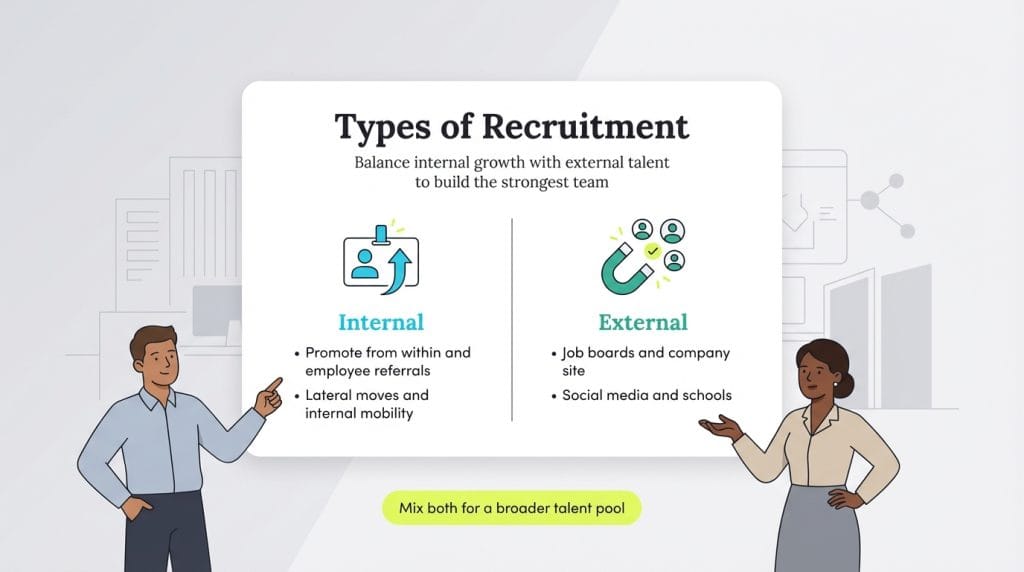
There are two primary types of recruitment: internal and external.
In many cases, employers use a mix of internal and external recruitment strategies to widen their candidate pool without overlooking existing talent.
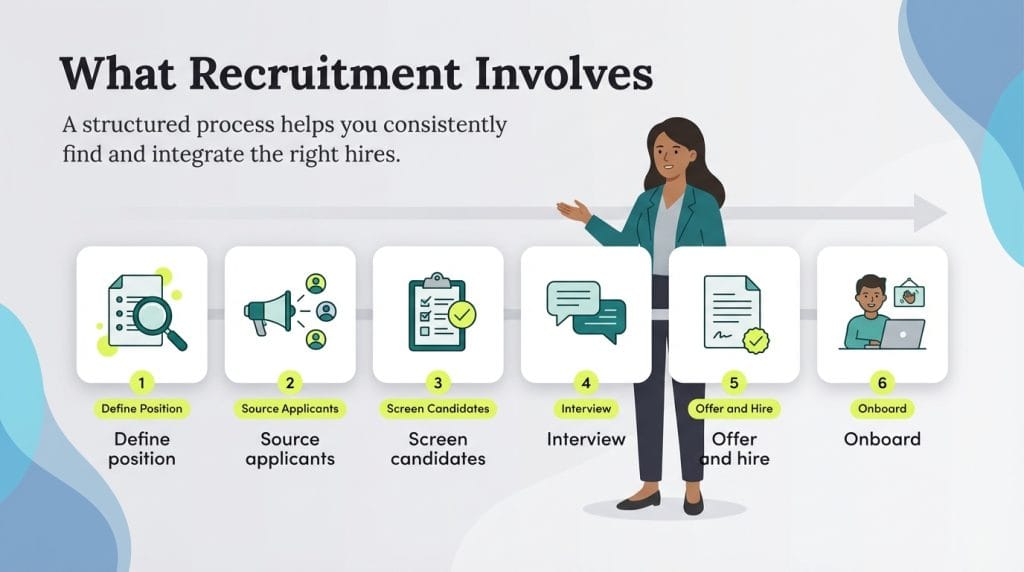
The recruitment process may look a little different at every company and for every role. Still, most hiring cycles follow a similar path: defining the open position, sourcing applicants, screening candidates, conducting interviews, selecting a candidate and extending an offer, and onboarding new hires.
Identify the key needs the position will fulfill, outline the job specifics (e.g., qualification requirements, anticipated start date, pay range, reporting structure), write a clear job description, and create a standard set of interview questions. Setting these details early can help you compare candidates more consistently later in the process.
You can have a recruiter or recruitment agency help with sourcing, ask employees or trusted colleagues for referrals, or find employees through other channels, such as posting open roles on your company website, job boards (like Indeed and its alternatives) and social media accounts.
Many recruiters think in terms of two applicant types: active candidates, who apply directly, and passive candidates, who may be qualified but aren’t actively looking. Reaching passive candidates usually calls for a different approach, depending on how familiar they are with your company or hiring brand.
According to Joe Mullings, founder, chairman and CEO of The Mullings Group, candidates typically fall into one of three engagement categories:
Once applications start rolling in, you must filter them to find qualified potential new hires. Review resumes and cover letters, then conduct brief phone screenings with candidates who appear to be strong matches. Some applicant tracking systems (ATS) now use AI to help sort or rank candidates based on keywords, which can help speed up this step.
Phone screenings should be brief. Ask each candidate the same set of screening questions to determine whether they meet the basic requirements for the role. Move the strongest candidates forward to interviews. For applicants who don’t meet your expectations, thank them for their time and let them know you’re not moving ahead. Job applicants would rather hear a “no” than radio silence.
“Be responsive, and don’t burn bridges,” advised Sarah Dewey, owner of Cake For Thought Bakery and a former talent sourcer at Meta. “If you have candidates that aren’t a fit for anything you’re currently hiring for, it does not mean you should ignore them. They may be a perfect fit for something down the road.”
The next phase of the recruitment process involves the hiring manager interviewing prospective candidates. They should ask competency-based interview questions and evaluate whether the candidate would be a good cultural fit for the company.
Many employers use structured interviews, where each candidate is asked a consistent set of questions, to help reduce bias (including gender bias) and keep evaluations more objective. This stage may include one or more rounds of interviews. During this phase, you may also want to contact the candidate’s job references.
After you interview and evaluate each candidate, choose the person who feels like the best fit. Draft an offer letter and extend it to the prospective employee.
During this stage, you may decide to conduct a criminal background check. In your offer letter, note that the job offer is contingent on the results. Be sure to comply with all applicable federal and state laws (including employment and anti-discrimination laws) when conducting background checks.
Let unselected applicants know you’ve moved forward with another candidate, and thank them for their time. End on a positive note; you never know when you may want to reconnect if your first-choice candidate declines or another opportunity opens later.
Once a candidate accepts your offer, the final step is the onboarding process. This stage is often handled by your company’s human resources team to make sure the new employee completes required paperwork and gets integrated into the business in line with labor and employment laws.
As with any other important business function, recruitment should be taken seriously, with experienced professionals guiding the process. Who leads recruiting efforts at your organization will vary depending on factors such as your company’s size and available resources.
For example, a small business might delegate recruitment and hiring to the employee who will manage the new hire, often referred to as the hiring manager. If a company has an in-house human resources department or HR manager, these professionals may screen candidates and consult with the hiring manager before making final selections.
If you don’t have someone internally to lead recruitment efforts, you can seek outside support.
“If your company doesn’t have the bandwidth to support all of their open [roles], a recruitment technique they can adopt is to work with an agency to fill roles more efficiently,” Dewey noted.
Companies that partner with recruitment agencies or rely on internal recruiters may be able to offload much of the recruiting workload. A recruiter may consult with an HR manager or hiring manager during the recruitment process, but often handles tasks such as posting the job, sourcing and screening candidates, negotiating salaries and coordinating placements.
A bad hire — or even a long vacancy — can be costly for a business. According to the Work Institute’s 2025 Retention Report, replacing an employee typically costs about 33 percent of their annual salary. And SHRM’s 2025 recruiting benchmarking data shows the median cost-per-hire was about $1,200 for nonexecutive roles and more than $10,000 for executive hires, highlighting how recruiting expenses can vary widely by position level.
“Your employees are the difference between success and failure, yet the [recruitment] process that is used is generally ad hoc, rushed, and has little strategy beyond a post-and-pray approach,” Mullings said.
Building a strong recruitment process starts with being intentional about how you source, evaluate and communicate with candidates. The experts we spoke with shared several hiring tips and best practices to help your business recruit top talent.
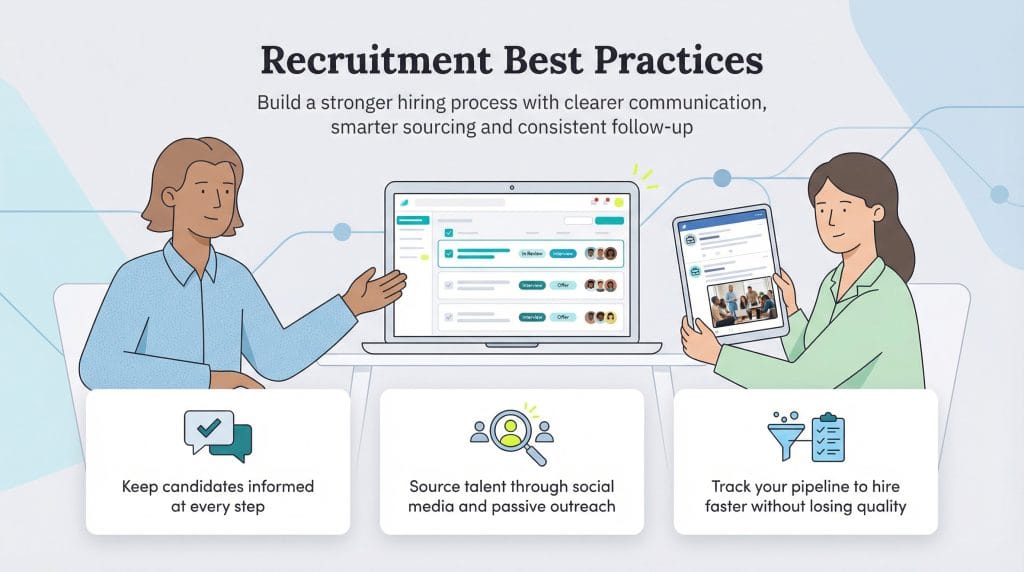
Clear communication between recruiters, HR professionals, hiring managers and candidates is essential throughout the recruitment process. That includes posting accurate job descriptions, responding to applicants in a timely way — whether it’s a yes, a no or simply an update — and keeping everyone involved informed about each candidate’s status.
Social media is a valuable marketing tool, but it can do more than just attract customers; it can also help you connect with potential candidates. Choose a few platforms that align with your brand, and maintain an active presence there.
Many businesses now use visual-first platforms like Instagram and TikTok to highlight company culture through “day in the life” content or employee stories. When you’re ready to hire, posting open roles on your social channels can help you reach an already engaged audience.
If you only target prospects who actively apply to your open roles, you may miss a lot of potential candidates. Recent workforce data suggests many employees remain open to new opportunities even while employed. A 2025 Gallup poll found that 51 percent of workers are watching for or actively seeking a new job. Do some research to identify potential candidates for the role. Platforms like LinkedIn and online job boards make it very easy to find top-tier passive candidates.
Once you’ve identified a possible candidate, reach out to them with a clear and concise message explaining what the position is and why they may be a great fit. Providing them with clear details about the next steps in your recruitment process will make it easy to get them in your recruitment funnel if they’re interested.
Employee recruitment is a continuous process, so employers should treat hiring as an ongoing brand effort to attract and hire top talent when needed. Mullings advised companies to use the Hum, Sing, Shout method to stand out from other organizations recruiting for similar roles and to attract the type of candidates they have in mind. Here’s what it entails:
It’s essential to track candidates throughout the entire talent acquisition process. Whether you’re using HR software, an applicant tracking system or another method, a standardized approach helps ensure no candidates or important details fall through the cracks.
Here’s a list of some of the best HR software platforms that include recruiting and onboarding capabilities:
“Do your due diligence, and make sure you’re keeping track of what’s going on in your pipeline,” Dewey said. “This helps being able to see your own progress and areas of opportunities. Keeping track of all your candidates and the stages they’re in (along with your data) will save a lot of sanity when hiring managers ask for reports.”
One strategy many successful recruiters use is maintaining an ongoing talent pipeline, which you can manage through an applicant tracking system or HR software. When you hire for a role, hold on to the information for prospective candidates who may still be a good fit for your company. That way, when you’re ready to hire again, you can return to your list and see whether any of those candidates align with the new role. Reach out to qualified candidates and encourage them to apply again if they’re interested.
New candidates aren’t the only option when hiring. Although bringing back a former employee may sound unusual, it’s more common than you might think. ADP’s 2025 research suggests boomerang hires account for roughly 31 percent of new hires on average.
Many of these boomerang employees may have been workers who mistakenly thought “the grass was greener” during the hiring surges of recent years. But if they left on good terms, there’s no reason you shouldn’t consider them again. You’ll likely save time during recruitment and onboarding, and they may have picked up new skills or industry knowledge while they were away.
When hiring boomerang employees, consider why they initially left and what has changed since then. You want to make sure they’ll be satisfied in the new role and not resign again as soon as another opportunity appears.
If you’ve tried all of the above strategies and you are still experiencing difficulties getting candidates through your recruitment process, it may be due to your timeline. How long does your recruitment process take? According to SmartRecruiters’ 2025 hiring analysis, the average time to fill a role in the U.S. is about 35 days. However, the best candidates don’t stay on the job market long.
Take a look at each step in your process, and identify where inefficiencies can be resolved. For example, you might need to cut redundant steps, streamline communications through automation or use AI-supported tools to keep hiring managers aligned. Regardless of how you choose to speed up the process, ensure that you don’t sacrifice quality, or you’ll be back where you started.
Source interviews were conducted for a previous version of this article.