Business.com aims to help business owners make informed decisions to support and grow their companies. We research and recommend products and services suitable for various business types, investing thousands of hours each year in this process.
As a business, we need to generate revenue to sustain our content. We have financial relationships with some companies we cover, earning commissions when readers purchase from our partners or share information about their needs. These relationships do not dictate our advice and recommendations. Our editorial team independently evaluates and recommends products and services based on their research and expertise. Learn more about our process and partners here.
Which method provides the best way to determine your business's financial health?


Understanding the primary distinction between cash- and accrual-basis accounting is essential for maintaining accurate financial records. The core difference lies in timing — specifically, when your business records sales revenue and expenses. However, each accounting method has pros and cons, and one may be better for your business than the other. For instance, while many startups begin with the simpler cash-basis method, they often transition to accrual accounting to gain deeper financial insight as they scale.
As a business owner, how do you know which small business accounting method is right for your company and when to make the switch? Keep reading for answers to these questions.
The table below outlines the key differences between these two accounting methods.
Feature | Cash accounting | Accrual accounting |
|---|---|---|
Timing of recognition | Records transactions when cash is received or paid out | Records transactions when they occur, regardless of when cash changes hands |
Complexity | Simpler to understand and implement | More complex and requires detailed recordkeeping |
Financial picture | Provides a snapshot of cash flow | Offers a more comprehensive view of financial performance |
Suitability | Often best for small businesses with simple transactions | Often used by businesses of all sizes, especially those with complex transactions and inventory |
Tax implications | Can affect tax liability based on the timing of income and expenses | Requires careful tracking of revenue and expenses to ensure accurate tax reporting |
Lender preference | Less preferred by lenders | Often preferred by lenders for financial analysis |
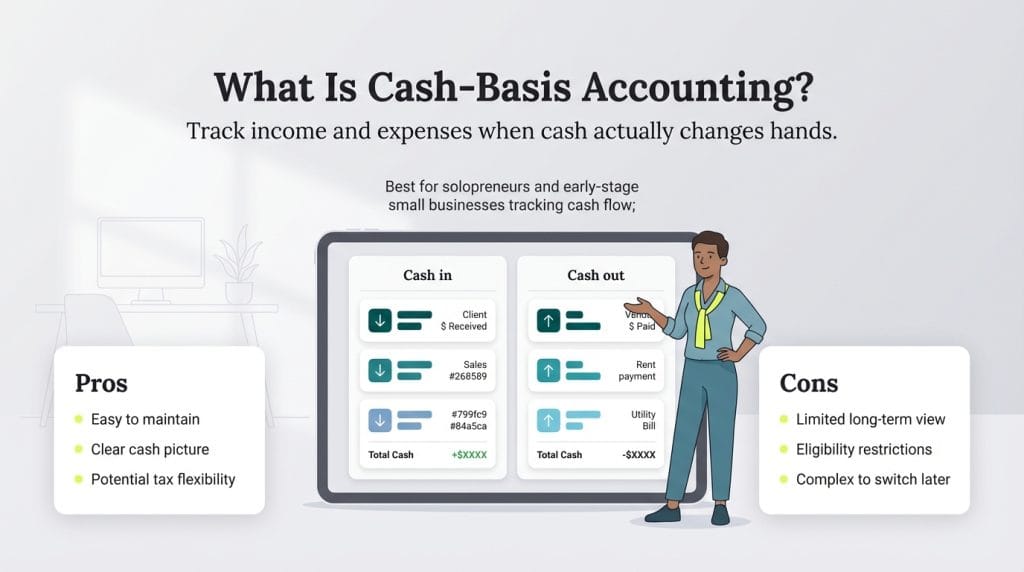
Cash-basis accounting is a straightforward accounting method that tracks a company’s financial activity based on actual cash inflows and outflows. In other words, the business records revenue when cash is received and expenses when payments are made. Unlike accrual accounting, it does not include accounts receivable (AR) or accounts payable (AP), which are typically tracked separately.
Cash-basis accounting is the simpler of the two financial accounting methods. Because it’s easy to maintain and requires minimal bookkeeping, it’s often the go-to choice for solopreneurs and early-stage small businesses.
If you’re considering cash-basis accounting for your business, it’s important to understand both the benefits and the limitations.
Pros
Cons
Accrual-basis accounting records revenue and expenses when they’re earned or incurred, regardless of when money changes hands. Instead of focusing only on cash on hand, it provides a more complete view of a company’s financial performance and is a more advanced way to manage business accounting.
For example, you’d record revenue when you close a sale, not when your customer pays the invoice. Similarly, expenses are recorded when you receive goods or services, rather than waiting until the payment clears.
Accrual-basis accounting provides a clearer, more dynamic picture of what’s happening in your business financially.
Accrual-basis accounting also has advantages and drawbacks.
Pros
Cons
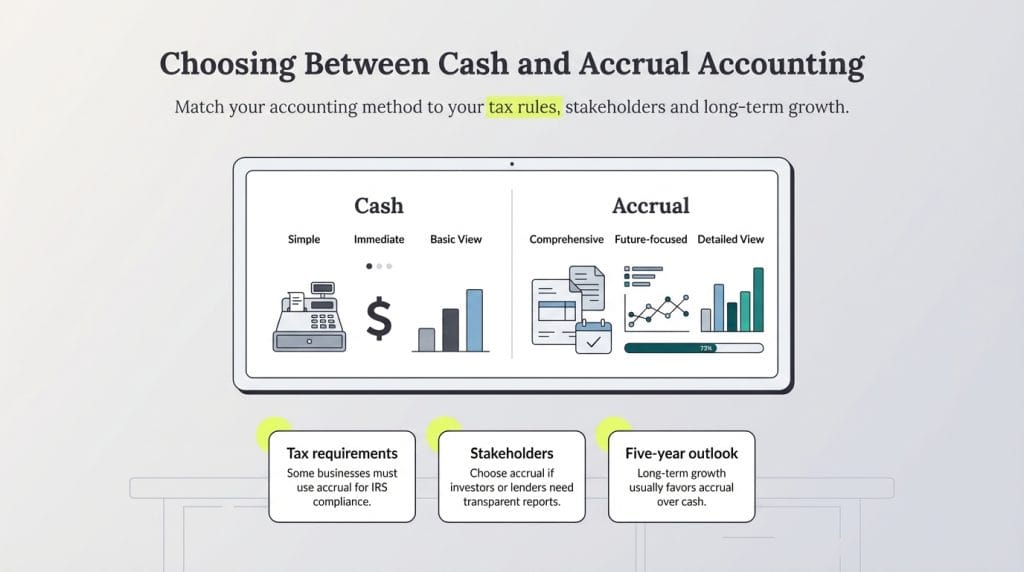
Choosing the right method requires evaluating your business model, scale and long-term objectives. Start by asking yourself the following questions:
These types of businesses may be required to use the accrual method for tax compliance:
If only a few internal managers review your financial data for relatively straightforward decisions, the cash method may be appropriate. However, leaders will be limited to the information available at that moment when making decisions.
If external stakeholders need visibility into your company’s finances, such as angel investors, banks or advisors, the accrual method is often a better fit. Using accrual accounting can signal financial maturity and transparency, showing investors that your business is prepared to manage more complex operations and long-term growth.
If you’re satisfied with your current transaction volume and don’t anticipate significant growth, the cash-basis method could be the right fit. However, if you have a business growth plan to move your company beyond its current revenue level, it may make sense to consider transitioning to accrual accounting.
Accrual accounting gives you the data needed to analyze trends and forecast future performance, helping stakeholders make strategic decisions that support long-term growth.
The best accounting software can help you maintain compliance and streamline financial management, whether you’re using cash- or accrual-based accounting. Here are a few top options to consider.
Read our detailed QuickBooks Online review to learn more.
Our comprehensive review of Xero explains more.
Check out our updated Zoho Books review for more details.
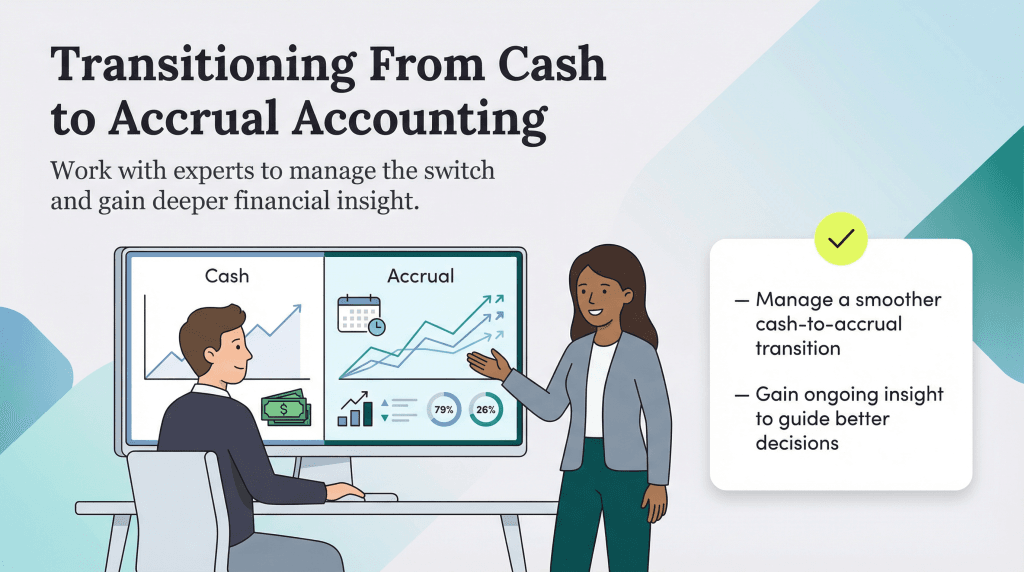
Making the shift from cash to accrual accounting is a significant milestone, but it can be challenging without the right expertise. In these situations, it may be worth hiring a certified public accountant or working with an outsourced accounting team. They can help manage the transition and provide ongoing accounting support and financial insight to help you run your business more effectively, analyze operations and make informed decisions.
Mike Berner contributed to this article.