Business.com aims to help business owners make informed decisions to support and grow their companies. We research and recommend products and services suitable for various business types, investing thousands of hours each year in this process.
As a business, we need to generate revenue to sustain our content. We have financial relationships with some companies we cover, earning commissions when readers purchase from our partners or share information about their needs. These relationships do not dictate our advice and recommendations. Our editorial team independently evaluates and recommends products and services based on their research and expertise. Learn more about our process and partners here.
Before hiring externally, your company should consider the benefits of internal recruitment. The right person for the job may already work for you.

Whether you’re filling a vacancy for an existing position or creating a new role, recruiting can be exciting for a company. Although your first instinct might be to search far and wide for new talent, the best option might be to look closer to home. Before you hire externally, consider promoting current employees who have the right business skills and potential.
When you promote an excellent employee, you know you’ll be working with a loyal, cooperative team member who already fits the company culture. Additionally, internal promotions can help boost productivity and morale. We’ll explore the benefits of promoting from within and share internal recruitment strategies, best practices and potential drawbacks so you can make the right hiring decision for your business.
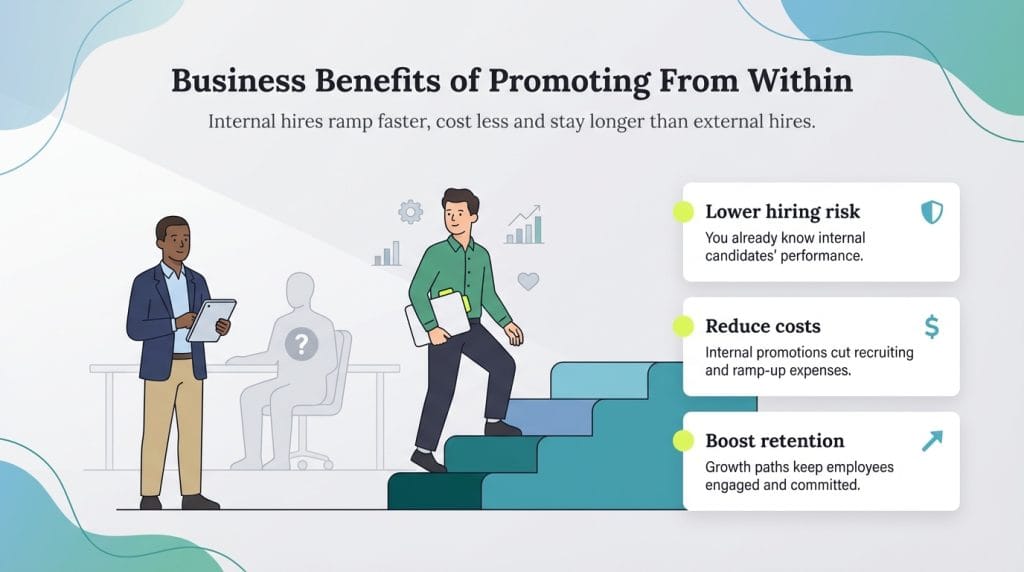
Internal recruiting can be an efficient hiring tactic with both obvious and less obvious business benefits. For example, employees who move into new roles already understand the company, its systems and its expectations, which can reduce time spent in the onboarding process and limit disruption for teams. Just as importantly, internal mobility can reinforce trust and boost employee engagement among team members who want to grow with the organization.
According to SHRM’s State of Recruiting 2025 Benchmark Report, most companies still rely heavily on external hiring, but more are increasingly looking to internal talent development. In 2025, 35 percent of organizations reported using an internal talent marketplace, up from 25 percent in 2024, reflecting growing recognition that existing employees can be a valuable source of future talent. At the same time, the SHRM data shows that 93 percent of nonexecutive roles are still filled externally, suggesting many businesses may be overlooking qualified internal candidates.
Shaylae Duprís, a former chief human resources officer and founder of Blu Prospects Consulting, noted that internal promotions can help improve representation throughout the organization. “Leadership should be reflective of the very workforce or the candidates that the organization wants to retain or attract,” Duprís told us.
Consider the following business benefits of promoting from within instead of hiring externally.
When the talent pool already works for the hiring company, there is a built-in level of security. You’re already confident in the candidates’ quality, so the focus is on finding the right fit for the vacancy. You have direct access to all applicants’ work histories, personnel files and job references, plus personal experience with their work quality. External candidates, by comparison, are largely an unknown quantity and thus higher risk. Even thorough interviews and background checks can leave critical gaps in your understanding of how they truly perform on the job.
Happy, well-established and respected employees already enjoy mutual trust with managers, company leaders and colleagues. They can immediately step into a new position with a high level of autonomy and confidence because they’re trusted and empowered to do their job.
These individuals have already cultivated relationships and understand your business’s mission statement, short- and long-term objectives, and challenges. The hiring team already understands these candidates’ career goals and can see how they align with the company’s values and culture.
Hiring externally is expensive, even before you factor in the less obvious costs. SHRM research estimates that the average direct cost to hire a new employee is about $4,700, and that figure doesn’t account for lost productivity, onboarding time or the added strain placed on existing team members during the transition.
Promoting from within typically costs far less. When you hire internally, you don’t have to pay for job ads, recruiter fees, criminal background checks, candidate travel expenses and other costs, and these team members usually need less ramp-up time because they already understand the company and the role. Over time, those savings can add up, especially for organizations that hire frequently or struggle with turnover.
Clear opportunities for growth play a major role in whether staffers stay at a company or leave for other opportunities. When people can see a future for themselves inside an organization, they’re more likely to stay engaged and committed and less likely to look elsewhere, helping your organization reduce employee turnover.
That concern is top of mind for employers. LinkedIn’s 2025 Workplace Learning Report found that 88 percent of organizations are concerned about employee retention, particularly the loss of critical skills in strategy, operations and project management. In response, many companies are putting more emphasis on internal mobility. More than half of businesses that prioritize learning and career development say internal movement is a key part of their retention strategy, and 44 percent already have a formal internal mobility program in place.
Employees are often clear about why they leave. When people don’t see opportunities to grow, they start looking elsewhere. Survey data backs that up: According to iHire’s Talent Retention Report, 18 percent of employees say they left a job because they lacked professional development, and 15 percent point to limited growth and advancement opportunities.
Imagine internal hiring as an investment circle that promotes employee loyalty and reduces turnover. When you hire someone new, you spend time onboarding and training them — a form of investment that should lead to increased productivity and quality workflow returns.
Suppose this investment is booming, and the staff member earns a promotion. In that case, you will build on the knowledge, skills and training already imparted to the team member while inspiring them to reinvest in the company and not seek another employer. Then the cycle continues. With an external hire, you’re investing anew and starting from scratch.
When employees step into new roles internally, they’re not starting from square one. They already understand the company’s systems, expectations and culture, which means less time spent on basic onboarding and more time focused on the work itself. Compared with external hires, internal candidates typically ramp up faster because the fundamentals are already in place. When time is of the essence, a current employee’s institutional knowledge is invaluable.
Promoting from within can strengthen your company culture and foster employee loyalty. However, there are also times when hiring externally makes good business sense. Consider the following circumstances.
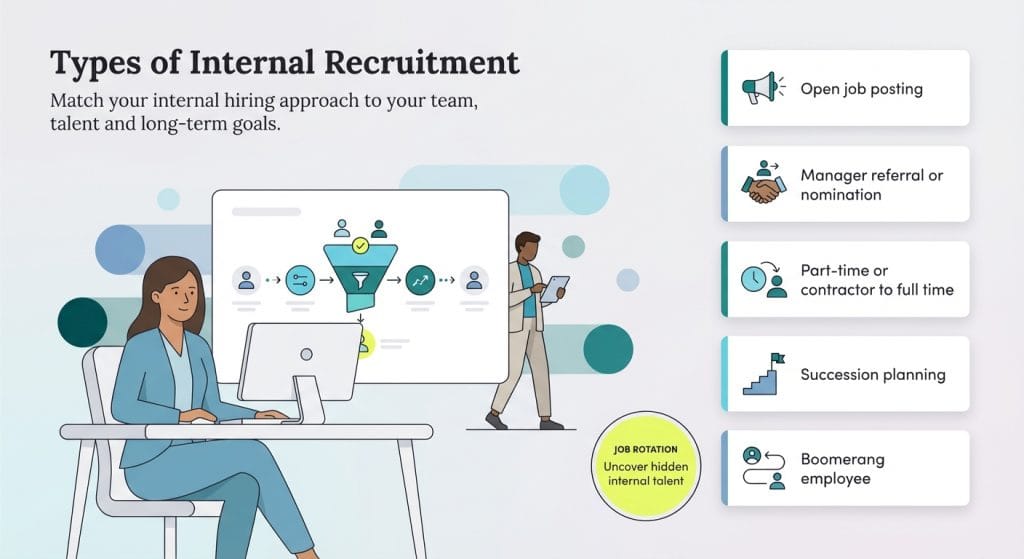
You have several options for internal recruitment strategies. Choose the one that best matches your business style and hiring goals.
With this approach, your human resources department or upper management internally announces a vacancy for which any qualified employee may apply. The job can be posted on internal communication platforms like Microsoft Teams or Slack, shared via company-wide emails or showcased on internal career portals integrated with your human resources information system (HRIS).
Some businesses prefer a behind-the-scenes approach to internal recruitment. Instead of posting an open job, you may seek manager referrals or promotion nominations from department supervisors for top-performing employees. This form of internal recruitment could also include department transfers.
Instead of promoting a full-time staff member, you might set your recruitment efforts on other types of workers. A part-time employee or independent contractor who already works with your company can be a great candidate for a full-time role. You’ve seen their work firsthand, know how they collaborate with your team, and understand how they handle deadlines and expectations. When performance is strong, transitioning that individual into a permanent position is often less risky than hiring someone entirely new, making this a practical form of internal recruitment.
Succession planning is a business practice that proactively recognizes and trains new leaders to replace employees who move on to other organizations, retire or otherwise leave the workforce. With this type of internal recruitment, managers are trained to understand and develop their team members’ potential with upward mobility in mind. When a promotion opportunity arises, you can immediately consult those managers about the most qualified employee.
Some companies find value in bringing back former employees as “boomerang” hires. A boomerang employee is someone who leaves the organization and later returns to work for the same employer. This can serve as a hybrid of internal and external hiring: The person has outside experience from their leave, but is already familiar with your culture and processes from their prior employment with you.
ADP’s research shows that boomerang hires make up about 31 percent of new hires on average, and in March 2025 alone, they accounted for 35 percent of new hires in the U.S. workforce. Employers can benefit from rehiring someone who knows the organization while also gaining new insights the worker picked up elsewhere during their time away.
Keep the following tips and best practices in mind to ensure your internal promotions are a win-win for your employees and your organization:
Internal recruitment and promotion can also create challenges. “Promoting from within can be especially difficult if there is a lack of trust between the workforce and leaders within the organization,” Duprís noted.
However, these hurdles can be overcome. Consider the following potential drawbacks of internal recruitment and how to mitigate them.
When you promote from within, you may not have access to the diverse selection of applicants you’d encounter via an external search process. Internal job candidates may not have every skill or experience you’d like your ideal hire to have.
Solution: While you can’t completely eliminate the constraints of a limited applicant pool when promoting internally, you can strategically expand your options. Consider these proven tactics:
A significant benefit of external hiring is that it provides an instant burst of new ideas and perspectives within your organization. Promoting internally risks perpetuating stagnant perspectives rather than welcoming fresh, out-of-the-box thinking from someone new.
Solution: There are many ways to encourage fresh perspectives and spark new ideas from your existing staff. You can:
Internal promotions don’t always fit neatly into a budget. When an employee moves into a new role, compensation often needs to increase — sometimes significantly — which can create unexpected cost pressures if the position was originally budgeted for an external hire at a lower starting salary. Resisting a salary increase can backfire if it leads to resentment or erodes trust among existing staff who feel their growth isn’t being valued despite being promoted.
It’s also important to avoid the trap of “quiet hiring,” where open roles are filled by piling on extra responsibilities to current employees without promoting them or offering higher pay. Over time, that approach can contribute to employee burnout, higher turnover and a strained workplace culture.
Solution: Set transparent budget guidelines for internal promotions, using salary ranges or performance targets to ensure internal candidates are paid fairly.
Employees who weren’t chosen for the internal promotion may feel overlooked and undervalued, which can breed jealousy and friction in the workplace and hurt the promoted team member’s chances of success.
Solution: Transparency in the internal hiring process is the key to avoiding resentment. Keep these best practices in mind:
When an in-house employee is promoted, their upward move will naturally leave an opening in their former role. You don’t want to overload team members or cause resentment because of this vacancy.
Solution: Work with management to determine how to handle the promoted employee’s former role. Answer these questions:
Promoting from within can be a smart move for both employers and employees. Businesses often benefit from lower hiring costs, less disruption to productivity and stronger employee retention, while team members gain recognition, motivation and a clear sense that growth is possible within the organization. That investment matters across the business. For companies with open or upcoming roles, it’s worth taking a close look at internal candidates before turning to external recruitment.
Julie Thompson contributed to this article. Source interview was conducted for a previous version of this article.