Your free business.com+ membership unlocks exclusive tech deals and advisor support
Join Free
BDC Hamburger Icon

Menu

Close
BDC Logo with Name
Search Icon
Search Icon
Advertising Disclosure
Close
Advertising Disclosure

Business.com aims to help business owners make informed decisions to support and grow their companies. We research and recommend products and services suitable for various business types, investing thousands of hours each year in this process.

As a business, we need to generate revenue to sustain our content. We have financial relationships with some companies we cover, earning commissions when readers purchase from our partners or share information about their needs. These relationships do not dictate our advice and recommendations. Our editorial team independently evaluates and recommends products and services based on their research and expertise. Learn more about our process and partners here.

The Benefits of Mind Mapping for Busy Professionals

Busy professionals can learn faster, organize ideas more clearly and work more efficiently by using mind maps.

author image
Written by: Sean Peek, Senior AnalystUpdated Jan 12, 2026
Gretchen Grunburg,Senior Editor
Business.com earns commissions from some listed providers. Editorial Guidelines.
Table Of Contents Icon

Table of Contents

Open row

Technology and business are constantly evolving, and as careers progress, professionals are under increasing pressure to absorb information quickly and stay organized. To keep up, many are turning to visual mapping techniques to break down complex ideas, plan projects and think more creatively.

Mind mapping is one of the most effective tools for doing just that. Used correctly, it can help entrepreneurs, creatives and leaders clarify their thinking, spot connections and master new business skills without getting overwhelmed. Here’s what you need to know about mind mapping and how to use it effectively in your professional life.

What is mind mapping?

Mind mapping is a visual way to organize ideas and understand complex information. A mind map is a diagram that starts with a single central concept and branches outward into related ideas, details and connections. Each branch represents a new line of thought, making it easier to break down big topics and see how different pieces of information relate to one another at a glance.

For busy professionals, mind maps are especially helpful when learning something new or working through unfamiliar topics. Instead of processing information in a linear list, mind mapping lets you group related concepts together and build on what you already know. As you add branches and subtopics, patterns and relationships become clearer.

Over time, a mind map creates a hierarchy that connects new ideas to existing knowledge. By turning abstract information into a visual layout, mind mapping helps many people absorb, retain and recall information more effectively than text alone.

Bottom LineBottom line
Mind maps are visual tools, similar to other data visualizations, that organize information around a central idea, making it easier to understand complex concepts and see how ideas connect.

What are the benefits of mind mapping?

Mind maps offer advantages beyond explaining new ideas. When used consistently, they can improve how professionals learn, retain information and apply new concepts at work.

Here are a few of the top benefits of mind mapping:

Improved retention and learning

Mind mapping helps people learn and retain information more effectively by changing how they engage with new material. Here’s how:

  • It helps you connect new information to familiar ideas. Instead of memorizing isolated facts, you organize information around a central theme, which makes relationships between concepts easier to recognize and recall.
  • It encourages active engagement with the material. Because mind maps are visual and interactive, you’re brainstorming, adding branches and making connections rather than passively reading or taking linear notes. This deeper level of engagement improves recall over time.
  • It makes complex or unfamiliar topics feel more manageable. Breaking information into smaller, related pieces and placing them in a visual structure helps learners absorb and retain material more efficiently than traditional memorization alone.
TipBottom line
Mind mapping can help improve the transfer of learning by making it easier to apply new information in real situations, not just remember it. When ideas are visually connected, learners are more likely to carry that knowledge from one task, project or context to another.

Increased productivity

Mind mapping can be a powerful tool for increased productivity, especially for teams juggling complex projects, competing priorities and limited time. This technique supports productivity in the following ways:

  • It helps teams get aligned faster. A mind map’s organized structure makes it easier to share ideas, clarify goals and communicate without ambiguity. When everyone can see how ideas connect, teams spend less time talking past one another and more time moving forward.
  • It simplifies complex discussions. By breaking down complicated topics into clear, visual branches, mind maps help teams get on the same page quickly. That shared understanding reduces back-and-forth and speeds up business decision-making.
  • It makes planning and strategy easier to manage. Mind mapping is especially useful for project planning, knowledge organization and strategic thinking. C-suite executives and team members can work through complex issues more efficiently by seeing priorities, dependencies and next steps laid out all in one place.

Enhanced creativity

Mind mapping encourages creative thinking and team innovation by making it easier to explore ideas, spot connections and build on early concepts. This approach helps in a few key ways:

  • It helps you see connections between ideas. Mind maps naturally push you to branch out from a central concept, which makes it easier to link related thoughts and explore new angles you might not uncover through linear note-taking.
  • It supports flexible, non-linear thinking. By jumping between branches and ideas, you can move freely through a problem or concept without forcing your thinking into a rigid structure. This openness often leads to more original insights.
  • It helps you capture ideas before they fade. Mind mapping makes it easy to jot down emerging thoughts quickly, so creative ideas don’t get lost while you’re trying to organize them. You can refine and prioritize them later, once they’re visible on the page.

Better collaboration

Mind mapping can improve workplace collaboration by giving teams a shared, visual way to understand how their work fits together. Mind mapping improves collaboration in these ways:

  • It shows how different teams contribute to a common goal. A mind map can visually connect departments, roles and responsibilities, helping teams see where their work overlaps and how progress in one area affects another.
  • It helps uncover gaps and bottlenecks. By mapping out processes end to end, teams can more easily identify breakdowns, redundancies or missing steps that might otherwise go unnoticed.
  • It supports collaborative brainstorming and problem-solving. Mind maps give teams a simple way to put ideas on the table and see how they relate to one another. When everyone can view the same map, it’s easier to spot overlaps, gaps or conflicts and build on each other’s input instead of working in silos. Take a product launch, for example. A shared mind map can outline how marketing, sales and product development connect, where timelines overlap and which tasks depend on one another. Seeing those relationships upfront helps teams coordinate more smoothly and flag potential issues before they slow things down.
FYIDid you know
Visual collaboration tools, like mind maps, can encourage teamwork by giving everyone a shared reference point during discussions. When ideas are visible and connected in real time, teams are more likely to contribute, stay engaged and collaborate productively.

Stronger communication and presentation skills

Mind mapping can help professionals communicate complex ideas more clearly and confidently, especially when presenting to investors or other stakeholders via a PowerPoint presentation or other presentation type. Here’s how:

  • It helps you organize complex ideas into a clear narrative. By laying out a topic visually, mind maps make it easier to structure your thoughts and explain how different points connect. This clarity can be especially useful when walking leadership or clients through a complicated idea or proposal.
  • It makes it easier to answer questions on the fly. Because a mind map shows the full scope of an idea at once, presenters can quickly reference related points and respond to questions without losing their place. This familiarity also helps reinforce your command of the subject.
  • It improves understanding by pairing words with visuals. Business presentations that rely solely on dense text can be hard to follow. Using a visual structure, like a mind map, helps audiences process information more easily and stay engaged throughout the discussion.
  • It can enhance your professional credibility. When ideas are presented clearly and confidently, audiences are more likely to trust the presenter’s expertise. A well-organized mind map signals preparation, clarity and a strong grasp of the topic.

Better problem-solving and decision-making

Mind mapping helps teams work through problems methodically and make more informed decisions by laying out options, risks and outcomes in one place. Here’s how these tools can help with problem-solving and making decisions:

  • It makes problems easier to break down and evaluate. Visualizing challenges and possible solutions helps teams see each step clearly, compare options and avoid overlooking key details that could affect the outcome.
  • It helps teams anticipate issues before they escalate. By mapping dependencies, bottlenecks and decision points, teams can identify potential problems early and address them before they slow progress or derail a plan.
  • It supports more confident, collaborative decision-making. When everyone can see the same information and understand how conclusions are reached, teams are better equipped to agree on next steps and move forward together.
Did You Know?Did you know
Mind maps help teams align on complex decisions by showing how elements like digital marketing strategies, timelines and responsibilities connect. This shared view makes it easier to agree on decisions and move forward confidently.

Versatile across business use cases

Mind mapping is flexible enough to support a wide range of business tasks, from planning and communication to training and strategy. Here’s a sampling of how it can help with various business applications: 

  • It helps teams plan and manage projects more clearly. Project managers often use mind maps to outline timelines, responsibilities and dependencies, making it easier for teams to understand how their work fits together.
  • It supports marketing and content planning. Marketers can use mind maps to organize campaigns, map out editorial calendars and connect ideas across channels without losing sight of the bigger picture.
  • It helps leaders visualize structure and roles. Mind mapping can be useful for creating organizational charts, clarifying reporting lines and showing how teams or functions are structured.
  • It makes onboarding faster and more effective. Mind maps can help businesses successfully onboard new employees, helping them understand company processes, goals and ongoing projects by presenting information in a clear, visual format.

Because mind mapping adapts easily to different needs, it’s a practical tool for leaders who need to communicate complex information clearly and ensure key messages don’t get lost.

How to build a mind map

There’s no single “right” way to create a mind map. The tools you use and the level of detail you include will depend on your goals and how you plan to use it. That said, the steps below provide a simple framework for building an effective mind map for business use.

1. Choose the right tool.

You can create mind maps with pen and paper, but many professionals prefer digital tools that make it easy to edit, share and collaborate. Popular options include MindMeister, ConceptDraw and MindNode. General collaboration platforms like Miro, Canva, Figma and ClickUp also support mind mapping.

2. Determine the central theme.

Start by clearly identifying the main idea or goal of your mind map. This could be a project, concept, strategy or problem you’re trying to solve. Place that central theme in the middle of your workspace and label it clearly. Many people also add a simple image or icon to reinforce the idea visually.

3. Add primary branches based on your central idea.

From the central theme, create four to seven main branches. Each branch should represent a key subtopic related to the main idea. Keep branch labels short — one or two keywords is usually enough — so the map stays easy to read and remember.

Using different colors for each primary branch can help visually separate ideas and improve clarity, especially as the map grows.
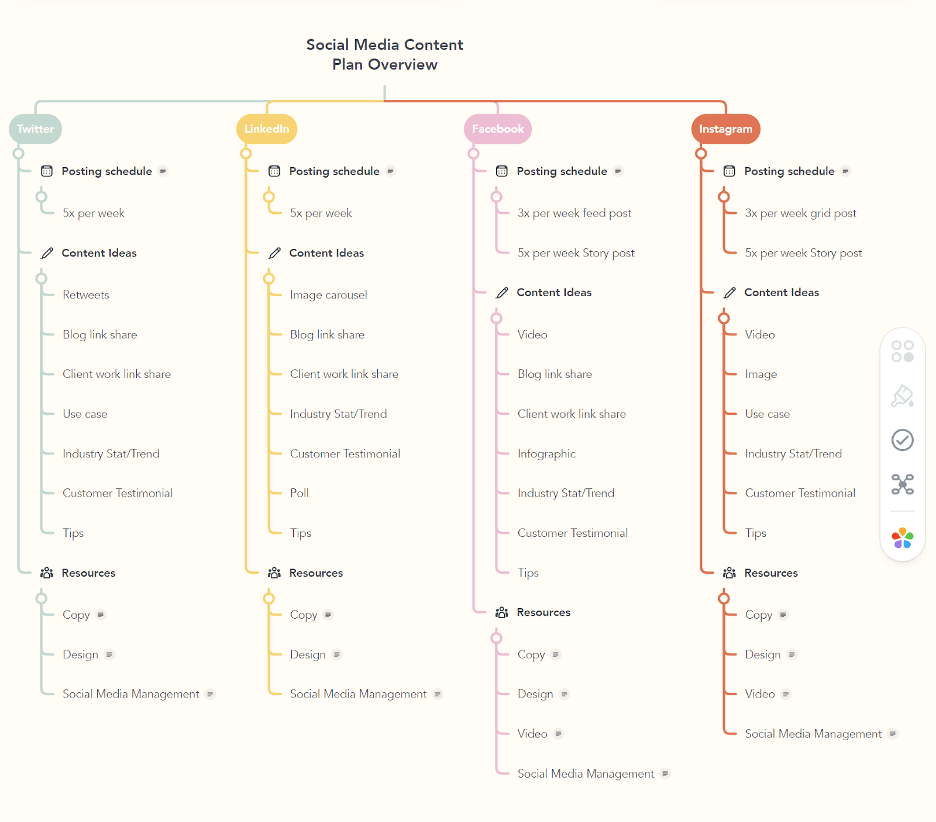
An example of a social media content plan mind map created with MindMeister
An example of a social media content plan mind map created with MindMeister.

4. Build out secondary branches.

Next, expand each primary branch with secondary branches that add detail. Keep broader ideas closer to the center and place more specific information farther out. This structure helps reinforce priorities and keeps the map from becoming cluttered.

As a general rule, try to make each branch roughly the length of the word or phrase it contains. Planning your spacing early will make it easier to complete the full layout without running out of room.
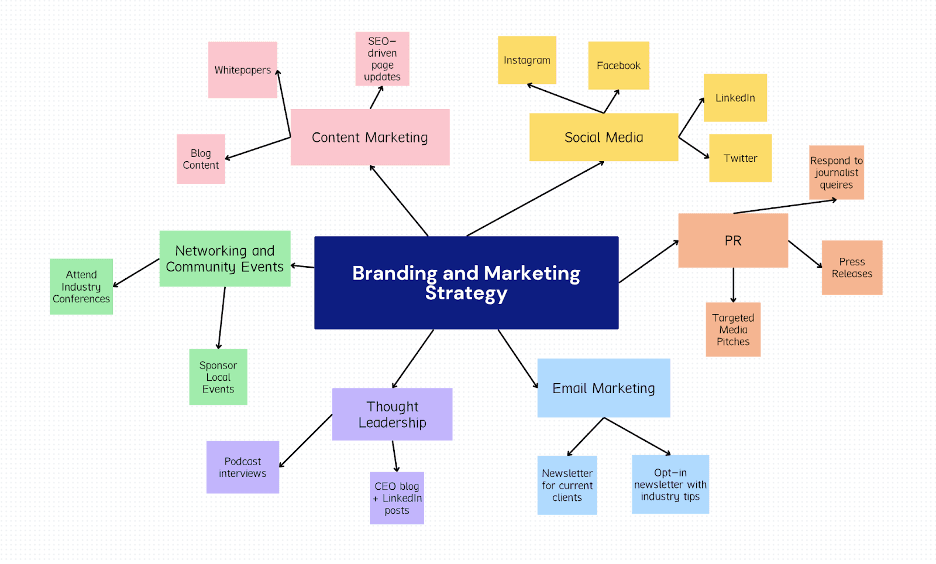
An example of a branding and marketing strategy mind map made with Canva
An example of a branding and marketing strategy mind map made with Canva.

5. Add images where it makes sense.

Images can improve both understanding and recall. When used thoughtfully, icons, symbols or simple visuals can convey meaning faster than text alone and add visual interest. They’re especially helpful when you plan to share your mind map with others or use it in presentations.

Putting mind mapping to work

In today’s business environment, there’s always something new to learn — and not much time to learn it. Mind mapping offers a practical way to manage that constant flow of information without feeling overwhelmed.

By turning complex ideas into clear, visual structures, mind mapping helps professionals absorb information faster, think more strategically and stay focused on what matters most. Whether you’re planning a project, learning a new skill or aligning a team, mind maps make it easier to act on information and spot opportunities before they pass by.

Over time, using mind mapping as part of your workflow can reduce mental clutter, support clearer thinking and make continuous learning feel more manageable, even in a fast-paced, digital workplace.

Ryan Ayers contributed to this article.

Did you find this content helpful?
Verified CheckThank you for your feedback!
author image
Written by: Sean Peek, Senior Analyst
Sean Peek co-founded and self-funded a small business that's grown to include more than a dozen dedicated team members. Over the years, he's become adept at navigating the intricacies of bootstrapping a new business, overseeing day-to-day operations, utilizing process automation to increase efficiencies and cut costs, and leading a small workforce. This journey has afforded him a profound understanding of the B2B landscape and the critical challenges business owners face as they start and grow their enterprises today. At business.com, Peek covers technology solutions like document management, POS systems and email marketing services, along with topics like management theories and company culture. In addition to running his own business, Peek shares his firsthand experiences and vast knowledge to support fellow entrepreneurs, offering guidance on everything from business software to marketing strategies to HR management. In fact, his expertise has been featured in Entrepreneur, Inc. and Forbes and with the U.S. Chamber of Commerce.
Related Tips & Topics
More Related articles
Arrow