Business.com aims to help business owners make informed decisions to support and grow their companies. We research and recommend products and services suitable for various business types, investing thousands of hours each year in this process.
As a business, we need to generate revenue to sustain our content. We have financial relationships with some companies we cover, earning commissions when readers purchase from our partners or share information about their needs. These relationships do not dictate our advice and recommendations. Our editorial team independently evaluates and recommends products and services based on their research and expertise. Learn more about our process and partners here.
How to Apply for a Business Credit Card if You Have Bad Credit
You may encounter challenges, but you still have options with less-than-stellar credit.
A business.com editor verified this analysis to ensure it meets our standards for accuracy, expertise and integrity.
Shari Weiss,Senior Editor
Business.com earns commissions from some listed providers. Editorial Guidelines.
Table of Contents
A business credit card can build your credit profile, improve your business’s cash flow and help you make essential purchases for your company. If your personal credit score has taken a hit, however, qualifying for a business credit card can be challenging — but not impossible. We’ll explain options small business owners with less-than-stellar credit can pursue to obtain a business credit card.
How do credit card issuers assess a business borrower?
When assessing a business borrower’s creditworthiness, the card issuer considers income from all sources. However, for most small business cards, the owner’s personal credit score is the primary factor that dictates approval odds and the interest rate offered.
What are good and bad credit scores?
Credit card issuers look for a good credit score when assessing a business borrower, just like they do when individuals apply for a personal credit card. The higher the score, the more creditworthy they consider the borrower. A lower score characterizes the business owner as a higher risk to lenders.
“Those with bad credit will have a difficult time getting a credit card, since there aren’t a lot of cards aimed at that particular segment,” said Gerri Detweiler, an author and expert on small business finance. “There are some issuers that will issue [credit cards] with a 600 score, which is not a bad credit score but not a great credit score.”
The table below offers a guide to what constitutes a good and bad credit score. Note that these are personal credit scores. While business credit scores (such as FICO SBSS or Paydex) exist, most issuers rely on personal FICO scores for small business card applications.
Excellent
800 to 850
Very Good
740 to 799
Good
670 to 739
Fair
580 to 669
Bad
300 to 579
What credit score do you need to get a business credit card?
While specific requirements vary by institution, many business cards look for scores of 670 or above. That’s not to say there aren’t options for borrowers with poor credit scores, such as those hovering around 600.
How can you get a business credit card with bad credit?
When you have bad credit or no credit history to speak of, it can be challenging to get a business credit card — but not impossible. Here are some steps you can take to find a business credit card no matter your credit score.
Consider applying for a secured business credit card
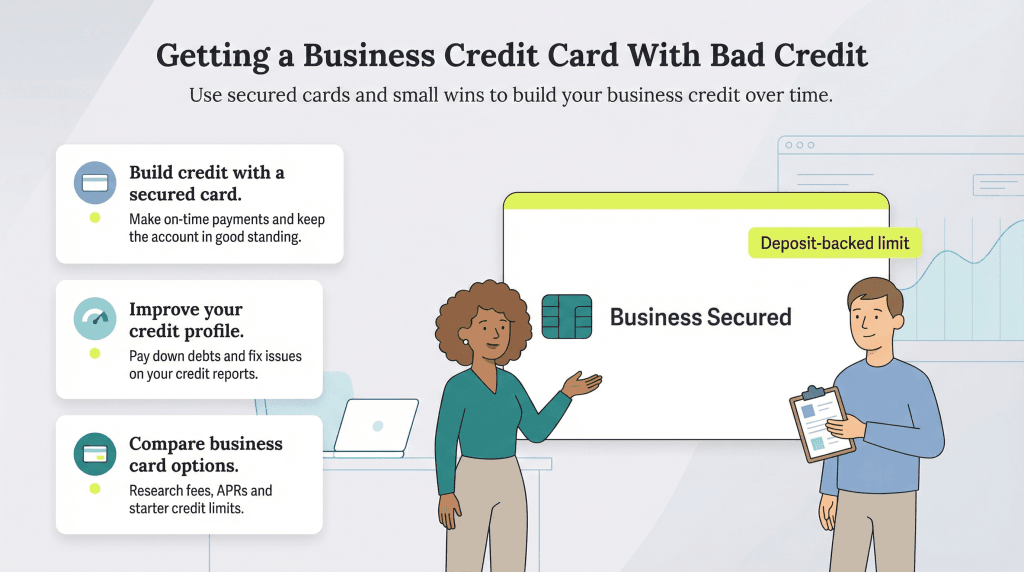
If you’re applying for a business credit card with bad credit or no credit history, consider applying for a secured business credit card. A secured card is a viable way to improve your credit score and access credit.
Secured business credit cards have the following parameters:
The credit card company requires a deposit upfront.
Your credit limit is typically in lockstep with the deposit.
The more on-time payments you make, the more your credit line increases.
If your account stays in good standing — which means no late payments — your credit score increases over time.
“Payment history accounts for 35 percent of your credit score,” said Barry Coleman, vice president of program management and education at the National Foundation for Credit Counseling. “Business owners would be wise to make on-time payments.”
Aside from the deposit requirement, secured credit cards are similar to unsecured credit cards: There’s an annual percentage rate (APR), an annual fee and potentially other charges.
In addition to secured credit cards, you could apply for a credit-builder loan. These loans are designed to help borrowers with no credit or bad credit improve their scores by making fixed payments on a monthly basis. As you make the payments, the lender will report to the credit rating agencies, helping you build or repair your credit score.
Work on improving your credit score
If you’re having a hard time getting approved for any credit cards, try improving your credit score a bit. Start by checking your credit reports with agencies like Experian, Equifax and TransUnion. The reports will help you understand your current credit score and what is contributing to it. Then you can begin taking corrective action to boost your score.
Improving your credit score doesn’t happen overnight. It requires making owed payments on time. If you have overdue or delinquent accounts, catch up immediately; legitimate negative marks generally remain on your report for seven years, diminishing in impact over time.
Focus on paying down existing debts as much as possible, too, since a big factor in credit scores is your debt-to-credit ratio. If you have high levels of debt compared to your available credit, you should aim to create some more breathing room by paying down debts aggressively (i.e., more than the minimum balance each month).
To give yourself an additional boost, you can add monthly bills for utilities, internet and mobile phones to your credit report. Demonstrating that you make these non-credit payments on time can gradually increase your score, and, since you’re already making those payments to keep your business running, it represents no additional cost to you.
Did You Know?
Registering for a DUNS number is essential for business credit building. This will enable you to get a business credit score from Dun & Bradstreet, the major credit bureau for business credit.
Shop around for business credit cards
There are a lot of business credit cards out there, including those designed for people with no credit or bad credit. We recommend doing extensive research to find some options and then compare them, looking at factors like annual fees and APRs. You may qualify for more business credit cards than you realize. If you qualify for even a modest credit limit, you can use that card as a way to further boost your score and eventually qualify for higher credit limits and more favorable terms.
What are some business credit cards for people with bad credit?
Despite some business credit card issuers being more cautious about who they approve, there are cards for business owners with bad credit. Consider the following options.
1. Spark 1% Classic From Capital One
Spark 1% Classic From Capital One is geared toward business owners with less-than-stellar credit. It considers applicants with “Fair” credit, defined by Capital One as having defaulted on a loan in the past five years or having a limited credit history.. While you aren’t required to make a security deposit, the card carries a variable APR of 36.49 percent.
There are no annual fees and you earn 1 percent cash back on every business purchase. You can redeem points at any time, regardless of how many you’ve accumulated.
Capital One reports your payment history to all three credit bureaus (Equifax, Experian and TransUnion), which means your personal and business credit scores get a boost every month you pay on time.
2. Bank of America Business Advantage Unlimited Cash Rewards Secured
The Bank of America Business Advantage Unlimited Cash Rewards Secured card helps establish and strengthen your business credit. It requires a security deposit of at least $1,000 and provides 1.5 percent cash back on your purchases, which you can use toward your credit card balance.
There is no annual fee and your account will be reviewed periodically to see if your credit limit can be increased. Potentially, you could transition to an unsecured card. The variable APR is currently 26.74 percent for purchases. The card comes with cash-flow-management tools and travel and emergency services, and it can even help you monitor your business credit score for free.
3. Ramp Card
The Ramp Card is unique because it doesn’t require a personal credit check or a founder guarantee. Instead, Ramp evaluates the business’s health, typically requiring a U.S.-incorporated business with a U.S. business bank account. It provides 1.5 percent cash back on purchases and integrates easily into most popular accounting software programs and other must-have business tools, including Gusto and QuickBooks.
Ramp is a corporate charge card, which means the balance must be paid in full every billing cycle, so there is no APR. If you want employees to have corporate cards, you can control and monitor their spending. It simplifies expenses and automatically collects receipts to make expense reports easier.
Robust software identifies duplicate transactions automatically and gives you information that can help you get a better price. The card has no annual fee. Freelancers and sole proprietors are not eligible for approval.
What should you look for in a business credit card?
Annual fees, APR, consumer protection and customer service tend to be the most crucial business credit card considerations.
Annual fees: Many credit cards have annual fees, which are part of how credit card companies make money. A credit card that approves a business owner with bad credit will likely charge higher annual fees. Compare your card’s annual fees to others to understand how fair it is. Low annual fees are nice, but higher fees may come with better perks or be a better deal overall if you can afford it.
APR: The Annual Percentage Rate (APR) is the credit card’s interest rate. For many businesses, APR is the most critical factor. If you carry a balance on the credit card, a high APR can be devastating. If you don’t carry balances and never have to pay interest on your cards, however, you may opt for a higher APR to get better deals or perks.
Consumer protection: Consumer protection is critical to some businesses and worth very little to others. Consumer protection covers a wide range of services. Some cards will insure all purchases over a certain threshold automatically. Cards may also provide identity theft protection and other valuable resources. You should choose a card with consumer-protection services that make sense for your business.
Customer service:Excellent customer service is essential in any product exchange. Everyone wants access to good customer service when things go wrong. Read customer reviews on the credit card you are considering to gauge the issuer’s customer service.
How can you use business credit cards to improve your credit?
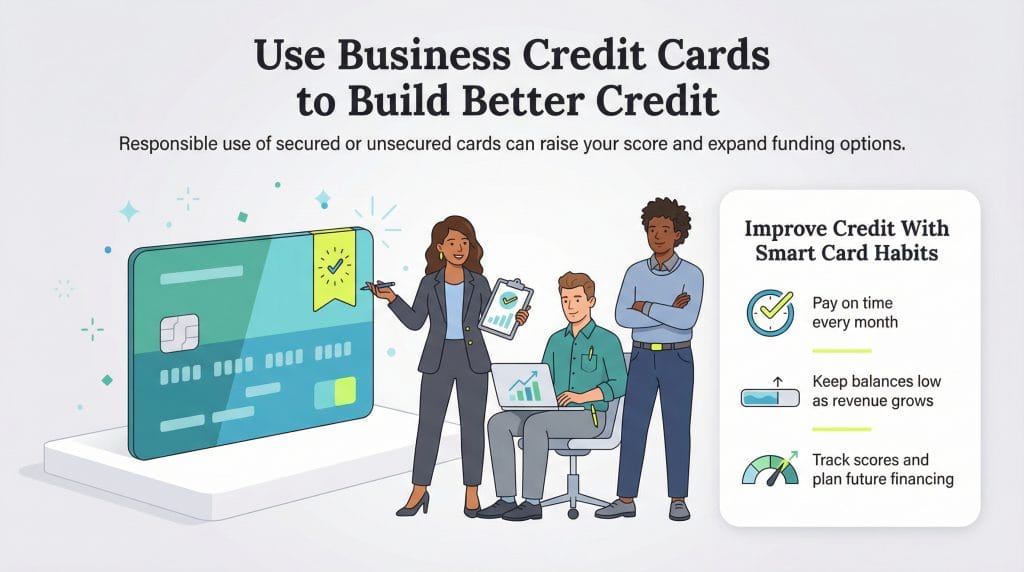
Business credit card options are limited for owners with bad credit, but using an approved secured or unsecured card responsibly yields multiple benefits. Your credit score and maximum limit will increase, and you can qualify for other business credit cards and other business funding options.
Here are four best practices for improving your credit after getting approved for a new secured or unsecured business credit card:
Identify the cause of your credit problem. Your credit score took a hit for a reason. Perhaps you missed payments or have more debt than you can manage. You must acknowledge and change the behavior that caused your current credit predicament. You will be in an even deeper financial quandary if you don’t.
Pay your business credit card on time. Your credit score is based in large part on your payment history. By paying your balance on time, your credit score will get a boost. Set an alert to remind you a week before the payment deadline or set up automatic payments with the card issuer.
Monitor your credit score. Your credit score will improve as you make timely payments and manage a reasonable debt load. If you’ve been working with a secured card, you may be able to apply for an unsecured business credit card as your score increases. Monitoring your credit score helps you understand your options. Check your score with Equifax, Experian and TransUnion quarterly or at least twice yearly.
Consider the future when using your business credit card. It’s easy to splurge on something your business can’t afford, but that short-term gain can lead to financial pain later. Coleman advised business owners with poor credit to focus on reaching financial stability as soon as possible. “It’s a lot easier to grow your business when you have access to capital,” he said. “That access comes with positive financial practices.”
FYI
The best accounting software can link to your business credit card and account for card purchases automatically. Read our review of FreshBooks to learn more about an affordable solution with that feature.
How can you build credit if you don’t want a secured card?
If you don’t want a secured card but you still want to rebuild poor credit (or establish a good credit history if your business is new), consider applying for financing from a vendor.
“There are a number of business suppliers — most notably office and industrial supply companies — that are a little more lenient when it comes to using credit,” Coleman said. “Businesses that secure an account with one of these and make sure to pay invoices on time will improve their credit.”
The purchasing limit may be low to start with, but it will increase over time if you meet your obligations. “There are a number of companies that offer these types of accounts,” Coleman said.
Things to avoid when building credit
To maximize your credit-building progress, avoid the following common mistakes:
Don’t have too many credit inquiries. Every time you apply for a credit card, line of credit, or business loan, there will be a credit inquiry. Having too many inquiries is a red flag that lowers your credit score.
Don’t mix personal and business expenses. Many new and small businesses run as limited liability companies. That setup makes it easy to mix your personal and business finances, which can be disastrous for the business’s credit. If you must buy a car for personal reasons, for example, you don’t want those credit inquiries and that debt tied to your business.
Don’t ignore your credit score. Keeping on top of your credit score is essential for tracking your progress and eliminating harmful errors. Monitor your credit score at Dun & Bradstreet, Equifax and Experian, and initiate a dispute if you see an error. Removing inaccuracies on your credit report can boost your score.
Don’t keep a high balance on your card. High balances are harmful for several reasons. First, you’ll pay the maximum amount of interest. Second, it keeps your utilization high. Utilization is the percentage of your overall credit line being used. High utilization depresses your credit score. Try to keep it under 30 percent by paying down your balance, keeping purchases in check, and eventually asking for a credit line increase.
Tejas Vemparala and Jennifer Dublino contributed to the reporting and writing in this article. Source interviews were conducted for a previous version of this article.
Donna Fuscaldo, who has 25 years of experience navigating the convergence of business, finance, and technology, is a trusted advisor to small business owners. Her expertise in business borrowing, funding, and investment strategies equips her to provide reliable counsel on everything from business loans to accounting and retirement benefits.
At business.com, Fuscaldo covers business grants and other financing options, business credit cards and retirement funds.
Her analysis has also graced publications like The Wall Street Journal, Dow Jones Newswires, Bankrate, Investopedia, Motley Fool, Fox Business and AARP, solidifying her authority in the field. Beyond her contributions to the financial landscape, Fuscaldo also lends her wisdom on employment matters, with her expertise sought after by platforms like Glassdoor and others.
Armed with a bachelor's degree in communication arts and journalism, Fuscaldo has the unique ability to simplify complex business and career-related topics into actionable insights. This makes her a valuable resource for professionals seeking practical solutions in today's dynamic business environment.
Armed with a bachelor's degree in communication arts and journalism, Fuscaldo has the unique ability to simplify complex business and career-related topics into actionable insights. This makes her a valuable resource for professionals seeking practical solutions in today's dynamic business environment.