Business.com aims to help business owners make informed decisions to support and grow their companies. We research and recommend products and services suitable for various business types, investing thousands of hours each year in this process.
As a business, we need to generate revenue to sustain our content. We have financial relationships with some companies we cover, earning commissions when readers purchase from our partners or share information about their needs. These relationships do not dictate our advice and recommendations. Our editorial team independently evaluates and recommends products and services based on their research and expertise. Learn more about our process and partners here.
CPAs and payroll services can handle payroll accurately with differing costs, service levels and features.

Business owners have several options for running payroll for their staff. They can process payroll internally, hire a certified public accountant (CPA) or work with a payroll service. Outsourcing to a CPA or payroll service is convenient, helps ensure your team is paid accurately and on time and supports compliance with applicable laws and regulations. However, CPAs and payroll solutions differ by cost and service level.
Before hiring anyone to manage payroll and other functions, it’s crucial to understand how you’ll be charged, where hidden fees may lurk and what each option provides. We’ll break down the services payroll companies and CPAs offer and what they charge.
Searching for payroll software or services and not sure where to start? Tell us a little more about your business and get customized quotes from qualified providers.
A payroll company is a paid service that helps employers compute employees’ pay and payroll withholdings and issue payments. Payroll services may be full-fledged companies that perform an array of services or they may come in the form of self-service software. The best online payroll companies tailor services to fit a business’s needs at a price that fits their budget.
Payroll services collect employee wage and time sheet data to calculate gross wages. Next, they subtract the appropriate withholdings and deductions and compensate employees via payment methods such as printed checks, direct deposit or direct deposit alternatives like payroll cards. Many payroll services also handle employee tax filing, year-end forms such as W-2s and 1099s, and ongoing compliance with federal, state and local regulations.
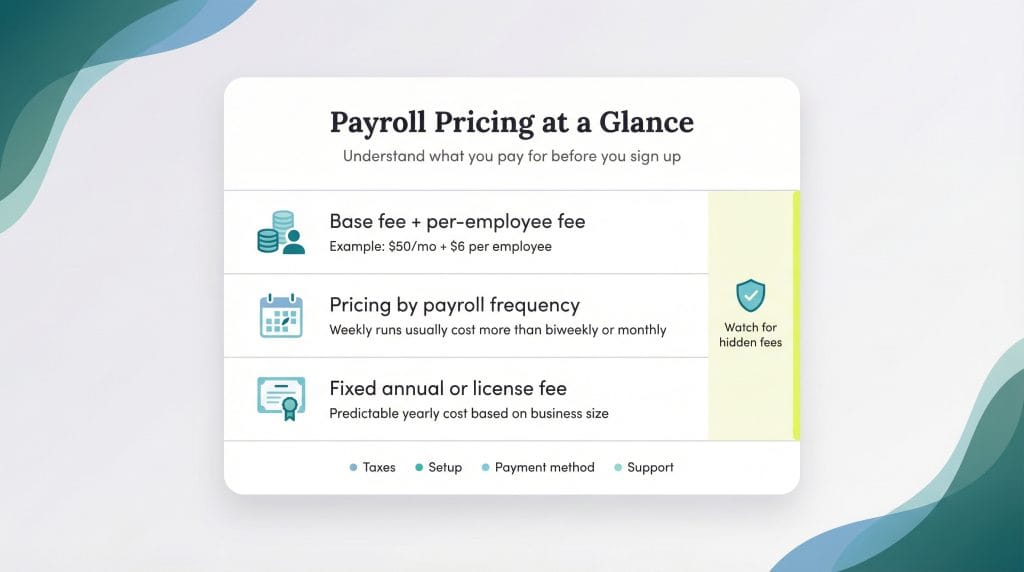
Payroll companies have varying pricing structures to accommodate different business needs. They may also offer a wide array of optional add-ons and impose fees that can incur additional costs.
Most payroll companies offer tiered pricing, with varying services, features and functionality on each service plan. Generally, the more you pay, the more you get. For example, QuickBooks Payroll offers three payroll plans with features that range from essential payroll services to access to financial experts.
“While each tier provides various levels of capabilities and functionalities, all plans in the QuickBooks Payroll portfolio offer full-service, automated payroll capabilities and can help business owners calculate, file and pay their payroll taxes with confidence,” explained Brian Rich, senior product marketing leader at QuickBooks.
Here are the various pricing structures you may encounter.
Base fee plus per-employee fee
Most payroll services charge a monthly base fee plus a per-employee fee. Base fees typically range from $20 to $150 per month, while per-employee fees generally run $2 to $15 per month.
For example, QuickBooks Payroll charges the following:
Payroll frequency
Some payroll services charge fees based on how frequently you run payroll. For example, if you process payroll weekly, you may incur higher fees than if you process biweekly or monthly. This model is best for businesses with predictable payroll schedules and stable employee counts.
Fixed pricing or license fee
Some payroll software providers charge a fixed annual fee based on your business size or total payroll value. This model may require an upfront payment for annual software upgrades. If your team size stays consistent, this pricing can be more cost-effective per employee, making budgeting easier with predictable costs. For example, CheckMark Payroll software starts at $579 annually for its solution.
Optional services
Beyond essential functions, many payroll companies have additional services. These can be bundled into packages or purchased a la carte. Many of these companies have vast ecosystems of financial and human resources (HR) tools that integrate effortlessly with payroll, creating a streamlined solution. “A platform of connected tools allows a business to have access to real-time data and insights to help them make better business decisions,” Rich noted.
Additional services may include:
For example, you can bundle QuickBooks Payroll with bookkeeping tools starting at $88 per month (billed annually) plus $6.50 per employee.
Beyond optional services, keep an eye out for less apparent charges, such as:
Numerous factors can affect a business’s payroll costs, including the following:
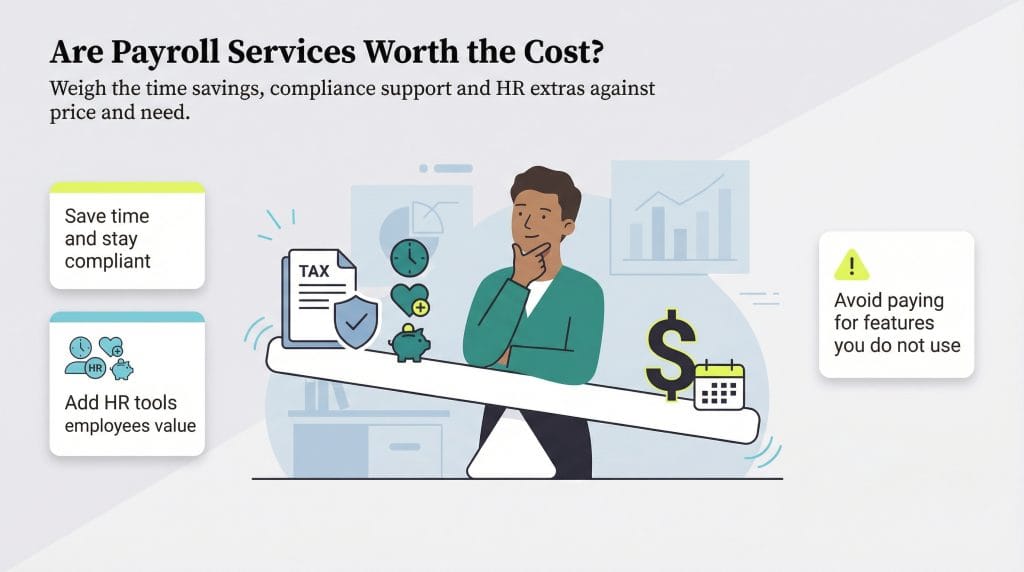
Paying for a full-fledged payroll service can be a smart investment for many businesses. Here are some of the key reasons to consider one:
“[Comprehensive payroll solutions] provide business owners with a platform that does much more than administer payroll — it helps them grow and support their employees, all while maintaining compliance,” Rich explained.
However, paying for a payroll service may not be worth the cost for some businesses. Consider the following downsides:
CPAs can play a role in payroll, but their primary focus is broader financial management and advisory services. Typically, businesses hire CPAs to help manage their finances, plan for growth and meet fiscal goals. While some CPAs may assist with payroll as part of their services, they generally do not specialize in payroll processing or administration.
CPAs and payroll solutions can both provide valuable support to businesses. “I would never say payroll replaces CPAs,” explained Sara Menke, founder and chairman of Premier Talent Partners. “But they can complement one another because [payroll companies] don’t offer the same work as an accountant.”
Rich agreed that both financial resources can provide essential assistance. “While CPAs provide a great deal of guidance and strategy for a business’s finances and growth, their services may not extend beyond the administration of payroll,” Rich noted. “[Online payroll platforms can] provide a streamlined, end-to-end human capital management solution that spans beyond payroll.”
CPA costs vary by region and specialty. According to 1-800-Accountant, the average CPA rate starts at approximately $200 per hour. Virtual services often have a flat rate for their services that can range from $100 to $400 for bookkeeping, tax prep and other support.
Some CPAs also offer monthly pricing for payroll services. “I’ve seen as low as $40 per month for just three to five employees paid bi-weekly with no benefits, up to $100-plus per month,” noted CPA Dan Henn. “It could be higher based on the cost of service.”
Because of their level of expertise, hiring a full-time dedicated CPA can be expensive. As a result, most small and midsize businesses work with CPAs on an hourly or project basis. However, fixed fees are becoming more common. With more custom payroll management options now available, CPAs are increasingly tailoring their services to better meet the needs of smaller organizations.
Henn noted that several factors affect CPA charges. “We look at cost of service, which includes the payroll platform or software used, in addition to the time involved, frequency of pay, number of employees and the benefits that need to be processed, such as health insurance, 401(k) or other retirement plans and other deductions,” Henn explained.
CPAs can help your organization meet its financial goals in the following ways:
Henn emphasized the value of integrating a CPA into your payroll process. “When a CPA manages payroll, it makes it easier for the CPA to do their job in advising the business,” Henn explained. “They have access to all the information and reports needed for bookkeeping, consulting, advising and tax planning.”
Having a CPA manage payroll can bring the following disadvantages:
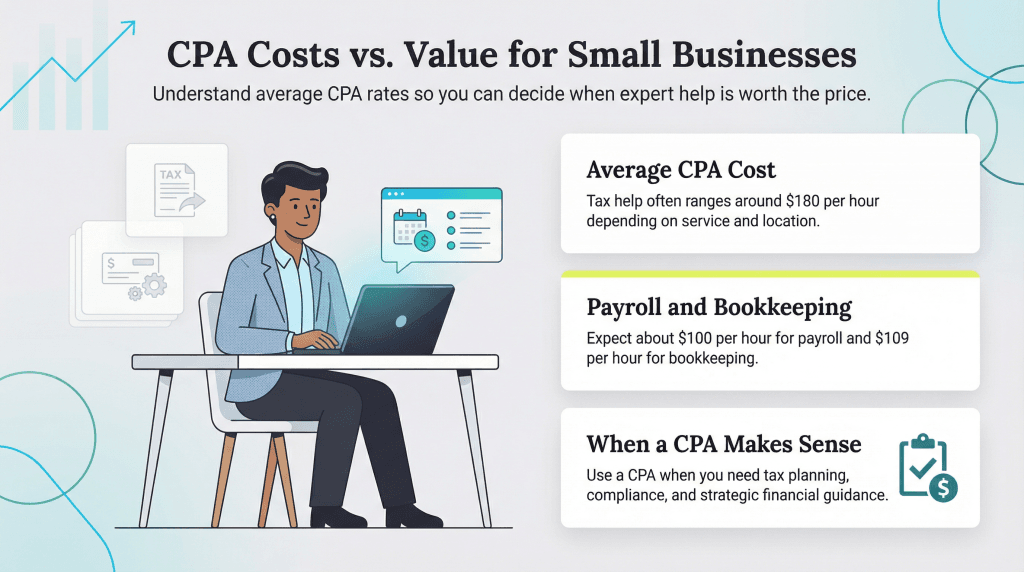
If you hire an accountant to run payroll, you’d likely pay less than you would for a CPA. However, CPAs have additional accounting and finance certifications and expertise that justify their price. When you use a CPA to handle your payroll, you ensure the following:
While both accountants and CPAs bring solid accounting knowledge to the table, CPAs undergo more rigorous training with a deeper focus on tax law and standard accounting practices. They’re also held to strict ethical standards by their state licensing boards and must complete continuing education to maintain their credentials — giving them an edge when it comes to navigating complex payroll and compliance issues.
Casey Conway contributed to the reporting and writing in this article. Source interviews were conducted for a previous version of this article.