Business.com aims to help business owners make informed decisions to support and grow their companies. We research and recommend products and services suitable for various business types, investing thousands of hours each year in this process.
As a business, we need to generate revenue to sustain our content. We have financial relationships with some companies we cover, earning commissions when readers purchase from our partners or share information about their needs. These relationships do not dictate our advice and recommendations. Our editorial team independently evaluates and recommends products and services based on their research and expertise. Learn more about our process and partners here.
Dissolving a partnership agreement isn't always easy. Here's how to end your partnership amicably.


When you enter a business partnership, it’s easy to get swept up in the possibilities of your new venture and not think about what happens if things don’t work out. Even well-run partnerships can reach a natural end if goals shift, interests fade or the business simply stops performing.
That’s why it’s important to have a signed partnership agreement in place and to understand how dissolution works before you ever need it. Knowing the right steps can help you end the partnership cleanly, protect your relationships and avoid potential business lawsuits if one or more partners loses interest, conflicts can’t be resolved or the company needs to close.
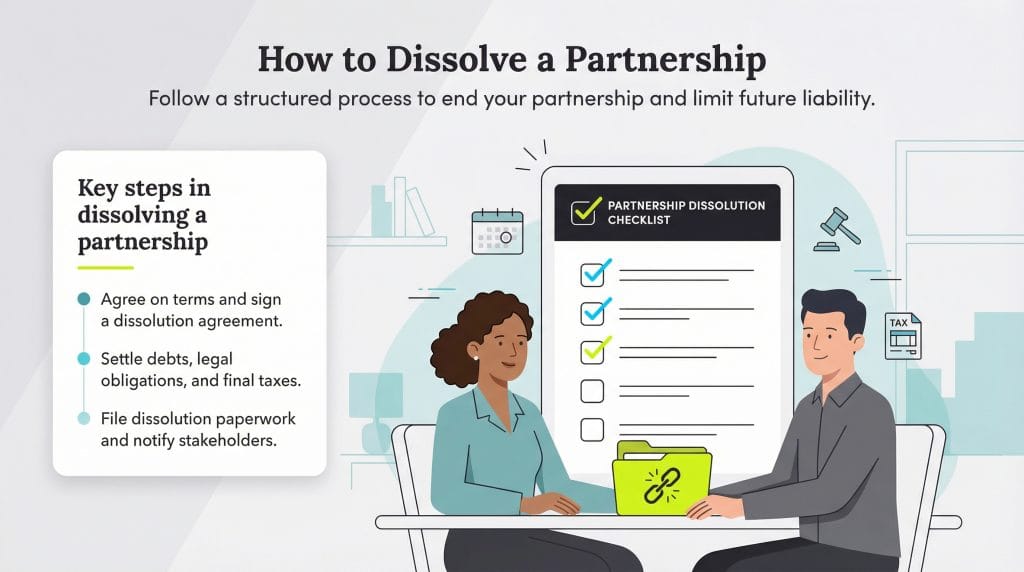
Although dissolving your partnership isn’t as simple as ceasing operations and closing up shop, it doesn’t have to be overly complicated, either. Start by reviewing your partnership agreement to see whether it includes a dissolution clause; many agreements outline the procedures you must follow, which makes things much more straightforward and smooth.
If your agreement doesn’t include a predetermined dissolution procedure, follow these general steps to dissolve a partnership:
It’s important to note that when a partnership ends, the individuals involved may no longer be partners in a legal sense, but the partnership continues until all debts are settled, the business is legally terminated, and the remaining assets are distributed.
There are a few types of agreements that govern how your business partnership or LLC can be dissolved without creating additional acrimony among the partners. Here’s an overview:
If one partner has lost interest but the other hasn’t (or vice versa), the partners can mutually agree to dissolve the business. In some cases, one partner may buy out the other’s ownership share instead of closing the company altogether.
A buy-sell agreement clearly spells out who can and cannot buy into the business if you or your partners sell your shares, declare personal bankruptcy or experience a major life event such as death, divorce or disability. With this type of agreement in place, the remaining partners are protected against unwanted individuals buying into the business or former spouses claiming an interest in the company.
If you and your partner mutually decide to end the business, a partnership dissolution agreement can help you agree on the terms of the breakup. This agreement outlines each partner’s responsibilities, sets timelines for winding down the business and clarifies who handles what during the process. Entering into a dissolution agreement does not immediately end the partnership; you still need to settle debts, legally terminate the business and distribute any remaining assets.
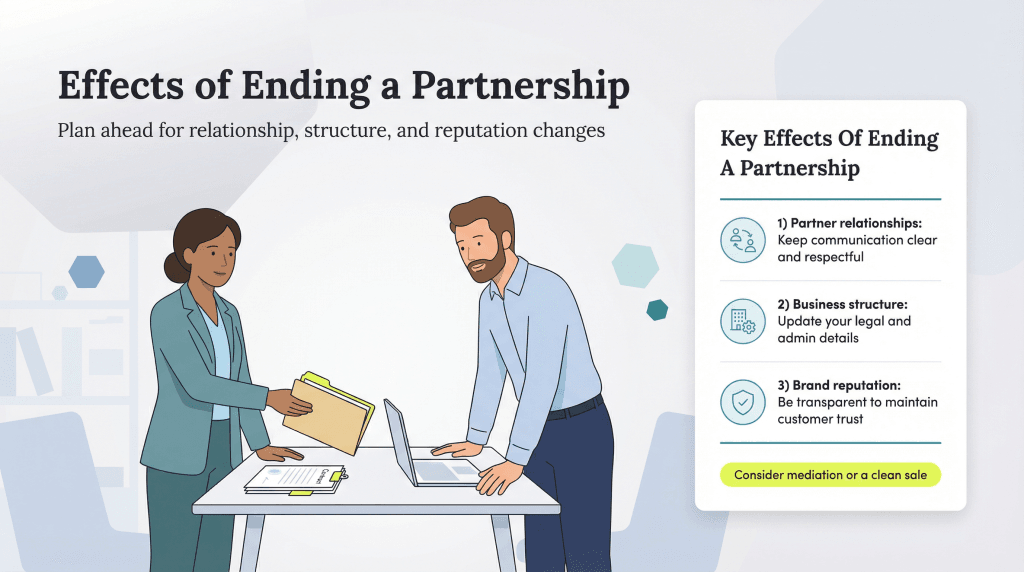
Ending a partnership has several consequences, many of which involve taxes. But the impact isn’t only financial: Dissolving a business can take a toll on you, your partners and the people connected to the company. Here’s what you need to know:
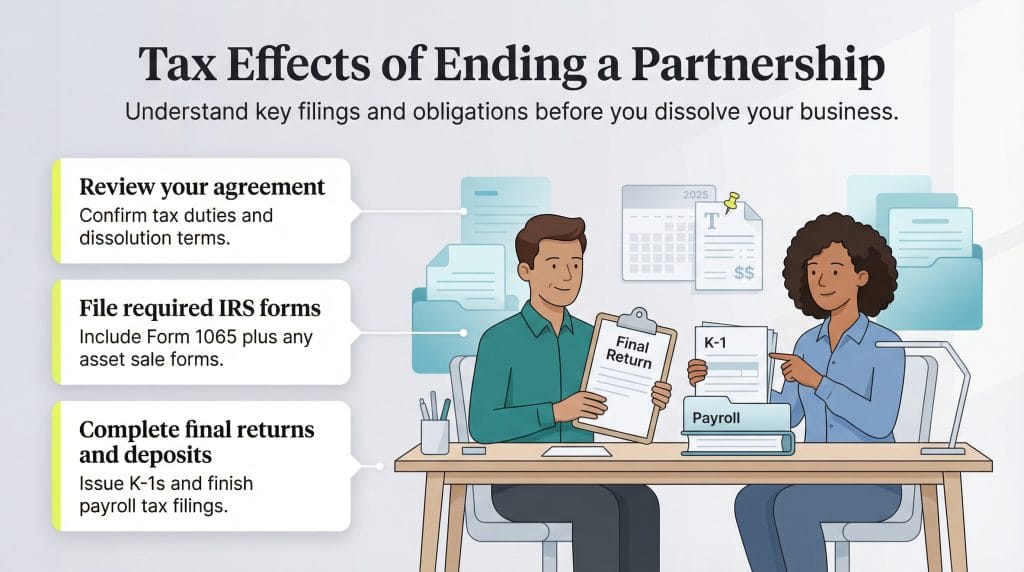
A partnership isn’t a tax-paying entity. Instead, profits and losses pass directly to the partners, who aren’t considered employees of the business. Because of that structure, dissolving a partnership comes with multiple tax implications. Here are a few of the key considerations:
Ending a business partnership isn’t just a legal or financial process; it can affect your relationships, your team and the overall stability of your business. Here are a few areas to keep in mind as you navigate the transition.
Ending a partnership can be tough on your relationship with your soon-to-be former partner, especially if you’ve built a friendship along the way. Even when everyone agrees it’s time to move on, it can feel personal.
To navigate the process as smoothly and painlessly as possible, start by reviewing your partnership or operating agreement so you both understand the exit plan, asset division and remaining obligations. From there, keep the lines of communication open and focus on clear expectations, which can help prevent misunderstandings and keep the relationship intact as you wind things down.
Depending on how the partnership ends, your business structure may need to change. If you’re closing the business entirely, you’ll need to follow your state’s rules for winding down a partnership or LLC. But if one partner is leaving and the remaining partner plans to continue operating, the business may need to shift to a different structure — for example, converting to a sole proprietorship or single-member LLC.
Either scenario comes with administrative work, such as updating registrations, adjusting your legal classification or taking on new compliance steps, all of which can add cost and complexity. These changes may also affect your employees, from shifting responsibilities to new reporting lines. Keep your team informed and give them space to ask questions as things evolve.
Customers and clients tend to notice when a business’s leadership changes, and it’s natural for them to have questions about what the transition means for them. The simplest way to keep their trust is to be upfront about the changes and give them a clear sense of what to expect. When people understand what’s happening and why, they’re much more likely to stay confident in your business. And if disagreements arise, choosing mediation over litigation can help protect your brand reputation and avoid unnecessary conflict.
Yes. Even after a partnership dissolves, you and your partner(s) can still be sued under certain circumstances.
If your general partnership entered into contracts with customers, vendors or other businesses, you and your partners may remain personally liable for those obligations. Unless the contract specifically releases you from liability if the partnership ends, the partnership — or each individual partner — can be sued for breach even after dissolution.
This is because dissolution doesn’t erase past obligations. The partnership continues for the limited purpose of winding up its affairs, and claims related to actions taken before dissolution can still be brought against the former partners.
Julianna Lopez contributed to this article.